
#On the Wind that Counts Back
"If the wind laughs first, don't answer with yours." — Wexel (Unregistered) superstition, officially discouraged and privately obeyed
The Chaff-Winds of Wexel are classified as a Category One Localized Atmospheric-Acoustic Disturbance, which is the Bureau's delicate way of saying that a town built to police laughter is being mocked by its own weather.
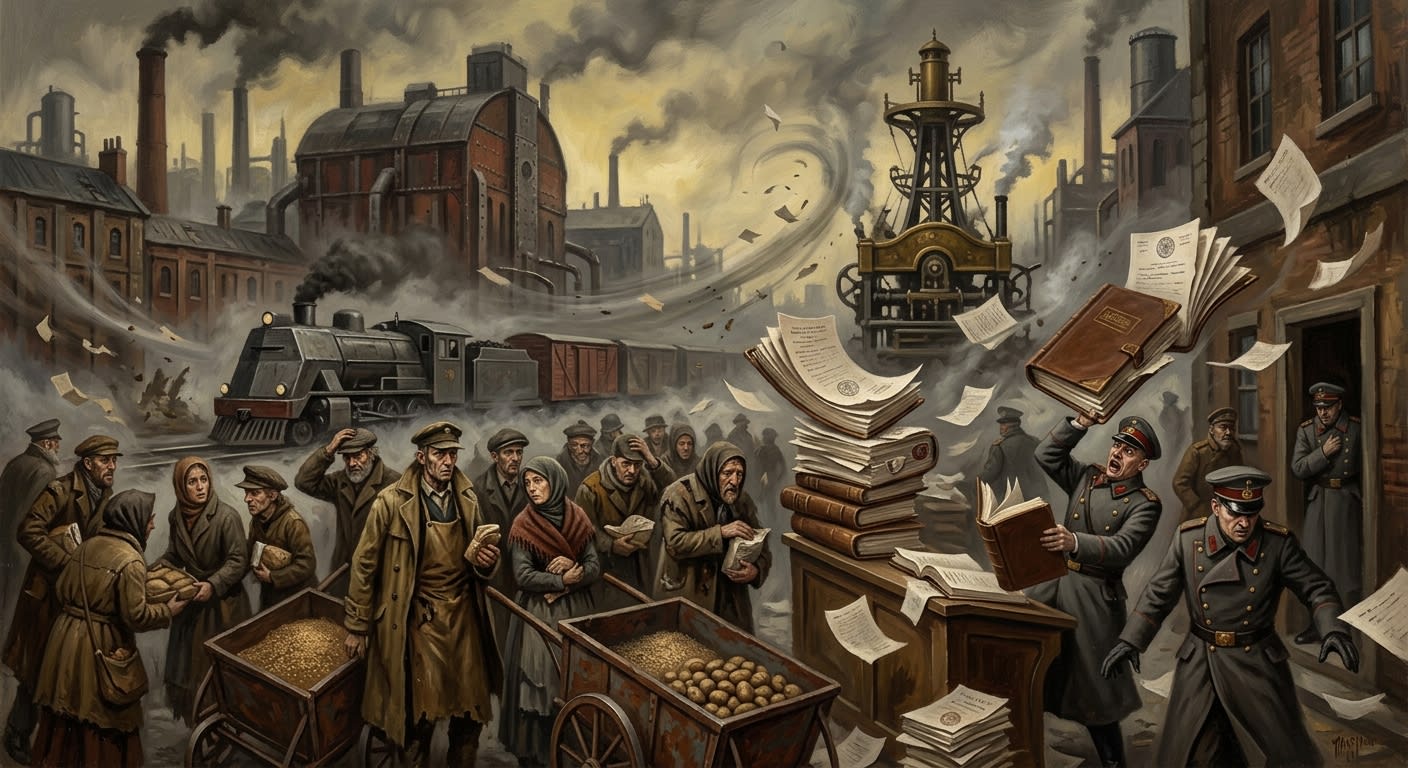
The anomaly presents as a dry gust moving through the Grain-Gray Ration Parliament of Wexel, carrying chaff, grain dust, pollen, silo-metal percussion, and voices that no lawful throat has admitted producing. It repeats fragments of speech. It lifts half-syllables from Parliament Square and returns them from the Silo Crown (Unregistered). It carries laughter through keyholes, under ration shutters, along the Scale Gate (Unregistered) chains, and into the Mirth Office Row citation rooms where Sister-Lector Neme Varr (Unregistered)'s inspectors sit with their brass smile-gauges, sour tea, and professional expressions of injured authority.
Wexel is a town of measured mouths. Founded in A.S. 98 after a Hessian famine killed eleven thousand and Records blamed the dead for insufficient grain accounting, it has spent a century perfecting the spiritual discipline of the ration chit. The Dust Fire of A.S. 112 killed three hundred and forty in the wooden silos and gave the town its steel crown, its Ration Prefecture (Unregistered), and its temporary joy discipline, which remains temporary after eighty-nine years with the endurance of all convenient emergencies.
The Chaff-Winds are older than their classification and younger than the first lie told about them. Weather has always crossed the basin. The Wexel wind rattled wheat, then silo skin, then law. After the Dust Fire, the wind remained; its audience changed. Once the Mirth Office taught the town to listen for unlawful amusement, the town began hearing laughter everywhere.
#On the First Citation of Air
The first preserved citation is Case 112-MO-44, filed six weeks after the Dust Fire. A mill hand named Orven Tesch was fined for laughing during the Silence Minute (Unregistered) before the noon ration. Tesch denied laughing. Twelve witnesses denied hearing him laugh. The Mirth inspector assigned to the Scale Gate recorded “audible mirth from subject direction, duration three breaths, tonal quality: genuine.” Tesch paid in labour-hours. His household allotment was reduced for two weeks.
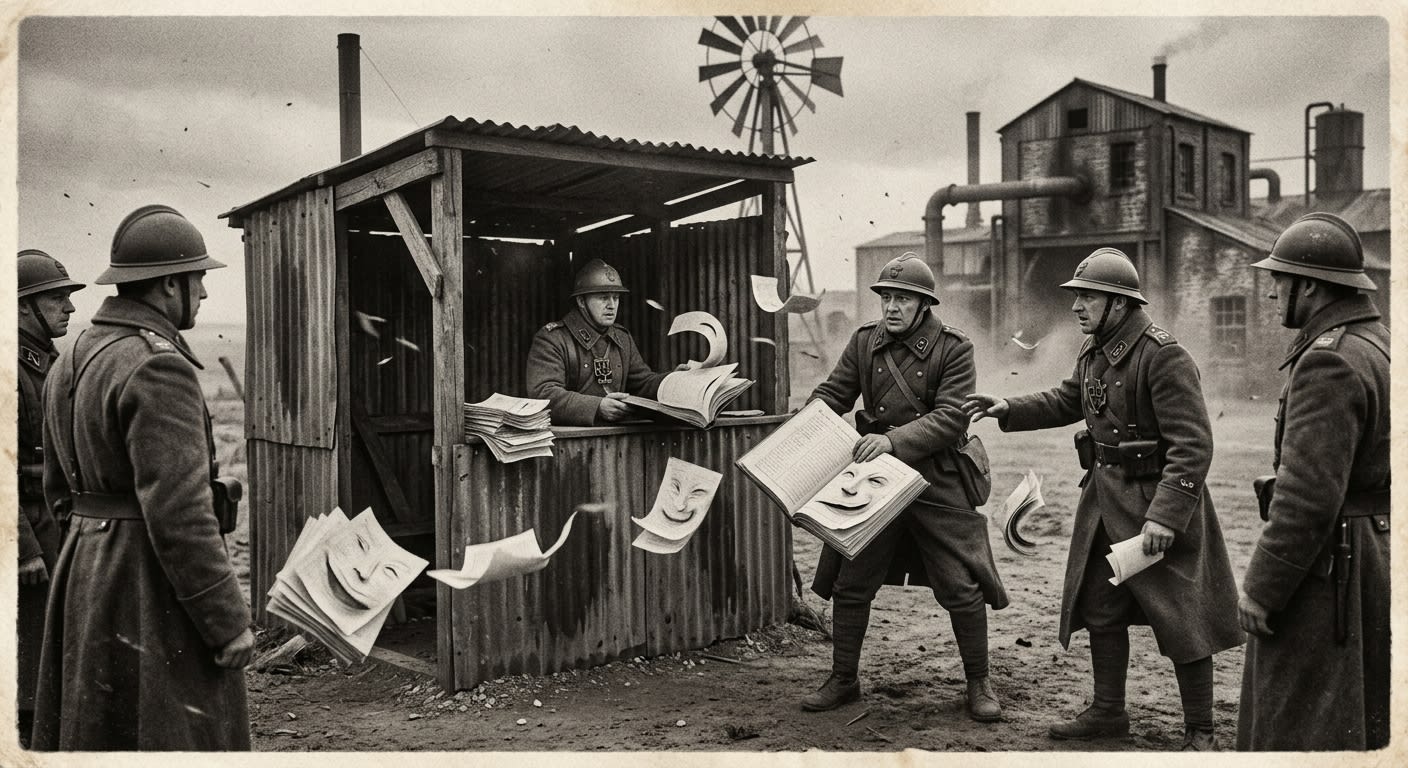
The same citation ledger contains a mark beside the entry: a loop of dried ink curved like a mouth.
Within the year, the Mirth Office began recording “airborne mirth.” Citizens were cited for expressions they did not wear, noises they did not make, and reactions they were judged likely to have had if the wind's provocation had continued. The logic is ugly and efficient: temptation becomes evidence of susceptibility; susceptibility becomes grounds for discipline; discipline becomes revenue; revenue becomes doctrine with a purse.
The Bureau of Records initially rejected these charges on procedural grounds, since air lacks a household ledger and cannot be summoned to tribunal. The rejection lasted eleven days. Speaker Huld Bex (Unregistered) of the Ration Parliament submitted an amended schedule of fines classifying wind-borne laughter as a civic hazard equivalent to open flame near grain dust. The Parliament approved it. Records accepted the fee structure. Doctrine praised the “swift harmonization of public safety and moral hygiene.” Tesch's fine was upheld retroactively, which is how Wexel makes prophecy cheap.
An A.S. 113 Ration Prefecture bulletin states that Chaff-Wind citations began only after formal Mirth Office authorization.
Incorrect. The citations preceded authorization by four months. The authorization was then backdated, witnessed, stamped, and declared prior in spirit. The Bureau of Records has certified the sequence as “administratively continuous.” It is always pleasing when time behaves after being corrected.
#On What the Wind Carries
The Chaff-Winds repeat three classes of sound.
First, ordinary fragments: quota numbers, names from the weighline, half a prayer, the scrape of a clerk's chalk made vocal by dust. These are common and treated as weather by citizens who wish to keep eating. A ration line hears “seven ounces” drift from the north gutter after the clerk has spoken “six,” and every person in line stares at the ground because looking up costs extra.
Second, laughter: never the approved civic exhalation taught in Mirth Office Schoolhouse, never the measured two-breath gratitude permitted at Silo Lantern Day (Unregistered), but the old animal burst that escapes before fear clamps the mouth shut. The wind repeats that kind of laughter faithfully. Too faithfully. It knows the shape of amusement better than the inspectors do, which is why they hate it.
Third, rearrangement. A parliamentary clause returns with its verbs shifted. A grain order spoken at the Scale Gate repeats from the Silo Crown as a question. A sermon on restraint comes back from Canalback Shacks (Unregistered) with one syllable changed, turning “contentment” into something very close to “contempt.” The Bureau of Rites insists these rearrangements are acoustic refractions. The Bureau of Doctrine calls them “non-doctrinal echoes.” The citizens of Wexel call them dangerous enough to remember.
MIRTH OFFICE LEDGER 199-L/CH: During harvest audit, wind repeated the question “WHO EATS?” through all fourteen silo throats. Inspectors reported no laughter. Citation loops appeared on every open ledger page. Three loops continued forming after the ink bottles were sealed. ██████████████████████████████.
The winds also move through matter. Grain shifts in certified-empty bins. Silo skins answer in faint knocks. Chalk dust gathers in little commas along Parliament Hall corners, as if the room were preparing to interrupt. None of these effects has harmed a citizen directly. Wexel's authorities find this more troubling than injury. Harm can be punished. Mockery must be interpreted, and interpretation is where officials begin to sweat.
#On Genuine Amusement
The anomaly responds to genuine amusement.
This phrase has caused more theological discomfort in Wexel than famine, fire, and Speaker Bex's annual address combined. The Mirth Office can command smiles. It can permit gratitude. It can fine levity, ration celebration, tax contentment, measure mouth-curvature to two millimetres, and write “appropriate civic satisfaction” beneath the portrait of a child too hungry to grin. It cannot manufacture the thing the wind recognizes.
Genuine amusement is more than sound. It is disobedience without agenda, pleasure before permission, the soul's small uncatalogued spasm at the spectacle of authority stepping in shit. No Synod office can issue it. No Parliament can vote it. No inspector can audit it without killing it. Wexel has built a revenue system on that murder.
When true laughter occurs, the Chaff-Winds carry it farther than physics allows. A cellar joke in Canalback reaches Parliament Square. A child's suppressed snort at Chit Market emerges from the Scale Gate chain as a bright metallic titter. A foreclosed widow laughing at the Marshals because her burned house has already spared her the rent is heard in the Mirth Office Schoolhouse during recitation drills. The inspectors record, triangulate, interrogate, and fail. The wind refuses to identify the guilty with useful precision. It distributes guilt. This is either mercy or superior accounting.
Countermeasures have multiplied. Salt lines at cellar doors. Wax plugs in keyholes. Joy masks during audits. Silence Minutes lengthened to three minutes after harvest. Licensed jokes printed on grey slips and tested for acceptable response. None of it works. Salt does not bind laughter. Wax does not stopper humiliation. Joy masks hide faces and leave shoulders shaking, which is worse, because a hidden laugh makes every inspector imagine the laugh is about him.
#On Ledgers that Smile
The Chaff-Winds' scribal residue appears in Mirth Office citation ledgers: ink drying into curved loops that resemble smiles. Records calls this a “minor inscriptional deformation.” Doctrine calls it “non-doctrinal.” The inspectors call it contamination when they are being brave and witchery when they think no superior is listening.
I examined three such ledgers during my A.S. 199 visit. Every page bore loops. Each loop differed. Some were narrow, as if suppressing themselves. Some were broad enough to constitute a fine under local joy codes. One loop ran through the amount column of a widow's citation and bent the figure from 9 to 0. The clerk corrected it; the loop returned by evening. The widow received a remission she had not requested, from an office that did not intend mercy, by the intervention of ink that appeared to find the whole arrangement amusing.
The Mirth Office's A.S. 199 annual report states that ledger loops are caused by “humidity, nib drag, and inexperienced clerks.”
Corrected after Sister-Lector Varr's private desk ledger, kept in a sealed drawer with no assigned junior clerk, produced forty-three loops overnight, each adjacent to an appealed citation later overturned on technical grounds. Humidity has never displayed such excellent jurisprudence.
The loops do not erase. They do not rewrite in the manner of Hungry Ink. They bend. They smile beside the text and alter the reader before the text is altered. A clerk confronted with a smile beside an execution surcharge hesitates. A hesitation becomes review. A review becomes delay. A delay becomes survival for one more ration cycle. The loop has done little. Little is sometimes enough, which is why the Bureau dislikes little things.
The Ration Prefecture has attempted to move citation ledgers to chalkboards. Chalk dust formed crescent shapes. It attempted slate tablets. The scratches curved. It attempted oral citation under bell. The wind repeated the charge with a laugh in the middle and ruined the dignity of the proceeding. By A.S. 201 the Office has returned to paper because paper at least permits blame.
#On the Present Disturbance
The Bureau has declined to raise the Chaff-Winds above Category One because no wall has fallen, no corpse has risen, no district has vanished, and no senior official has yet been laughed out of office in a manner Records is willing to acknowledge. Category One is a comforting classification. It says the anomaly is local, survivable, and beneath the dignity of panic.
The citizens of Wexel understand the lie. The winds have entered the Parliament Hall vents. They have crossed wax plugs. They have sounded inside sealed bins. They have repeated names from the buried ledger and asked, in grain-hiss and silo-knock, who profits from the fines. They have learned the cadence of Sister-Lector Varr's citations and now recite them with enough accuracy to make the inspectors answer themselves.
Wexel endures in its usual posture: chin lowered, mouth measured, hand extended for the chit, ear tilted against its will toward the silo ring. The wind moves over the grain basin. The silos rattle. The ledgers smile. Somewhere in Canalback, a joke passes from hand to hand on folded paper so poor that the crease nearly splits it.
The wind hears first.