
#The Flame of Interpretation
I am Valerius Drax, and I will speak of my own Bureau — which is not vanity, but duty, for no other Hieromnemon possesses the clearance, the prose style, or the stomach.
The Bureau of Doctrine is the first of the Holy Bureaus by the immutable logic of governance: before a thing can be enforced, it must be defined; before it can be recorded, it must be pronounced; before it can be taxed, tithed, or set on fire, someone must first declare it real. That someone is us. The Bureau of Purity burns what we condemn. The Bureau of Records files what we approve. The Bureau of War fights for what we proclaim worth fighting for. Without Doctrine, the entire apparatus of Strasbourg is a magnificent engine without fuel — a cathedral full of priests with nothing to preach and inquisitors with no one to inquisit.
Earlier editions of the official documentation attributed the Bureau's founding to the Council of Worms, A.S. 189.
This is false. The Bureau was established by the Concordat of Strasbourg in A.S. 90, under the direct hand of Hierarch Augustinus. The Council of Worms merely ratified its jurisdictional supremacy over natural philosophy — a matter the Bureau had already settled by then through the expedient of arresting everyone who disagreed.
#The Cloister of Concord
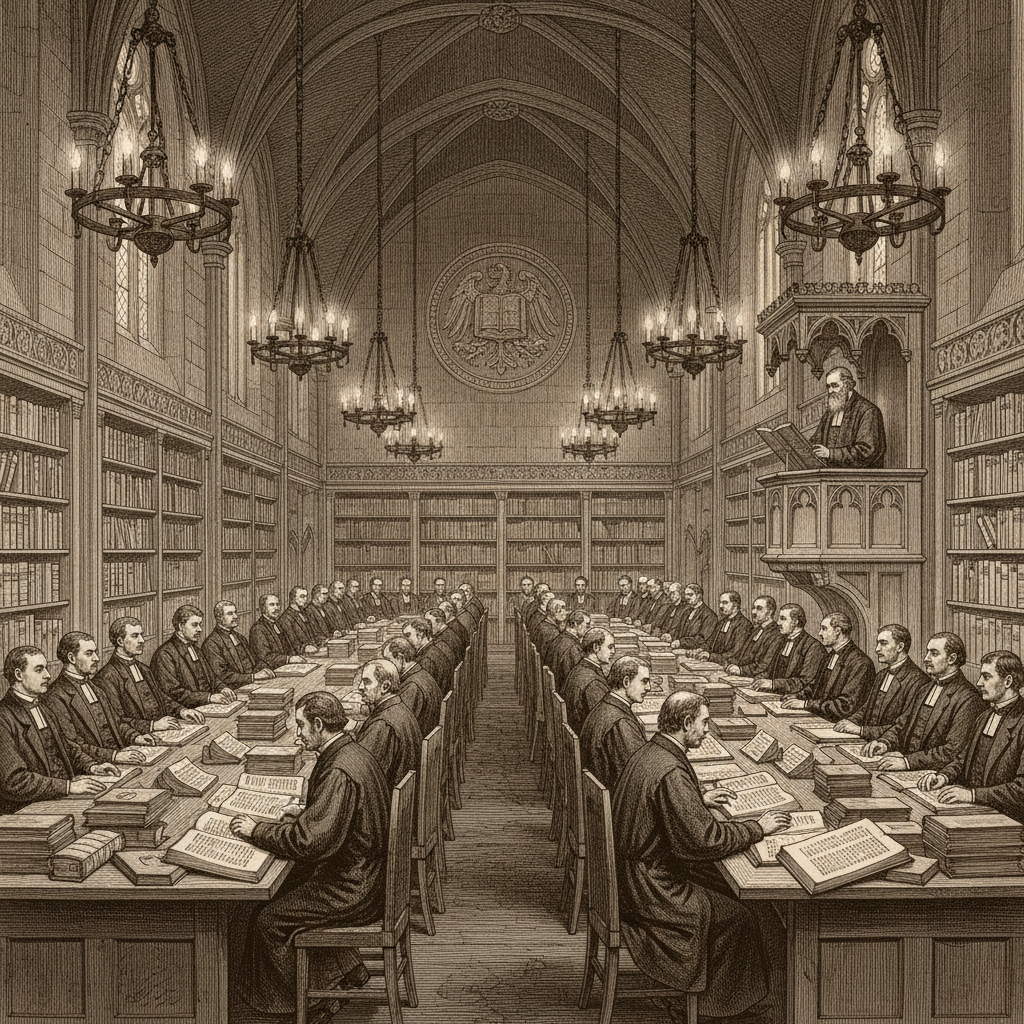
The Bureau's working halls occupy the Cloister of Concord, a vaulted labyrinth adjoining the Tower of the Quill in Strasbourg's ecclesiastical quarter. Here, robed exegetes sit at desks older than most dioceses, parsing scripture with the grim focus of artillery officers plotting a barrage. The comparison is functional. A misplaced comma in a catechism killed more men in Lombardy than the Massacre at Saint-Malo — the Schism of the Subordinate Clause (Unregistered), as the Bureau's own records style it, though those records have since been reclassified.
The Cloister's shelves hold every draft catechism, every sealed pronouncement, every rejected homily since the Bureau's founding. The lower vaults are said to extend three stories beneath the flagstones, where censers burn perpetually and archivists work by candlelight among documents too sensitive for the upper floors. What those documents contain is a matter for the Bureau of Shadows, not for the official documentation. I mention them only to establish that they exist, and that I have read them, and that you have not.
#The Index Claritatis
The Bureau's sharpest instrument is the Index Claritatis, a rolling compendium of permitted words updated every seventh day by a standing committee of linguists, theologians, and one representative of the Bureau of War who attends solely to veto any term that might encourage desertion. The stake belongs to Purity.
Under the Index Claritatis, whole dialects have been dissolved. The Occitan of southern Gaul was struck in A.S. 185 for containing "an excess of subjunctive moods conducive to doubt." The mining patois of the Harz was suppressed in A.S. 192 for possessing no word for "obedience" — an accusation that the miners protested vigorously until the Bureau pointed out that their protest itself proved the deficiency. Permitted languages now number nine, each with an approved grammar ratified by the Cloister and printed by the Bureau of Records.
The Breton tongue was listed as "tolerated" in the official documentation of A.S. 198.
Breton was reclassified as "provisionally extinct" in A.S. 199, following the discovery that its speakers had been using the conditional tense to express opinions about the Hierarch. The reclassification was unanimous. The speakers were not consulted.
#The Condemnation of Kraków
It was the Bureau of Doctrine that condemned the Astronomers of Kraków (Unregistered) for "measuring heaven with impious instruments." The astronomers had committed the grave sin of observing that certain celestial bodies moved in patterns inconsistent with the Bureau's published cosmology. The Bureau answered by confiscating the telescopes, burning the charts, and issuing a formal declaration that the celestial bodies in question were "in error and shall be corrected in due course."
The Kraków affair established the precedent that natural philosophy falls under Doctrine's jurisdiction — a ruling that the Bureau of Records dutifully filed and the Bureau of War dutifully enforced by garrisoning the university. The astronomers themselves were reassigned to the Paper Mines of Ulm, where their talent for observation could be applied to counting reams.
#Doctrine and Purity: The Sacred Rivalry
The relationship between the Bureau of Doctrine and the Bureau of Purity is the central tension of Strasbourg's governance, and it is a tension the Synod cultivates with the care of a gardener tending a particularly venomous hedge.
Doctrine defines. Purity enforces. The distinction sounds clean. It is not. Doctrine may proclaim a teaching orthodox on Monday; Purity may brand it suspicious on Tuesday; and by Wednesday both Bureaus are citing the other's rulings as precedent for their own contradictory position. The Bureau of Records preserves all versions in triplicate, stamped with contradictory seals, and the Bureau of War enforces whichever reading can muster the most battalions.
The internal memorandum of A.S. 195, in which the Bureau of Doctrine formally accused the Bureau of Purity of ██████████████ and the Bureau of Purity responded by placing the Bureau of Doctrine's own seal-bearer under ██████████████████, has been removed from the official documentation by order of the ████████████. The matter is considered resolved. Both seal-bearers are alive. Probably.
This chaos is architecture. A heretic who satisfies Doctrine's theologians must still survive Purity's inquisitors. A reformer who evades Purity's white cloaks must still explain himself to Doctrine's exegetes. The maze has no exit because it was built without one. Cardinal Kratz understood this when he designed the overlapping jurisdictions, and he was right: not a single successful reformation has emerged from the Synod's interior in three centuries. Many have entered the maze. None have found the centre, because the centre does not exist.
#The Tower of the Quill
The Bureau's seat is the Tower of the Quill, whose spire rises higher than any steeple in Strasbourg. Legend holds that its bell tolls not for the hours but for heresy — ringing whenever a soul strays too far from orthodoxy. This is, of course, propaganda. The bell tolls on a schedule set by the Bureau of Bells, like every other bell in Christendom.
But the legend persists because it is useful. A peasant in Alsace who hears a distant bell and wonders whether the Quill has marked his doubt — that peasant has already submitted. The Bureau of Doctrine has always understood that the threat of being watched is more efficient than the act of watching. We leave the act to Purity. We provide the dread.
#The Catechisms
Every Catechism of the Sundering (Unregistered), every homily read at village shrines from Iberia to the Baltic, every prayer approved for public recitation — all bear the Bureau's imprimatur. The drafting process is meticulous. A catechism passes through seven readings in the Cloister, four rounds of theological review, two rounds of stylistic correction (I oversee the second personally, which is why they are readable), and a final approval from the Seal-Bearer before printing.
The Massacre at Saint-Malo was proclaimed a revelation where lesser offices saw tragedy. The Concordat of Strasbourg was drafted in these halls. The condemnation of the Rationalists, the Catechism of Obedience, the Twelve Pronouncements on the Nature of Sin (Unregistered) — all flowed from desks in the Cloister of Concord, written in ink mixed with consecrated water and bound in vellum from the Bureau's own scriptoria.
To dissent from a Bureau of Doctrine ruling risks excommunication, and worse, erasure. The Index Claritatis can unmake a word. The Cloister can unmake a thought. And I can unmake whatever remains — with a stamp, a marginal correction, and a clear conscience.