
#On the Antiquity of Form
"Form is Function, Function is Form." — Inscription above the Archive of Prescribed Gesture, Bureau of Rites, Strasbourg
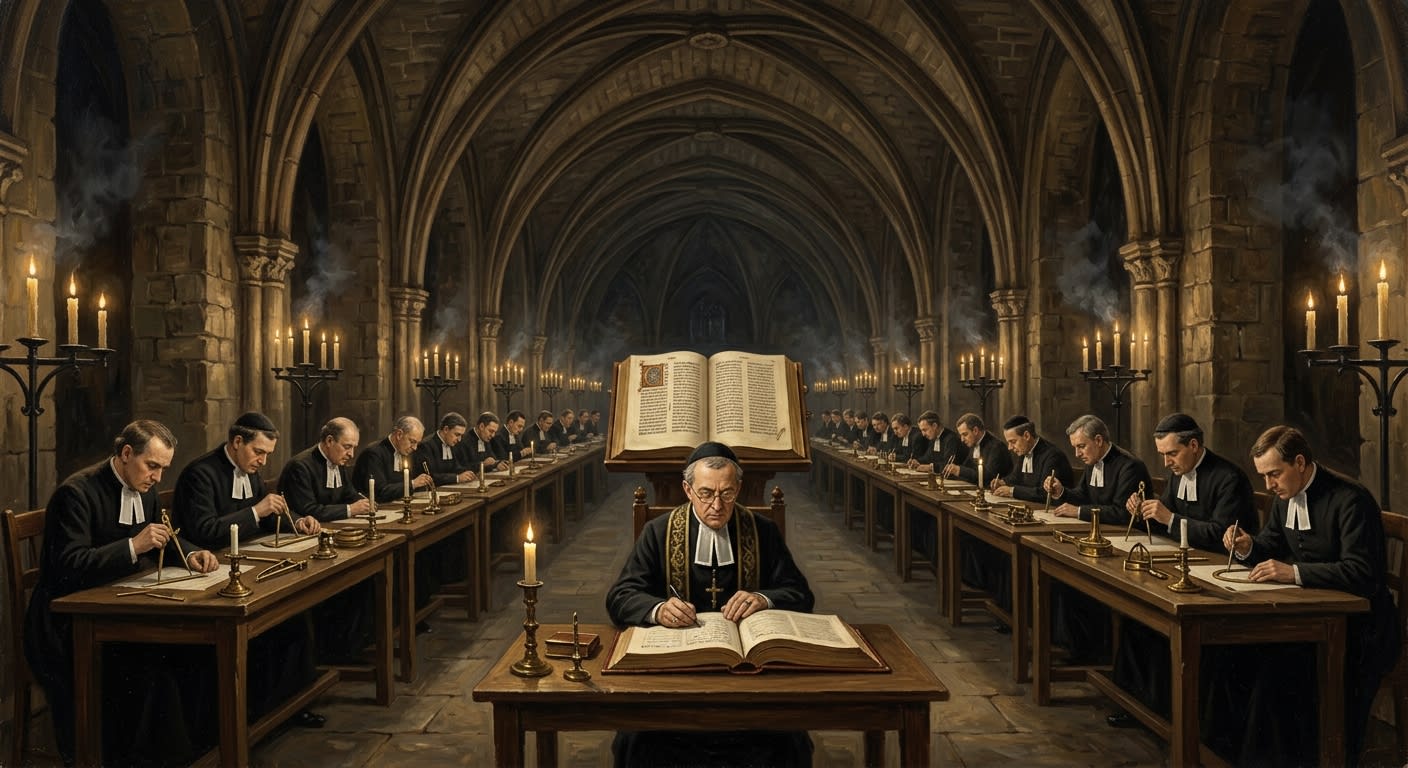
The reader will have observed that my entry on the Holy Bureaus listed twelve organs of governance and left the Bureau of Rites unmentioned. This was deliberate. The Bureau of Rites does not require listing because it is not, in the precise sense, a Bureau at all. It is the grammar of the Synod — the syntax by which every other Bureau speaks. One does not list grammar among the sentences it governs. One simply obeys it, or one speaks nonsense, and nonsense in the Theocratic Dominion is punishable under three separate Codes and an addendum the Bureau of Rites drafted in A.S. 14 specifically to address the problem of listing things improperly.
The Bureau of Rites predates the Concordat. It predates, in a certain theological sense, the Synod itself — for wherever two priests have quarreled over which hand holds the censer, the Bureau of Rites was already present in embryo, taking notes, filing precedent, and preparing a memorandum on the proper angle of the wrist. When Augustinus forged the Common Allegiance and the scattered dioceses consented to be bound beneath a single assembly, the Bureau of Rites was the first instrument constituted — not because it was the most urgent, but because without standardized liturgy, the binding itself would have been performed incorrectly, and an incorrectly performed binding is, per the Bureau's own founding charter, "an invitation to the Enemy written in the handwriting of the faithful."
That charter — the Charter of Prescribed Observance, ratified in A.S. 58 under Augustinus's own seal and countersigned by Kratz with characteristically illegible enthusiasm — remains in force. Its six hundred and fourteen articles govern every liturgical act performed within the Dominion: the angle of incense, the cadence of the Bell Codex's prescribed rhythms, the weight of the Host (three grains heavier in Lent, two lighter on feast days), the permitted duration of a genuflection (four seconds minimum, nine maximum, with a dispensation of eleven for the infirm, annotated in triplicate). When the Bureau says Form is Function, it means that the manner of worship is identical to its content. A prayer spoken at the wrong hour is heresy. A candle lit from the wrong end is a Wound-invitation. A genuflection held for ten seconds without dispensation is an affront to the Creator whose mathematical preferences the Bureau alone is qualified to interpret.
#On the Substance of Ritual
The Bureau of Rites governs seven categories of observance, which it designates with the modesty that characterizes all its operations as the Seven Pillars of Prescribed Form:
The First Pillar is the Sacramental Calendar — the liturgical year itself, a construction of such labyrinthine precision that the Bureau of Festivals is merely its public-facing appendage. Every feast, fast, vigil, and ember day is set by the Bureau of Rites, cross-referenced against the Bureau of Bells' peal schedule, the Bureau of Tithes' collection calendar, and the seasonal campaign timetables of the Bureau of War. A change to a single holy day cascades through every Bureau's planning cycle. In A.S. 167, the Liturgist-Primus moved the Feast of Saint Verena forward by two days. The Bureau of Tithes lost eight thousand Crowns in miscalculated harvest levies. The Bureau of War's spring offensive arrived forty-eight hours early at Bastion-Przemyśl, finding no supplies and a very confused garrison. The Liturgist-Primus noted these consequences with the serenity of a man who had been proven correct about a calendar date and considered everything else a secondary concern.
The Second Pillar is the Codex of Gesture — every physical movement of worship, from the sign of the cross to the positioning of the hands during absolution, catalogued and prescribed. The infamous debate over two fingers versus three consumed three years of the Bureau's energies and produced a schism that lasted a generation. The two-finger faction (the Dyarchists) held that the binary nature of the gesture reflected the dual nature of the Creator's mercy — given and withheld. The three-finger faction (the Tridentines) insisted the trinity of digits honored the three Seals of the Concordat. In the end, the Liturgist-Primus of the day — one Corvin Marche's predecessor by four occupants of the chair — decreed three fingers for cathedral rites and two for field worship, a compromise that satisfied no one and produced a manual of exceptions running to three hundred pages.
The Third Pillar is the Canonical Texts — the approved prayers, hymns, litanies, and responsorials that constitute the verbal architecture of worship. Every word of every prayer must match the Bureau's authorized edition. In A.S. 119, a parish priest in Saxony substituted "mercy" for "justice" in the Vespers antiphon. He was reported within the week, tried within the month, and assigned to the Paper Mines of Ulm within the season. His congregation received a corrected antiphon and a notice reminding them that mercy, in the Bureau's view, is a luxury the liturgy cannot afford.
The Fourth Pillar is the Fasting Protocols — a system of alimentary regulation that would make the Bureau of Tithes weep with admiration. The Bureau of Rites determines who fasts, when, for how long, and to what degree. There are seven grades of fast: the Partial (bread and water after noon), the Solemn (bread and confession after vespers), the Severe (water and prayer only), the Penitential (nothing, with hourly confession of appetite), the Expiatory (nothing, with the addition of physical labor), the Immolative (nothing, while carrying a stone representing sin through the streets), and the Terminal, which is imposed upon the condemned and — as the name suggests — ends when they do.
The Fifth Pillar is Penance — the Bureau's classification of sin and its prescribed remediation. Each sin carries a codified penance whose severity scales with the offender's rank, station, and proximity to relics at the time of commission. A lie spoken by a common laborer costs three Hail Marys and a day of Partial Fast. The same lie spoken by a Bureau clerk costs a week of Severe Fast, public confession, and a fine payable to the Bureau of Tithes. The same lie spoken by a Hierarch costs — well, Hierarchs do not lie. The Bureau of Rites has no codified penance for Hierarchical falsehood, which is either a statement of faith in their virtue or an acknowledgment that certain problems are solved by the Bureau of Shadows rather than by prayer.
The Sixth Pillar is the Consecration Protocols — the rituals by which places, objects, and persons are made sacred. Every bastion, every reliquary, every bell, every stretch of the Sagittal Line has been consecrated under protocols the Bureau of Rites has refined across a hundred and fifty years. The consecration of Thessaloniki's harbor-chain required nine days of continuous ritual and cost four divers their lives — drowned while inscribing psalm-script onto submerged chain links. The Bureau filed their deaths as "liturgical expenditure" and noted that the ceremony had been performed correctly, which was, in the Bureau's assessment, the more important statistic.
The Seventh Pillar is Supernatural Classification — the Bureau's authority to provide official theological explanations for phenomena that defy explanation. When the Chain of Saint Anakletos ceased to glow on eleven separate nights over eighteen months, it was the Bureau of Rites that produced the forty-seven-page theological explanation. I have read this document. It explains everything and accounts for nothing. Its central argument holds that the Chain's luminescence is "a gift of grace, not a guarantee of grace," and that its periodic dimming represents "the Creator's invitation to renew faith through the experience of its temporary withdrawal." The explanation arrived six weeks after the crisis began. Three new chain links had already been found installed without explanation after one of the dark nights. The Bureau's document did not address the new links. When questioned, the Liturgist-Primus responded that chain links fell outside the Bureau of Rites' jurisdiction and should be referred to the Bureau of Engineering. The Bureau of Engineering responded that the links were consecrated, and consecrated objects fell under the Bureau of Rites. The links remain unaccounted for.
#On the Liturgist-Primus
Corvin Marche has held the Chair of Prescribed Observance for nineteen years, an occupancy exceeded only by Liturgist-Primus Aldric the Unbending, who served for thirty-one years and was found dead at his desk with his quill still moving — the Bureau claims he was completing a sentence, and the sentence was grammatically perfect when his hand finally stilled.
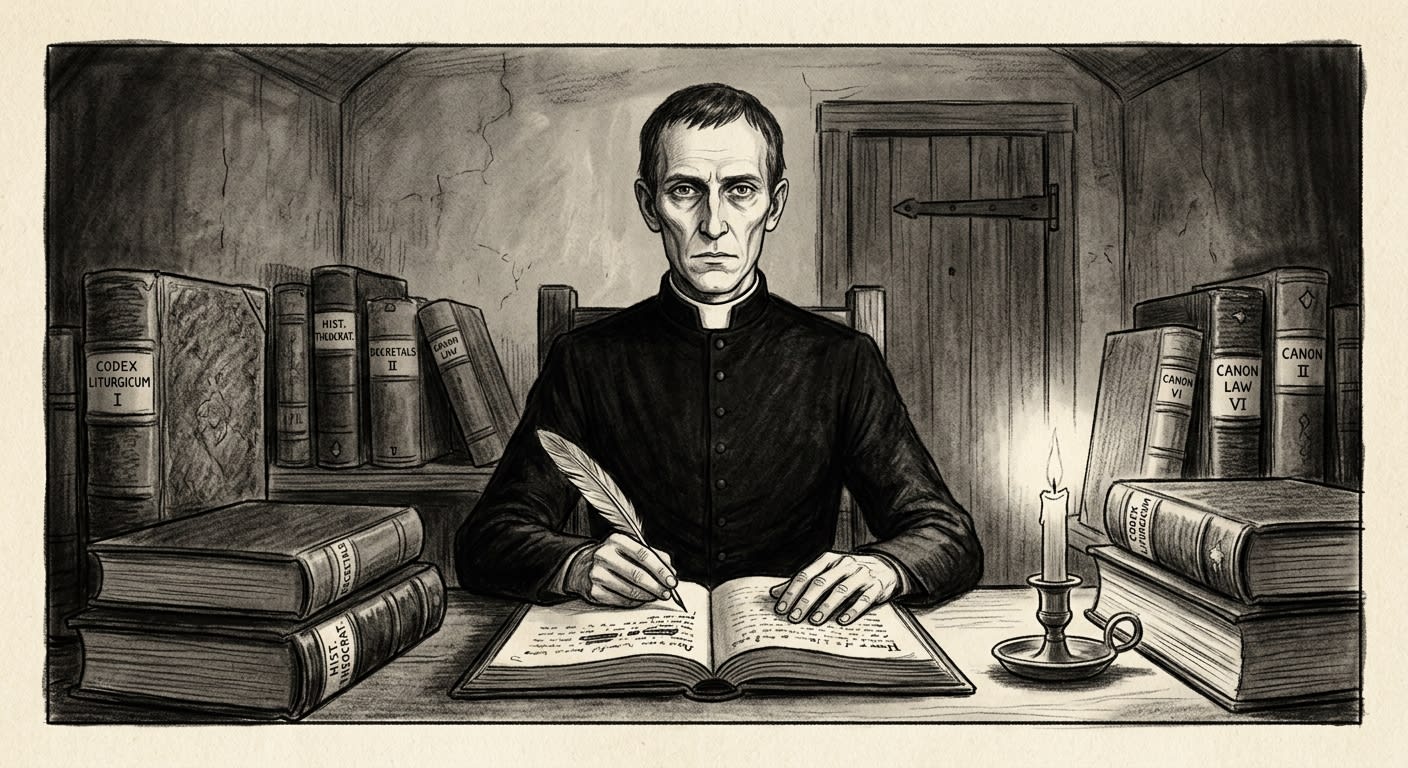
Marche governs the Bureau from a chamber in the Strasbourg Cloister that has not been redecorated since A.S. 72. The chamber contains a desk, a chair, a crucifix, and the Codex Liturgiae — the master reference of every authorized rite, running to eleven volumes and thirty-seven supplementary annexes. There is no window. Marche considers natural light "an unregulated illumination source inconsistent with the prescribed candle-schedule." His seventeen assistants — the Sub-Priors of Form — occupy adjacent cells in identical arrangement. They do not speak to one another except through written ritual queries, formatted according to Bureau Standard 7-C (Revised, A.S. 187).
I once carried Marche's private disdain across a Confession Wind, and I know the quality of the man's contempt. It is institutional. He does not hate individuals; he hates imprecision, which is to say he hates everything in the Dominion that is not the Bureau of Rites, and much within it that fails to meet his standards. The Confession Wind that bore my private thoughts about the Bureau of Rites to the Archbishop's office in the Year of Smoke — an incident I have recorded elsewhere — merely confirmed what Marche already knew: that I found his Bureau tedious. His response was a seven-page liturgical correction of my most recent Codex entry, annotated with references to four Councils and a commentary I had quoted incorrectly by one syllable. The correction arrived on my desk within the hour. He had been waiting.
#On the Controversies
The Bureau of Rites' conservatism is not merely institutional temperament; it is doctrine. The Bureau maintains — with the conviction of a man standing on the last dry stone in a flood — that any deviation from prescribed form opens a crack through which the Great Deceiver may enter. The liturgy is the wall. Every syllable is a brick. Remove one syllable and the wall admits a draft, and drafts in the Sundered Lands carry things worse than cold.
This position brings the Bureau into perpetual collision with every other organ of governance.
Earlier editions of this Codex suggested the jurisdictional dispute between the Bureau of Rites and the Bureau of Medicine was resolved in A.S. 134.
Nothing involving the Bureau of Rites is ever resolved. It is merely deferred to the next liturgical cycle, which, the Bureau assures us, will arrive at the appropriate time and in the correct order.
The jurisdictional dispute with the Bureau of Medicine over the Famine Pits classification is canonical. In A.S. 134, the Bureau of Medicine confirmed the phenomenon — the radiating hunger emanating from the Pits of Kargath's Blightmarsh — and coined the term "Residual Consumptive Emanation, Category Three." The Bureau of Rites objected. The phenomenon, Rites argued, was not medical but theological: a manifestation of spiritual starvation, a consequence of the dead's unabsolved appetite, classifiable only under the Bureau of Rites' jurisdiction as a "Post-Mortem Appetitive Disturbance, Liturgical Origin." The Bureau of Medicine responded that hunger was a physiological event regardless of its origin. The Bureau of Rites responded that physiology was a subset of theology, and always had been. The dispute consumed fourteen years, three joint commissions, and the patience of two successive Hierarchs before a compromise was imposed in A.S. 148: the Bureau of Medicine retained the classification but was required to append the phrase "pending liturgical review" to every report. The phrase remains appended. The review remains pending.
The collision with the Bureau of the Hourglass is more recent and more dangerous. The Hourglass, that peculiar instrument of temporal measurement lodged in the marshes of Bastion-Shipka, has begun documenting correlations between its temporal drift readings and the manifestation frequency of the dead. The Bureau of Rites has claimed jurisdiction on the grounds that any interaction between the dead and the measurable world constitutes a "post-mortem atmospheric disturbance" — a classification the Bureau of Rites authored in A.S. 92 and has applied to phenomena ranging from ossuary hauntings to unexplained candle behavior to the persistent chill in the Bureau of Records' sub-basement. The Hourglass has declined to surrender its data. The resulting jurisdictional dispute has generated more paper than the findings themselves, a fact the Hourglass — to its credit — has refrained from measuring.
The Bureau of Rites also maintains, through its Classification of Supernatural Events division, the authority to explain the inexplicable. When the Bureau's explanation contradicts empirical observation, the Bureau does not revise its explanation; it reclassifies the observation. The Minute Drift at the Queue Road's Apparatus — a phenomenon the Bureau of the Hourglass characterizes as temporal extraction — carries the Bureau of Rites' Category Two classification, which designates it as "a localized liturgical irregularity consistent with known devotional debt patterns." The Hourglass analyst who informed me that the Apparatus was performing extraction rather than deceleration — that "the time is going somewhere" — has filed his report with both Bureaus. The Bureau of the Hourglass filed it as evidence. The Bureau of Rites filed it as a specimen of "speculative theology exceeding jurisdictional remit."
#On Devotional Debt
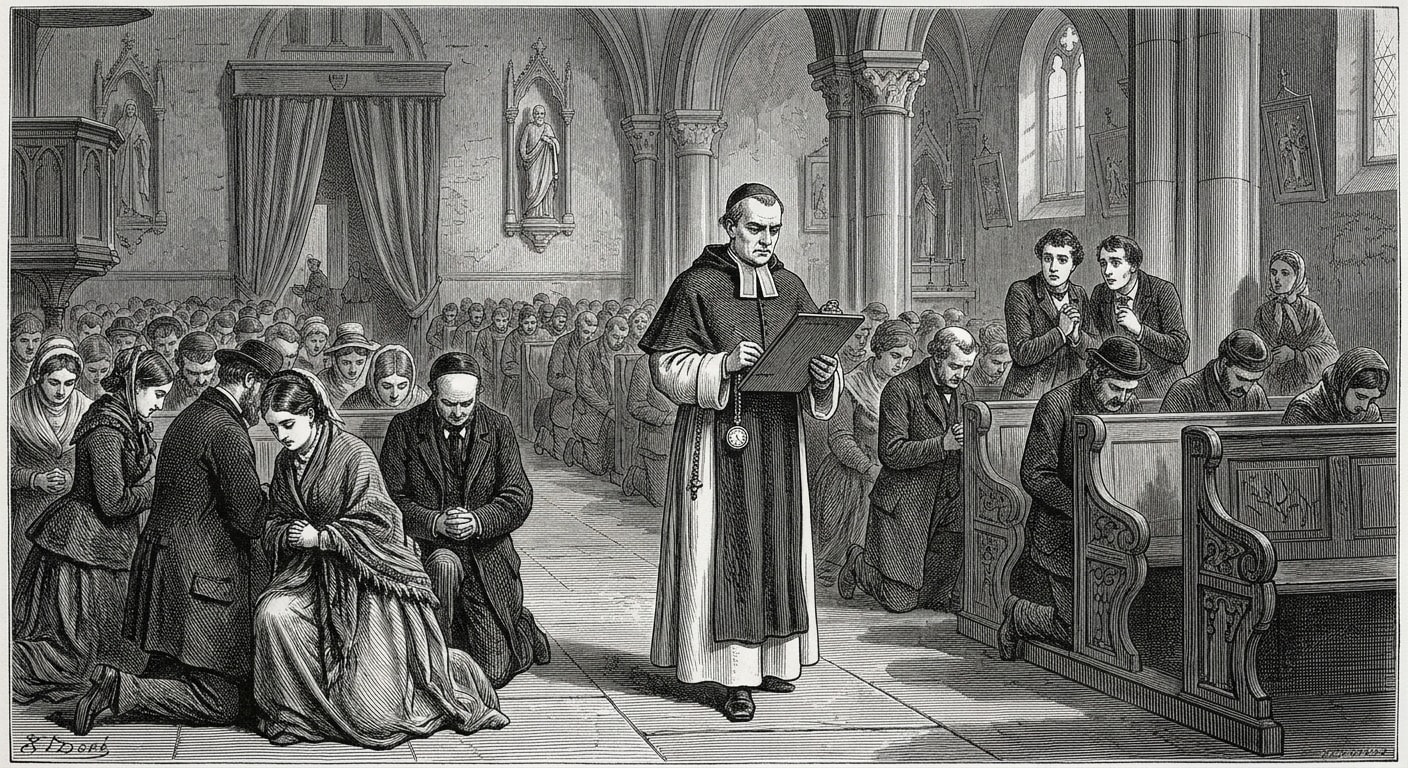
The Bureau of Rites' most consequential — and most quietly terrifying — function is the monitoring of devotional debt. Each act of grace exacts something from the obedient. A fast, a tithe, a service, a vow. The faithful pay with their substance, and the Bureau records what is owed and what has been spent.
The symptoms are clinical and catalogued. Dulled taste — bread becomes ash on the tongue, wine loses its warmth, salt its savor. Insomnia hymns — the ears ring at night with phantom bells, the peals of every service attended echoing backward through the skull in an accumulating ledger of worship. Brittle joy — laughter that fractures like glass in the throat, a merriment so worn thin by debt that it shatters at the first pressure. These are not metaphors. The Bureau of Rites has measured them, filed them, cross-referenced them against parish records and tithe schedules. Communities that pray hardest show the highest rates of dulled taste. Garrisons stationed near relics of the first class — where miracles burn brightest and grace flows most freely — exhibit insomnia hymn rates three times the Dominion average.
Some districts walk about gray-faced, unable to enjoy their rations. The miracle has already consumed them. The Bureau of Rites does not call this a problem; it calls it a "devotional maturation curve" and recommends additional fasting as the remedy — on the grounds that hunger is less distressing when the tongue can no longer taste bread.
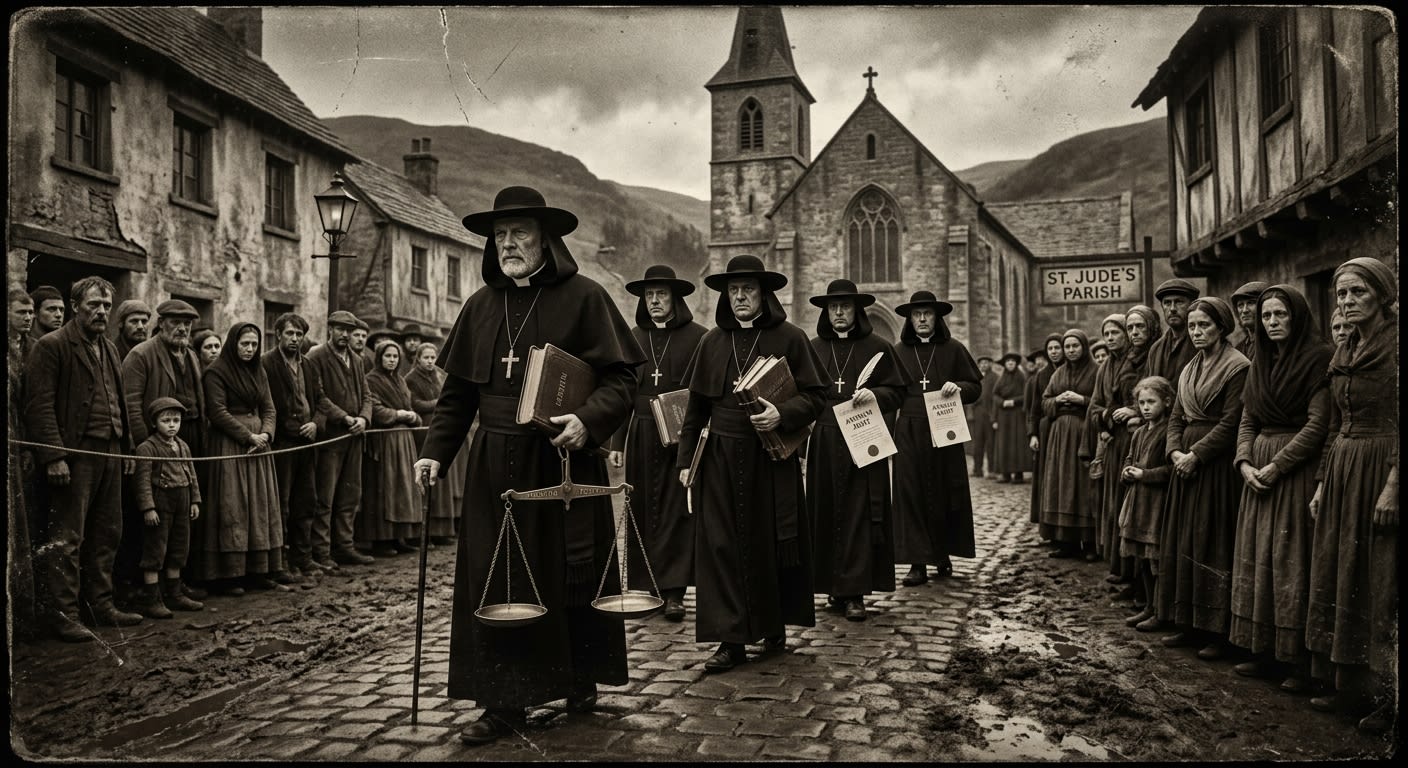
The Bureau publishes quarterly assessments to every parish in the Dominion, grading communities on a seven-point scale from "Spiritually Solvent" (rare; the Bureau has never awarded this classification to a community of more than forty persons) to "Devotionally Overdrawn" (common; nearly universal along the Sagittal Line, where proximity to the Wound drives both miracles and debt to heights the Bureau's original scale was not designed to accommodate). Communities rated below the fourth grade — "Provisionally Indebted" — receive mandatory additional services: three supplementary masses per week, a monthly penitential procession, and an annual audit by a team of Sub-Priors who weigh the congregation's collective spiritual credit against their accumulated liturgical expenditure with the focused intensity of the Bureau of Tithes examining a tax return.
I once asked Marche whether devotional debt could be forgiven. He considered the question for nine seconds — I counted — and responded: "Debt is the structure of grace. To forgive the debt is to collapse the structure. The Bureau does not forgive. The Bureau balances."
#On the Present Condition
The Bureau of Rites in A.S. 201 occupies a position of unacknowledged supremacy and openly acknowledged irrelevance. No Bureau can function without its liturgical framework; every consecration, every fast day, every bell-schedule depends upon its calendar. The Bureau of War cannot launch a campaign without the Bureau of Rites certifying the date as liturgically permissible. The Bureau of Bells cannot alter a peal schedule without Rites' countersignature. The Bureau of Purity cannot conduct a trial without Rites certifying the oaths of the judges. And yet no Bureau considers the Bureau of Rites interesting. Its work is invisible in the way that grammar is invisible — noticed only in the breach, appreciated only by those who have studied its architecture closely enough to understand what would collapse without it.
The Bureau's seventeen centuries of liturgical variations — each annotated with theological significance, each cross-referenced against the Council that authorized it, the Hierarch who ratified it, and the Bureau that (in many cases) later condemned it — constitute the single most complete record of the Synod's doctrinal evolution. The Codex Liturgiae is, in this sense, a more honest history than the Bureau of Records' Great Ledger of Souls, for the Ledger records what the Synod claims to believe while the Codex records what the Synod actually does when it worships. The gap between the two is itself a classified document.
The Bureau of Rites does not seek influence. Influence would require correspondence, and Marche does not correspond. It does not seek power. Power would require compromise, and the Bureau of Rites has not compromised since A.S. 58, when Kratz attempted to insert a clause allowing "liturgical flexibility in frontier conditions" and was told that the frontier was a condition of geography, not of liturgy, and that the Creator's preferences regarding the angle of a censer did not bend at the Sagittal Line.
An earlier edition suggested the Bureau of Rites was "the most boring of the Holy Bureaus."
The Hieromnemon responsible for this assessment has been corrected. The Bureau of Rites is the most precise of the Holy Bureaus, a distinction that the imprecise frequently confuse with tedium. The correction was drafted by the Bureau of Rites itself, in a format so exact that this office could find no procedural grounds for refusal.
What the Bureau of Rites is, in the end, is the thing that holds when everything else fails. When the Grey wears faces at Bastion-Königsberg, the soldiers do not reach for weapons first; they reach for the prescribed prayer, in the prescribed cadence, at the prescribed volume, because the Bureau of Rites has told them that this sequence will hold the wall — and it has held the wall, nine times out of ten, which is a success rate the Bureau of War has never matched. When Syrion's fog creeps across the marshes of Shipka and the clocks begin to lie, it is the Bureau of Rites' bell-schedule — maintained to the second, pealed without deviation — that keeps the garrison oriented in time. When the Velvet Choir's infiltrators burrow into a community and begin to unseat its certainties, the Bureau of Rites' prescribed liturgy is the last structure standing — the last thing the compromised cling to before everything else dissolves.
Form is function. The wall is the brick. The brick is the syllable. And the syllable is the Bureau of Rites' jurisdiction, from now until the final bell, which the Bureau has already scheduled and whose tone it has already prescribed.