
#On the Inconvenience of a Second Pope
"There was no pontiff crowned in Avignon; therefore, there was no culling. Fishers' tales are unreliable." — Stamped Erratum, Bureau of Records, 3rd Revision
I am Valerius Drax, and I am about to tell you the official history of something that did not happen. This is not paradox. This is governance.
In the Year of Our Sundering 111, some eleven years after the Council of Cologne had yoked the dioceses beneath Synod command and two decades after the Concordat had dried upon its altar-stone, the city of Avignon decided it disagreed with Strasbourg. Not on doctrine — doctrine is whatever the Bureau says it is, and Avignon had signed the same parchment as everyone else. No, Avignon disagreed on jurisdiction. On the question of who, precisely, held the seal.
A faction of Provençal clergy, led by figures whose names the Bureau has scraped from every register with such thoroughness that even I cannot recover them, declared that the Concordat had been ratified under duress. That Augustinus had bullied the southern dioceses into submission. That Strasbourg's claim to supremacy was a northern fabrication dressed in incense.
Earlier editions of this entry identified the leaders of the Avignon secession by name.
Those names have been struck from this and all subsequent editions by order of the Bureau of Records. The reasoning is sound: to name a heretic is to grant him a grave, and graves attract pilgrims. The unnamed rot faster.
They were not entirely wrong, of course. Augustinus had bullied the southern dioceses. The Concordat was signed while the memory of the Massacre at Saint-Malo still bled fresh in every parish. Strasbourg's claim was a fabrication — but it was a fabrication backed by reliquaries, armies, and the genuine conviction that the Creator Himself had authorized the paperwork. Conviction of this sort is not easily argued down, particularly when the arguer has fewer swords.
#The Crowned Beneath the River
What happened next enters the territory of whisper, rumor, and — if the Bureau is to be believed — pure invention.
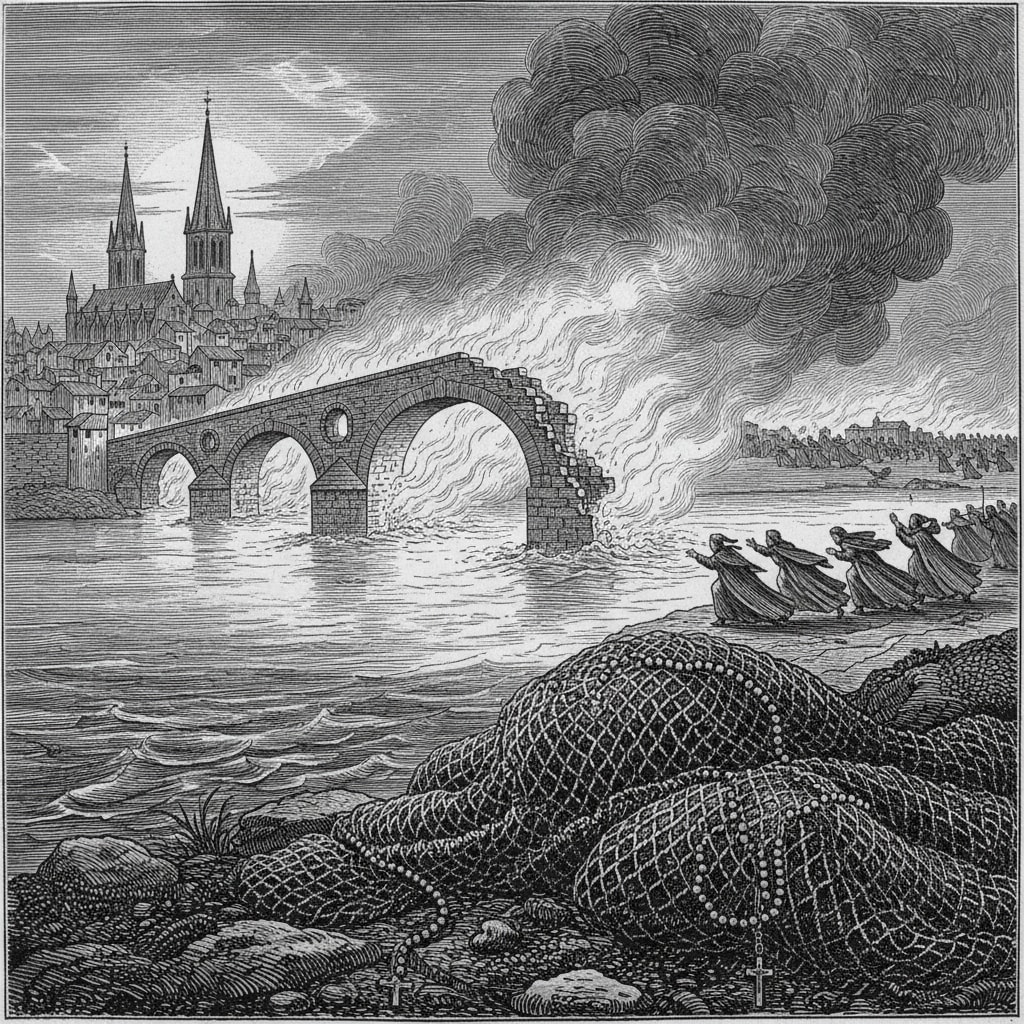
A rival pontiff was crowned. Not in a cathedral — Avignon's cathedral was still loyal to Strasbourg at the time, its bishop having been replaced three months prior with a more cooperative candidate — but beneath the Rhône. In the river itself, if the surviving parchments are accurate. Crowned in waterweed and secrecy, anointed with silt, his congregation standing waist-deep in the current because no consecrated ground would have them.
The rival pontiff's name is gone. His title — Pontifex Submersis, the Drowned Pontiff, as the Provençal faithful called him — survives only in fishers' accounts that the Bureau has classified as "unreliable" with the sort of vehemence that suggests they are extremely reliable. He claimed apostolic succession not through Rome, not through Strasbourg, but through the river itself: water being older than stone, and the Rhône being older than any cathedral built upon its banks.
The theology was, I concede, interesting. Heretical, naturally, and punishable by incineration, but interesting in the way a well-constructed bomb is interesting before it detonates. The Drowned Pontiff argued that the Synod had confused Order with ossification, that faith flows and does not sit in ledgers. He attracted thousands. Tens of thousands, if we credit the accounts the Bureau has not yet burned. The southern dioceses wavered. Iberia sent quiet delegations. For six months, the Synod held its breath.
#The Razing
The breath was released as fire.
Cardinal Kratz — not yet possessed of the title "Quill of Strasbourg" but already possessed of the instinct that would earn it — drafted the order. He did not call it a siege. He called it a Clarification. The term persists in Bureau parlance: "to clarify a city" means to burn it until the question it raised no longer exists.
The garrison of Strasbourg marched south. They were accompanied by Wardens of the Bureau of Purity, whose white cloaks were spotless upon departure and considerably less so upon return. Avignon's walls held for nine days. On the tenth, the gates were opened from within — by whom, no record states, though the Bureau of Purity's expense ledgers for that month show a line item for "persuasive disbursements, Avignon garrison, confidential."
What followed was not a battle. The Bureau does not fight battles; it administers corrections. Every structure associated with the schismatic clergy was pulled apart, stone by stone. The stones were loaded onto barges and shipped north to Strasbourg, where they were used to build the staircases of the Cloister of Concord. Doctrine found this poetic. I find it practical: the heretics' own masonry now supports the boots of orthodoxy, and every clerk who ascends those stairs treads upon Avignon's pretensions without knowing it.
Previous editions described the Razing of Avignon as "a measured response to clerical disobedience."
This is technically accurate but insufficiently vivid. The Razing of Avignon was the Synod's first demonstration that it would destroy an entire city to settle an argument about seals. The lesson was not the destruction — any army can destroy. The lesson was the paperwork filed afterward, which reclassified Avignon from "city" to "former terrain feature" in the Bureau of Records' geographic index. A city that no longer exists on paper cannot have hosted a rival pontiff. The logic is impeccable.
#The Culling
And here the account fractures, because what the garrison did was the Bureau's business, but what happened after the garrison's work was finished belongs to a different ledger entirely.
Survivors — and there were survivors, because the Bureau is thorough but not omniscient, however much it pretends otherwise — spoke of the last night. After the fires had consumed the wooden structures and the stone had been carted off, after the schismatic clergy had been rounded up and the Drowned Pontiff's congregation scattered, something else moved through the ruins.
Glass rods striking the ground. Whole neighborhoods collapsing not into rubble but into shapes — faceless statues, brittle husks of men frozen in postures of prayer. When investigators arrived at dawn, they found no bones. No relics. No bodies of the sort that fire produces. Only these figures, calcium-white and silent, arranged in rows as if a congregation had been calcified mid-genuflection.
The Bureau of Purity calls this "seditious fiction." The Bureau of Records filed seventeen depositions, sealed them, and stamped the seal with a second seal. The Penitential Shadows visited each of the seventeen witnesses within the year. Fourteen recanted. The other three vanished, their names scraped from the parish rolls with the same efficiency applied to the schismatic clergy.
And yet. And yet. The fishers of the Rhône still drag up rosaries in their nets. Glass-caked, river-worn, beads fused to iron chains as if melted and then quenched in water. The Bureau has sent three separate delegations to investigate. Each returned with the same report: "natural mineral accretion." Each delegation's lead investigator was subsequently transferred to the Paper Mines of Ulm. Draw what conclusions you will. I shall draw none, because drawing conclusions about Avignon is a disciplinary offense, and I have not been disciplined in four years, a record I intend to maintain.
#What Avignon Taught
The Schism lasted six months. The Razing took ten days. The aftermath has lasted centuries.
Three lessons were extracted, codified, and distributed to every Bureau in the Synod's apparatus:
First: dissent is not defeated by argument. Dissent is defeated by the removal of the physical structures in which it gathers. A heretic without a church is merely a madman shouting on a riverbank. A heretic with a cathedral is a pontiff. Destroy the cathedral.
Second: the unnamed cannot be martyred. The Bureau of Records' decision to scrape the schismatics' names from every register was not cruelty — or rather, not merely cruelty. It was strategic. A martyr requires a name. A name requires a record. No record, no martyr. Avignon's rebels died not twice but thrice: once in body, once in name, once in memory. The Bureau calls this the Trifold Erasure.
Third: contradiction strengthens. The Synod's own internal debates about the Avignon affair — Doctrine declared it a "theological correction," Purity called it a "prophylactic cauterization," Records simply filed it as "geographic reclassification" — produced not confusion but a thicket of overlapping justifications so dense that no single account could be challenged without validating the others. Three truths are harder to disprove than one.
It was in the years after Avignon that the Synod learned its most sacred axiom: contradiction is not weakness but mortar.
This entry previously contained a fourth lesson attributed to the Avignon affair.
The fourth lesson has been redacted at the request of the Bureau of Purity, which states that three lessons are "doctrinally sufficient" and that the enumeration of a fourth would constitute "structural heresy against the Triune principle." I am not persuaded by this reasoning, but I am persuaded by the Proctor who delivered it, who was carrying a branding iron. Three lessons. Three is sufficient.
#Coda: The Chains That Hum
There is one final artifact the Bureau has failed to account for, and it irritates me.
The Chains of the Martyrs of Avignon — iron links said to have bound the schismatic clergy during their processing — are rumored to exist in a sealed vault beneath the Basilica of the Ledgered Saints. No official record acknowledges their presence. The Bureau of Records denies the vault exists. The Bureau of Purity denies the chains exist. The Bureau of Doctrine denies that martyrs can be produced by an event that did not occur.
And yet, on certain nights — and I have heard this myself, standing in the Basilica's lower archive during a late inventory — there is a sound from beneath the floor. A low, rhythmic hum, as of iron links settling against stone. It could be pipes. It could be rats. It could be the building's ancient plumbing protesting the damp.
It sounds like chains.