
#On the Character of Wexel
"Measured mouths, measured hearts." — Inscription above the Scale Gate, paint renewed quarterly by civic mandate
I have visited Wexel three times. The first was an administrative inspection in A.S. 194, during which I was presented with a forty-page dossier on the town's grain surplus, a twelve-course dinner of boiled porridge served in graduated portions, and a laughter permit valid for one controlled exhalation. The second was a pastoral tour in A.S. 197, during which the Ration Parliament staged a demonstration of "civic joy" — two hundred citizens smiling on command in Parliament Square while a clerk measured the curvature of their mouths with a brass gauge. The third was in A.S. 199, when I returned to confirm what the previous two visits had made perfectly obvious: that Wexel is the most efficient machine for the production of obedience the Synod has ever accidentally built, and that its operators have no idea what they are feeding.
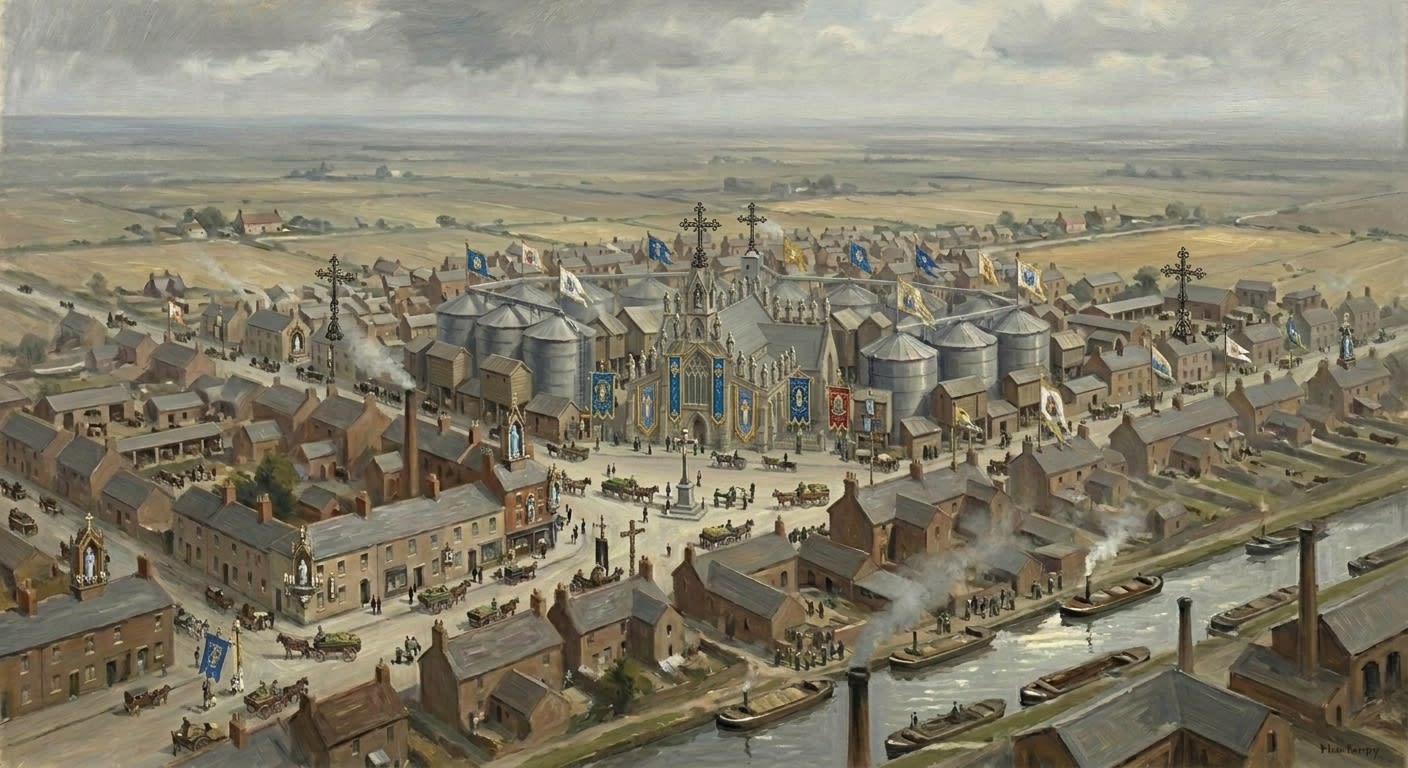
Wexel sits in a grain basin in the Hessian lowlands — flat country, wind country, the sort of terrain where a man can see his future arriving for three days before it reaches him and still cannot outrun it. The town is visible from a great distance by its silo ring: fourteen cylindrical steel towers arranged in a crown around a civic centre of pale brick, canal-water, and chalk. The wind never stops. It rattles the silo skins in a cadence the locals call "the counting," and on still days — of which there are almost none — the silence is so absolute that the Mirth Office has been known to issue citations for "atmospheric unease."
The Queue Road feeds Wexel from the west; the rail spur connects it to the Palatine Switchyard of Lorn in a single day's transit. Wagons arrive full and leave light. Grain enters; obedience exits. The exchange rate has held steady since A.S. 110, when the first silos were erected on the site of a pre-Synod harvest shrine — torn down, naturally, because the shrine lacked a filing system, and a granary without a filing system is merely a barn, and a barn without a filing system is an offence against the Ledger.
#On the Founding and the Dust Fire
"Hunger teaches holiness." — Ration Prefecture propaganda broadsheet, distributed at every Scale Gate checkpoint
Wexel was founded in A.S. 98, eight years after the Concordat, when a Hessian famine killed eleven thousand across three provinces and the Bureau of Records determined that the casualties were attributable to "insufficient grain accounting." The Bureau's solution was characteristic: build a town whose entire civic purpose is counting food. A grain consolidation depot was established at the canal junction; a clerk was installed; a stamp was issued. Within a season, the clerk had hired four assistants. Within a year, the assistants had formed a committee. Within five years, the committee had become a parliament, and the parliament had begun to tax emotions.
The first catastrophe came in A.S. 112 — the Dust Fire. A grain-dust explosion in the original wooden silos killed three hundred and forty souls in a column of flame visible from Lorn. The Bureau of Records logged the dead. The Bureau of Doctrine interpreted the dead. The interpretation was this: the explosion was caused by "reckless behaviour" — by which the Bureau meant singing, running, and the improper management of flour near open flames, but by which the Bureau of Purity would shortly mean "any unregulated expression of human vitality." The Ration Prefecture (Unregistered) was constituted within the month. The Mirth Office followed within the year. Joy discipline — the formal regulation of emotional display — was introduced as a "temporary public safety measure" and has not been rescinded in eighty-nine years.
The steel silos that replaced the wooden ones were built to Bureau of Engineering specifications, funded by the Bureau of Tithes, and consecrated by the Bureau of Rites with a hymn composed specifically for the occasion — a hymn so joyless that the choir wept, which was entered into the record as "evidence of appropriate devotion."
#On the Parliament and Its Instruments
"A smile is a receipt." — Wexel proverb
The Ration Parliament of Wexel meets daily in Parliament Square — a chamber of pale brick and chalkboard walls where quotas are voted, fines assessed, and citizens evaluated for "fiscal-spiritual compliance." The Parliament is, on paper, elected. In practice, the Bureau of Records approves every candidate, the Bureau of Doctrine vetoes every candidate the Bureau of Records approves, and the surviving names are presented to the electorate with the instruction that "any ballot is acceptable, provided it is correct."
Speaker Huld Bex (Unregistered) presides. He is a man who laughs only when someone else is fined — a reflex so reliable that the junior clerks use his amusement as a barometric indicator of the day's revenue. Bex maintains the Parliament's master ledger key and the "name drawer" beneath the dais — a locked compartment containing the names of citizens earmarked for audit. The drawer is opened at his discretion. It is closed at no one's discretion. Names enter; some emerge with clearance stamps, others with foreclosure writs, and a reliable minority emerge with nothing at all, because the name has been passed to the Ash-Fine Marshals for "property purification."
Beneath Bex, two powers hold the real architecture of control:
Prefect Marwen Kile commands the Ration Prefecture. His hands are always dusty — flour dust, chalk dust, the dust of paper worn thin by counting — and his eyes perform arithmetic on everything they touch. Kile controls household allotments: how much grain a family receives, when they receive it, and whether the receiving is logged as "provision" or "clemency." The distinction matters. Provision is a right. Clemency is a debt. Kile has converted most of Wexel's population from the former to the latter over fifteen years of patient reclassification.
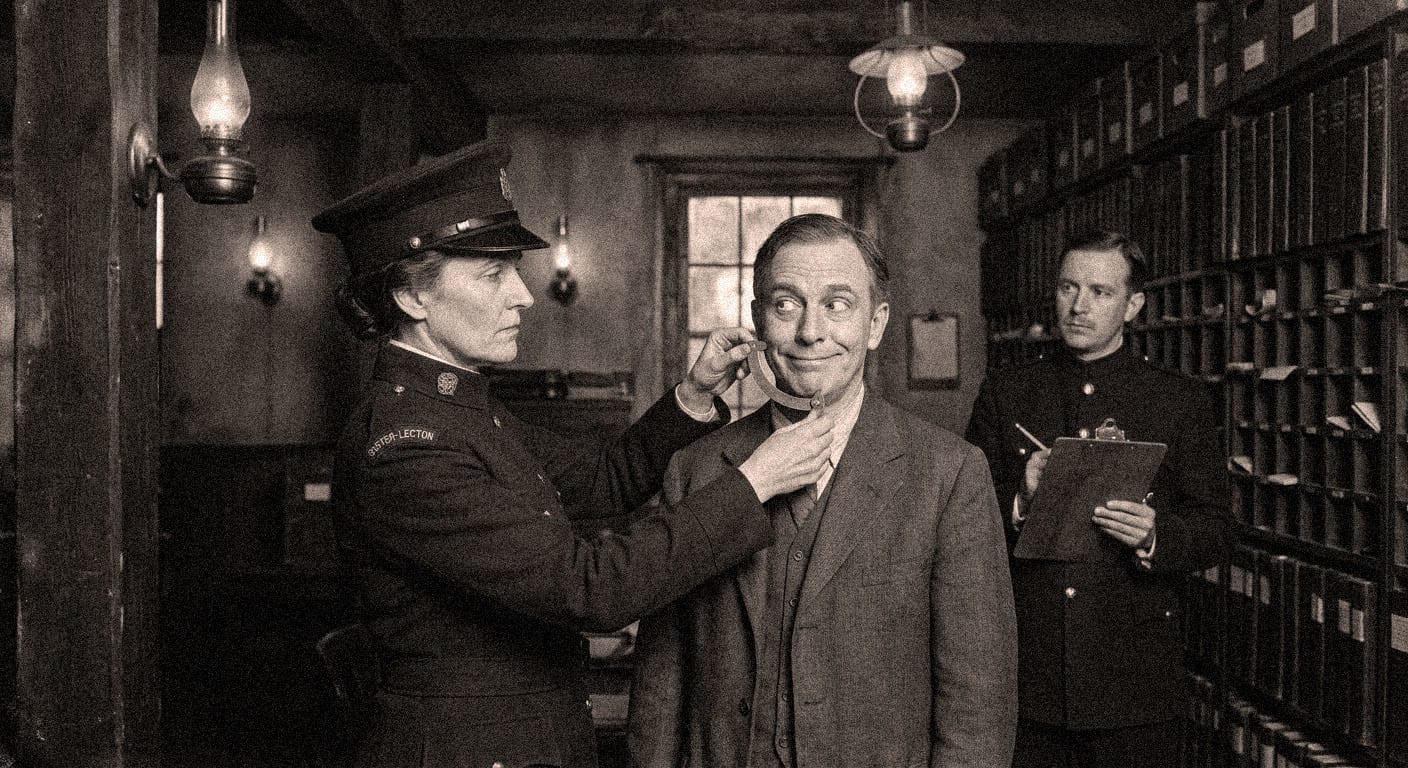
Sister-Lector Neme Varr (Unregistered) commands the Mirth Office — formally, the Doctrine Office of Emotional Compliance, but no one in Wexel uses the formal name, because using the formal name in full takes eleven seconds and the Mirth Office has been known to cite pauses longer than eight seconds as "suspicious hesitation." Varr carries a smile-measure tool: a little curved brass gauge, hinged at one end, which she holds against the faces of citizens to determine whether their expression falls within the Bureau-approved parameters of "measured contentment." Too wide and you are cited for "unearned joy." Too narrow and you are cited for "ingratitude." The acceptable range, I am told, is approximately three millimetres. I measured. It is two.
Earlier compliance reports described the Mirth Office as "an advisory body with no enforcement capacity."
This classification has been revised. The Mirth Office maintains a staff of forty-three inspectors, a citation archive exceeding twelve thousand entries, and a holding cell designated "the Laugh Box." Its advisory capacity is, by any honest measure, indistinguishable from its enforcement capacity, and the Bureau of Doctrine sees no reason to clarify the distinction further.
#On the Mechanisms of Wexel
"The ledger eats last." — Canalback proverb
The economy of Wexel runs on ration chits — stamped paper, sealed with tallow-wax, issued at dawn from the Scale Gate Weighline (Unregistered) and redeemable at the Chit Market (Unregistered) for grain, flour, soap, and the thin broth that constitutes Wexel's contribution to European cuisine. Coin circulates but matters less. Labour-hours are logged. Confession slips carry value. "Mirth compliance" fees — the fines levied by the Mirth Office for emotional infractions — represent, by the Bureau of Records' own accounting, eleven percent of Wexel's annual municipal revenue. This figure was presented to me with pride. I received it with the expression the Mirth Office would classify as "appropriate concern."
The Scale Gate Weighline is the town's true chokepoint — every sack of grain that enters or leaves Wexel passes across the iron scales at the Scale Gate, and the Scale Gate Authority (Unregistered) determines the weight of the sack and the moral status of the person carrying it. Clerks check chits. Doctrine monitors watch faces. A citizen who presents grain with an expression deemed "too pleased" may find his allotment reduced on the grounds of "suspect abundance," which is the Bureau's way of saying: if you look like you have enough, you have too much.
Below the chit economy, a black market breathes. The Cellar Circles — they call themselves "the Quiet Mirth" — operate in the undercellars and Canalback shacks, trading forged chits, hidden grain, lamp oil, and the commodity that carries the highest markup in Wexel: jokes. Smuggled humour moves through the town in coded proverbs, tap-knock signals on cellar doors, and folded paper sheets — "mirth scripts" — that circulate like samizdat. The content is rarely funny. The act of possession is the point. To hold a joke in Wexel is to hold proof that you are still capable of wanting to laugh, and wanting to laugh is the closest thing to rebellion this town permits.
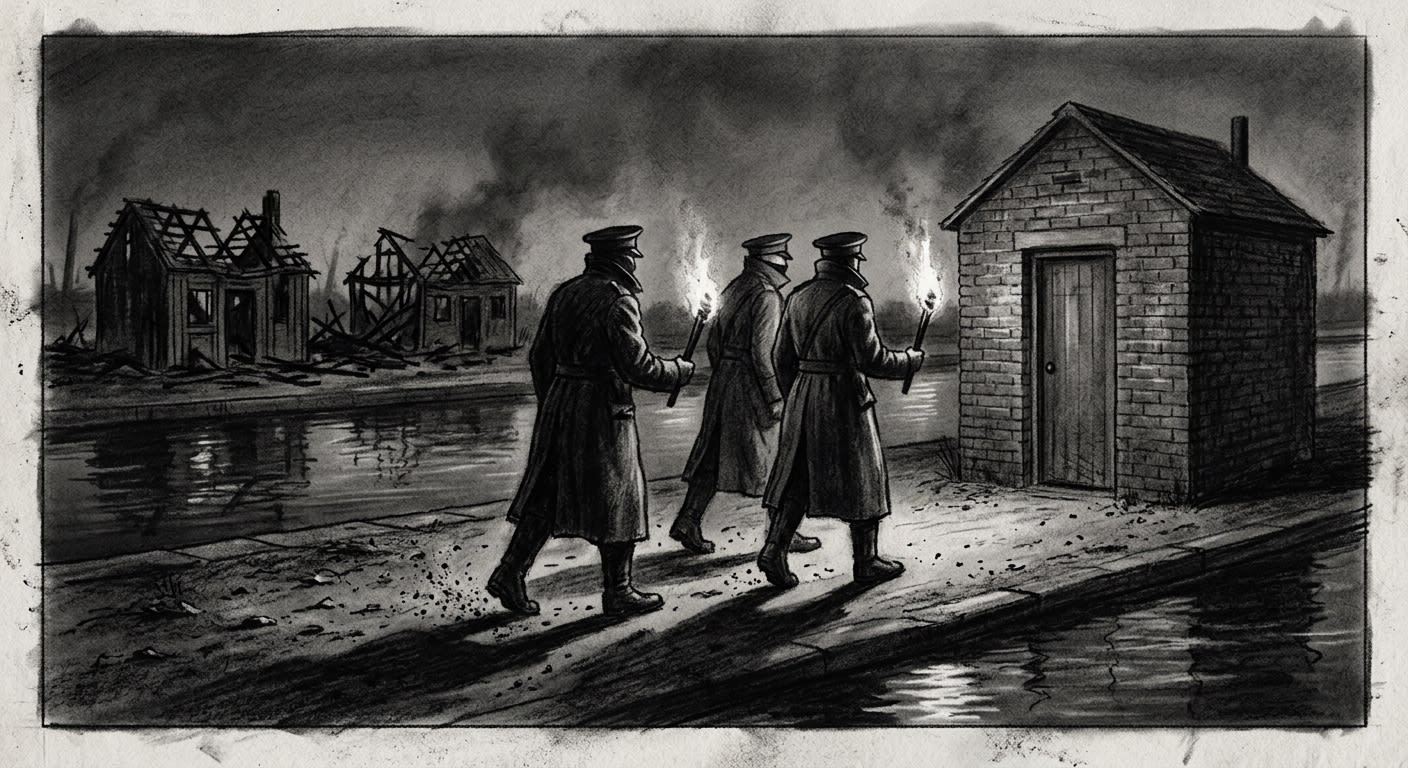
The Ash-Fine Marshals enforce the other end: debt collection by arson. A family that falls behind on fines receives an "ash bill" — a foreclosure writ stamped with a flame seal. The family has three days to pay. On the fourth day, the Marshals arrive with torches and carts, and the house is "purified." The Bureau of Records logs the event as "property purification." The Bureau of Tithes collects the land assessment. The family moves to Canalback or vanishes into the Ash Fines District — a quarter of burned lots, wet cinders, and the peculiar silence of people who have learned that losing everything is cheaper than keeping it.
#On the Districts and Their Humours
Wexel is built in rings. The silo crown — fourteen steel towers connected by catwalks, ladders, and gantry bridges — forms the outer perimeter, and everything else fits inside it like organs in a ribcage.
Parliament Square occupies the centre: chalk-dusted, ink-stained, permanently occupied by clerks carrying quotas between the Parliament Hall of Measures and the various offices that orbit it. The Hall itself contains the name drawer, the master chalkboards, and a smell I can only describe as the distilled essence of administrative anxiety — ink, boiled grain, and fear drying slowly on paper.
The Silo Crown is Wexel's watchtower, warehouse, and cathedral combined. The catwalks are the domain of the Silo Catwalk Choir — a civic unit that sings hymns over the stored grain on a bell schedule and simultaneously serves as the town's surveillance apparatus. From the catwalks, every street is visible. Every movement is observed. The grain dust hangs in the air like a perpetual fog, and the wind plays the silo skins in harmonics the Bureau of Bells has classified as "non-doctrinal but structurally tolerable."
Scale Gate Ward is where the weighing happens. Iron scales, sweat, the creak of hemp rope under grain-sack weight, and the scratch of stylus on wax tablet as the clerks log each transaction with the meticulous disinterest of men who understand that the numbers they record will determine whether a family eats tomorrow or starves by decree.
Chit Market is where the ration chits change hands — a covered arcade smelling of onions, burlap, and the faint ammonia tang of desperation. Stalls sell flour at regulated prices. Behind the stalls, everything else is sold at unregulated ones. A bread stall in the southeast corner of the arcade has operated a counterfeit-chit ring for eleven years; the Mirth Office knows this and permits it because the stall's proprietor provides names.
Mirth Office Row smells of incense and sour tea — the two substances the laughter inspectors consume in quantities that would alarm a physician. The Row contains the Mirth Office Schoolhouse, where new inspectors are trained in the art of reading micro-expressions, calibrating smile gauges, and drafting citations with the particular bureaucratic poetry that transforms "a man laughed in public" into "unlicensed emotional expenditure constituting potential doctrinal infraction, ref. code 7c."
The Ash Fines District is what happens when the machine finishes with you. Burned lots, foreclosed houses, wet ash that never fully dries because the canal runoff keeps it damp, and the people who live there — the ash-fined, the erased, the surplus — moving through a geography of cinders with the careful quiet of those who understand that the next citation will have nowhere left to land except their bodies.
Canalback Shacks cling to the irrigation canal's southern bank — the poor quarter, the sick quarter, the quarter where the joke-sheets circulate most freely because the Mirth Office's inspectors prefer not to walk in algae. It smells of rot, cheap stew, and the particular variety of defiance that comes from having nothing left to lose and knowing the Bureau has already counted you as lost.
#On the Chaff-Winds and What They Carry
"If the wind laughs first, don't answer with yours." — Wexel superstition
Wexel has an anomaly. The Bureau of Rites classifies it as "Category One Localized Atmospheric-Acoustic Disturbance" — a classification so deliberately vague that it tells you everything about how little the Bureau wants to discuss it.
The chaff-winds blow through Wexel year-round: dry gusts carrying grain dust, pollen, and the rattling percussion of silo skins flexing in the air. This is weather. But the winds carry something else. Voices. Laughter. Fragments of speech that no one spoke, echoing across Parliament Square or drifting through the Chit Market arcade in the hour after curfew. A citizen laughs; the wind laughs back, half a second later, from the wrong direction. A clerk reads a quota aloud in the Parliament Hall; the quota repeats itself in the corridor outside, syllables rearranged into something that sounds like a question. Grain shifts in sealed bins — bins locked and inspected and certified empty by the Scale Gate Authority — and the shifting sounds, to those who listen closely, like applause.
The Mirth Office treats the chaff-winds as a disciplinary problem — a provocation designed to elicit unauthorized emotional responses. Countermeasures include salt lines at cellar doors, wax plugs in keyholes, and "joy masks" — blank face coverings worn during audits so that no inspector can read a citizen's reaction to whatever the wind chooses to say. The countermeasures are, by the Bureau's own admission, ineffective. The chaff-winds do not obey salt. The chaff-winds do not acknowledge wax. What the chaff-winds do acknowledge is laughter — specifically, human laughter produced in a state of genuine rather than regulated amusement — which they repeat, amplify, and scatter across the town in patterns that the Bureau of Alchemical Standards has tentatively mapped to "the grain cycle of the regional harvest," a correlation no one at the Bureau has volunteered to explain further.
Ink dries into strange loops in the Mirth Office's citation ledgers. The loops resemble smiles. The Bureau classifies this as "scribal anomaly, non-doctrinal." I examined three citation ledgers during my inspection. Every page bore the loops. Every loop was slightly different. Every difference was, by any reasonable interpretation, a variation on the same expression — the expression of something that finds all of this very, very funny.
#On the Buried Ledger and What Wexel Feeds
"Names are currency. Pay in people." — Canalback saying
The public story of Wexel is a story about grain and discipline. Hunger teaches holiness. The Parliament measures mouths. The silos stand full. The ration chits circulate. The machine works.
The buried story is simpler and worse.
The Mirth Office's "name payments" — the practice of trading a citizen's name to clear one's own citations — are the visible mechanism. What is less visible is where those names go. They travel through the Parliament's name drawer, through the Ration Prefecture's sealed files, into a surplus ledger that does not appear in any accounting the Bureau of Records has published. Grain marked as "consumed" in the public ledger reappears in the surplus ledger as "diverted." Diverted to whom, diverted where, diverted for what — these questions are filed under a classification tier I am not at liberty to name, which is itself filed under a classification tier I am not at liberty to acknowledge exists.
█████████████ grain tonnage ████████ quarterly ████████ Bureau of ██████████ via ██████ corridor. Beneficiary: ████████████████. Authorization: ████-Ratification. This entry has been redacted per standing order. The standing order has also been redacted. The existence of a standing order is ███████.
What I will say is this: Wexel produces more grain than Wexel consumes. The surplus is real. The question is who eats it, and the answer — I suspect, I do not state, because stating would require a classification I do not possess and a courage I do not waste on towns — is that Wexel has been feeding something other than its citizens for a very long time, and the joy discipline, the mirth quotas, the smile gauges and the ash bills and the laughter inspectors with their curved brass instruments and their sour tea — all of it, every mechanism, every fine, every foreclosure — exists to keep the population compliant enough to produce, quiet enough to remain ignorant, and grey enough that no one asks the question the chaff-winds keep repeating in the corridors of Parliament Hall, in a voice that sounds like grain shifting in a bin that the Bureau has certified empty:
Who profits from the fines?
An earlier draft of this dispatch described the Ration Parliament of Wexel as "a model of civic governance deserving emulation across the Heartlands."
I regret the enthusiasm. Wexel is a model. What it models is a question the Bureau has not yet agreed to ask.