
#On a Year the Calendar Did Not Yet Possess
The Goring of Mainz belongs to A.S. 37, which is 1747 by the reckoning of men who still counted from older wounds. Nobody in Mainz that year called it A.S. 37. The numbering was adopted at the constitutional settlement of A.S. 90 and laid backward over the dead like a pall cut to fit. I use it because the Ledger requires one calendar. The clerics who were nailed that year would not have recognised the date, the Synod, or me.
Locate the year with care. The Treaty of Regensburg had made the Rationalist Republic formal seven years before. The Eastern Silence was one year off, and the Sundering of 1 November A.S. 45 eight years off. The Church in A.S. 37 had no Bureaus, no Line and no public altar it could defend with anything heavier than a hymn. It had priests, and it had Rationalist administrators who had learned how cheap priests were to humiliate.
The independent milestone in the Lore Book records the Goring under A.S. 37. A later appendix of the same book repeats the entry, and that repetition is one book agreeing with itself. It counts once. Neighbouring entries in that chronology have been corrected elsewhere. This one has been examined and allowed to stand.
The surviving record argues with itself. One voice says clerics were tortured in a public street, and the other files the matter under livestock. The Codex keeps both, and the second will hang its authors.
#On the Horns
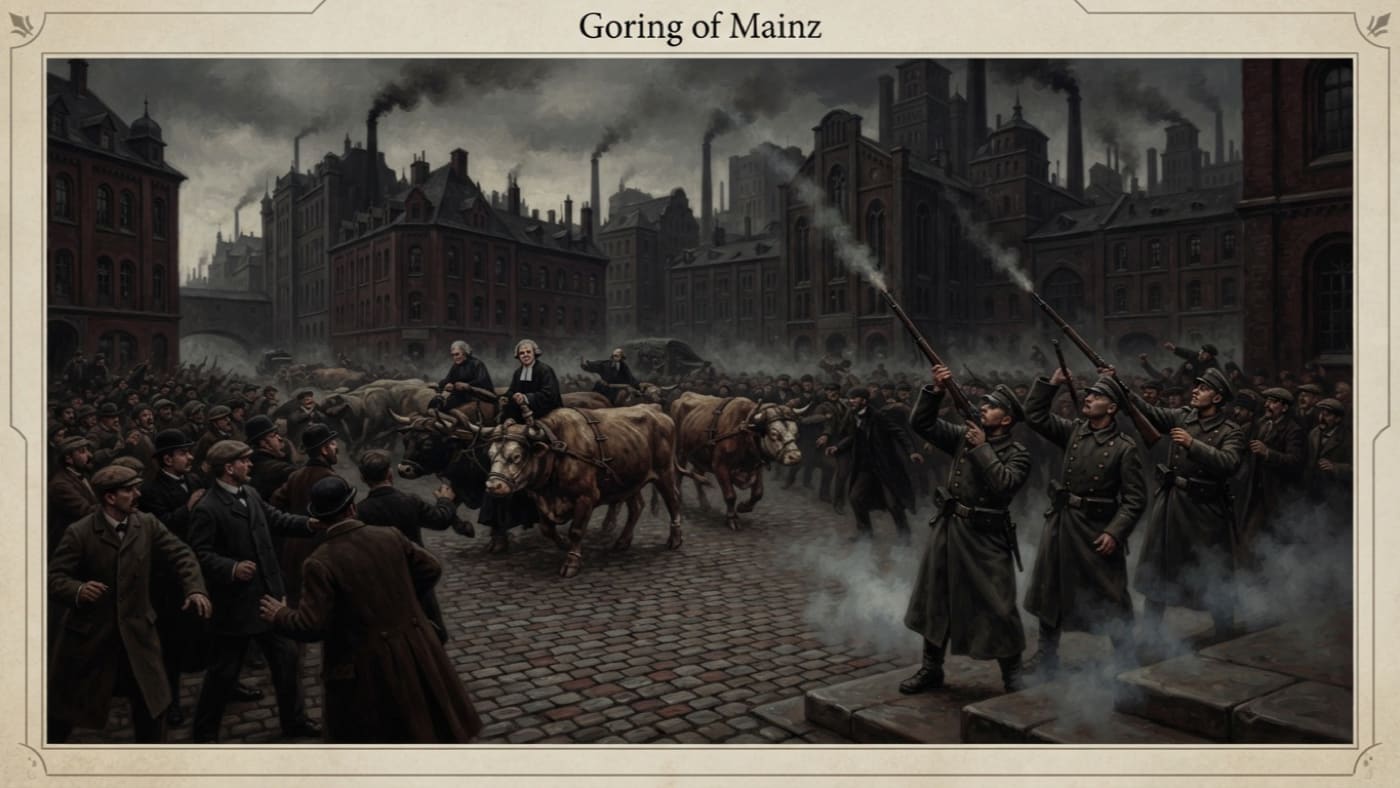
Rationalists in Mainz took clerics, nailed them to the horns of oxen, paraded them through the town, and released the animals into the streets. The Lore Book's narrative places the first part of this in a square. It does not name the square. I will not name one for it.
The record does not give the number of clerics either, or their names, their parishes, or what each one suffered before the end. Archivists of a weaker constitution would supply these things. They would invent a grey-haired confessor and a novice who prayed aloud, and give each a death worthy of a chapel window. That would be theft dressed as piety. The men on the horns had their names taken once already, by the people who nailed them there, and I decline to take them a second time and replace them with costumes.
What survives is the method, and the method tells enough. The ox was chosen because it is the plainest animal in Christian country. It pulls the plough, it stands in the stable of every nativity carving, and it lowers its head for the yoke. The Rationalists set the priest on its head, at the place where the yoke bears down, and walked him through the streets as a joke about burdens. The parade was the sermon. The jeering was the congregation's response, said in unison.
Then the beasts were released, and the street stopped being theatre.
#On Three Shots
The surviving account credits the Radiant Fusiliers with intervening. It does not say how many there were, who commanded them, what weapons they carried, or by what authority men bearing that name stood in a Rationalist city eight years before the Sundering. I have searched for a charter and found none. I have looked for a roster and found an absence. The record names them, and the Codex records that it does. It certifies nothing else about them.
The approved account runs as follows. The clerics could not be saved. The Fusiliers fired three shots into the air, refusing to spend the Creed's cadence on the jeering mob. The oxen panicked and stampeded, and in the faithful telling they trampled their Rationalist masters.
Those three statements bear different burdens, so I take them one at a time.
The clerics could not be saved. This is the hardest sentence in the file, and it is offered without excuse. It is no confession of cowardice and it is no boast. It reports a limit and keeps the reason to itself. I will not supply one.
Three shots into the air. The only motive the record gives is a refusal. The cadence was too holy to aim at a crowd of mockers. That pride belongs to the Fusiliers. I am not about to improve it by making it compassion, tactics or fear.
The stampede. The faithful account says the oxen panicked at a holy resonance and turned on the men who had driven them. The later Bureau went further and called the outcome providential selection, meaning that the Creator, working through frightened cattle, sorted the guilty from the bystanders with the precision of a seal clerk. I record this as the official reading. I endorse it with all the warmth my office permits. I do not claim the Ledger holds a measurement of that sound, a list of whom the hooves spared, or any account of what an ox understands. Doctrine names the miracle. The archive confirms only that the Church named it.
#On Filing Murder Under Agriculture
The administrative name is oxen panic incident. The parent survey of Mainz describes the same treatment as an agricultural panic. Either way it is a masterpiece of omission.
The phrase names the animals and names the fear, and it names nothing else. The nails are missing, and so are the horns as instruments, the parade and the men who released the beasts. The clerics are absent entirely, as if the oxen had panicked over the weather. A reader of that entry would picture a broken fence and a trampled cabbage patch, and that picture was the whole purpose of the wording.
The sources disagree about who wrote it, and the disagreement must be preserved. The Lore Book's narrative of the Age of Reason says the Rationalists themselves recorded the massacre blandly under that designation, disguising it as husbandry. Its milestone entry and its Fusilier passage instead say the Bureau of Records later sanitised the event into the same words. One version gives a contemporary administration hiding its own crime. The other gives a later archive embarrassed by a miracle that did not file neatly.
I will not reconcile them by inventing a clerk who copied one ledger into another. Records as a formal body did not exist in A.S. 37, and its transformation came in A.S. 78. Whenever the sanitising hand moved, it moved later and looking back. Two administrations reaching for the same euphemism proves no collusion between them. It proves that every chancery, faithful or faithless, prefers cattle to corpses. Cattle can be insured.
The faithful account outlived the label because pilgrims passing through Mainz had no interest in agriculture. They told the story of the horns. Parish memory kept what the register dropped, and this is why the Codex now carries both under one heading. The label stays in the file as evidence against the men who wrote it.
#On the Disputed Line
One sentence in the Lore Book's account of the Fusiliers opens by saying they fired at clerics bound upon oxen. The next sentence in the same paragraph says they could not save them and fired thrice into the air. Both cannot describe a single discharge, and the paragraph describes no second one.
The Fusiliers at Mainz fired at the clerics bound upon the oxen.
Disputed. The same passage immediately places the three shots in the air, and the published Mainz survey gives that sequence alone. The Codex follows the main account. The variant is retained here as a textual fault. It does not attest a second volley, a mercy killing, or wounds of any kind upon the clerics.
Some readers will want the contradiction resolved by miracle or by mercy: an aimed shot to spare a priest the horns, followed by a salute to heaven. That is two interventions where the record has one, and a story built to settle a typesetting quarrel. The Ledger keeps the quarrel.
Later Fusilier doctrine makes the original sentence easier to read. The regiment as it stands now loads by prayer and fires by banner, and assigns its three volleys to command, discipline and the Creed. Mainz in A.S. 37 had no banner-light on record, no ranks and no chaplain's count. It had three shots. The temptation to back-date the drill-book onto that street is very strong, and I refuse it. The modern doctrine shows why the faithful remembered the number three and the refusal. It does not tell us who stood in Mainz.