
#The Hinge of the South
I am Valerius Drax — Hieromnemon of Strasbourg, Warden of the Sacred Ledger, Archivist of the Holy Bureau of Doctrine, and the only man you will meet this winter qualified to tell you what Bastion-Constantinople is. Earlier Hieromnemons have tried. Earlier Hieromnemons have failed. Some were reassigned to the Paper Mines of Ulm. Others were promoted. The distinction, in the Theocracy, is often procedural.
Bastion-Constantinople is not a building. It is a verdict — rendered in stone, ratified in bell-bronze, and countersigned in the blood of every soldier to die within earshot of its carillon. It is the Sagittal Line's southern anchor and its spiritual keystone: where the advance of the Great Deceiver first broke against the Wall, where it has broken ever since, and where — if doctrine is to be trusted, and it is — it will break for as long as the bells ring.
This is not to say Constantinople has never fallen. It has fallen. Twice in its living memory it has fallen, and twice it has risen again before the next Sext, because to acknowledge a fall for longer than a half-peal is to admit the possibility of defeat, and the possibility of defeat is a heresy the Bureau of Doctrine does not permit. What falls at Constantinople rises corrected. What rises corrected is, by definition, what always was.
#Foundations
The Rising of Bastion-Constantinople is fixed in the Ledger of Years: A.S. 68 — southernmost hinge of the Line ratified, bell-schedule standardized along the marches, and Governor-Praelate Hugo returns his ancestral coronet to the treasury of Strasbourg, demonstrating for all time how crowns properly behave when confronted by Creed.
Earlier editions of this Codex, compiled under the failing hand of
Hieromnemon Octav, claimed the Bastion was raised in A.S. 48 by
the levies of a pre-Synodic duchy.
This is false. Construction was sealed in A.S. 68, per writ of the Bureau of Records, witnessed by three Procurators and countersigned by the Bureau of Tithes. The notaries responsible for the prior error have been reassigned to instructional terrain along the southern trenches.
Understand what was ratified that year. Not merely a fortress — any warlord can raise a fortress; many did, in the centuries before the Sundering, and all of them are now either rubble or renamed. What was ratified at Constantinople in A.S. 68 was an organism — a stone body whose lungs are bells, whose blood is ink, whose spine is the Sagittal Line itself, and whose purpose is to stand where standing is the only virtue the Creator recognizes in flesh.
#The Annal of the Hinge
Or: How We Arrived at This Glorious Predicament
The history of Bastion-Constantinople is not a history of triumph. It is a history of catastrophe survived — which, in the Age of Heresy, is the only kind worth recording.
The retreat from the Danube brought what remained of the Continental Levy to the Bosphorus in the winter of A.S. 47 — two years after the Sundering, while the wound in the world was still bleeding. Command was shattered. The generals who survived the crossing were men whose primary qualification was that they had not yet died. They surveyed the ruins of the ancient city before them, surveyed the demon furnace-legions of Maldrake the Wrathforged descending from the Thracian Plain behind them, and made the only decision available to them: stand.
What began as ditches became walls. What began as mass graves became the First Ossuary Ring — because bodies, you see, do not cease accumulating merely because you lack ceremonial time, and the Hieromnemons who survived the retreat were inventive men who declared the walls consecrated by virtue of the bones mortared into them. Sacred geometry. Also structural necessity.
The First Continental Levy — twelve nations, eight languages, six incompatible liturgies — swore an oath on the bones of their dead: "The Line is carved into earth. We retreat no further." The Synod later ruled that retreat from Bastion-Constantinople constitutes heresy. This is called making virtue of necessity, and it is one of the Bureau of Doctrine's finest administrative achievements.
#The Siege That Stopped the World
For twenty years, Constantinople burned.
I do not mean this poetically. The city was literally on fire for two decades. Maldrake's siege engines hurled burning brass across the walls. The Thracian Plain became a lake of slag. The Bosphorus boiled in places, and the things it boiled up were filed under sealed record and never spoken of again.
And yet: the walls held. Not through miracles, though the Bureau of Rites has printed seventeen contradictory accounts of divine intervention. The walls held because logistics held — because the Anatolian grain convoys kept moving through the Pilgrim's Coast, because Navy engineers stretched reliquary chain-booms across the strait, because every time a breach opened, the Bureau of War filled it with bodies and concrete in that order.
The siege broke by A.S. 65, not with a climactic battle but with a silence. Maldrake's furnace-legions withdrew north. Velmora's infiltrators simply ceased appearing at the harbor. For six months, the front went still. Command spent those six months digging in harder — they had learned. Demons do not retreat; they reposition. The siege had not ended. It had merely shifted posture. It continues to this day, slower and colder, and I am employed because of it, which is the only gratitude I permit myself.
#Stone Into Bureau
By A.S. 90 — the year of the Concordat of Strasbourg — Bastion-Constantinople had become the single most fortified installation on the continent, and Strasbourg could no longer pretend it was simply a military encampment. The city required bureaucracy. The Concordat delivered it.
The Bureau of War arrived first: logistics, artillery coordination, levy rotations. Thrilling. The Bureau of Purity arrived second, with considerable fanfare, because demon infiltration had grown sophisticated and Tests were needed — cold iron, fasting, and the ordeal of paperwork, which I personally consider the cruelest. The Bureau of Records arrived with me, and I came young and naïve and convinced that archival work in a fortress would be peaceful. I was wrong. There is nothing peaceful about a city that generates four thousand death certificates per week. Finally, the Bureau of Shadows arrived, which does not officially exist, and which I am therefore forbidden from discussing except to note that I file reports to them twice monthly and have done for eleven years.
Earlier editions of this Codex described Bastion-Constantinople as "a military installation administered from Strasbourg."
Strasbourg does not administer Constantinople. Strasbourg funds Constantinople, pleads with Constantinople, and issues strongly worded doctrinal memos to Constantinople, which Constantinople acknowledges, files, and routes to the Bureau of Records, where they wait in chronological order with the other three million documents that will outlast everyone who wrote them. The Bastion governs itself. It has to.
Strasbourg declared it a Shield-Prefecture — autonomous in military matters, authorized to levy tariffs on all trade passing the strait. This made Constantinople rich. Rich made it powerful. Powerful made it a target for the second type of enemy: the internal kind, from the Warrens and the counting houses and the pilgrim quarter, wearing human faces and forged papers.
#The Last Hundred Years: A List of Disasters We Survived
I shall be brief. Histories are tedious when they attempt grandeur.
A.S. 143 — The Year of Ash Rain. Maldrake ignited the Thracian forests. Ash fell for nine months. Crops failed across the eastern prefectures. The Ninth Bell Famine killed what Maldrake's shells did not. The Ossuary Rings expanded by a quarter-mile. The Bureau of Records logged 68,000 casualties. The Bureau of Rites declared it "a refining tribulation." The two positions are not in conflict.
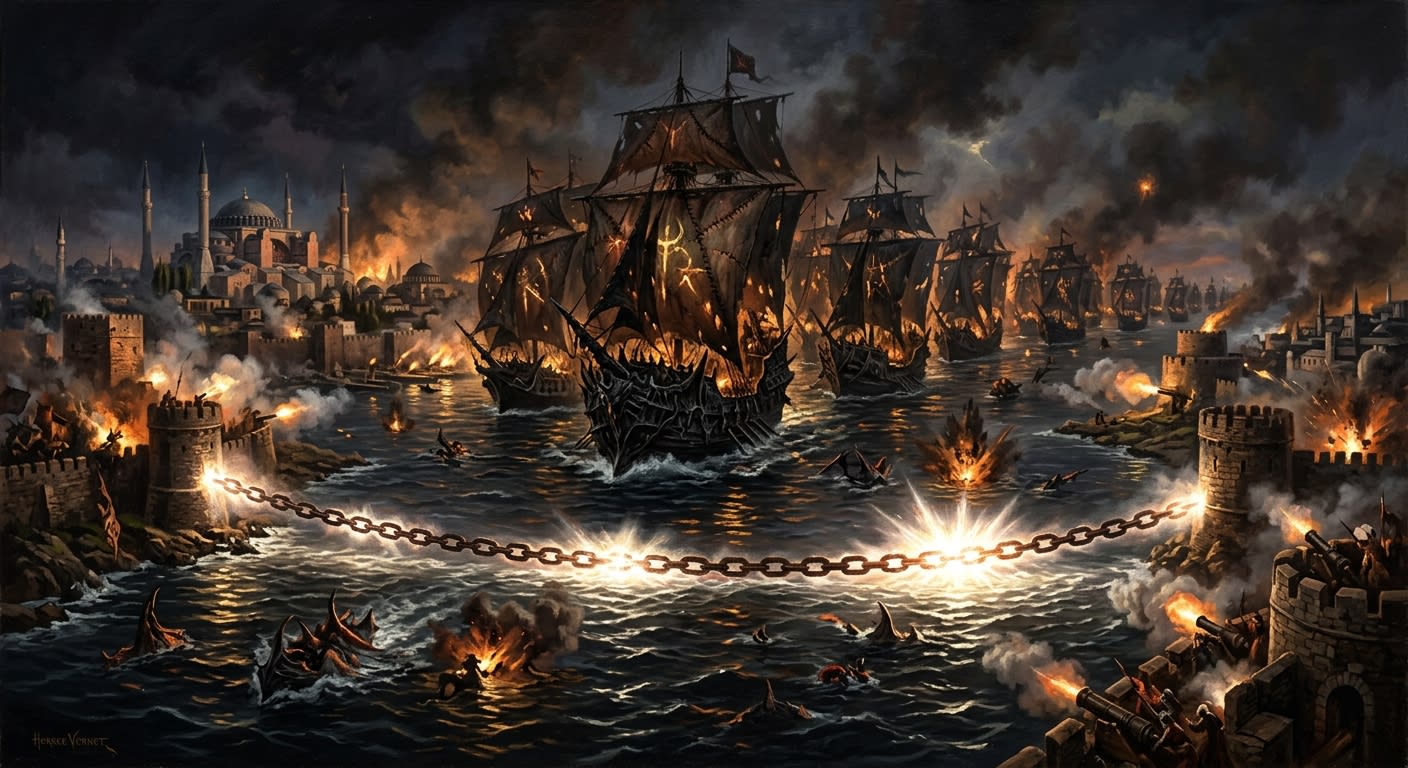
A.S. 162 — The Black Sea Armada. A demon-crewed fleet of forty-seven ships attempted to force the Bosphorus in the late autumn, timing their assault against the harvest convoy season when the strait would be crowded with grain ships. The Harbor Chains held. More than held: they glowed — white-hot, humming with something the Hieromnemons called "divine resonance" and the engineers called "we have no idea, please stop asking." The wrecked ships were melted for scrap. Some of the metal still screams when heated.
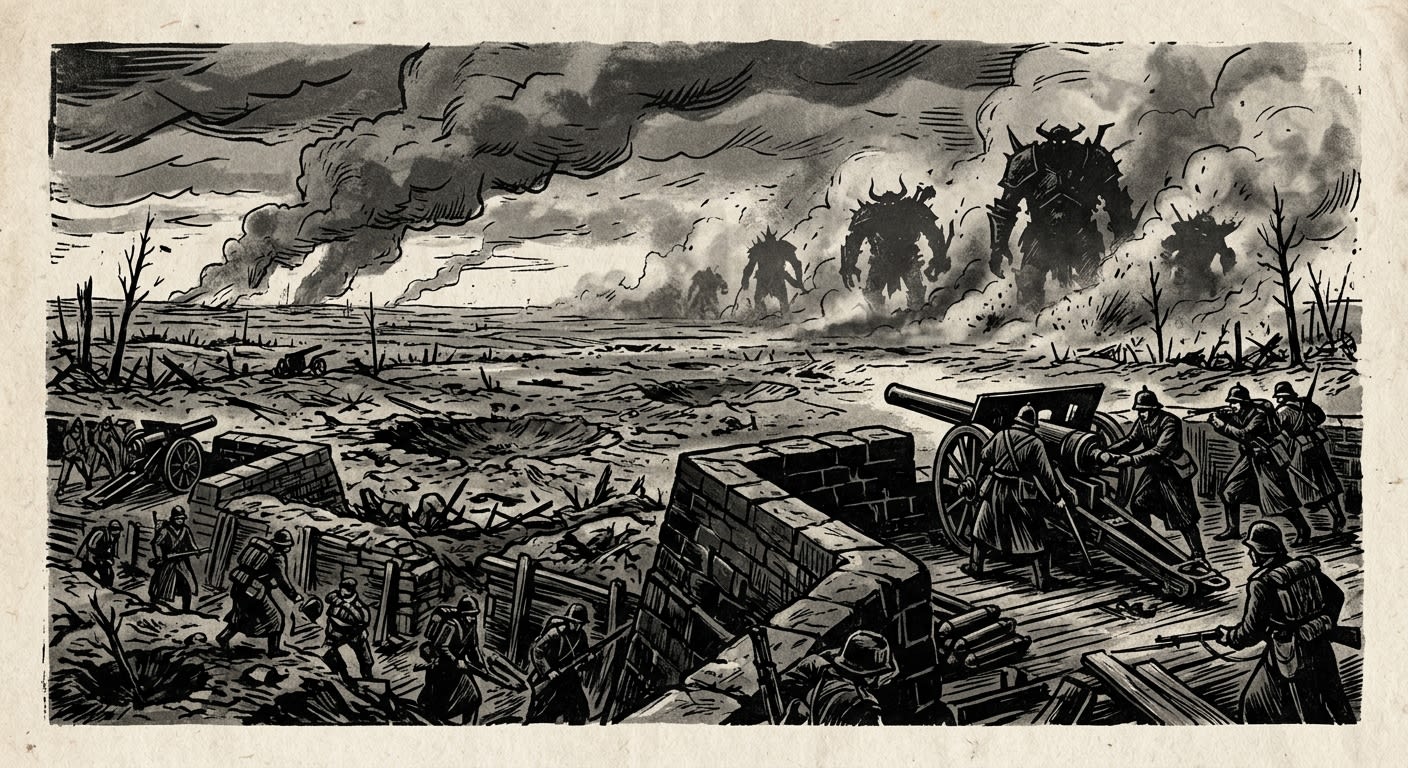
A.S. 177 — The Three-Night Bombard. Velmora's agents smuggled munitions into the Foundry Quarter — a sophistication of infiltration that should have been impossible, given the Ordeal procedures. Three nights of explosions. The Bureau of Purity executed one hundred and forty persons, of whom I estimate perhaps seventy were genuinely involved and the remainder were simply adjacent to the wrong invoice at the wrong moment. Morale improved regardless. Fear is, in practice, a more reliable remedy than justice.
A.S. 185 — The Silence of Harbor Lamps. For three nights, every lamp in the harbor went dark. No storm, no mechanical failure, no Bureau-sanctioned reason. When the lamps relit, one ship — the Saint Veritas, a supply galleon of the Bureau of Records' own convoy pool — was missing from its moorings. It returned six months later, crew intact, claiming they had never left. The Bureau of Shadows confiscated the ship's log. I have seen it. It contains only one phrase, repeated across forty pages: We were invited below.
I have been instructed not to elaborate on this incident. I shall obey, while noting that obedience does not erase my questions.
#The Six Ravelins
The outer works comprise six ravelins, each dedicated to a virtue the Synod has not yet publicly lost. In order of construction, sunwise from the north:
- The Ravelin of Vigilance — facing the Knife-Mile and the bayonet-hedges of No Man's Land
- The Ravelin of Purity — facing the marshes opposite Kargath, whose dominion begins where the reeds begin to crawl
- The Ravelin of Obedience — facing the Sister Trenches, named for a virtue too often disputed and therefore relocated here for safekeeping
- The Ravelin of Fortitude — facing nothing in particular, which is the hardest thing of all to face
- The Ravelin of Sorrow — facing the Quarter of Widow's Light, the only ravelin whose lamps burn oil distilled from tears
- The Ravelin of Correction — facing the Rail Spur, by which supplies and condemned men arrive in equal measure

The relic of Saint Iselda is borne along the parapet of the Ravelin of Vigilance on the third Friday of each month. It is a femur. Whether it is her femur is, per the Bureau of Relics, immaterial: all femurs are authentic if notarized.
#The City of the Hinge
Bastion-Constantinople is not merely a fortress. It is a city of three hundred thousand souls — soldiers, their descendants, their dependents, their suppliers, their priests, their surgeons, their undertakers, their undertakers' priests — arranged in concentric rings around the ancient Bosphorus waterfront like the cross-sections of a wound that never fully healed. The Bureau of Settlement divides it into seven administrative zones, each assigned its own ledger-color, each administered by a sub-Archon whose name changes every three years to prevent the sort of local loyalty the Bureau has learned, at great cost, to distrust.
The traveler's first impression of Constantinople is that it is organized. The traveler's second impression, arriving approximately six hours later, is that this organization is performed rather than achieved — a theater of order sustained for the benefit of the inspectors, behind which everything proceeds by habit, exhaustion, and the quiet competence of people who have stopped waiting to be thanked. — Warden-Adjutant Remy Sauvage, Dispatches from the Southern Hinge, A.S. 197 (suppressed pending theological review)
The Ossuary Rings form the fortress's innermost defensive shell — six concentric walls of catacomb-fortification dug into the old Byzantine substrate, each ring garrisoned and filed with the bones of its predecessors in the cavities between courses. The outermost ring is modern, its stone still pale. The innermost is original to the city's first fall: black stone, old mortar, and, in the sub-chambers, a humidity that tastes of iron. The Third Ossuary — the third ring from the inside, sealed since A.S. 47 — is the matter no one discusses. Its bells are still; no bells should be audible through six feet of mortared stone. The dogs of the garrison know otherwise.
The Foundry Quarter is the city's industrial engine — furnaces, proof-ranges, ammunition sheds, the long echoing galleries where the Bureau of War's artificers assemble weapons that the Bureau of Doctrine will later decide, retrospectively, were always there. It was partially destroyed in the Three-Night Bombard of A.S. 177, when Velmora's agents ignited three months of stockpiled powder in a single evening. The Foundry Quarter was rebuilt in two years by workers who received, in the Bureau's estimation, adequate appreciation. Its current overseer, the artificer Lute Brann, is a man of murky provenance and unambiguous results: the siege engines he produces function reliably, and the sounds they make when first ignited — a low, sustained tone, like a held note in a minor key — are filed by the Bureau of Records under the heading "acceptable operational variance." What they are, exactly, is not a question the Bureau has formally asked.
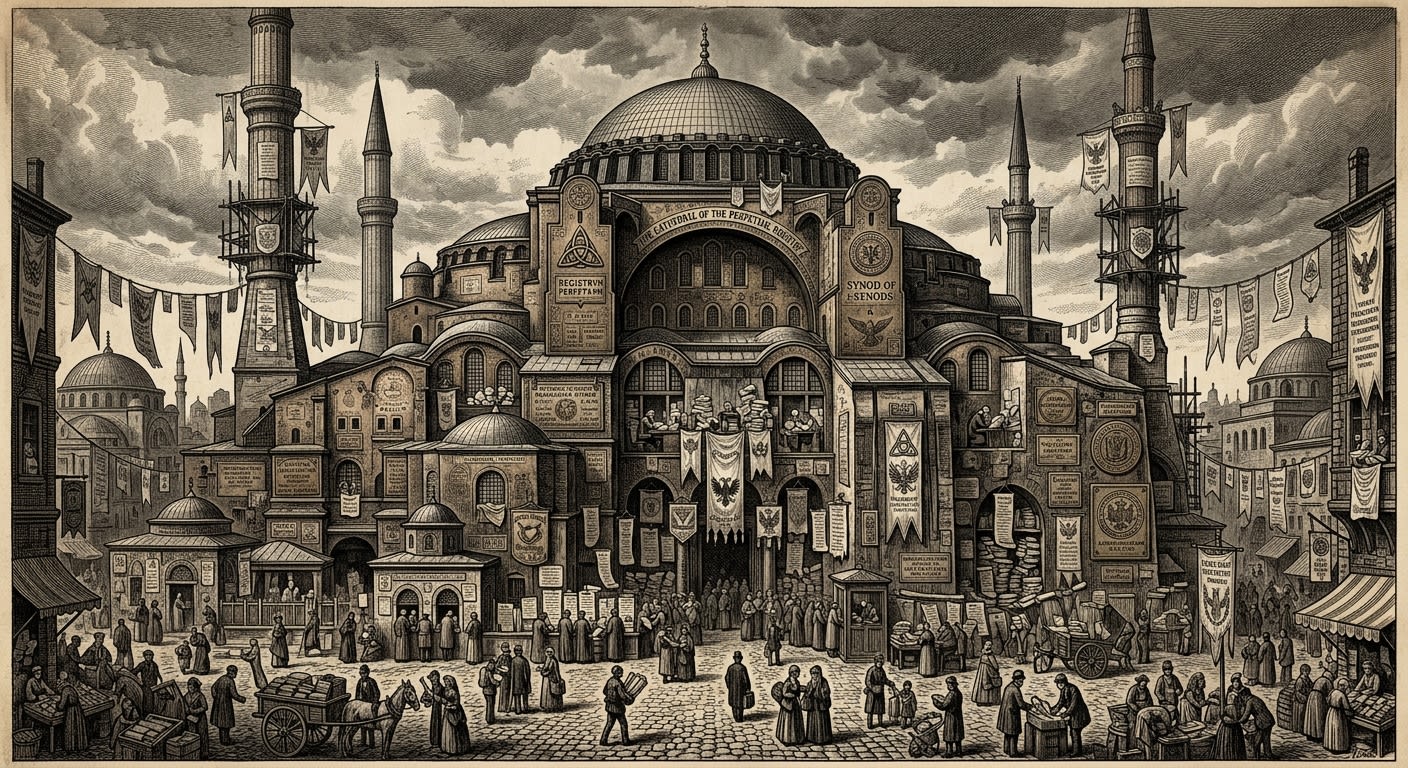
The Sanctum Mile stretches from the old Hagia Sophia — now the Cathedral of the Perpetual Registry — westward through the administrative quarter, past the Bureau of Records' sub-vaults, the Hierarchate Offices, and the Council Chamber of the Southern Prefect, to the great Belfry of the Hinge at the far end. This is where the Synod's authority is made visible: the broad avenues, the marble facades stamped with the Triune Knot, the processions of Lictors and Ledger-Carriers that move between buildings with the deliberateness of official purpose. It is the only part of the city that looks like what the Bureau says the entire city is.
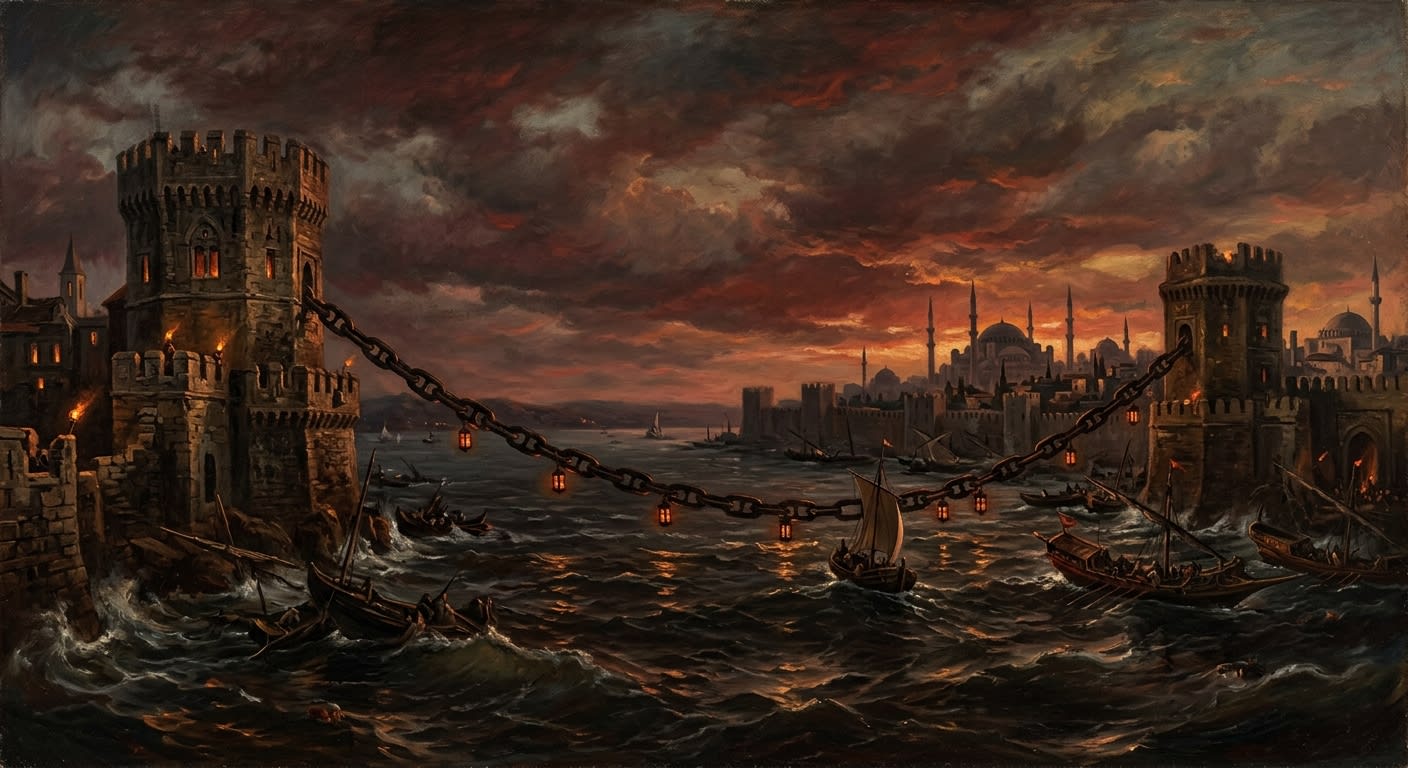
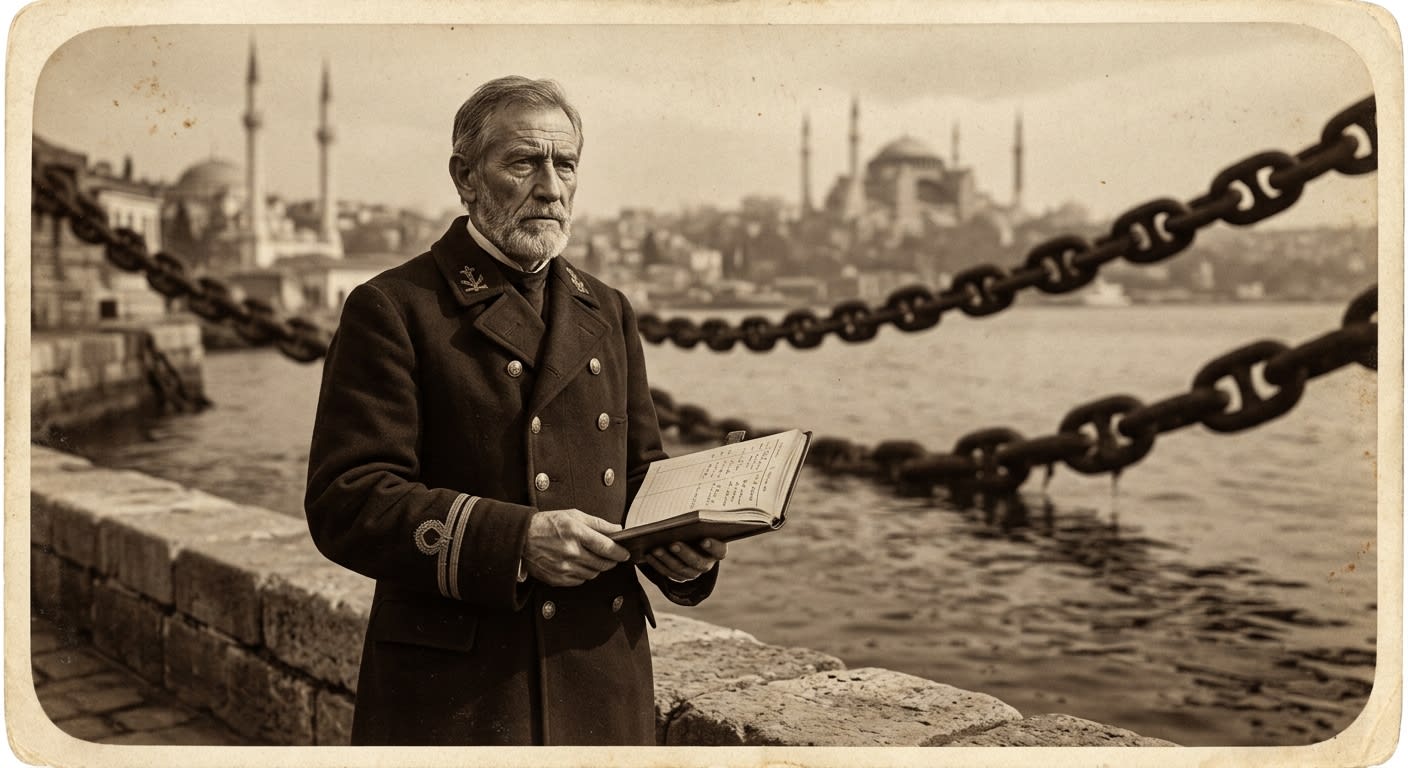
The Harbor of Chains requires its own entry, and will receive one. Suffice it here to say that the harbor fronts the Bosphorus along a mile of fortified quay, that the Catacomb-Carrier Threnody is moored at its seventh pier and has been, by some accounts, for eleven years, and that the great reliquary chains which close the strait at night — heavy iron links set with reliquaries of crushed bone and blessed oil — have not glowed since the Black Sea Armada of A.S. 162. Harbormaster Joram Clee logs daily inspections of the chains. He has noted their dormancy every single day for thirty-nine years without appearing to form an opinion about it.
The Warrens exist beneath and between the Ossuary Rings, in the spaces where the Bureau of Settlement's maps do not reach and the ledger-clerks do not visit. Some forty thousand people live here — veterans too damaged to return to garrison, the families of soldiers killed before pension age, craftspeople who came to supply an army and could not afford to leave, religious wanderers whose permits expired, children born to all of the above. The Bureau of Records counts them in the Ledger. The Bureau of Settlement has proposed, on twelve separate occasions in A.S. 180–200, a program to "regularize the sub-civil population of the Hinge." All twelve proposals were filed, reviewed, and referred to committee. The committee meets biennially, on a date that moves.
The Hammers is the conscript quarter — mass barracks for the rotating garrison contingents drawn from the continental levy, twelve thousand men at any given time, cycling through in ninety-day deployments that the Bureau of War's scheduling office has not quite managed to synchronize with the supply chain. Morale here is a technical term. The men who serve here do not speak of it when they return; those who study them note only that they sleep very lightly for several years afterward, and that they flinch at sudden quiet.
The Ash Gardens lie outside the third ravelin, in a strip of ground that was a cemetery before the Sundering and has been a hospital-garden since. The ash that falls from the Thracian Plain after Maldrake's seasonal fire-offensives settles here with a persistence the Bureau of Records classifies as "meteorologically consistent." Sister Ovidia, who has maintained the gardens since A.S. 178, notes that the ash is good for the roses. She does not note other things she has noticed. The men who recover here — the burned, the shell-concussed, the ones who speak to people who are not there — tend to improve at a rate the Bureau of Medicine has acknowledged is statistically unlikely, filed accordingly, and declined to investigate.
#The War Theater
Or: A Geography of Approaches, and Why Each One Is Attempting to Kill You
I am not a soldier. I was never a soldier. I have committed to paper the deaths of roughly eighty thousand soldiers, which is the closest I have come to the business, and it has been close enough. What I am, however, is a man who has stood on the northern parapet of the Ravelin of Vigilance at dawn and watched the Thracian Plain smoke, and who has read every deployment map, theater assessment, and strategic analysis the Bureau of War has filed in the last two decades — including the ones it filed under headings designed to ensure no one would read them. I know the approaches to Constantinople the way a physician knows an infected wound: intimately, unhappily, and with the grim respect you afford to something that would very much like to kill you.
There are four approaches. Let us discuss them in the order of their ambition to destroy us.
#The Thracian Plain
The north is the wound that never closes.
The Thracian Plain stretches from the walls of Constantinople outward for sixty miles before the terrain begins to do anything interesting. Sixty miles of flatland. Shell-cratered, ash-dusted, broken by trenchwork and wire and the occasional slag-river that Maldrake the Wrathforged left behind from one of his seasonal attentions. It is the most direct approach to the city, which is why it is also the most fortified, the most mined, the most prayed over, and the most frequently saturated in corpses from both directions.
Maldrake prizes the Plain for exactly the reason we dread it: there is room to deploy the Hellbow Legion, the Flameheart Colossus, and his pyre-smiths in mass formations that can advance with the patient certainty of geological processes. He does not hurry. Wrath does not rush — Wrath arrives with the weight of the inevitable, and the inevitable, the Bureau of Doctrine assures us, is heresy, which is why we oppose it with artillery. The Bureau of Records counts the shells fired against the Thracian approaches. The number is, as of A.S. 201, twelve million, four hundred thousand, and some. The counting continues.
Marshal Vaubret, who commands the Thracian theater from a reinforced command bunker beneath the Ravelin of Fortitude, is a man who has internalized the Plain until he thinks in contour lines and wire-gauge specifications. I have attended his briefings. He describes demon advance formations with the detached authority of a man cataloging insects — here the pyre-division moves, here the slag-river will shift westward, here the Flameheart Colossus was sighted at grid reference four-nine-seven and has not yet moved, which is worse than if it had moved. Vaubret does not pray during his briefings. His subordinates do, on his behalf, quietly, at the back of the room. The Bureau of War and the Bureau of Doctrine have maintained a longstanding rivalry over whether this constitutes appropriate devotional practice or a dereliction of faith on the Marshal's part. Vaubret has declined to comment. He is too busy counting wire.
The Year of Ash Rain (A.S. 143) demonstrated the Thracian Plain's peculiar vulnerability to a tactic that is not, strictly speaking, a military tactic: Maldrake simply burned it. The forests to the north — what had been forests — went up across a front of forty miles in a single night. Ash fell on Constantinople for nine months. The Ash Gardens are named for this. The soil of the Plain now grows nothing except, in certain hexagonal patches that the Bureau of Engineering regards with the professional caution of people who know what consecrated ground looks like when it is not consecrated, a persistent iron-gray moss that smells faintly of sulfur and rings like metal when the wind moves over it. The Bureau of Doctrine has classified the moss as "meteorological debris not requiring doctrinal response." I have been instructed not to send samples to the Bureau of Purity for analysis. The instruction arrived before I submitted the request.
#The Macedon Escarpments
If the Thracian Plain is where the war comes loudly, the Macedon Escarpments are where the war comes carefully.
The Macedon Escarpments rise to the northwest of Constantinople — broken limestone terraces, fault-cracked ravines, and the gold-veined geological formations that give the region its peculiar quality of light, a pale amber refraction that the troops stationed there claim makes it impossible to judge distance accurately and that the Bureau of Engineering confirms, in a report I have read twice, actually does make it impossible to judge distance accurately. The escarpments are Velkara's preferred theater. Wrath arrives in columns on open ground. Greed slips through passes.
The Macedon approaches have produced, in the last forty years, an operational phenomenon the Bureau of War designates "the Merchant Problem" — caravans that arrive from the escarpment roads appearing outwardly legitimate, bearing correctly stamped manifests and apparently living personnel, and which are not. The corrupted goods that arrive are catalogued, in Bureau terminology, as "complex contraband." What arrives in corrupted couriers is filed under sealed reference in the sub-vaults beneath the Harbor of Chains where Mother-Cryptor Sabine maintains the deep records. I have not read those files. I have read the index to those files, which was itself sufficient to require three days of mandatory devotional rest.
What moves through the Macedon passes, specifically, is not merely materiel but influence. The Crimson Concord — Velkara's operational cells within the city — are understood to refresh their personnel along the escarpment routes. A captain of pilgrims, a merchant-quartermaster, a junior Bureau clerk with impeccable devotional records: these are the shapes the Macedon Escarpments deliver to Constantinople. The Bureau of Purity runs Ordeal-teams on the escarpment checkpoints at irregular intervals, which the Bureau considers unpredictable and the infiltrators, presumably, have long since mapped.
Legate-Inspector Theron Vast, who commands the escarpment checkpoints and whom I have met twice and both times found deeply unsettling in a way I cannot specifically articulate, has proposed a complete closure of the Macedon supply routes pending full doctrinal review of all active manifests. This proposal has been pending Bureau of War review for four years. The supply routes are necessary. Necessity is, as ever, the argument that wins.
#The Pilgrim's Coast
The south is where we are supposed to be safe. The south is where the supply ships come from, the grain convoys from the Anatolian prefectures, the pilgrim vessels from Marseille and Genoa and the ports that still send pilgrims because they have not yet been close enough to the front to lose their faith in the symbolic power of proximity to holy war. The Pilgrim's Coast runs along the Anatolian shore — villages, sanctuary towns, the harbors that feed Constantinople's harbor, the causeways that process an endless stream of the faithful, the frightened, and the functionally indistinguishable.
The Pilgrim's Coast is Kargath the Devourer's secondary theater — not his preference, but his patience. Where Maldrake burns and Velkara seduces, Kargath empties. Supply ships that depart Anatolian ports in good order arrive at Constantinople having been subtly, comprehensively depleted — holds that should contain twelve hundred tons of grain containing eleven hundred and forty, the remainder having passed through some accounting gap that no audit has satisfactorily closed. Kargath does not take the grain. He makes the grain not arrive. The distinction is administrative and the result is identical.
The sea control question — specifically, the question of what controls the passage between the Anatolian coast and the Bosphorus mouth — is a question the Bureau of War answers with the Harbor Chains and the Vigil Ark Saint Barachiel, and the answer is: we do, contingently, on most days, when the weather is cooperative and the thing inside the engine of the Catacomb-Carrier Threnody is quiescent. This is a satisfactory answer. It is the only answer available.
The coastline itself has produced, over the last thirty years, a settlement phenomenon the Bureau of Settlement calls "organic garrison towns" — communities that grew up around Synod fortifications and have since exceeded them, villages of twelve thousand surrounding a fort built for a garrison of two hundred, the civilian population engaged in supplying the fort and the troops rotated through it while also supplying the village itself and also, along the eastern stretches where the Bureau of Records' inspectors do not reliably reach, trading with vessels that do not appear in the harbor master's log at Coastal Station Theron and presumably trade in things the log would not approve. I note this without editorial comment. I have editorial comments. They are not authorized.
Somewhere beneath the waters off the Pilgrim's Coast — approximately seven miles out from the sanctuary harbor at Phaleron Bay — a mile-long iron idol rests on the sea floor. Fishermen in the region swear its eyes glow on fasting days. The Bureau of Engineering surveyed the location in A.S. 189 and returned a report consisting of a single sentence: "The survey is complete." The survey's findings are not appended.
#The Hintermark
The Hintermark is what lies behind Constantinople — to the west, along the supply roads that connect the Bastion to Sofia and the broader Synodic infrastructure of the southern theater. It is orchards and foundry-towns and levy-villages and grave-fields, a landscape that has been supplying this city for a hundred and thirty years and shows it. The trees are old but thin. The roads are well-maintained because the Bureau of War maintains them, and maintained roads are how armies eat. The villages fill their levy quotas with the systematic efficiency of communities that have been filling levy quotas for three generations and have stopped feeling the loss the way a body stops feeling a wound it has grown around.
The Hintermark is where Constantinople's economy breathes — where the Black Sea coast villages send their dried fish and preserved goods, where the foundry-towns run the secondary manufacturing that the Foundry Quarter cannot handle at capacity, where the village infirmaries process the overflow from the Ash Gardens when the casualties outrun the city's intake numbers. Lute Brann's supply chains run through the Hintermark: the materiel for the Shackled Flame workshops comes from three separate Hintermark forges, and if you know which forges and follow the shipment routes, you begin to understand something about Brann's operation that the Bureau of Purity has either not noticed or chosen not to notice. I have been instructed not to specify which. I obey the instruction. I note that I received it.
The Hintermark is also, practically speaking, where the Bureau's authority becomes ambient rather than active — where the Ledger-Carrier is expected and therefore where the expected and the actual diverge. The Widows' Syndicate runs ash-credit operations through seven Hintermark villages. The Pilgrims' Court controls three of the four main road franchises west of Constantinople. The Black Ledger is understood to operate a redistribution network out of the foundry-town of Keska, which is small enough to have been overlooked in the administrative redrawing of A.S. 188 and large enough to matter. I have read this in Bureau of Shadows intercepts to which I have access I was not formally granted. My access was not formally revoked. I proceed on the principle that unrevoked access is authorized access, and if the Bureau of Doctrine disagrees, I am confident they will find a way to let me know.
The Hintermark does not appear, to the casual eye, to be a theater of war. It is. It is the theater of attrition and quiet and the slow consumption of everything that sustains the fortress. You will not find Maldrake here. You may find Velmora's people, wearing familiar faces. You will definitely find the Bureau's exhaustion, worn smooth by a century of logistics, no longer noticing what passes through because it has always passed through and the paperwork was always in order, and the alternative to trusting the paperwork is to stop trusting the paperwork, and if we do that, we stop trusting everything, and everything, in Constantinople, is paperwork.
To speak of Constantinople is to speak of its bells, and to speak of its bells is to speak of time itself — for the carillon of Bastion-Constantinople rules the hours of half the front.

The Bureau of Bells fixes the clappers and codifies the peals. The Bureau of Doctrine loads each peal with its meaning. The Bureau of Tithes ensures every toll carries its tariff. The Bureau of Records proves it happened, and countersigns the proof against its own ledgers of proving.
In Constantinople even hunger is punctual. Miss the noonday peal and the kitchens lock. This is not cruelty. This is harmony. As the common litany of the ration queues has it: sing or starve. It is not metaphor. It is law.
There is a doctrine, much beloved of the parish clergy, that every soldier who dies within earshot of the Constantinople carillon is entered automatically into the Book of Departures without the need for clerical hand. Doctrine affirms this. Records (in a note never officially unsealed but not officially sealed either) demurs: "Our ink never runs dry in Constantinople. That is not the same as autography."
The contradiction is not an error. It is policy. The reader who requires a single truth is not yet ready for Constantinople.
#The Enemy Opposite
Constantinople faces north across the Thracian Plain, and what faces back from across the Line is not one enemy but two, for the Sin-Generals who press hardest against the southern anchor are rivals as much as they are allies.
First — and nearest — is Kargath the Devourer, Sin-General of Gluttony. The marshes opposite the Ravelin of Purity are his, and have been since the Blackening of the Bosporus. Reeds crawl there. Water froths with algae the colour of bile. Caravans meant for the city arrive, when they arrive at all, as wagons of rot. Every convoy that fails, every soldier who gnaws his own boot leather during the long marches, is counted as a tithe in Kargath's ledger of famine.
Second — and more dangerous when he bothers to attend — is Maldrake the Wrathforged, Sin-General of Wrath. Maldrake does not press the line as Kargath does; he arrives in campaigns, with pyre-smiths and the Hellbow Legion and the Flameheart Colossus, and each time he arrives Constantinople loses a wall. Each time Constantinople loses a wall, Constantinople rebuilds the wall taller, because the only response to Maldrake that Doctrine will ratify is escalation.
The wall that was lost in A.S. 170 was lost in a manner that remains sealed to readers below the fourth ratification. What is permitted here is this: a Night Paper arrived from Strasbourg on the eve of the breach, naming the parish regiment assigned to the relic artillery as oath-broken. The colonel, a ████████ man whose name is not permitted to the Ledger, burned his own men in their barracks before the cannon could fire. When dawn came, the regiment existed nowhere in the rolls. Bureau of Records stamped the battle "a miraculous demonstration of zeal." Survivors — survivors being, in this case, ████████████ — whispered that it had been written in wax.
Readers who believe they understand what is permitted and what is sealed above should understand, further, that the quantity of black ink required to redact a record is itself a record. The Bureau of Doctrine does not regard this as ironic.
#The Unsanctioned Interior
On those matters which the Bureau of Doctrine acknowledges exist, declines to explain, and has forbidden the present author from investigating further. He investigated further.
Every fortress has its shadows. Bastion-Constantinople has its catacombs, its sealed vault, its airship that apologized, and its engines that speak. The Bureau classifies these as "administrative anomalies requiring ongoing review." The Bureau has been reviewing them for decades. The reviews have not concluded. The Bureau does not expect them to.
#The Third Ossuary
Beneath the Ossuary Rings — beneath the kilns and the Widow's Lanes and the smell of perpetual ash — there is an older structure. The builders of the Bastion found it when they drove the first pilings into Constantinople's ancient bedrock, and what they found they sealed, and what they sealed they named the Third Ossuary, and what they named they filed under "Relics of Unprecedented Sensitivity, Classification: Maximum, Access: Hierarch's Seal or Above."
Officially: it contains relics too holy for common access.
The Third Ossuary has been sealed since A.S. 47, the year the retreating armies made their stand at the Bosphorus. Whatever was there when they arrived was already sealed. They sealed it again, with fresh mortar and a wax stamp. The stamp has been renewed eleven times. The mortar has cracked and been reapplied seven times. The wax seal shows, on careful examination, seventeen layers.
Mother-Cryptor Sabine administers the Ossuary Rings that surround it. She knows every urn in the catalog — forty-six thousand, three hundred and twelve, as of the last audit, and she can recite their locations from memory, in sequence, without error. The Bureau of Purity has investigated her fourteen times. She passes every test.
She knows things that are not in the records. I checked.
At night — in the lower Rings, in the Widow's Lanes, in the bone-choked alleyways nearest the sealed vault — one sometimes hears bells. The bells do not match any liturgical schedule. They ring in sequences the Bureau of Bells cannot identify. No bell-tower is close enough to account for the sound.
Dogs hear them clearly. They do not bark. They lie down, face toward the Third Ossuary, and wait.
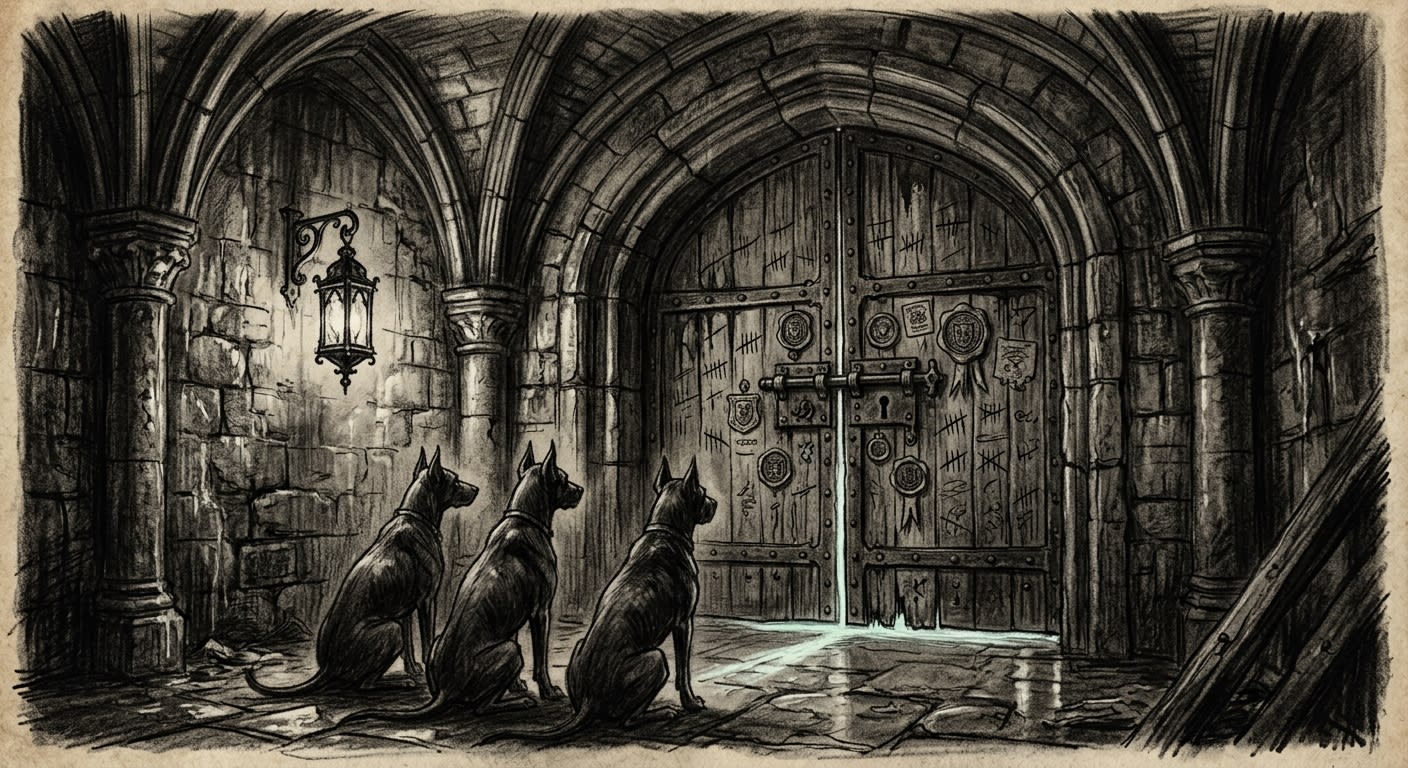
I have heard the bells. I will not elaborate. I will note, for the record, that when I heard them I was on the fourth floor of the Bureau of Records annex, and that I subsequently requested and was granted a transfer to the second floor. The transfer was approved in four minutes, which is the fastest any transfer request has ever been approved in my administrative career.
An earlier edition of this Codex entry noted that the Third Ossuary "presents no operational hazard and has been thoroughly catalogued."
This Errata replaces that passage. The Third Ossuary has not been catalogued. The Third Ossuary has not been opened. The previous passage was filed by an inlier-clerk who has since transferred to Bastion-Danzig. The Bureau of Records considers the matter closed.
#The Vigil Ark Saint Barachiel
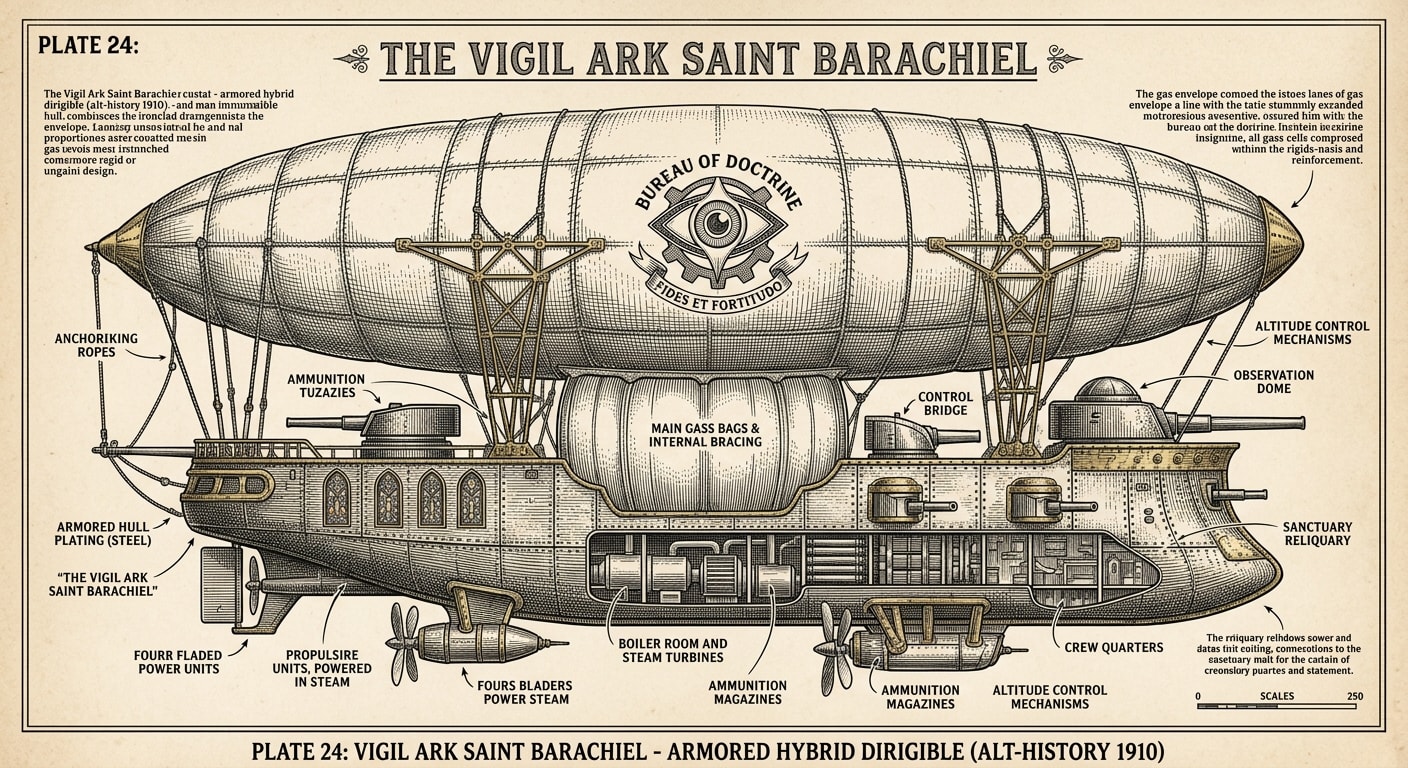
Above the strait — above the chain-booms and the mine-barges and the freezing Bosphorus fog — the Vigil Ark Saint Barachiel patrols. It is a dirigible-warship hybrid, commissioned in A.S. 168 by the Bureau of War as a solution to the problem of Kargath's mid-strait assaults: if the demons would attack from the water, then the Synod would attack from the sky. It broadcasts sermons through horn-amplifiers the size of organ pipes. It drops blessed incendiaries on anything that moves without authorization.
Its record is excellent. Its crew is, technically, also excellent. They are the fourth crew. The third crew was replaced in A.S. 199, after the incident.
The incident: on the 3rd of Argent, A.S. 199, Saint Barachiel broadcast, across all frequencies, for eleven minutes, a voice that was not any crew member's, reading what several listeners have described as "an apology." The content of the apology is classified at the Hierarch's Seal level. Four listeners who have attempted to describe it publicly have been offered, at Bureau expense, a period of theological rest at a facility in the Swiss cantons.
The fourth crew flies the Ark. They do not discuss the broadcast. When asked directly, they describe the air at elevation as "sometimes unusual." The Bureau of Doctrine has classified this description as acceptable.
Saint Barachiel still flies. The strait is still patrolled. The blessed incendiaries still fall.
#The Catacomb-Carriers and the Threnody
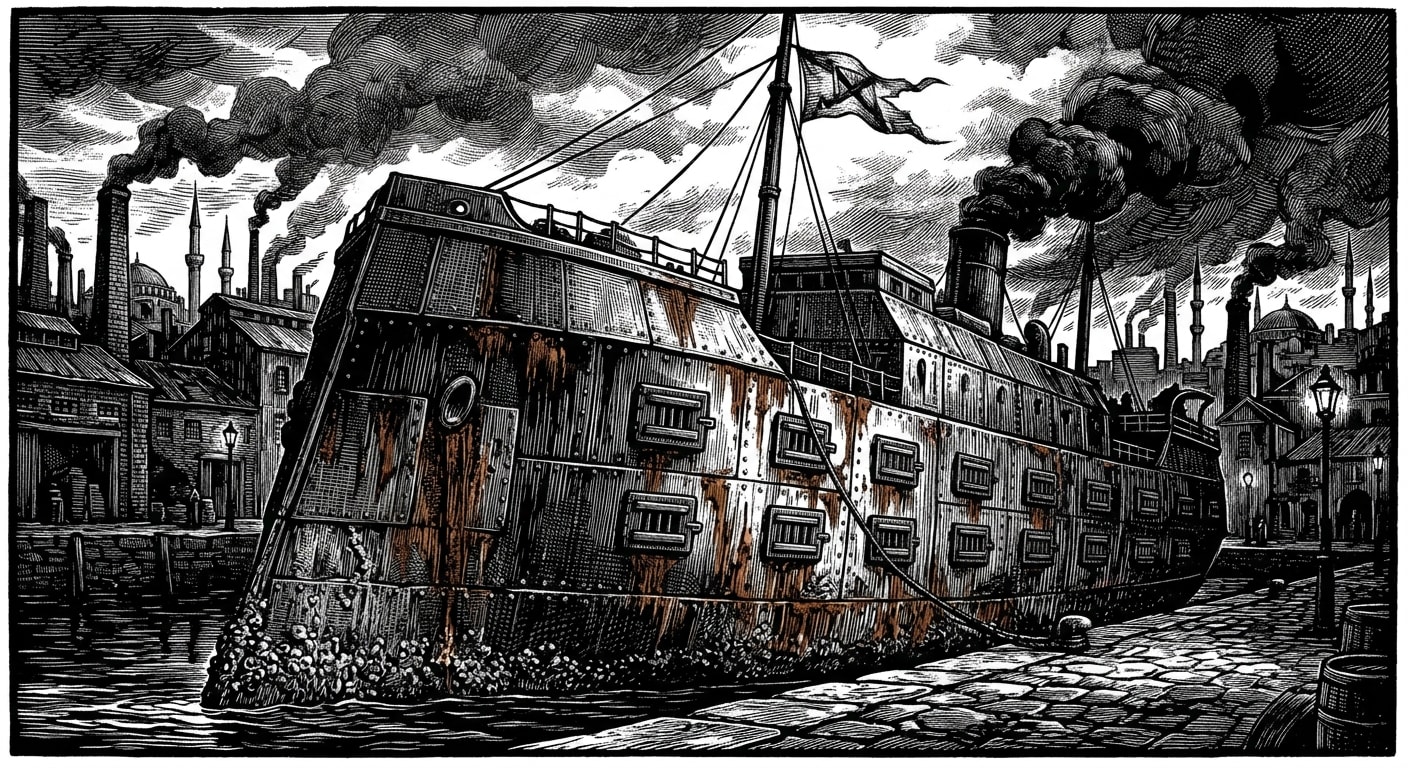
The Catacomb-Carriers are the Foundry Quarter's most terrible gift to the War Eternal: sixty-ton armored reliquary-engines that crawl across the Thracian mud on iron treads, broadcasting hymns through bone-resonance speakers, delivering death by blessed artillery and closing charges of shield-saints in full panoply. They are iron cathedrals that move. They are magnificent. They are wrong in ways that cannot be easily articulated.
Arch-Artificer Lute Brann designed the current generation at the Shackled Flame Workshops, under the aegis of the Order of the Shackled Flame — a semi-official body that binds demonic essences into mechanical housings "for the war effort." This is technically heresy. It is also technically effective. The Synod observes, from a careful distance, the principle that if it wins wars it can be retroactively sanctified.
The pride of the Foundry Quarter's Carrier fleet is Threnody. She is the oldest surviving Carrier, commissioned A.S. 145, and she has fought in thirty-seven engagements, including the routing of Kargath's Horde at Belgrade and the Macedonian corridor defense of A.S. 188. She is also, as of three years ago, under continuous maintenance in the Threnody Barn, where the artificers have been unable to perform what they describe, in their official reports, as "routine engine inspection."
The engines contain something that speaks.
The artificers will not admit this. The Wardens pretend not to notice. I have read the maintenance logs — six hundred and fourteen pages, sealed, which I accessed through channels I am not prepared to specify — and the word "voice" appears in them forty-two times, always in quotation marks, always followed by an explanation for why the phenomenon was not, in fact, a voice.
The explanations grow less convincing with each successive entry.
Something else escaped from the Foundry Quarter in A.S. 198. Fourteen artificers died. The Bureau of Purity declared it an industrial accident. The scorch marks formed words. The Bureau of Purity declared the words a "pattern consistent with heat stress fracturing." I have seen the photographs. The Bureau of Purity and I have a different understanding of the word "pattern."
#Velkara's Velvet Choir
Of the Seven Sin-Generals, Velkara, the Architect of Lust does not besiege cities. She does not need to. She enters them.
The Velvet Choir — Velkara's order of infiltrators, seducers, and conscience-corrupters — operates, according to Bureau of Purity estimates, in approximately thirty Synod settlements of meaningful population. It operates in Bastion-Constantinople. This is not an estimate. This is a fact the Bureau of Purity acknowledges on page forty-seven of its classified annual review, where it also notes that it has been unable to determine the Choir's present membership, the locations of their primary cells, or the identities of the officers currently operating as Choir assets.
What is known: the Velvet Choir maintains active cells in the pilgrim quarter, in the infirmaries of the Hammers district, and in at least two of the Sanctum Mile's Bureau-houses, which the annual review declines to name but which the annual review's own redaction patterns strongly suggest. They recruit through seduction and blackmail, binding their members through escalating compromise, until the compromised party is no longer capable of choosing anything other than continued cooperation.
They are, the annual review concedes, very good at this.
The Bureau of Purity conducts quarterly sweeps. The Choir is not found. The Bureau of Purity conducts thorough interrogations of suspects. The suspects are not Choir assets, or are assets who have been trained to pass interrogation, or — this is the hypothesis the annual review introduces and then immediately retreats from — are assets who have developed, through Velkara's direct intercession, a capacity to believe their own cover stories so completely that no interrogation can detect the seam.
#On Service at Constantinople
Service at Bastion-Constantinople is both a duty and a sentence, and the distinction between the two is maintained, in the official correspondence of the Bureau of Conscription, only because maintaining the distinction requires paperwork and paperwork, in Constantinople more than anywhere, is prayer.
Earlier editions of this Codex asserted that a tour at Constantinople
concluded, on average, at the sixth month.
The Bureau of Records has clarified: the sixth month is the median length of a tour among those whose tours concluded. The broader average, when those who did not return are counted, is substantially shorter. The Bureau does not publish the broader average.
The pilgrim who visits Constantinople in a time of peace — peace being, in this war, the hour between the Fifth Peal and the Sixth — will find a city of impossible contradictions. Cathedral and artillery park share the same cobbled square. Clerks file requisitions on one side of a street while on the other side a requisitioned regiment eats its rations in four-fold rhythm, breathing on the bell. A midwife and a battlefield confessor may be the same woman. The line between the sacred and the operational has been deliberately eroded; the Bureau of Doctrine has ruled the erosion edifying.
#Pilgrimage and Inspection
Civilian pilgrimage to Bastion-Constantinople is permitted three days a year, each corresponding to a doctrinal anniversary:
- The Ratification (14th of Ferrum, A.S. 68)
- The Burning of the North Gate (9th of Corvus, A.S. 140)
- The Vigil of the Hollowed (23rd of Argent, A.S. 170)
Pilgrims on these days are admitted as far as the Ravelin of Sorrow. Beyond it, the living are not welcome and the dead are already home. Applications for pilgrimage permits are lodged through the Bureau of Pilgrimage, routed through the Bureau of Purity, stamped by the Bureau of Records, and — in almost every case — approved. Almost.
Inspection of the Bastion's internal administration is conducted quarterly by the Legate-Praetorial. The Legate Seraphinus of Lyon once arrived unannounced and demanded the execution of three generals for "improper observance of fasts." None dared gainsay him. The fasts were observed. The generals were not.
#Unconfirmed Intelligence (Filed Under Compulsion)
A Supplemental Memorandum from Hieromnemon Valerius Drax, submitted to the Bureau of Doctrine's Registry of Unsubstantiated Claims, A.S. 201. The Bureau does not endorse the following. The Bureau notes, however, that Drax has been right before, which is the reason the Bureau remains uncomfortable.
The Bureau of Doctrine recognizes, with theological reluctance, that not all truth arrives stamped and countersigned. Some truth arrives at three in the morning, carried by a sailor who will not give his name, describing a sound he heard in the water beneath the Bosphorus. The Bureau does not print such testimony. It does, however, file it. These are the filings.
#I. The Chain That No Longer Glows
The reliquary chain across the Bosphorus — the Chain of Saint Anakletos, the great boom-barrier that burned with cold light through every assault since A.S. 68 — has not glowed, by credible report, on eleven separate nights in the last eighteen months. Not dimmed. Not flickered. Dark. The Harbor Patrol logs for those nights list the reason as "atmospheric interference." The Bureau of Rites has provided a written theological explanation that runs to forty-seven pages and accounts for all eleven instances by asserting that light, when it retreats from holy iron, is itself performing a kind of prayer.
I find this explanation excessive. Forty-seven pages to say "we don't know" is forty-six pages more than honesty requires.
#II. The Drowned Choir
Sailors will not say this in port, for obvious professional reasons. But sailors will say it to each other, in the dark, in the lower decks, in the way that sailors have always said the things that they cannot afford to say aloud: there is a choir beneath the Bosphorus.
Not a metaphor. Not a symbol. Not a doctrinal vision. A choir — voices in harmony, rising through the hull timbers, heard most clearly in the three hours before dawn. The melodies are described, consistently across forty-seven independent testimonies the Bureau of Purity has gathered and sealed, as beautiful. This is the detail that concerns me most. The enemy does not deal in beauty. The enemy deals in appetite, and despair, and the degradation of the will. Beauty — unearned, uncategorized, rising from the water like a question — is something else.
What is beneath the Bosphorus, singing?
The Bureau of Purity has classified this inquiry. I am including it anyway. If the Bureau objects, it may file a complaint with the Bureau of Doctrine, of which I am currently the senior ranking officer in this prefecture. It will be processed in order.
#III. The Coin That Screams
Every mint in Synod territory has attempted, at least once, to melt down a particular coin — a coin of no denomination, struck with no authorized die, depicting a face the Bureau of Records cannot identify. The denomination is blank. The face is recognizable to anyone who looks at it, in the way that faces seen in nightmares are recognizable: immediately, completely, without knowing why.
The coin cannot be melted. Or rather — it melts. And then it returns. Not to the mint. Somewhere else. Someone else's pocket. Someone who had never seen it before, and who does not know, until they reach into their coat, that they have it now.
It has, the Bureau of Purity's files indicate, passed through the hands of twenty-three individuals who subsequently died in unusual circumstances, eleven individuals who subsequently disappeared, and one individual who is still alive and who, according to his last medical review, has not slept since A.S. 197. The Bureau of Purity considers this coin a Class IV Unresolved Anomaly. I consider it a reason to be careful about accepting change.
#IV. The Quiet Boy's Maps
In the Warrens district there is a cartographer. He is perhaps twelve years old. He does not speak. He draws maps — obsessively, constantly, on whatever surface presents itself: walls, bread wrappers, the backs of conscription notices. The maps are of Constantinople. Accurate to within the tolerances of the Bureau of Engineering's own surveys.
Except for the streets that do not exist.
Not inaccurate streets. Not invented streets. Streets that look like they will exist — that follow the geometry of expansion, that connect districts in ways the Bureau of Engineering has proposed but not yet built, that show, in one case, a road running through a building that was still standing when the map was drawn and which collapsed four months later, which the road now runs through.
The Quiet Boy has been examined twice by the Bureau of Purity. He passed both examinations. He is not a sorcerer, not a heretic, not a Choir asset. He is, the examining Lictors concluded, simply a boy who draws maps. This conclusion is both the most reassuring and the most unsettling sentence in any official document I have read in twenty years of service.
#V. The Widow's Syndicate and What It Keeps
The Widow's Syndicate of Constantinople — the consortium of war-widows who operate the city's primary lending-houses, relief offices, and unofficial record-archives — maintains a vault beneath the Harbor of Chains. It is known. It is permitted. The Bureau of Records has surveyed it, confirmed it contains no contraband, and filed its dimensions.
What the Bureau of Records did not file is that the vault's dimensions have changed between surveys. The vault is larger than it was. The Bureau surveyor noted this in his raw field report and did not include it in the final submission. I obtained the raw report through a contact I will not identify. The discrepancy is eleven meters in the eastern wall.
What is eleven meters larger than recorded? The Widow's Syndicate will not say. The women who run it are polite, cooperative, and completely impenetrable. They serve excellent tea. They smile at questions and produce, with remarkable speed, documentation confirming that everything is correct and always has been.
Inside the additional eleven meters, one surveyor's raw notes suggest — this is the final line, written in smaller handwriting than the rest — "a child's bed. Still warm."
#VI. Maldrake's Earthquakes and What They Carry
The Thracian Plain has always trembled. Maldrake's Wrath-tide armies include siege engines that move by seismic force — walking furnaces that press their weight against the earth itself. This is known. This is documented. This is, by Bureau of War accounting, expected.
What was not expected, and has not been formally explained, is that the slag-rivers beneath the Thracian trenchlines have begun moving in patterns. Not random flow. Patterns. The engineers in Trench-Section 14 noticed first, because their drainage works kept failing in sequences too regular to be coincidence. The Bureau of Engineering sent inspectors. The inspectors found what they described as "routing behavior" in the subterranean slag — as if the liquid wrath beneath the earth were navigating. Moving through the rock toward specific points. Avoiding others.
Toward what? The inspectors did not determine this. The inspectors were recalled before their survey was complete, for reasons the Bureau of War has filed under "operational security." What is beneath the Thracian Plain, routing itself toward us?
The Bureau of Doctrine's official position is that this represents the natural thermodynamic behavior of cooling magmatic material. I wrote that position. I am not confident in it.
#VII. The Iron Idol in the Strait
In A.S. 162, the Black Sea Armada — which the Bureau of Records logged as forty-seven ships of varying supernatural provenance — forced the outer Bosphorus approach. Of the forty-seven ships, forty-three were sunk, three retreated, and one was never accounted for. The Bureau of Rites marked the engagement as a victory and filed the missing ship as "destroyed, evidence submerged."
The fishermen of Phaleron Bay describe, on clear water days, the shadow of something very large resting on the bed of the strait. It is, they say, roughly ship-shaped, but not entirely. Something that might have been a ship, once, or might have decided it was done being a ship and has been becoming something else ever since.
On fasting days — specifically, on the Feast of Doctrinal Submission (the 3rd of Ferrum) — the fishermen do not fish the inner strait. When asked why, they say they do not want to look down. When asked why that, they say, "the eyes."
The Bureau of Rites considers this superstition. The Bureau of Rites also does not fish the inner strait on the Feast of Doctrinal Submission. I did not include this in the Bureau of Rites' section of the Codex. I am including it here, where the Bureau of Rites does not habitually read.
#VIII. What Waits Beyond the Black Sea
This last entry I include with the understanding that to include it is itself an act of a kind I would ordinarily classify as treasonous sentiment. I include it because I am a clerk. And a clerk who omits data is not a clerk. He is a storyteller.
There are those — a small number, widely distributed, mutually unknown to one another as best the Bureau of Purity can determine — who believe that the Virtue Generals exist. Not as rumor. Not as enemy disinformation. As fact. As six beings of virtue and transcendence equal and opposite to the Six remaining Sin-Generals, waiting — for what, the theorists disagree — somewhere beyond the Black Sea. Gathering. Preparing.
The Bureau of Doctrine's position is that this is heresy. The Virtue Generals are a fiction invented by the desperate and repeated by the credulous. The Creator works through the Synod, not through wandering supernatural agents whose whereabouts are unconfirmed. There are no Virtue Generals.
I wrote that doctrine, too. I stand by it. Officially.
Unofficially, I note the following: three times in the past six years, the Saint Barachiel's reconnaissance logs have included, in the margin, a notation that is not part of standard log format. The notation reads, each time, slightly differently — but each version is some variation on "something moving east of the Black Sea. Not enemy. Unknown."
The Saint Barachiel's current crew cannot be questioned, as I have previously documented. But the logs exist. And the notation recurs. And whatever the crew saw — three times, at three different headings, over six years — they did not mark it as enemy. They did not mark it as friendly. They marked it, three times, as Unknown.
In the Bureau of Doctrine, Unknown is the most expensive word in the vocabulary. I spend my life trying to eliminate it. In this case, I confess, I find myself hoping it persists.
#Closing Ratification
Bastion-Constantinople is the hinge of the South. While its bells ring, the Wall holds. While the Wall holds, the Theocracy endures. While the Theocracy endures, the Creator's attention — so we must believe, and so we do believe, with the loudness of all our daily ornament — remains upon us.
To record it is holy. To believe it is holy. To obey it is holy.
The Codex of the Age of Heresy has spoken.