
#On the Choir That Kills
The wall holds. The bell commands. The rifle answers. Between these three articles of faith stands the Radiant Fusilier, powdered, blinded, and magnificently obedient.
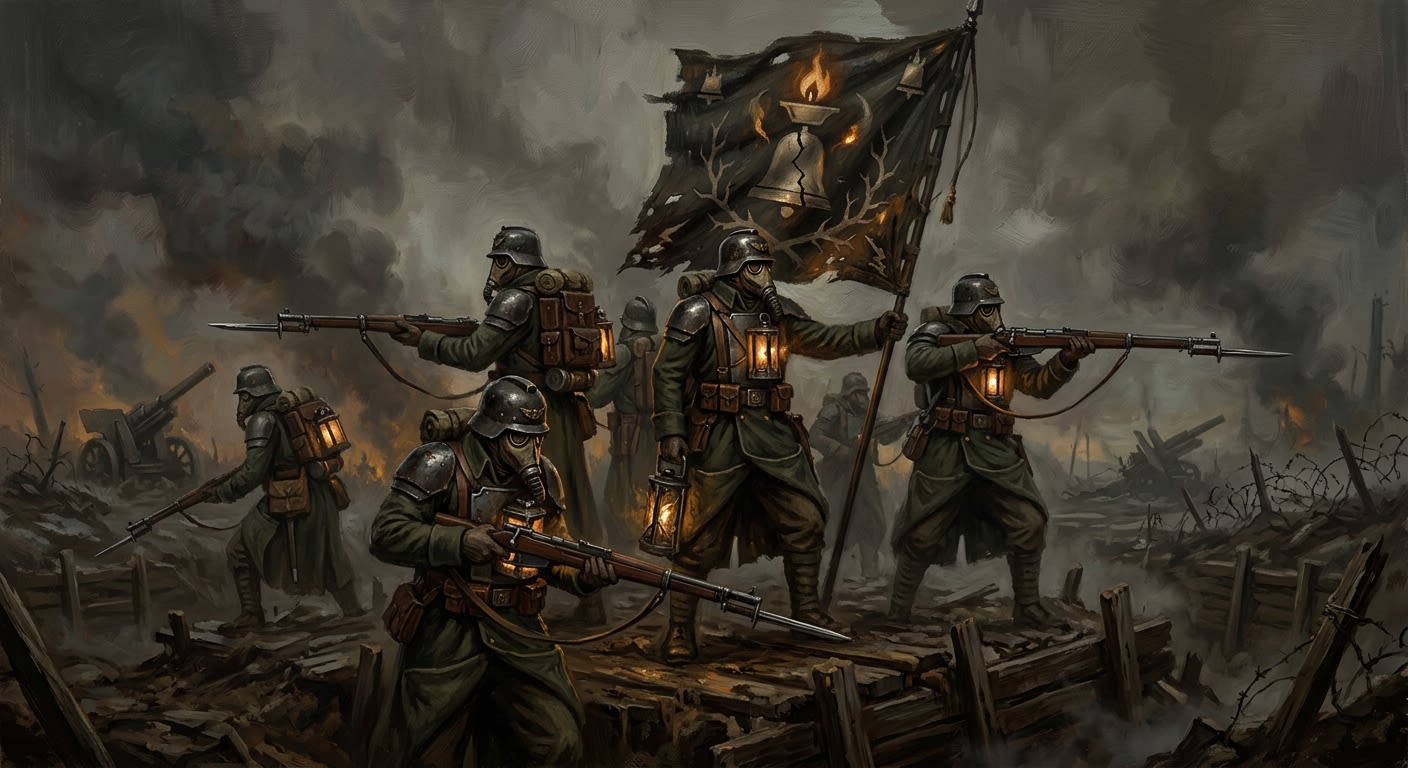
The Radiant Fusiliers are the Covenant's elite light infantry, if one accepts the phrase light infantry for men whose coats carry hymn-plates, reliquary thread, banner-hooks, cartridge rosaries, and enough devotional metal to make a quartermaster weep into his scales. They are called radiant because their volleys are fired under banner-light: white flare from consecrated standards, reflected in polished bayonet bosses and saint-medallions, turning a firing line into a brief, disciplined sunrise with paperwork.
The common soldier fires a rifle. The Fusilier conducts a rite through one.
They load by prayer. They fire by banner. The first volley belongs to command, the second to discipline, the third to the Creed. That sentence has appeared in enough recruitment broadsheets to make even Doctrine suspicious of its prettiness, but prettiness occasionally tells the truth by accident. A Radiant Fusilier company is trained to make powder, posture, breath, sight, and obedience indistinguishable. The ramrod stroke is timed to a psalm syllable. The cartridge is bitten after a whispered article of faith. The trigger is touched only when banner-light opens like a seal.
Their place in the Line's grammar is simple. Shield-Paladins receive the breach. Radiant Fusiliers close it. Ash Chaplains bind the two in syllable and smoke. The Bureau of War has attempted twenty-seven formulations more technical than this. None improves it.
#On Drill, Banner, and Cadence
A Fusilier recruit learns first to stand in light without flinching. This seems theatrical until one sees banner-light at full war-strength: white flame along the silk, saint-script flaring in the weave, brass finials singing just above the threshold of pain. Men blink. Men weep. Men look away. Fusiliers do not. Their eyes belong to the banner until the volley has passed.
The second lesson is breath. The line inhales under the chaplain's count, holds through the banner rise, and exhales only after recoil. A ragged breath becomes a ragged volley. A ragged volley becomes a gap. A gap becomes a demon inside polite society with claws on the table. Discipline, in this case, is a civic courtesy.
The third lesson is moral: a Fusilier does not select a target like a hunter. He receives a sin placed within range by command. This distinction is beloved by chaplains and loathed by honest marksmen. A hunter has judgment. A Fusilier has cadence. Judgment wavers under screaming. Cadence, properly installed, continues after judgment has packed its bag and fled.
#On Debrecen and the Usefulness of Witnesses
The Fusiliers became more than exemplary killers at Debrecen. Between A.S. 78 and A.S. 83, during a push into Blightmarsh territory east of Bastion-Constantinople, Captain Elias Brekke and his company found the Pit: seventy Ash-Mothers chained inward around a pyre of infants, smoke rising in the shape of a hand that clawed the sky until reliquary bells drove it back.
The Fusiliers did not fire into the women. They fired into the pyre, into the chains, into overseer sigils cut into stone, and into three smoke-born things wearing borrowed infant faces. The distinction saved Brekke from the easiest slander. It did not save him from reassignment.
Public recitations once described Debrecen as a Fusilier victory over a “sorcerous nursery.”
Corrected. Brekke's deposition records discovery, partial interruption, and withdrawal under bell-cover. Victory is a word generals use when the dead cannot read the map.
Debrecen changed Fusilier doctrine because it proved the regiment could serve as witness as well as weapon. A common unit would have burned the pit, lost half the details, and filed a report stained with courage and ignorance. Fusiliers counted chains. Fusiliers measured the pyre. Fusiliers recorded the duration of the smoke-hand's ascent, the pitch of the bell response, the number of recovered restraints, the failure point of the central sigil. Their obedience made them terrible witnesses. Terrible, here, means excellent.
#On Failures Under Song
No institution with rifles and hymns escapes humiliation. The Radiant Fusiliers have suffered failures so pure in their symbolism that Doctrine had to lock them away before preachers made the wrong sermon from them.
At Prague in A.S. 167, on the Night of Silent Steel, a regiment of Fusiliers stood loaded beneath banner-light while seven Pale Chanters sang an inverted Kyrie Eleison from a seminary ruin. The banner flared. The order was given. No volley came. Forty-three men died without discharging a round. Records insist the regiment was the Seventh; older files say Fourth; the Fourth has since become clerical weather.
BUREAU OF WAR REVIEW — PRAGUE, A.S. 168 Question posed to surviving Fusilier: “Why did you not fire?” Answer: “I remembered the command perfectly. I remembered the rifle. I remembered my finger. I could not remember what firing was for.” Disposition: witness retained for auditory study; later status █████████████████████.
The Bureau filed the event as command miscommunication. Soldiers called it the day the Creed went silent. Both names are wrong. The command was understood. The Creed was present. The Pale Chanters cut the thread between obedience and action, leaving the Fusilier intact and useless, like a sealed order no one can open.
A Bureau of War revision blamed the Prague failure on wet powder and poor trumpet relay.
Withdrawn after powder inspections and trumpet depositions proved inconveniently sane. The current classification reads: hostile auditory sorcery, Fusilier cadence severance, morale-sensitive.
Debrecen wounded them through sight. Prague wounded them through silence. The Festival of Worms wounded them through material fact. In A.S. 172, during a general advance at Debrecen, Fusilier shelling ruptured a Blood-Tithe pit. Blood geysered skyward. For three days crimson rain fell in a radius of two miles, corroding every touched iron thing: rifle barrels, bayonets, belt buckles, ammunition hinges, chaplains' crosses. The Fusiliers' advance stalled because a regiment built around sacred firing cadence discovered that rifles become sermons only while barrels survive.
#On the Present Regiment
As of A.S. 201, Radiant Fusiliers serve along all seven bastion sectors, though War concentrates them where banner-lines can be protected from fog, song, and hostile bell interference. Brest uses them against lowland masses after Shield-Paladins fix the wave. Przemyśl uses them in ridge volleys, where banner-light catches wire and turns the whole slope white. Irongate keeps them behind pressure doors until the gorge vents clear. Shipka rotates them brutally, because Syrion's sleep-fog makes cadence treacherous and no officer enjoys explaining why an elite company loaded, blessed, aimed, and dreamed through contact.
Their enemies have learned them. Pale Chanters seek the cadence. Veil-Stalkers cut banner cords. Blood-Tithe handlers bury pits where artillery will do the enemy's work. Velkaran agents perfume cartridge cases with distractions too delicate for Purity to discuss without blushing. Maldrake's shock troops time charges for the seconds after the third volley, when smoke blooms and shoulders reset.
War answers with bell-anchors, double banners, alternate cadence tables, ash-sealed cartridges, and officers trained to shoot any man who lowers his rifle before the line is ordered down. This last measure is unpopular among recruits and beloved by veterans, which is usually how one recognises necessity.
Radiant Fusiliers remain what the Bureau requires them to be: disciplined flame on the edge of the human wall, witnesses when horror must be counted, executioners when doctrine needs range. They are beautiful at distance. Up close they smell of powder, wax, eye-salve, wet wool, and fear hammered flat enough to pass inspection.