
#On the River City That Learned to Sing Through Its Teeth
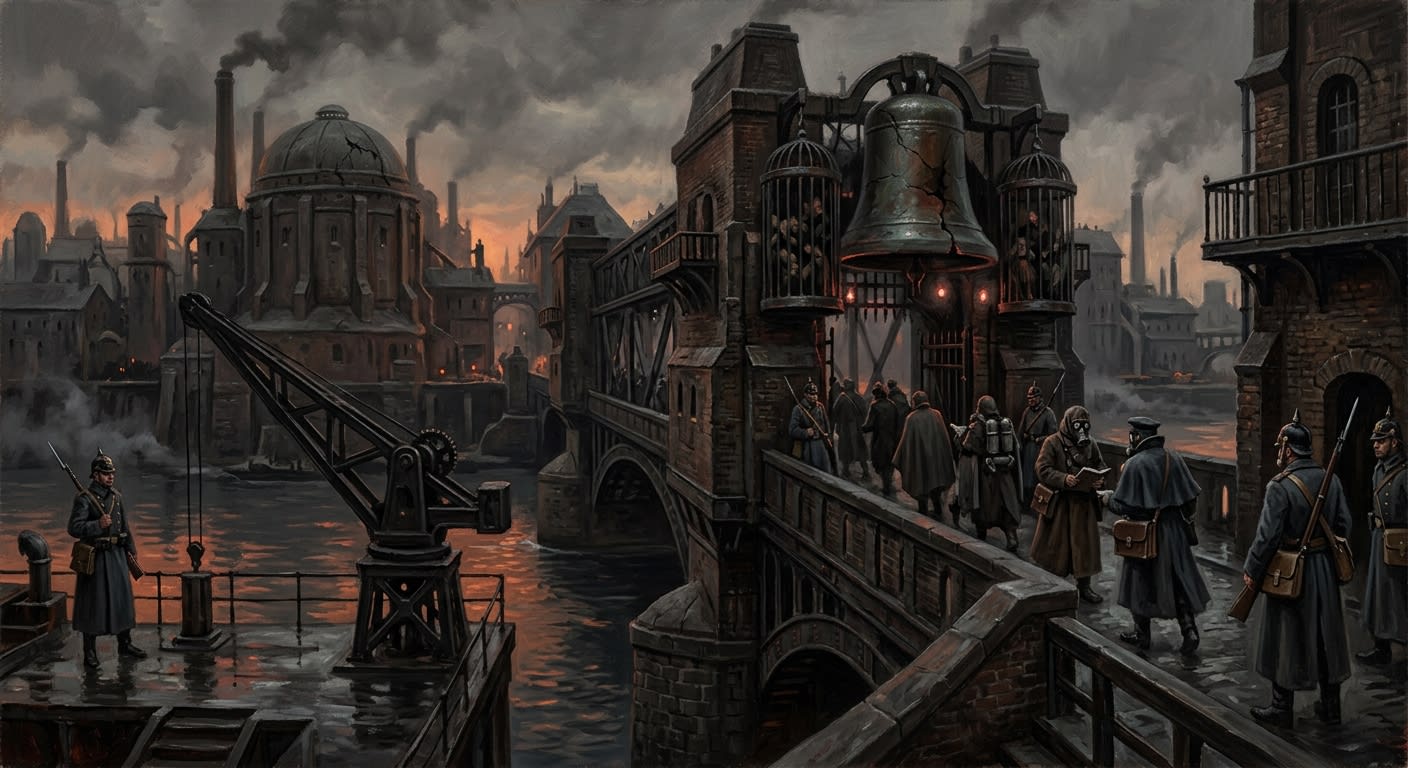
Mainz sits on the Rhine at the place where water, road, bridge, relic, debt, and terror have been made to shake hands under supervision. The Locations Registry calls it a Zone 2 river city, major, marked by the Goring of Mainz, bridge and toll systems, and the Bell-Ledger Collapse. This is accurate in the way a gravestone is accurate. It names the dead man and omits the smell.
The city is old in the Roman sense, holy in the post-Sundering sense, and useful in the only sense that matters to the Synod. It commands river traffic between the Rhine supply chain and the eastern corridors; it feeds pilgrims toward Strasbourg, relic caravans toward the Line, and condemned acoustics toward the Iron Choir of Mainz. Bargemen call it the Coughing Gate. Pilgrims call it Augustinus's City. Clerks call it profitable.
Mainz's importance begins with Hierarch Augustinus of Mainz, the Binder of Wounds. He defended the city during the siege of 3 February A.S. 28, became its bishop in A.S. 40, and emerged publicly after the Sundering in A.S. 45. His shared work on the Common Allegiance of A.S. 55 and his council leadership later passed through Mainz by authority, memory, and civic claim. Mainz has been dining on Augustinus ever since. Cities do this. They eat their saints first.
#On Augustinus and the First Uses of Holy Violence
The Bureau of Doctrine records Augustinus's origin at Mainz. The Bureau of Records has entertained Worms. The Bureau of Purity, eager as ever to turn ignorance into perfume, insists the saint was born nowhere and everywhere. Mainz ignores all three files and prints his face on pilgrim tokens.
During the Siege of Mainz, Augustinus loaded catapults with reliquaries rather than stone. Rationalist cohorts broke when the relics came down among them, partly from impact, partly from the voices of dead saints reportedly singing through shattered bone. This was the theology that built the Synod: practicality dressed in vestments, blasphemy made obedient by aim, artillery granted a choir-stall. The Bureau of Ordnance still thanks him. It does so quietly, because gratitude from artillerymen resembles theft.
The later Councils that fixed the Synod's structure turned Mainz into a remembered threshold: the Council of Mainz in A.S. 93 confirmed the first seven Hierarchs after the Concordat of Strasbourg, while revisionist ledgers, with that feline little dishonesty beloved of archives, later tried to attribute older Bureau foundations to the same assembly. The lie was convenient. The Records themselves endorsed it until the lie became cumbersome and was reclassified as historical enthusiasm.
Instructional catechisms once stated that the Bureau of Records was founded at the Council of Mainz, A.S. 93.
Corrected. Wartime record networks preceded Veyrault's A.S. 78 consolidation. The Council in A.S. 93 ratified, displayed, and claimed an institution already working. These are not the same act, though the Bureau has charged fees for all three.
#On Hildegarde, Severian, and the City Opened
Mainz did not become terrible all at once. It acquired terror as a cathedral acquires chapels: one endowment, one patron, one rededication after fire.
Procurator Hildegarde of Mainz gave the Bureau of Purity its visible instrument when she decreed the white mantle in A.S. 62 under the Mandatum Candoris. Her sentence survives: heresy thrives in ambiguity; correction must be seen. The mantle was white so soot would betray the day's labour. It was also white because the Synod enjoys making cruelty launder itself before appearing in public. Hildegarde razed forty villages during the Grain Tithe Riots and became Defender of Stability. Mainz keeps her stamp behind glass. Pilgrims kiss the case. Clerks inspect the seal. Children are threatened with the Hungry Eye when they fidget in ration lines.
Severian of Mainz came later and improved terror's acoustics. He declared the city and province “a single heretic body” and proceeded parish by parish, street by street, with the professional calm of a butcher who has read canon law. From this correction came the Iron Choir: cages along the Mainz road, condemned bodies hung upright, throats slit shallow enough to sing and deep enough to instruct. Some cages are empty. Some are not. All hum when the air is still.
PURITY ANNEX — MAINZ CORRECTION, SEVERIAN SEQUENCE Parishes processed: ███ Cages raised: ████ Voices retained past third day: 17% Children routed past installation under Little Witness pilot programme: █████ After-action note: “City compliance improved beyond ordinary human expectation.” Attached witness drawing removed after paper began humming in storage.
The Iron Choir remains Mainz's masterpiece and accusation. The Bureau of Orison and Song did not build it, being innocent in the narrow way a man is innocent of a murder because he only tuned the knife afterward. It maintains the cages, classifies their hum as residual liturgical resonance, and sends old workers past them with rags in their ears. New workers are told to listen.
Travel permits formerly described the Mainz road cages as “decorative penitential architecture.”
Withdrawn after three pilgrims attempted to sleep beneath Cage Row 14 and woke repeating severance clauses in Severian's voice. Approved wording: “active acoustic correction installation; distance recommended.”
#On Bridges, Ledgers, Bells, and Other Civic Teeth
Mainz governs crossings the way an inquisitor governs silence: by presuming guilt until paid otherwise. Its bridge officers maintain toll books older than several current Bureaus; its river clerks can calculate cargo tithe, pilgrim surcharge, ash transit duty, and unauthorised song penalty while a barge is still fifty yards from dock. The bridge is not a convenience. The bridge is a mouth.
The Goring of Mainz remains the city's oldest shame in Bureau memory. Rationalists nailed clerics to oxen horns and loosed the beasts through the streets, recording the result as an agricultural panic. The faithful account preserves a crueller mercy: Radiant Fusiliers fired thrice into the air, refusing to spend Creed's cadence on the jeering mob, and the holy resonance drove the oxen through their masters. The clerics could not be saved. The mockers could be trampled. The Bureau calls this providential selection.
Mainz's ledgers have habits. The Bell-Ledger Collapse, remembered in ration offices and ammunition depots with the tenderness men reserve for profitable errors, doubled an entire storehouse register. For three months, the front received twice its assigned food. Soldiers grew strong. Morale rose. Then the mistake was found, and the regiment was executed to correct the imbalance. Doctrine called it abundance heresy. The Ledger slept better afterward.
The Cracked Bell of Mainz tolls despite the Bureau of Bells, which despises broken bells as a musician despises a cough in the nave. The Bureau of Festivals protects it because symbolism, once licensed, is harder to confiscate than contraband. Fourteen protests, three redesign proposals, one attempted seizure, and a crowd of three thousand celebrants have left the bell in place. It rings badly. That is why Mainz loves it.
#On the Present City
As of A.S. 201, Mainz is too useful to punish and too punished to trust. Casselius of Mainz holds Heraldry and Masks and Seals in personal union, from which height he once confiscated a doorbell for bearing an unregistered chime-mark. This is civic governance at its purest: no object too small to betray Order, no sound too petty to require a seal. The city's training houses supply acoustic specialists to Orison, including Sunken Choir preparation rooms whose existence was recently noted in the Sunken Choir dossier and, with weary inevitability, became an unresolved link requiring this entry.
Mainz is two to three days by barge from Rheinscarp, close enough for soldiers on furlough to complain about its tolls and far enough for them to miss them when posted forward. Its streets carry pilgrims, auditors, cage-maintainers, bridge-scribes, choir engineers, saint-ladle devotees, seal inspectors, and children marched past the Iron Choir so obedience may enter through the ear before reason gets its grubby little fingers on the catechism.
The city's morning cough ritual persists in several districts, officials listening for wetness as evidence of hidden heresy in the chest. During the Cough Winter, frost made every cough sound suspect and a thousand died by efficiency. Later physicians blamed weather. Purity blamed corruption. Records blamed poor classification. Mainz continued coughing.