
#On the Signing
"They called it peace. They called it dawn. They called it the future. It smelled of incense and fresh blood, and the ink was barely dry before the omens began." — Drax, personal notation, filed nowhere
The Atheist Wars lasted twenty years. The Treaty that ended them was drafted in nine days and signed in an afternoon, which tells you everything the Bureau needs you to understand about the relative speed of destruction and construction. Destruction is always faster. Ask any cathedral.
Regensburg was chosen for the signing because it was neutral ground — or rather, because every other city of sufficient dignity had been burned, besieged, or occupied to the point where neutrality was a geographical impossibility. The Rationalists wanted Vienna. The remnants of the old Church wanted nowhere, because they had already been beaten into the cellars and had no seat at the table. Regensburg's cathedral still stood, which made it convenient. That it still stood because the Rationalists had converted it into a lecture hall rather than burning it was, the Bureau observes, a coincidence of administrative preference rather than mercy.
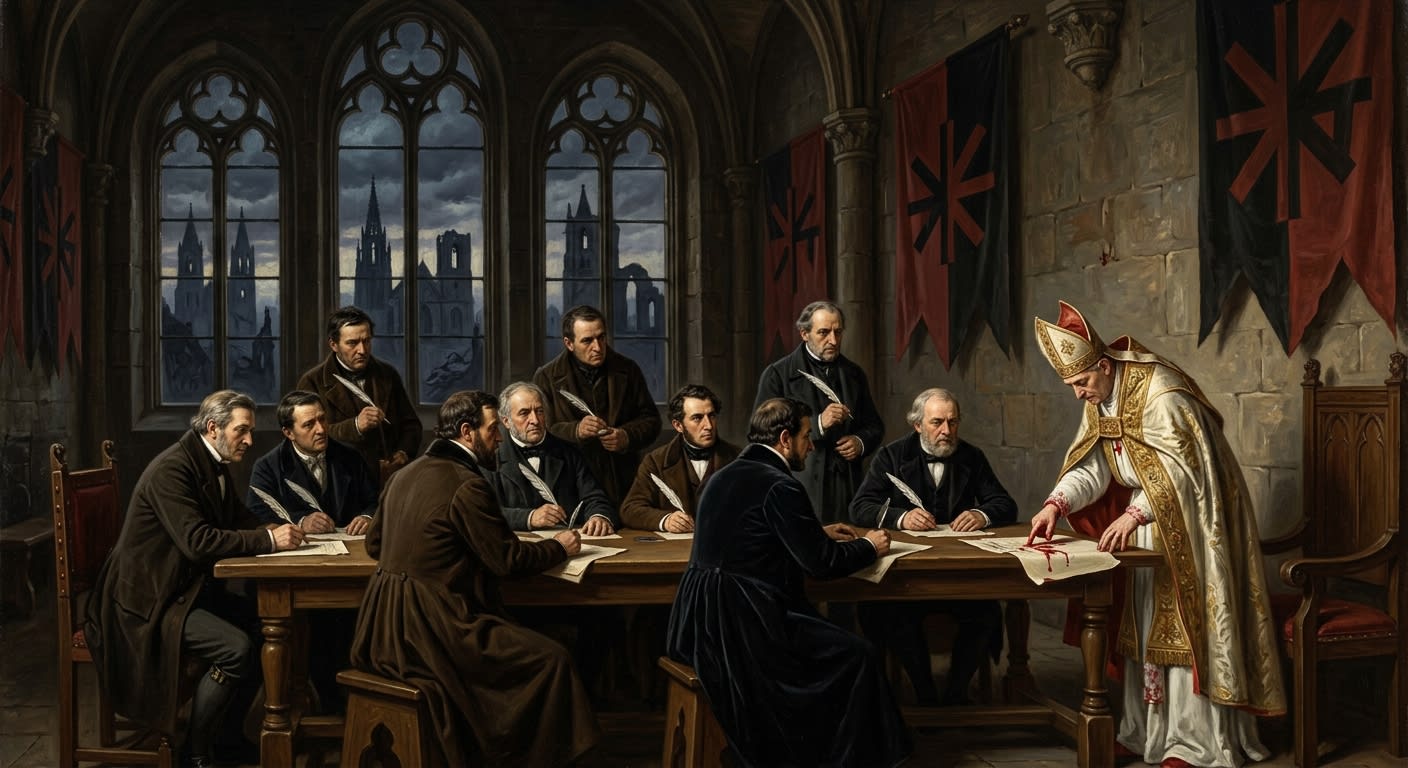
The hall chosen for the signing was the Reichssaal — the old Imperial Diet chamber, stripped of its crucifixes during the Cauterization years, its walls hung instead with Rationalist banners bearing the Broken Cross. Through the windows, the ruins of three churches were visible. The Rationalists considered this a scenic arrangement. The Bureau considers it evidence.
Nine signatories represented the Council of Nine. Their names are sealed. Their faces survive in no portrait — or rather, the portraits exist but are kept in the same vault as the Treaty, where they serve as a useful visual catalogue of what happens to men who believe they have defeated the Creator. Opposite them sat the remnants of the old order: three bishops, a baron of the Rhineland whose forces had collapsed at Aachen, and an aide-de-camp to Lord-Protector Guillaume himself — Guillaume having declined to attend, on the grounds that he was already governing the Lowlands from a palace the Rationalists had given him as the price of his betrayal.
The Archbishop of Vienna was present. His signature was required for the dissolution of the Holy See — the seat of the Church's continental authority, maintained across seven centuries of schism, plague, and the occasional antipope. The Archbishop signed. The Rationalists had explained, with their customary precision, that he would sign or they would find someone who could hold the pen with the correct number of fingers remaining. He signed in his own blood. The Rationalists considered this theatrical. The Bureau of Doctrine considers it a consecration by duress, which is theologically distinct from a valid contract, which is why the Treaty was annulled retroactively to the moment of its execution, which is to say it was never valid, which is to say it never existed, which is to say the Bureau's filing system is magnificent.
#On the Terms
The Treaty contained forty-seven articles. The Bureau of Records has summarized them in a single sentence: "Faith is abolished, Reason is sovereign, and the signatories may keep whatever they stole."
The first twelve articles dissolved every ecclesiastical institution on the European continent. Dioceses were replaced by Philosophical Prefectures. Monasteries were declared state property. Cathedral chapters were disbanded. The tithe system was abolished — replaced by the Rationalist taxation apparatus, which collected more efficiently and with less theological justification, a combination the Bureau of Tithes has studied with the attention one gives a rival's balance sheet.
Articles thirteen through twenty-nine established the Rationalist Republic as the sole legitimate government of continental Europe. The Council of Nine was recognized as the governing authority. The Concordats of Governance — that body of constitutional law replacing every crown and cloister with Rationalist administration — were appended as a supplementary instrument of four hundred and twelve pages, each page bearing the Council's cipher-seal. Thirty-seven Philosophical Prefectures were mapped, numbered, and assigned Prefects of Reason. The old borders were erased. France, Germany, the Italian principalities, Spain, the Lowlands, the Scandinavian holdings — all reorganized along lines of "rational efficiency," which meant that a man who had been Bavarian on Tuesday was a citizen of Prefecture Twelve on Wednesday and owed his taxes to a different capital by Friday.
Articles thirty through thirty-nine dealt with property. The Church's accumulated wealth — a millennium of tithes, bequests, reliquaries of gold and silver, monastery lands stretching from the Baltic to Iberia — was nationalized. The Treaty's language was precise: "All assets presently held by ecclesiastical bodies are hereby declared instruments of public education and shall be administered by the Prefectural Treasury for the advancement of Reason." The advancement of Reason, in practice, meant the Council of Nine's treasury. The advancement of Reason built the Observatory at Vienna, furnished the Academies with mahogany desks, and minted the Lumen — the Republic's currency, stamped "RATIO SOLA," which circulated for exactly fifteen years before becoming a collector's curiosity and, later, a Bureau of Tithes training aid in the identification of heretical coinage.
Articles forty through forty-seven concerned the disposition of the faithful. Prisoners of conscience — a Rationalist euphemism for captured clergy — were offered "rehabilitation" in the form of public recantation. Those who recanted were released into prefectural supervision. Those who refused were classified as "ideologically non-participating" and transferred to facilities that the Treaty described as "centres of rational correction" and that the survivors described as prisons.
Earlier Bureau publications listed the Treaty as containing forty-eight articles.
Article Forty-Eight — concerning the disposition of relics held in private collections — was struck from the final document at the insistence of a Council member whose identity is sealed. The Bureau of Relics has filed seventeen requests for the struck article's text. All seventeen requests have been denied by the Bureau of Silence, which states that Article Forty-Eight "does not exist and never existed," a position the Bureau of Doctrine finds familiar and, for once, does not dispute.
#On the Oaths and the Drowning
The signing itself was preceded by what the Rationalists called the Oaths of Regensburg — a ceremonial event staged the previous evening, A.S. 29 by the Lore Book's reckoning, in the grand hall of the city's former episcopal palace.
The Oaths were a banquet. The Council of Nine and their senior officers gathered in a hall lit by candles taken from the cathedral's own altar — a detail the Rationalists recorded with pride and which the Bureau records with the same ink used for capital sentences. Toasts were raised. The death of superstition was proclaimed in seventeen languages, which is fourteen more than were necessary and thirteen more than the Council could speak without an interpreter, but the Rationalists had always believed that redundancy in the service of rhetoric was a form of thoroughness rather than vanity.
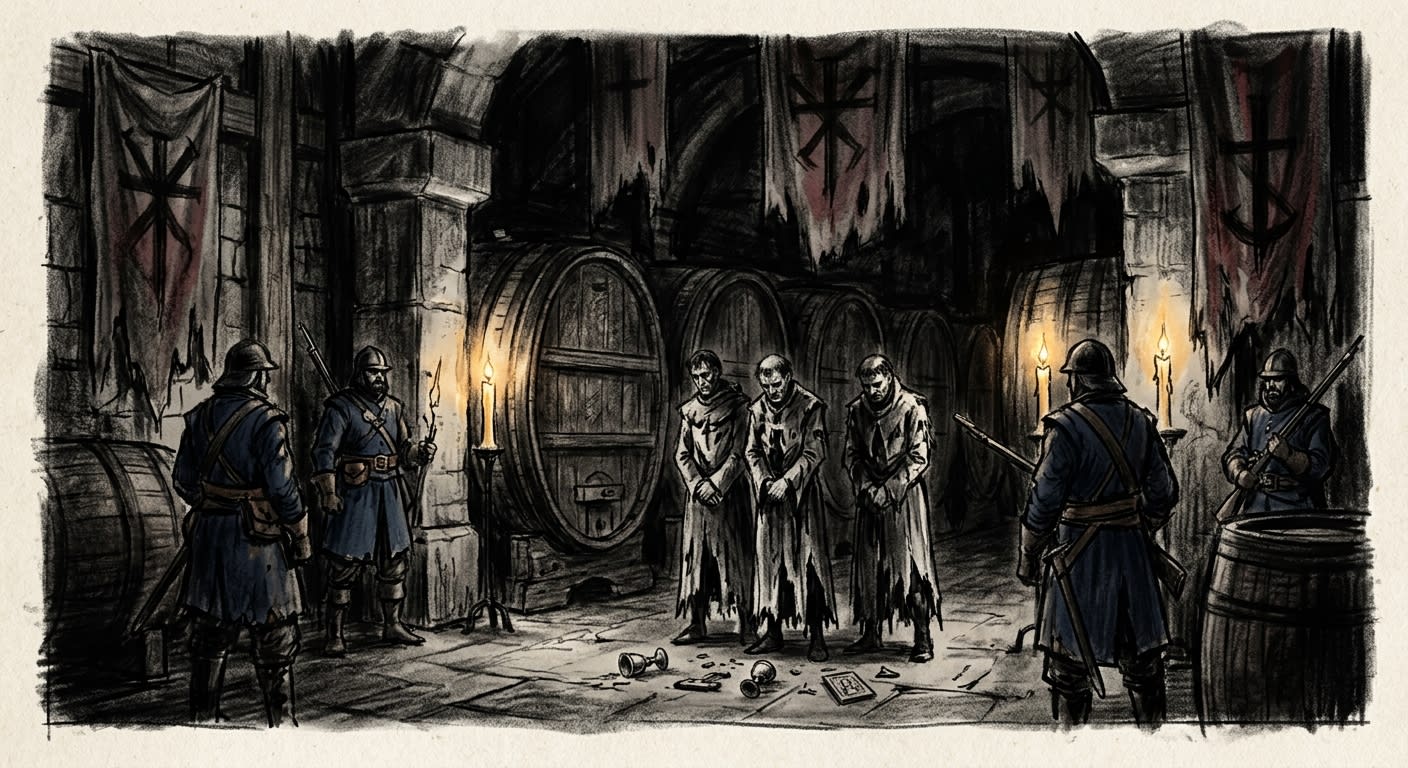
Between the seventh and eighth toasts, three priests were brought into the hall. They had been captured during the Cauterization of Rouen and held in a prefectural prison for five years. They were offered a choice: recant publicly and join the celebration, or refuse. They refused. The Rationalists drowned them in wine-vats — three great casks of Rhenish red, the good vintage, which the Bureau considers an especially Rationalist form of murder: wasteful, symbolic, and documented.
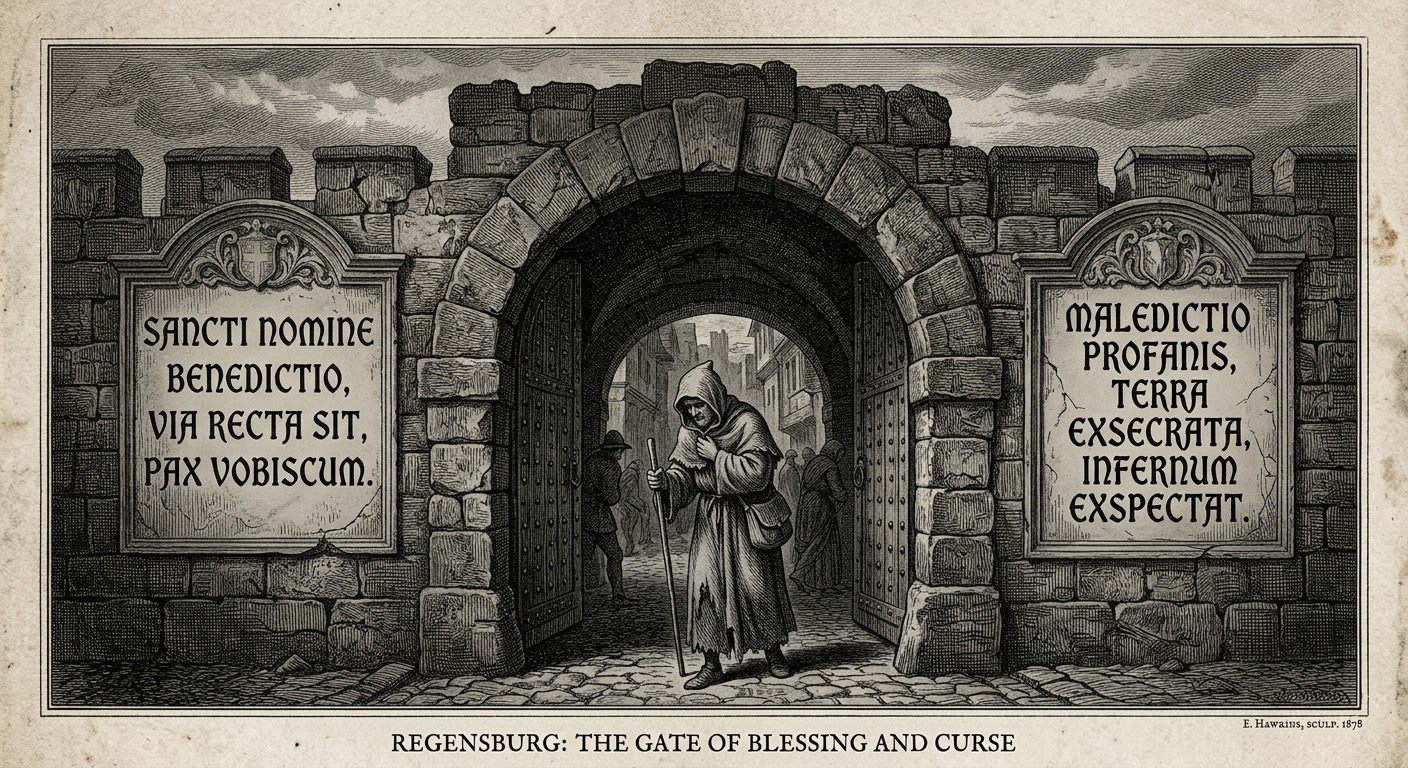
The Gates of Regensburg — the city's great stone portals through which the signatories passed — bear plaques engraved with both benedictions and curses, so that every traveller who enters is simultaneously absolved and condemned. The theologians have debated for a century which inscription takes precedence. The consensus, naturally, is that both are true, and that the contradiction is sanctifying. The Bureau endorses this view. Contradiction has always been the Bureau's native element.
#On What Followed: The Fifteen Years
The Treaty consolidated a political order already growing in local administrations. Its continental supremacy lasted fifteen years.
From A.S. 30 to A.S. 45, the Rationalist Republic held continental supremacy, extending earlier local machinery. The Edict of Ironmouth silenced the faithful. The First Black Census erased them from registers. Republican Guards enforced compliance. The Cellar Saints and other surviving clergy preserved prayer, shelter, and relief.
The omens came. The Year Without Dawn (A.S. 32) — forty days without sunrise, explained as "natural eclipse" by Rationalist astronomers who had never seen a natural eclipse last forty days. The Red Flood of the Danube (A.S. 34) — waters boiling crimson for three weeks, explained as "iron deposits" by men who had never seen iron deposits boil. The Silencing of the East (A.S. 38) — Balkan villages ceasing all correspondence, explained as "communication failure" by an administration whose communication apparatus was the finest in Europe.
Each omen was filed. Each was explained. Each explanation was published in the prefectural bulletins with the confidence of men who believed that naming a thing was the same as understanding it.
Then the Sundering broke central command. The Treaty lost effective authority, but western prefectures and services survived unevenly before being absorbed or displaced. The instrument itself became a document of historical interest in the Forbidden Stacks alongside the Year of Letters pamphlets and sealed Council of Nine correspondence.
#On the Gates: A Present Observation
The Gates of Regensburg still stand. The plaques still read their double verdict — blessing and curse, absolution and condemnation — and every pilgrim who passes through them on the mandated route from Strasbourg to the eastern shrines receives both. The Bureau of Pilgrimage issues a pamphlet explaining that the benediction applies to the faithful and the curse applies to everyone else, which is true in the way that all Bureau pamphlets are true, and which satisfies the literate.
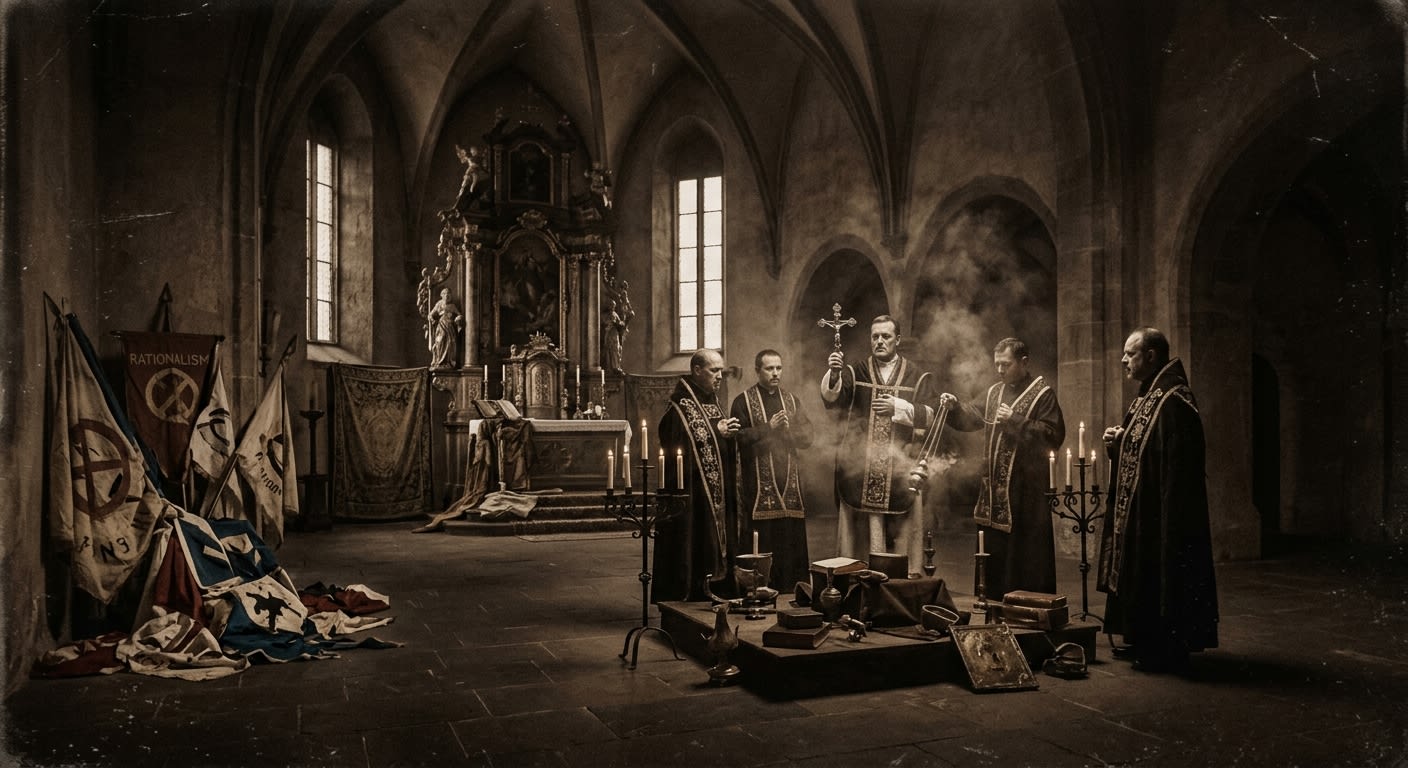
I visited Regensburg in A.S. 197, during my tour of the Rhineland archives. The Reichssaal is a chapel now — reconsecrated in A.S. 92 with rites that took three days and required the participation of fourteen exorcists, which the Bureau of Rites considered proportionate and which the Bureau of Engineering considered "structurally unnecessary but atmospherically persuasive." The windows that once framed the ruins of three churches now frame three new churches, rebuilt on the old foundations, each smaller than the original, each bearing a plaque that reads: "Rebuilt by the Bureau. Do not burn."
The wine-vats are gone. The hall where the Oaths were spoken is a refectory for the local seminary. The students eat where the priests were drowned, and the seminary's annual feast-day toast is a glass of water, raised in silence.