

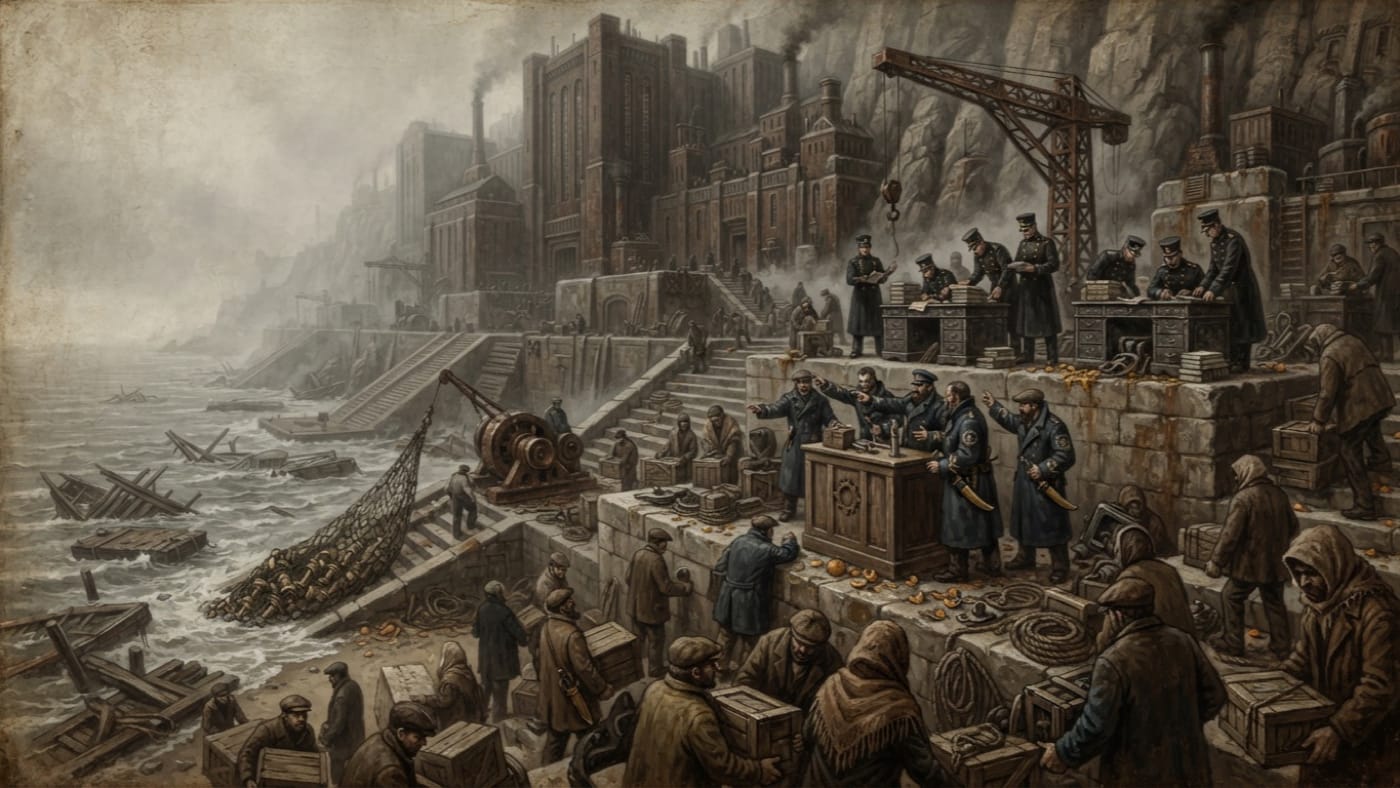
#On the Steps Above the Beaches
This survey of the Wreckmarket was compiled in A.S. 201 (1911 CE). The year belongs to the compilation. Nobody recorded when the market was founded or how old it is, and I will not assign a founding date to a staircase whose commissioning nobody remembers.
The Wreckmarket is one of the nine districts of Saffron Bastion, the Synod's terraced port on the Adriatic near Ragusa, in Zone 7. It is built as stepped stone platforms climbing from the wreck beaches. A buyer can stand on dry masonry and watch a lot being dragged out of the surf before bidding on it. The sea delivers the goods and the steps put a price on them. Between the two lies a strip of shingle where the port argues out its whole law of ownership in wet boots.
The district smells of rust, cheap rum and citrus peel. The peel is strewn across the lower platforms to cover the smell of whatever salt water has done to the contents of a crate. The docks call this fishmask. It fails every time and is put down again every time, like a rite whose congregation stopped expecting a miracle long ago. The rum does the same job for the bidders.
Its masonry is the port's usual salt-stained stone, with crust on every surface that sits still long enough. Iron fittings bleed rust down the risers. Above the steps the terraces of Saffron go up toward the cliff batteries. Below them the grey water keeps sending up more stock. The Wreckmarket is also one of the places where the port gathers, beside the ropewalks, the quay taverns and the quarantine waiting yards. Some come to bid. Most come because a wreck brought up in public is the only free entertainment the Quay Chapterhouse has not yet taxed.
#On the Lots
Recovered cargo comes up the beach and is auctioned on the steps. That is the whole public account of the trade, and it is true as far as it goes. Saffron lists salvage auctions among its industries and salvage metal among its exports. In the port's ordinary day the auctions belong to midday, the same hours as the stamping of seals and the hearings of the Insurance Courts. In Saffron all three are forms of the same office: deciding who owns what the sea has handled.
I give no catalogue of the stock. What comes up depends on what went down, and the Registry has published no complete inventory. I will not draw one up from tavern talk. The lots are wet, sealed or broken, and they have usually been claimed by someone before they are dry.
Salvage has its own coin. Salvage tokens circulate among the port's currencies, and some are stamped with a quay number. Like everything else at Saffron, a token is worth what the next clerk agrees it is worth.
There is a quieter difficulty at the top of the steps. The port's list of things that may not move through Saffron includes unsealed cargo and unregistered relics. A lot sold on the Wreckmarket has been sold. Whether it may then leave is a matter for the Third Quay Sealhouse and the buyer's purse, and the buyer is advised to settle both before the hammer falls.
#On the Schedule and the Knife
The steps belong in practice to the Wreckmarket Salvagers, whom the whole coast calls the Gilt-Knives. They are a cartel with divers, boats and fences, and they hold the market and the wreck beaches below it. Their public face is salvage recovery. Their legitimacy is a thin membrane over a blade.
They control the auction schedule. In a port where cargo rots, liens fall due and quarantine clerks can arrive without warning, the party that decides which lot is called and when decides a good deal more than the order of business. The Gilt-Knives decide it. I have no order book to quote, and none is needed. A competitor who has stood on the steps watching the buyers' purses empty understands the mechanism well enough.
Their recorded methods are forged claims, violence and staged wrecks, with a single aim: to keep certain wrecks "sainted" and so lock competitors out of the richest salvage. At Saffron a sainted wreck has nothing to do with canonization. It is a commercial closure spoken in a pious accent. No sanctity has been certified for any of these hulls. The port's own ledger of corruption says everything in Saffron is for sale except two things, and one of them is an unchallenged salvage claim on a sainted wreck. The cartel's trade lies in making sure no challenge ever gets far enough to be refused.
The port's dossier puts the staged-wreck schedules in an ordinary place. They are coded into the bid sheets on the auction steps. The paper on which the cartel records what it means to buy also records, for a reader with the key, what it means the sea to sell. I have seen no decoded sheet. I can name no wreck that was proved staged, no date of staging and no method. The dossier records that the code exists. Anything beyond that would be invention, and the Gilt-Knives already have forgers.
On Wreck-Tithe Day the knives come out over claims. The day is known as a salvage-auction occasion, and the port marks it among its festivals. I can cite no approved calendar that fixes its date. The Bureau of War does not intervene, because the Gilt-Knives pay their dues on time. Afterward the lower platforms are scrubbed with the same brine that ruins the cargo.
#On Paper, Dues and Writs
Three offices touch a lot between the surf and the buyer, and they should not be confused.
The Coastal Registry records the recovery. Salvage dues go to the Bureau of War, and the port counts a salvage tithe among its revenues alongside salt dues, berth fees and the rest. No published rate is available, and I have not supplied one. The record and the payment are the market's whole public obligation, and the Gilt-Knives meet both punctually.
The Insurance Courts work on the far side of the loss. Their writs include salvage-loss indemnities, which pay owners for destroyed cargo at rates the Courts determine. They also include storm exceptions, which suspend civil law during a declared emergency and allow property to be redistributed by writ. An indemnity is a court instrument. A lot on the steps is a recovered object. The claim to that object is a third thing, whatever the paper presented at the steps says it is. The three can attach to the same hull without ever meeting. No compact between the Courts and the cartel has been produced, and I enter none.
The port draws one line clearly. Forging a Synod seal on an insurance writ is among its offenses of instant annihilation. Forging a salvage claim is listed as a method of an organization that is tolerated. The Church's hierarchy of sin may be read in that difference, and the Wreckmarket has learned it by heart.
Coastal Registry entries described the Insurance Courts' storm exceptions as "a measured and proportionate response to maritime emergency."
Withdrawn, A.S. 200, Bureau of Doctrine Coastal Registry, after the discovery in A.S. 199 of pre-signed exception writs dated before the storms they referenced. Revised characterization: "administratively irregular." No corresponding revision has been published for salvage claims entered under those exceptions.
#On the Wet Road Around
Not all salvage climbs the steps. Low Nets, the under-quay district of dockhands, rope-makers and salvage divers, opens its culverts, tide holes and rope ladders after chain-drop. Through those routes the Gilt-Knives move salvage that never passed the Wreckmarket. Unreported salvage is also sold on the Low Nets black market. These goods are a different traffic from the lots on the steps. Sales on the platforms are recorded and pay dues. Goods carried round them by night are not and do not. The same hands may touch both, but the ledger keeps them apart, and so do I.
The labor comes up from below. Salvage divers lose teeth to cold and pressure and lungs to brine-fever, and they speak registry numbers on the piers after dark like every other pier hand. Some are cartel men. Many are hired by the day. The Ropehand Compact of Low Nets is a separate union with its own knots, skiffs and grievances. It is not a branch of the Gilt-Knives. When a ropehand works a salvage boat, the work is paid labor, and the claim belongs to whoever holds the paper. I have found no standard contract for that labor. Its terms are known only to the parties, and possibly the tide.
#On the Wreckfield's Account
The Sainted Wreckfield lies offshore, two to three hours by skiff from the harbor by the boatmen's estimate. It is a separate place. The Gilt-Knives control access to it and sell its recoveries through the Wreckmarket. The steps take cargo from more than one sea-floor. Not every lot sold there came from the Wreckfield, and I do not assume that any particular one did.
The reported Wreckfield recoveries fall into three kinds: sealed cargo from ships absent from every register, relics attributed to saints the Church never canonized, and bells heard beneath the water. Provenance for all three is undetermined. A forged claim can give a cask an owner. It cannot give the cask an origin, and the Wreckmarket has never tried. It sells the object and leaves authentication to the buyer.
In A.S. 199 (1909 CE) a wreck was reported ringing bells underwater. The Bureau of Bells sent an auditor. The auditor has not returned. The public file gives no name, no date of dispatch and no findings. A buyer on the steps who is offered a bell is advised to ask nothing and pay cash.
#On the Present Condition
So stands the Wreckmarket at the compilation of this survey in A.S. 201. The steps are open and the citrus is down. The schedule belongs to the Gilt-Knives, the dues are current, and the Registry has recorded what was declared to it. The Insurance Courts await a Canon-Inquisitor, Silex Marrow, whose warrant covers their pre-signed exceptions and the Lanternline pattern books. The market's bid sheets appear in neither instrument. The dossier names one thing that would break the cartel's composure: a rival who finds proof of staged disasters. No such rival has been recorded.
The lots will be called in the order the Gilt-Knives choose. When Wreck-Tithe Day comes, on whatever date it falls, the knives will come out. The Bureau of War will collect its dues.