
#On the Undercity That Keeps the Harbor Moving
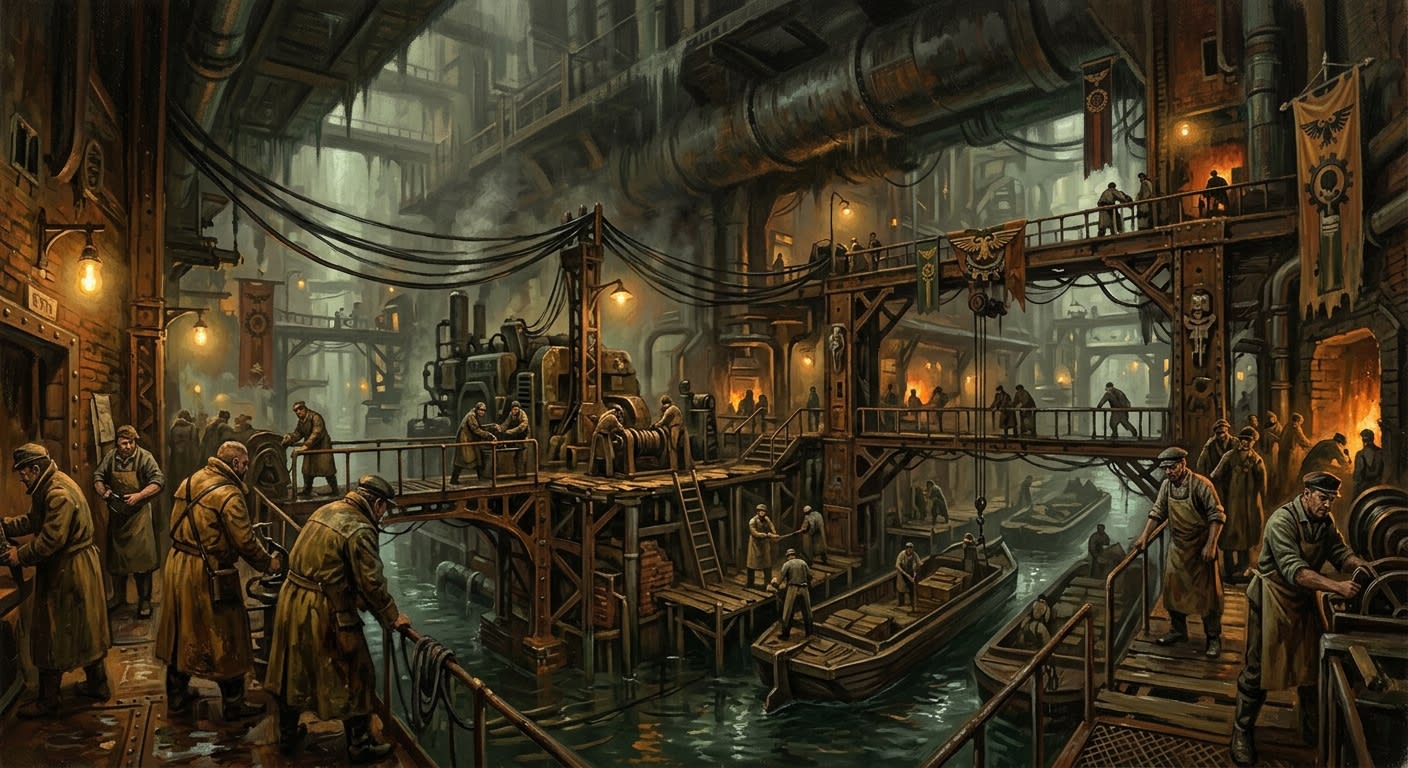
Low Nets is the part of Saffron Bastion the upper terraces pretend not to stand on.
The sentence is literal. The district occupies the under-spaces: behind sea walls, beneath quay stairs, between terrace piers, above tide culverts, below the respectable drains, beside the piles where black water remembers names better than clerks remember wages. It smells of mildew, fish guts, brine-sour breath, old rope, wet ash, and the small domestic courage by which people keep living where government has already reclassified them as an expense.
The district's name began as dock slang. Nets hung low under the quays to catch dropped cargo, dead gulls, illegal parcels, and, in better seasons, edible fish. Men slept beside the nets because rent was cheaper near damp and because hunger is a better architect than comfort. Women repaired rope under lamp-drip. Children learned to climb pilings before they learned their letters. By A.S. 112, after the Brine Fever Winter killed one in five and the Quarantine Prefecture discovered the administrative value of a captive labor population, the slang had hardened into geography. Low Nets became a place because every cruelty eventually requires an address.
#On Its Walls, Floors, and Tides
The upper city descends by terraces. Low Nets climbs by need.
Huts brace themselves against retaining walls. Plank rooms hang over culverts on rope, nail, prayer, and fraudulently certified timber. Families occupy old net lofts, disused tackle vaults, brine sheds, lamp niches, drainage galleries, abandoned counting booths, and those municipal gaps that appear when three Bureaus draw jurisdictional maps and none of them wishes to pay for the seam. A room may have a wall from the Harbor Marshal (Unregistered)'s storehouse, a roof from the Quay Chapterhouse (Unregistered) overflow, a floor from a wreck auction, and a door stolen from the Quarantine Causeway during fog. Records calls this illegal construction. Residents call it Tuesday.
The tide enters through old culverts at spring rise and withdraws at neap, leaving grey silt that dries into salt rash on floors, bedding, infants, cooking pans, and lungs. Residents scrape it each morning with boards cut from cargo crates. The Prefecture classifies the silt as “non-hazardous particulate.” This classification was made from an office three terraces above the waterline by a man whose boots had never been wet except by polish.
Night makes the district wider. Legal Saffron ends when chains drop across the piers; Low Nets then opens its under-wall routes, tide holes, rope ladders, hidden docks, and culvert paths. Smugglers move forged dry-passes through fish barrels. Gilt-Knives move salvage that did not pass the Wreckmarket (Unregistered). Lanternline failures sell half-remembered shutter counts. Mothers buy “safe-lure” charms from liars, pious fools, and the occasional liars whose charms work. The tide takes a tithe from every transaction.
#On Labor, Rope, and the Compact
Low Nets supplies Saffron's hands.
Its dockworkers unload pilgrim ships, salt barges, ammunition crates, lamp oil, quarantine pallets, rope coils, saint-bone dust, and cargo whose manifest has been edited with the anxious neatness of a guilty priest. Its rope-makers twist the harbor's muscles in long wet walks: mooring rope, salt-cord, bell tether, salvage line, quarantine boundary, lureline, hanging rope if the Harbor Marshal has had a busy week. Its divers descend under breakwater teeth where bells ring underwater and wrecks produce objects no registered vessel lost. Its lure-watch patrols walk after curfew with waxed earplugs and registry numbers instead of names.
The Ropehand Compact (Unregistered), called by outsiders the Dock Union of the Low Nets, performs the district's practical government. It is union, cartel, mourning society, ration broker, burial club, strike engine, debt office, and night court, depending on tide and witness. Its enforcers keep order with knots and silence. A knot on a door may mean debt, warning, bereavement, safe passage, do not work this pier, or leave before dawn. The upper city hates this ambiguity because it did not invent and cannot invoice it.
The slow strike is the Compact's cleanest weapon. Berths unload at half pace. Rope coils are tied with deliberate imprecision. Cargo manifests develop damp. Gangs obey every safety rule with such reverent exactness that the harbor chokes on compliance. Saffron authorities find this infuriating because law, when used by poor men, feels like theft.
Three slow strikes in A.S. 200 produced no concessions. The Quay Chapterhouse answered with quarantine labor drafts that took the strikers' families. The Compact has been considering whether a fast strike can be named without inviting massacre. Its younger enforcers have already chosen several names.
#On Names, Lures, and the Brine Choir
Full names are forbidden on open piers after chain-drop. In Low Nets, this is less rule than nursery doctrine. Children learn registry numbers as a second skin. They learn to answer to rope taps, not voices from drains. They learn that if the water says your mother's name, you fetch an adult; if it says your own, you bite your tongue until you taste blood; if it says a dead person's name in a living person's voice, you do not boast of the distinction because the lures dislike pedantry.
The Brine Choir grows from this soil: widows, ropehands, divers, quarantine laborers, failed Lanternline apprentices, saffroned pilgrims, and children who have listened too long at grates. Its services gather beneath piers, in culvert mouths, by hidden docks, where singers stand ankle-deep and answer the water with tide phrases older than the Synod's claim to Ragusa. Purity calls them cultists. Low Nets calls them people who know which pier will be quiet tonight.
During the A.S. 199 South-Pier Incident (Unregistered), two Lanternline lamps guttered, a false registry number was answered by the dead man who once carried it, and the water rose under the boards. Battery Twelve could not depress its guns. Harbor provosts forgot part of the retreat phrase. The Brine Choir, gathered illegally under gutting racks, sang three tide phrases. The water lowered. Six men survived. The official report credited corrected lantern pressure. Low Nets remembers the singers' names, though two of them are now heard only beneath Pier Six at noon, when no service should be possible.
A Quarantine Prefecture digest described Low Nets participation in waterline safety as “untrained civilian panic behaviour.”
Corrected for internal use. Low Nets supplies lure-watch patrols, Brine Choir counter-pattern warnings, under-wall evacuation routes, body recovery crews, and most of the dead whose deaths become evidence. The civilians are untrained only in the sense that no Bureau paid for what they learned.
#On Quarantine, Passes, and Population Arithmetic
A dry-pass (Unregistered) is humanity printed on paper.
Without it, a Low Nets resident may be held, moved, conscripted, quarantined, questioned, disinfected, or forgotten with impressive ease. With it, the same resident may stand in a queue and be overcharged lawfully. Forged dry-passes circulate through Low Nets by fever season, storm season, pilgrim season, audit season, and those brief technical intervals when Saffron pretends seasons are natural rather than fiscal. Prices rise when the Prefecture announces sweeps. Prices fall after burn crews discover a forgery plate and hang the wrong engraver, which reassures the market that production continues.
The Bureau of Records' A.S. 200 census counted fourteen thousand three hundred occupants in structures Engineering classes as sub-habitable. An earlier internal memorandum listed approximately nine thousand souls in adequate housing. The discrepancy of five thousand three hundred persons was attributed to seasonal flux. The season has lasted eleven years.
Older harbor notices call Low Nets “temporary worker accommodation.”
Withdrawn. Temporary structures do not acquire grandmothers, burial corners, rope courts, plague shrines, smuggler tariffs, school slates, and children who can name every drain by taste. Low Nets is permanent. The notice was temporary.
Quarantine sweeps enter before dawn. Burn crews carry ash warrants. Nurses with kind eyes and brutal checklists test tongues, lungs, and paperwork. A cough may cost a week. A missing pass may cost a family. A valid pass may cost more than either if it was bought from the wrong intermediary and the intermediary has sold the buyer list to the Prefecture as evidence of lure anxiety.
#On the Buried Arrangement
The central scandal of Low Nets is that everyone knows the arrangement and everyone profits from pretending discovery remains possible.
The Quarantine Prefecture needs labor and removals. The Insurance Courts need marine incidents, storm exceptions, claims, salvage, and a population whose losses can be priced without diplomatic inconvenience. The Harbor Marshal needs pliant docks and plausible deniability. The Lanternline needs pier darkness sold by the hour. Low Nets supplies the bodies, the replacements, the witnesses, and the silence.
Demon-Lures are managed. Specific lantern patterns draw waterline entities toward specific piers at specific times under specific orders later described as unfortunate convergence. Losses are classified as marine incidents. Insurance writs finance quarantine operations. Quarantine holds supply labor to replace the lost. The system is self-sustaining, self-financing, and, in the language of the Courts, actuarially sound.
COASTAL REGISTRY INTERNAL CROSS-LINK — LOW NETS / LURELINE 7 / A.S. 198 Pattern shift authorised by ████████████. Affected housing row: Culvert Red-Nine. Recorded civilian loss: marine incident, tide surge. Replacement labor drawn from: Quarantine Hold Yard C. Insurance recovery: storm exception pre-dated by █ days. Note: children in adjacent row began humming safe pattern before lamps changed. Source unknown. Do not interview in daylight.
Canon-Inquisitor Silex Marrow (Unregistered) is expected to audit Saffron. Low Nets has prepared in the manner of people who do not trust official rescue: documents hidden in oilskin, witness knots tied under prayer boards, children sent inland with names hummed but not spoken, bribes placed where auditors will feel clever finding them, real evidence placed where only a man willing to get wet will look.
#On the Present Condition
As of A.S. 201, Low Nets is swollen, fevered, necessary, and less frightened than its governors prefer. Brine-fever remains endemic. Tide culverts flood higher each spring. The Ropehand Compact's slow strikes have taught the upper terraces that obedience can be sharpened. The Brine Choir's noon fragments have taught the Lanternline that intervals can be stolen in daylight. Children play name-muffling games over drains and sometimes receive answers too accurate for childhood.
The district continues to wake before the upper terraces, scrape silt from its floors, boil rope tar, mend nets, forge passes, bury the unclaimed, hide the useful, bribe the cruel, feed the singing, and send workers upward so Saffron may pretend labor comes from nowhere. At dusk the chains drop. Registry numbers replace names. Lamps bend seaward. Under the boards, where the official city ends and the wet city begins, Low Nets listens.