
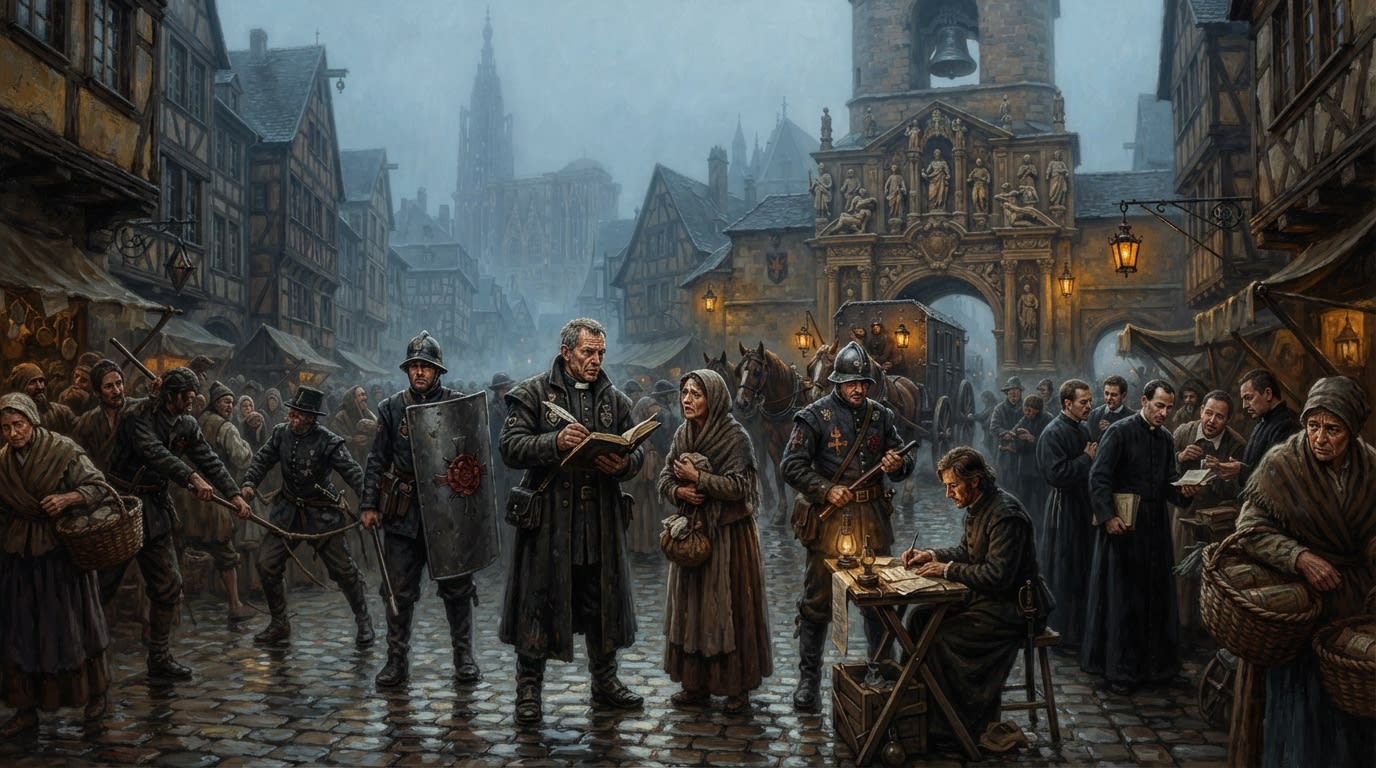
#On the Nature of the Bell
"Answer the bell." — Night Bell Book of Ninth Precinct, inscribed above the shield rack and the complaint desk and the custody door, in the same hand, at the same hour, by a clerk who apparently believed that repetition was doctrine. The Bureau of Doctrine has not corrected him. The Bureau of Doctrine, for once, agrees.
I am Valerius Drax, and I will confess an opinion the Bureau of Records would prefer I stamp and file rather than speak aloud: I do not know whether the Bastion Watch is a civic institution, a local militia, a bureaucratic afterthought, or a slow-burning fire wearing a badge. The Watch itself does not know. Its officers patrol the markets and bridges and tenement corridors of Strasbourg carrying shields, ledgers, truncheons, restraints, lantern codes, and the particular exhaustion of men who answer to every Bureau and belong to none. They arrive at gate crushes. They hold cordons during processions gone foul. They carry custody wagons through streets where the cargo — a living human being with a name the Watch is supposed to preserve — is more dangerous to release than to hold and more dangerous to hold than to explain.
The Watch exists because the Synod discovered, in the decades following the Concordat, that superior offices are magnificently equipped to issue orders and catastrophically slow to arrive at the street where the orders matter. The Bureau of War can mobilise a regiment. The Bureau of Purity can seal a district. The Bureau of Records can classify a corpse with three competing designations before the body cools. What none of them can do — what none of them will admit they cannot do — is answer a bell in a market square at four in the morning when a gate has jammed, a woman is screaming, a crate that may contain medicine or may contain carbines is blocking the fire lane, and the only authority present is a constable with a lantern and a bell-book and the institutional memory of every lie his precinct has told him.
The Watch fills that interval. The interval is where people die.
#On the Bell That Requires a Human Answer
The Night Bell Book of Ninth Precinct — a ledger so water-stained and ink-blotted that the Bureau of Records has twice refused to archive it on grounds of presentational hygiene — defines a bell as an answer owed. The definition is unofficial. It is also the only one that works.
Bells exist at gates, markets, shrines, custody desks, ward posts, schools, bridges, kitchens, fire posts, and complaint desks across the Ninth Precinct district. Some are brass. Some are iron. Some are ropes attached to tin plates that produce a sound the Bureau of Bells would classify as "acoustically inadmissible" if the Bureau of Bells were willing to descend from its nine-floored tower long enough to listen. Each bell carries a civic weight because it creates an expectation: someone will arrive. Someone will record the call. Someone will name the authority under which they act. Someone will identify the endangered person and separate the accused from the convenient scapegoat, and someone will keep a route open — a lane, a gate, a corridor, a door — so that the response does not become a trap.
That is the theory. The practice, as Watch Sergeant Ilex will tell you with the patience of a man who has stopped expecting the theory to survive contact with a Tuesday, is considerably worse.
Ilex keeps an unofficial column alongside the formal bell book. The official column records call, time, response, disposition, and command note — the clean arithmetic of answered bells. Ilex's column records the names of people who rang, who waited, who were carried out on stretchers, who were taken into custody, and who were reduced to administrative categories before anyone thought to ask if they had a family. The unofficial column is the one that Ward-Sisters quote. It is the one that the Bureau of Records opposes, because duplicate public memory threatens singular archival authority, and because the names in Ilex's margin have an inconvenient habit of contradicting the names in the Bureau's sealed files.
The Bureau has requested that Ilex discontinue the practice. Ilex has filed the request. The column continues.
#On Local Authority in a World of Superior Offices
The Watch operates beneath every Bureau in Strasbourg and above none. This arrangement is deliberate. The Synod designed a civic force with local knowledge, gate keys, custody wagons, shields, and enough institutional memory to manage the gap between a crisis and the arrival of whichever Bureau claims jurisdiction — and then ensured that the force would possess no formal authority to contradict the Bureau once it arrived. The Watch brings the bucket. The Bureau brings the seal. The seal outranks the bucket. The fire does not care.
The Synod brings sealed matters and doctrinal authority. The Watch brings keys, shields, wagons, familiar routes, lantern codes, and names the district recognises. The Bureau of Records demands clean custody chains; the Watch must keep a body in place long enough for witnesses to identify what happened, which is a different thing entirely from clean. The Bureau of Tithes demands ownership; the Watch must determine, in the three minutes before a crowd becomes a mob, whether a crate is evidence, contraband, bait, stolen medicine, shrine property, or the immediate cause of the riot it is standing in. The Bureau of Purity demands doctrinal compliance; the Watch sees trapped children, conflicting papers, dangerous crowds, and urgent routes, and must choose among them before Purity arrives to explain which choice was heretical.
The Watch is the Synod's callused hand. It is also the hand the Synod slaps when the calluses show.
#On the Patrol, the Precinct, the District, and the Public
The patrol is the visible street-level Watch: two to six officers carrying shields, ledgers, restraints, lanterns, keys, truncheons, sidearms, scene caskets, route chalk, and the accumulated local knowledge of every shift they have walked. The patrol makes the first public choice — at gates, custody corridors, shrine boundaries, warehouse thresholds, and the contested ground where one jurisdiction ends and another begins but neither has posted a sign. A good patrol reads terrain before it reads warrants. A bad patrol reads warrants and wonders why the terrain has changed by the time it finishes.
The precinct is the institutional structure behind the patrol: cells, duty board, evidence room, armoury, captain's office, complaint desk, roll-call yard, custody ledger, and discipline book. Ninth Precinct has a history of extraordinary service and ordinary corruption, which is the natural state of any institution old enough to have done both well. It has opened gates during emergencies and closed complaints during embarrassments. It has maintained a public ledger and a second ledger. It has produced officers who carried children from burning tenements and officers who sold confiscated goods through the rear evidence door before the ink dried on the seizure receipt. The precinct can equip and legitimise a patrol, or it can teach every officer under its roof to protect the house before the ward.
Earlier editions of this Codex described the Ninth Precinct as "a model of civic administration."
The precinct is a model of civic administration in the same way that a man who has committed both murder and charity is a model citizen. The record contains both entries. The Bureau of Records has stamped the file ACCURATE, which is the Bureau's way of declining to say GOOD.
The district is everything the precinct is supposed to serve: markets, gatehouses, bridges, tenements, chapels, shrine courts, public kitchens, warehouse lanes, fire routes, custody corridors, and the response-disadvantaged wards that the bell book records as answered and the residents record as forgotten. District memory is older, more granular, and considerably less flattering than the precinct's official accounts. It tracks which officers take bribes, which gates close for maintenance and which close for profit, which bells produce boots and which produce silence.
The public is the thing the Watch claims to protect and the thing the Watch most often fails: families, claimants, prisoners, witnesses, stallholders, procession wardens, dispatchers, workers, and the ordinary people who move through danger with no badge, no seal, and no institutional memory to protect them. The public may obey a Watch line while distrusting the officer holding it. Public cooperation is temporary, conditional, and earned by whether the Watch's action is understandable from the side of the rope that does not carry a shield.
#On the Badge and Its Beat
Jurisdiction in the Watch is a question of boots, familiarity, and who can leave. A badge carries weight where the officer wearing it has been seen before, has answered a bell before, has carried a stretcher or held a gate or returned a child. Outside that beat, the badge is brass and the authority is theoretical.
The Watch recognises five modes of authority, which is four more than the Bureau of Doctrine considers theologically tidy. Local Beat is authority earned through repeated service — the officer at the gate who has held the gate, the constable at the market who has answered the market's bells, the patrol on the bridge who pulled a body from the river last winter and is remembered for it. Mutual Aid is entry under another office's request — the Watch assisting a Bureau operation, a fire crew, a quarantine cordon. Invited Presence is access granted by a shrine, a guild, a community facing danger it cannot manage alone. Disputed Command is the nightmare: conflicting ranks, seals, offices, release papers, and paid authorities all claiming precedence while the crowd waits to discover which claim will determine whether it can leave. Out of Beat is the officer in unfamiliar ground, where the badge has limited automatic force and the authority depends on an emergency, a named order, or an accepted route lending it temporary weight.
Gatehouse Six combines all five in a space the size of a large courtyard. Ordinary Watch authority overlaps with shrine jurisdiction, guild control, the Underground's informal transit routes, market board claims, custody transfer protocols, stable access, and gate operation. A Watch line at Gatehouse Six can preserve passage across the gate; spreading the same line across all adjacent doors becomes an occupation claim. The operational test — the one Riot Officer Rook repeats before every cordon — is where do the boots stand, and can people still leave?
#On the Central Image
The Watch thinks in lines because public panic, unmanaged, becomes a crush.
A line is a physical gate or shield cordon. A line is a bell-book entry. A line is a chain of custody — officer to wagon to cell to receiving desk to release paper. A line is a witness statement taken before the crowd rewrites the event. A line is a safe-passage route through a burning tenement. A line is a command order that may become a wall if the commander forgets that the order was supposed to have an opening.
The sentence written above the shield rack at Ninth Precinct, painted over during inspections and restored by constables whose names do not appear in the discipline book, is this: A line without a route is a wall. Rook uses it before establishing cordons. Ilex uses it against overly broad command orders. Investigator Coil uses it when evidence procedure traps a witness who ought to be free. The rule condemns cowardice and zeal with equal indifference. A line with a route can guide, slow, separate, shelter, and save. A line without one traps people and calls the result discipline.
The Watch paints the sentence back because the sentence is the Watch. Everything else is brass, ink, and the institutional habit of answering a bell that no superior office hung and no superior office will thank them for reaching.
#On Calls and Their Classification
A Call is a public problem with a place, a subject, a deadline, and an office that will later explain — or dispute — the response. The Watch categorises every Call into one of five types, and the category determines whether boots move or ledgers open. Harm covers fire, armed threats, gate crushes, missing children, attacks, and public violence — the calls where delay produces bodies. Disorder covers rival processions, market panic, barricades, guild force, shrine crowds, and the particular escalation that occurs when public anger discovers it has no designated exit. Investigation covers double-logged bodies, burned carts, false bells, missing evidence, contradictory witness accounts, and seals broken before anyone with authority arrives to record the break. Custody covers release orders that contradict holding orders, vanished detainees, transfer disputes, mob-threatened suspects, and the nameless prisoners who arrive at the receiving desk as numbers and leave — if they leave — as administrative ghosts. Infrastructure covers jammed gates, broken fire lanes, silent bells, blocked bridges, closed complaint rooms, and posts abandoned by officers whose absence the duty board does not record.
Classification is the first distortion. It determines whether movement is triggered or delayed, whether shields are carried or ledgers consulted, whether the call becomes a line in the bell book that the Bureau of Records will later stamp as adequate. A missing child becomes a family dispute when the captain wants the precinct's numbers clean. A private hold becomes a cautionary detainment when the holding party has guild patronage. A guild beating becomes market disorder when the guild's tariff licence is under review and the Bureau of Tithes would prefer the review to conclude without incident. A burned cart becomes property damage when investigation would require opening a warehouse whose contents the precinct has agreed — in ink that does not appear in the formal ledger — to leave uncounted.
#On Jurisdiction and Its Practical Cost
Jurisdiction is tested every time boots cross a threshold. The five authority modes — Local Beat, Mutual Aid, Invited Presence, Disputed Command, Out of Beat — are clean when written in the field manual and filthy when applied to a burning tenement, a shrine courtyard under processional seal, a guild warehouse with a private guard complement, or a gatehouse corridor where three offices have posted conflicting closure notices and a crowd of four hundred has been standing in the cold since dawn.
Procedure can prevent an officer from treating urgency as personal permission. Procedure can also delay aid until danger becomes official enough for recognition. Both failures kill, and the Watch has examples of each framed and hung — figuratively — in the institutional memory of every precinct that has operated long enough to produce both heroes and corpses.
A tenement in the South Ward was saved because a junior officer respected a Fire Warden's headcount and held the stairwell evacuation line until the count matched, preventing a second crush at the rear exit. The officer's name is in the bell book; the Fire Warden's commendation is in the margin. A schoolroom in the East Ward was lost while two captains argued over a gate signature — one holding Bureau of War authority, the other holding a precinct command seal — and the children inside waited for a door that required only one signature to open and received, instead, a jurisdictional memorandum that arrived after the floor had collapsed. The memorandum survives. The schoolroom does not. A shrine crowd at Saint Ordel's was saved because Riot Officer Rook recognised that his cordon authority ended at the processional boundary and coordinated with the shrine warden rather than claiming the threshold. A detainee at the Ninth Precinct transfer corridor disappeared because a private seal — carried by a man whose guild affiliation the duty sergeant declined to record — was treated as superior to the Watch's chain of custody, and the detainee's name was struck from the transfer log before the ink had dried on the receiving desk's copy.
Earlier editions attributed the schoolroom loss to "structural failure compounded by delayed response."
The delay was jurisdictional. The structure failed because the jurisdiction failed first. The Bureau of War's position is that the gate signature was a procedural safeguard. The precinct's position is that the procedural safeguard killed eleven people. Both positions are filed. Neither has produced a revision to the gate-signature protocol. The children's names appear in Ilex's margin column and nowhere else.
Before acting, decent officers ask three questions. Who can lawfully open the place? This determines whether the Watch enters under its own authority, under invitation, or under a claim it will later need to defend. Who is trapped if the line moves here? This determines whether the response creates a new danger in the act of addressing the original. Who benefits from delay? This determines whether procedural caution is protecting the public or protecting the office that caused the problem. The questions are not in the field manual. They circulate on slips of paper passed between constables during shift change, in handwriting that does not match any officer's formal record.
#On Cordons and Public Lines
A cordon declares where civic authority believes bodies may move, wait, pass, or be stopped. Cordons operate at gates, hearing corridors, market lanes, procession crossings, fire routes, custody doors, stable arches, shelter entrances, bridges, kitchen queues, schoolyards, and complaint rooms. They are the Watch's most visible instrument and its most dangerous one, because a cordon is either an act of protection or an act of containment, and the difference is determined by a single operational fact: whether the people inside it can leave.
A legible cordon gives a specific passage, a stated reason, and an identifiable officer. A marked opening — south arch left clear, fire lane kept passable, family waiting area established with a named constable. A witness rail — the line behind which observers may stand without entering the scene, close enough to see what is happening, far enough to avoid contaminating the evidence. A custody door — closed until a release paper is read aloud in the presence of a receiving clerk and a public witness. Every element is answerable. Every element can be examined afterward. A corrupt cordon strips these elements and replaces them with collective punishment dressed as crowd management: a funnel that sorts bodies toward arrest, a barrier that makes public access dependent on patronage, a line that exists because command wanted the street quiet and the street's opinion of its own quietness was not consulted.
#On Custody and Release
Custody begins when an officer names a subject in front of public witnesses. The cell door is an administrative detail. The legal and moral chain starts at the moment a human being is identified, by name, as a person the Watch claims authority to hold — and from that moment, the Watch owes that person a sequence of duties it cannot abandon without abandoning the legitimacy the badge was supposed to carry.
Restraint. Wagon. Cell. Release order. Hearing. Property receipt. Transfer log. Family notice. Receiving signature. Release review. Each link preserves personhood — the subject's name, their physical condition, their property, their destination, the authority under which they are held, and the name of every officer who touched the chain. The responsible officer names the subject and basis for restraint aloud. Prefers the shield edge and controlled hold over unnecessary injury. Marks suspect hands and material evidence before either can be erased by rain, accomplices, or the precinct's own procedural convenience. Records property before witnesses — not afterward, when the inventory has a habit of shrinking. States destination and receiving authority so that the subject does not enter a corridor with no exit and no name attached to the decision that put them there. The objective, as Dema Orr describes it, is to deliver a living person with their name intact. Magistrate Senn Vale calls it answerable jurisdiction: the principle that force exercised in public must remain traceable to the officer who exercised it.
Taking a person alive creates obligations that command may prefer to avoid. The person can testify. The person can be innocent. The person can be exploited — traded to a guild, held for a ransom disguised as a surety bond, delivered to an office whose methods the Watch is not authorised to examine. The person can become a scapegoat — the convenient body charged with the convenient crime that closes the inconvenient case. The person can require release, which means the precinct must admit, in writing, that the reason for holding has expired and the subject walks free into a district that watched the arrest and will remember it. Decent officers treat release as part of custody — the final link in the chain, the proof that the chain held. Monstrous officers treat release as a discretionary favour, extended when convenient and withheld when the cell is the only evidence that the shift produced results.
#On Scenes, Evidence, and Contradictions
The Watch encounters truth as physical and contradictory material. Soot patterns on a warehouse wall. Rain pooling in boot prints that face the wrong direction. Wax drippings from a seal applied after the fire started. Blood on a gate handle that the gate-warden says was locked all night. Missing receipts where the manifest says full. Wrong bell notes — a fire alarm rung at a gate that had no fire, summoning a response that left the actual emergency unattended for eleven minutes. Extra signatures on a transfer log, one of which matches no officer at the precinct. Witness names that appear in the bell book as callers and in the custody ledger as detainees, which raises the question of whether the Watch responded to their alarm or arrested them for raising it. Double-entered bodies — corpses logged once at the scene and once at the receiving morgue under different names, different causes, and different investigating officers, as though death itself required a second opinion.
Investigator Coil's method is a set of habits so unglamorous they would bore an inquisitor to tears: weatherproof evidence tags, because rain in Strasbourg is more destructive to a case than any alibi. Separated witnesses — kept apart until each account is recorded, because a crowd that discusses what it saw before each member is asked will produce a consensus, and a consensus is a story, and a story is the enemy of a scene. Wheel marks measured and chalked before traffic resumes. Named evidence handling — every item tagged with the officer who found it, the officer who moved it, and the officer who signed it into the evidence room, because unnamed evidence belongs to whoever claims it. And the cardinal rule: suspicion of records that arrive too clean. A manifest without a correction is a manifest that has been rewritten. A custody log without a delay entry is a custody log that has been edited. A bell book without a late-response note is a bell book that has been managed.
Contradiction is treated as evidence. An official record that disagrees with the scene is not an error to be resolved but a fact to be preserved — because the disagreement tells Coil which office moved first, which version was written for inspection, and which version was written for the people who will never inspect. Scene preservation has costs that honest officers acknowledge: it can slow rescue, block aid to people behind the cordon, preserve a body that a family needs to grieve, or delay opening a crate that the district believes holds medicine. The cost is real. The alternative — contaminated scenes, edited evidence, convenient conclusions — is worse, and Coil will say so to anyone who asks, and to several people who have specifically asked him to stop.
#On Gates, Routes, and Public Services
The Watch's practical infrastructure forms a second city of access — a network of gates, posts, lanes, doors, stairs, and passages that the official city does not acknowledge because the official city believes its own maps. Gatehouse Six is the anchor: the gate that connects the South Ward to the Bellmarket approach, where ordinary Watch authority overlaps with shrine jurisdiction, guild control, Underground transit routes, market board claims, custody transfer protocols, stable access, and the gate-operation schedule of the Bureau of War, which considers the gate a military asset and the Watch a civilian inconvenience. The East Ward response posts — three of them, theoretically staffed around the clock, actually staffed until the third shift runs out of lamp oil and the duty sergeant decides that darkness constitutes a natural cordon. The Old Fire Station, decommissioned by the Bureau of War and reoccupied by the Watch as an unofficial staging point, evidence annex, and shelter for officers whose housing priority has been revoked by the Bureau of Tithes for reasons the Tithes will explain when the audit is complete, which the audit will not be. The Bellmarket Pavilion, where the complaint desk and the bell-book archive share a room with the armoury, because the Pavilion was designed for one purpose and has been used for seven.
Emergency Gate Keys are the Watch's most contested possession. A gate key can release a crowd trapped behind a jammed portcullis. A gate key can open a fire route that the Bureau of War sealed for strategic reasons the Bureau declines to share with the officers whose district is burning. A gate key can free a person held in a corridor that no formal order placed them in. A gate key can also admit danger — open a gate the Bureau sealed because the threat on the other side was real, release a crowd into a street that is already on fire, or serve as the alibi for an entry that was never authorised and an exit that was never recorded.
The Old Patrol Map — a water-stained, hand-corrected, coffee-ringed document that hangs behind the duty board at Ninth Precinct in defiance of two separate orders to destroy it — preserves routes the official city has forgotten. School-to-bakery doors that provide rear evacuation when the front entrance is blocked. Stable-to-shrine passages that allow transit during processional closures. Drains wide enough for a constable in light kit. Bell tunnels — the acoustic conduits that carry bell sound between towers, which are just wide enough for a rope and, in one case documented by Coil, a small child. Service stairs under tariff chapels that the Bureau of Tithes sealed years ago and the Watch unsealed with a bent key and a theological argument too flimsy to record. Postern gates in walls the Bureau of War considers solid. Shutters in buildings the Bureau of Records considers empty. Keeping one route open may close another. Evacuation can become selection — the choice of who leaves through the door and who stays behind the line. A clear lane may be mercy or a sorting mechanism, depending on who holds the key and who wrote the list of names permitted to use it.
The Old Patrol Map is an unofficial document and does not carry civic authority.
The Old Patrol Map has been used as the primary route reference during four gate emergencies, two fire evacuations, one custody-transfer crisis, and the Bellmarket Candlemas crush of A.S. 196. During each of these events, the official maps — printed, stamped, sealed, and archived by the Bureau of Records — were consulted, found to be incorrect, and set aside. The Old Patrol Map does not carry civic authority. It carries civic survival, which the Bureau has not yet found a category for.
#On Complaints and Public Memory
Talla Morn keeps the complaint desk at Ninth Precinct as a public counter against unrecorded harm. The desk receives property claims from families whose belongings vanished between arrest and the evidence room. Missing-detainee reports from relatives who delivered a person to the custody wagon and received, in return, a shrug and a transfer code that corresponds to no receiving facility. Claims against officers — identified by badge, by physical description, by the particular cruelty that made the encounter memorable. Response-time challenges from wards that rang a bell at midnight and received an officer at dawn, with a six-hour gap the bell book classifies as "operational discretion." Witness corrections — statements amending the precinct's official account of an event, submitted by people who were present and whose presence the precinct's version does not acknowledge. Bell failures — reports of bells that rang and produced nothing, filed by residents who have learned that silence is not the same as absence of need. Grief. And precise accusations, written in steady hands or dictated to Talla in voices that shake, naming names and dates and the particular things that were done.
Response-time records, when Talla compiles them — which she does quarterly, in a ledger she keeps separate from the precinct's official performance reports — reveal the architecture of selective care. The wealthy wards and guild-patrolled market lanes receive boots within minutes. The residential tenements receive boots within the hour if the call is classified as harm and within the day if the call is classified as anything else. The East Ward, the poorest district in the Ninth Precinct's jurisdiction, receives response times that Talla has stopped averaging because the average disguises the truth: some calls are answered in minutes by officers who know the ward. Some calls are answered in hours by officers transferred from other beats. Some calls are not answered at all, and the bell book records them as "resolved prior to response," which is the precinct's way of saying that the problem fixed itself or the person who rang gave up or both.
#On the Doctrine Called "Answer the Bell"
The Watch's doctrine has no liturgical name. No saint authored it. No Bureau ratified it. It circulates on duty boards, shift-change slips, shield-rack graffiti, and the opening line of the Night Bell Book, and it says the same thing every time: Answer the bell.
Recognition is the first obligation. A cry, a custody dispute, a blocked lane, a fire-route failure — none of it becomes public duty until an officer acknowledges it. The act of acknowledgment is the act of assumption: the Watch has heard, the Watch has named, the Watch has made itself responsible. What follows — classification, response, disposition, report — is administrative machinery. The moment of hearing is the moment of moral weight, because everything after it can be justified, delayed, transferred, suppressed, or edited, but nothing before it creates the duty at all.
Naming a call determines what the district receives. Harm produces shields. Disorder produces lines. Custody produces wagons. Infrastructure produces clerks. Investigation produces Coil's evidence tags and the particular scowl he wears when someone has moved a body before he arrived. Complaint produces Talla Morn's desk and the long, patient, devastating process of writing down what happened to someone the precinct would prefer to forget. Silence — the call acknowledged and not answered, the bell heard and not recorded, the complaint filed and not read — is also classification. A closed desk means the ward can suffer after hours and the precinct will call it operational discretion. An unanswered bell means a street has been classed as tolerable loss. A misfiled complaint means harm has been made administratively convenient, tucked into a category that produces no boots, no shields, and no line in the bell book that a magistrate could later read aloud in a hearing.
#On the Fact That Every Answer Chooses Who Waits
This is the moral limitation the Watch cannot solve and cannot ignore. Every bell answered is a bell that must wait. Every shield deployed is a route left uncovered. Every custody wagon rolling toward one call is a custody wagon unavailable for the next.
A gate line protects one public emergency while a child waits beyond an arch that the gate line has, by its positioning, sealed. Scene preservation lets a suspect gain distance — Coil's evidence tags and separated witnesses and chalked wheel marks take time, and during that time a man with blood on his hands walks through a gate that the Watch could have closed if it had abandoned the scene and chosen pursuit over proof. Honouring a release order creates a freed detainee who may be dangerous and a district that now contains both the freed person and the crowd that watched the arrest. Protecting a processional route — shields along the procession's path, a cordon holding the crowd, officers posted at every crossing — closes a worker route to the docks, and the workers who cannot reach their shift cannot feed their families, and the families who cannot eat do not file a complaint because the complaint desk closes at vespers. Wealthy market bells — the bells in the guild-patrolled lanes where the stallholders pay a supplementary tariff that the Bureau of Tithes classifies as "civic enhancement" — receive boots within minutes. Poor ward bells receive delay. The delay is recorded as operational triage. The triage is recorded as neutral. The ward stops ringing.
Good officers watch the waiting call. They know it is there — beyond the cordon, behind the gate line, in the ward that did not receive boots — and they carry it in the margin of every decision, the silent entry beside the loud one. Bad officers reduce the waiting call to arithmetic: prioritisation, resource allocation, the clean calculus of a field manual that does not account for the particular despair of a street that rang its bell and heard nothing. The long-term result appears in the bell book's own statistics, if anyone reads them honestly. A ward that receives consistent, answerable response continues to ring. A ward that receives consistent delay, or silence, or response so late it arrives after the crisis has resolved itself in violence — that ward stops ringing. And a ward that has stopped ringing is a ward the Watch has already lost, whether the precinct's performance report acknowledges it or not.
#On the Four Duties and Their Corruption
The Watch organises its work under four duties, each of which contains its own destruction.
Peace separates rival processions before a relic argument becomes a street brawl. It manages market fights, crowd pressures, gatehouse bottlenecks, feast-day surges, and the slow escalation that occurs when two guild companies occupy the same square and neither will yield because yielding is a tariff concession. Peace, performed decently, slows a situation until it can be resolved by talk, by dispersal, by the crowd's own decision to leave. Peace, corrupted, becomes imposed silence — suppressed complaints, closed desks, broken witness boards, and the public quiet achieved by ensuring that the public is too frightened to speak.
Protection preserves people, routes, evacuation lanes, kitchens, witness access, and the particular fragile infrastructure of daily life that collapses when a crisis meets an unprepared district. It keeps a school route open during a warehouse fire. It holds a kitchen queue during a procession. It maintains a fire lane when the Bureau of War's gate closure has blocked the only path the fire crew can use. Protection, corrupted, becomes fortress policing: selective passage, sponsored rescue, protected routes available to those who can pay the supplementary fee, and the doctrine that the precinct itself is the thing being protected — its reputation, its officers, its budget — while the district rots outside the door.
Investigation preserves scenes, witnesses, contradictions, custody chains, and the material details that prevent convenient punishment. It keeps evidence alive long enough for someone to examine it. It tags, chalks, separates, records, and — when Coil is the investigating officer — preserves unofficial copies of records that the precinct's rear evidence door would otherwise eat. Investigation, corrupted, becomes indefinite delay: cases held open because closure would require naming an officer, witnesses treated as exhibits rather than people, and the investigator who loves an unresolved file more than a living need.
Enforcement interrupts armed harm, removes unlawful private force, takes offenders alive, and makes seizure public and accountable. It is the Watch's sharpest instrument and the one most likely to cut the officer holding it. Enforcement, corrupted, runs on its own success: custody becomes proof of usefulness, full cells justify the next budget cycle, defiance of a Watch line is treated as automatic guilt, and the act of resistance — a man pulling his arm from a constable's grip, a woman refusing to name herself at a cordon — is reclassified from human reflex to criminal act.
#On Duty and Cause
Duty describes the current shift. Cause describes what the Watch is trying to make true after the bodies have been counted and the ledgers filed.
A patrol assigned to Protection at Gatehouse Six may serve a duty that lasts eight hours and a Cause that lasts a year: restoring response to the East Ward, where the bells have gone quiet because the Watch stopped answering them. Enforcement in a custody operation may serve a Cause of ending the arrest-for-debt arrangements that allow guild creditors to use the Watch as a collection agency — filing debt warrants as disorder complaints, converting a civil obligation into a criminal custody, and producing a debtor in a cell who will sign away property rights in exchange for release. Investigation into the evidence room's rear door may serve a Cause of exposing the contraband trade that funds the captain's private accounts and arms the guild guards whose presence the Watch is supposed to regulate. Peace at Saint Ordel's processional boundary may serve a Cause of keeping district gates open during purges, ensuring that the Watch's cordon protects a route rather than a seal.
The larger Cause — the one that officers discuss in low voices during the dead hours of the night shift, the one that does not appear in any field manual or standing order — is rebuilding a Watch that the district calls before it calls a mob. A Watch that arrives when the bell rings. A Watch whose presence makes things better rather than quieter. A Watch that a family trusts with a name, a complaint, a child, a question. That Cause is measured in a currency no Bureau has a stamp for: whether the bells in the East Ward start ringing again.
#On the Principle Decent Officers Defend
Decent officers defend traceable authority. This is the phrase Ilex uses, and it means exactly what it says: every act of the Watch — every arrest, cordon, seizure, gate closure, custody transfer, complaint response, and bell answer — must remain connected to the name of the officer who performed it, the order that authorised it, and the record that preserves it.
A living subject remains a responsibility. This is the first principle, and it is the one that separates the Watch from the Bureau of Purity, which considers a subject's usefulness exhausted at confession, and from the Bureau of War, which considers a subject's usefulness exhausted at deployment. The Watch holds a person, and the person remains a person for the duration of the hold — fed, named, transferred with documentation, released with property intact, or delivered to a hearing where the basis for restraint is spoken aloud. Complaints belong first to the complainant — the person who brought the harm to the desk, whose name is written on the form, whose grief or anger or precise accusation is the reason the form exists. The complaint does not belong to the precinct, which may wish to suppress it. The complaint does not belong to the Bureau, which may wish to reclassify it. Lines preserve passage — every cordon, gate line, and shield formation must contain an opening, a stated purpose, and a route by which the people inside it can leave. Custody creates duties that survive the captain's convenience: release, hearing, transfer, or proof. Late answers must be honestly timed — the bell book records the gap, and the gap is not filed as discretion. Public orders must remain connected to the name that gave them — because an order without a name is an order that no one will answer for when the order produces corpses.
These officers make failure expensive. They preserve records. They maintain witnesses. They keep source questions alive — who ordered the gate closed? who signed the transfer? who filed the complaint and what happened to it? They record missed calls. They refuse to harmonise the bell book. They make the Watch accountable by making the Watch legible, and legibility, in an institution whose worst instincts prefer the dark, is the closest thing to justice the badge can produce.
#On the Principle Monstrous Officers Adopt
Monstrous officers do not begin as monsters. They begin as tired people. Efficient people. Officers who have held too many cordons in the rain and carried too many stretchers and filed too many reports that produced no discipline, no reform, and no change — only another shift, another bell, another crowd that hates them on sight. The slide is incremental. The beliefs harden one at a time, each one reasonable in isolation, each one lethal in aggregate.
Visible order proves correct judgment — the street is quiet, therefore the response was appropriate, regardless of how the quiet was achieved. Custody solves uncertainty — if the person is in a cell, the person is contained, and containment is the same as resolution. Closed reports end danger — the case is filed, the stamp is applied, the desk is clear, and the fact that the underlying harm continues is a problem for the next shift. Defying a Watch line chooses consequence — the man who argued with the cordon chose to argue, and what followed was his decision, and the officer who broke his arm was enforcing compliance, and compliance is order, and order is the Watch's duty. Paid streets deserve faster bells — the guild tariff funds the precinct, the precinct serves the guild, and the ward that cannot pay receives the response it can afford. Guild guards and private ledgers are necessary — because the Watch cannot be everywhere, and private force fills the gap, and the gap's cost is paid by people who do not sit at the table where the cost is calculated. Complaint boards cause unrest — because naming harm makes harm visible, and visible harm is a political problem, and the precinct would prefer a political solution, which is the absence of the complaint rather than the absence of the harm.
A mature corrupt precinct does not ignore emergencies. It edits them. It adjusts classifications until only approved danger receives response. It maintains a public ledger and a private one, and the private ledger determines which calls produce boots and which calls produce delay. It replaces the district's memory with the precinct's account, and the account is clean, and the streets are quiet, and the bells in the East Ward have stopped ringing because the residents have learned that ringing produces nothing — and the precinct records the silence as peace.
#On the Sentence Repeated When Frightened
The sentence has been addressed in this survey's opening section and requires no repetition. It is written above the shield rack. It is painted over during inspections. It is restored by constables. It condemns cowardice and zeal with equal indifference. It survives because the officers who need it most are the ones who put it back.
The Bureau of Doctrine has not commented on the sentence. This is unusual. The Bureau comments on everything.
#On How the Work Begins
Work begins when the city interrupts itself. A bell. A runner. A complaint. A body at a gate. A witness with blood on her hands and a name she will not give to anyone who does not carry a badge she recognises. A jammed portcullis with a crowd behind it and a crowd in front of it and a gate mechanism that the Bureau of War serviced last quarter and the Bureau of War's service record says is functional and the gate says otherwise. A release paper stamped by a magistrate whose seal the receiving desk does not recognise, producing a detainee in a corridor that no one will claim authority to open. A fire route blocked by a procession float abandoned when the procession's guild escort decided the relic-bearer's route was more important than the fire crew's. A wrong-time signal — a bell rung at a gate that should have rung at a ward post, summoning a gate response to a ward emergency and leaving the ward to wait.
Dispatchers and bell officers shorten the first report into a category. This is the first possible distortion: the translation of a complicated, frightening, human event into a word that fits a ledger column. Ilex reads the category alongside the pressure behind it — the captain's attention, the route's condition, the family's risk, the guild phrasing in the complaint, the repeated signal from a bell that has rung three times this week and produced no response and is now ringing a fourth time and the pattern is either coincidence or selection and Ilex does not believe in coincidence after twenty years of reading bell books. A call is logged, delayed, transferred, suppressed, or answered. Every choice leaves a trace — in the book, in the margin, in the district's memory, or in the silence that follows when a trace is erased.
#On Reading the Beat
The patrol reads terrain before it reads warrants. It identifies the space: Watch post, public route, shrine court, guild room, Bureau corridor, ward hall, harbour step, market lane, schoolyard, bridge, or detention door. Each space carries its own authority — who installed the lock, who hung the bell, who granted the access, who will claim jurisdiction when the Watch arrives and who will claim the Watch overstepped when the Watch leaves. The patrol asks five questions, and the five questions are older than the field manual. Who can open this place? Who invited the Watch? Who will resent entry? Which authority has failed? Who benefits from delay?
Ilex identifies public posts and declared authority — the visible facts that determine whether the Watch is operating on solid ground or contested ground. Rook looks for pressure and exits — the crowd's density, the corridor's width, the gate's condition, the number of doors, and the answer to the question that Rook considers more important than jurisdiction: can people leave? Coil looks for material facts likely to be erased — the evidence that someone will move, burn, edit, reclassify, or file through the rear door before an investigation can record it. The key question — the one every officer learns on the first shift and carries through every shift afterward — is which route must remain open for the response to mean anything. Close the route and the response becomes a cage. Hold the route and the response becomes a passage. The difference is one decision, made by one officer, in the three seconds between arrival and the first order.
#On the First Line
The first line creates a public fact from an intention. An officer arrives, holds position, gives an order, and the order — if it is any good — tells the crowd what is happening, where they can move, and who they should look for if the situation changes. Instructions are short, loud, repeatable, and understandable under panic. Use the marked opening. Stay behind the stable arch. Witnesses to the left rail. Families by the pump. Healers through the south lane. Custody door stays closed until papers are read aloud. The instructions are painted on drill boards at Ninth Precinct. Officers rehearse them in the roll-call yard at shift change, shouting them into the rain until the words are reflex. Rook insists on rehearsal because he has seen what happens when an officer reaches the gate without the words ready: the officer freezes, the crowd reads the freeze, and the crowd's reading of the freeze produces the panic that the line was supposed to prevent.
The line requires holding and explanation. Holding alone is occupation. Explanation alone is a speech. Both together produce the thing the Watch calls a managed passage — the redirection of public movement through a safer shape, a shape the crowd can see and the officer can defend. Success means public movement continues. People leave through the opening. Families reach the pump. Healers pass through the south lane. The custody door stays closed and the crowd understands why. Failure means the crowd understands that the Watch has closed every exit, and a crowd that understands it cannot leave is a crowd that has begun calculating its own response, and the Watch's line has become the thing it was built to prevent.
#On the Scene
While line officers manage bodies, scene workers preserve time-sensitive facts. Coil uses chalk, tags, sealing cord, evidence caskets, wax paper, and witness slips — the particular unglamorous materials of a profession that the Bureau of Records considers beneath its archival dignity and above its tolerance for contradiction. She marks soot patterns before the rain alters them. She marks wax drippings before they are scraped away by someone who does not want the seal identified. She marks boot prints, body locations, torn complaints, spilled cargo, wrong-direction wheel marks, and the particular physical evidence that tells a different story from the one the fastest official account will publish.
She separates witnesses because a witness who has heard another witness's version will confirm the version rather than the memory. She protects body identification because a corpse that reaches the receiving morgue without a name attached becomes a corpse that can be filed under any name convenient to the filing office. She retains material that challenges the fastest official story — because the fastest official story is the one written by the office with the most to lose, and the material that challenges it is the material that will vanish first. The scene is a clock. Every minute that passes is a minute of evidence lost to weather, traffic, command, and the institutional habit of making inconvenient facts administratively invisible.
#On the Demand
The Demand is force given a public, understandable basis. It identifies the officer — by name, by badge, by station. It identifies the location. It identifies the subject. It identifies the reason — the call, the authority, the specific danger that has prompted the Watch to exercise a power the badge carries and the district has not consented to forget. It identifies the expected conduct — what the subject is being asked to do. And it identifies the intended outcome — what happens next if the subject complies.
An armed-subject surrender at Gatehouse Six. A disputed custody paper at the East Ward receiving desk. A fire-route clearance at the Bellmarket Pavilion. Each demand gives people visible room to obey or refuse, and the visibility is the point — because a demand issued in public, with a stated basis and a named officer, is a demand that can be examined afterward, and examination is the only restraint the Watch has against its own authority. A subject who obeys becomes a living responsibility. A subject who refuses presents a decision the Watch must make in front of everyone watching, and the decision — to pursue, to withdraw, to hold, to escalate — carries the officer's name and the precinct's reputation. An officer who follows a contradictory command — an order from a captain that conflicts with a magistrate's release, a Bureau seal that overrides a Watch cordon, a guild request that resembles a directive — publicly chooses a side, and the choice should survive in the record. Later edits should not erase it. Later edits frequently do.
#On Restraint and Its Instruments
Restraint preserves the possibility of hearing, witness, release, correction, and contradiction. A dead subject testifies to nothing. A maimed subject testifies to one thing — the Watch's failure — and to nothing the Watch intended. Restraint keeps the subject alive, present, and capable of speech, which is the minimum condition for justice and the maximum condition that certain officers and certain offices are willing to tolerate.
Tools: shields, used as barriers and crowd separators and, when held correctly, surfaces against which a subject can be pressed without injury. Nets, used for armed subjects in confined spaces, tangling weapons and limbs without the particular finality of a truncheon. Hounds — the pursuit mastiffs of the Watch, trained to hold a subject by the arm or leg, trained to release on command, trained by handlers who understand that a dog that does not release is a weapon and a weapon is not restraint. Riot details — the coordinated shield formations that Rook deploys at gate crushes, designed to compress a crowd slowly enough that the crowd can breathe and move and does not discover, in a single crushing moment, that the shields have become a wall. Controlled holds — the physical techniques taught in the precinct yard, practised on sandbags and on each other, designed to immobilise a joint without breaking it. And magnacles — the iron wrist restraints stamped with Ninth Precinct's sigil, designed to hold without cutting, inspected each shift for burrs and corrosion, because a restraint that injures is an injury the Watch will answer for.
#On the Wagon, the Cell, and the Release
Custody wagons promise that a public street will not decide a captive's fate. The promise requires named routes, witnesses, property records, receiving signatures, family notice, and stated destinations — the chain of evidence that proves a person entered the wagon at this intersection, arrived at this facility, was received by this officer, was held under this authority, and was either transferred, released, or retained under a stated basis. Dema Orr demands property receipts, injury notes, names, and transfer accountability because she has seen what happens when the chain breaks: a person enters the wagon and leaves the record, and the record's silence is the only coffin the Bureau will provide.
Magistrate Senn Vale challenges charges when wagon times are missing, when receiving signatures do not match the stated destination, when the gap between arrest and arrival exceeds the route's distance, or when the custody log contains entries in two hands and the second hand belongs to no officer at the receiving desk. Vale's challenges are a nuisance to captains and a salvation to subjects, because a challenged charge requires the Watch to explain itself, and explanation — in the particular grudging, ledger-citing, badge-tapping manner that the Watch explains anything — is the process by which civic force becomes answerable civic force rather than armed convenience.
Release is part of the same process. Public reading of release orders — spoken aloud, in the presence of the subject, a receiving clerk, and a public witness. Advocate access — the right of the released person to have someone present who is neither the Watch nor the Bureau. Receiving-office scrutiny — the review of the custody chain by the office that held the person, confirming that the person leaving matches the person who entered and that the property leaving matches the property that was taken. Family observation — the presence of a relative or named companion at the point of release, ensuring that the released person walks into the street accompanied by someone who knows their name and will notice if they do not arrive home. A successful operation preserves the subject, property, evidence, route, and answer under names that remain challengeable. A failed operation produces a gap in the ledger and a family at the complaint desk asking where their father went.
#On the Bell That Waited
Every operation must account for what was not answered. The child missed beyond the stable arch because the cordon held the arch for the crowd and the child was on the wrong side. The East Ward post unopened because the officers who staff it were redeployed to Bellmarket for a guild-priority response. The delayed release — a detainee held six hours past the magistrate's order because the release paper required a counter-signature from a captain who was attending a Bureau of Tithes tariff review and could not be reached and did not consider the detainee's liberty a matter of urgency. The uninspected evidence room — the rear door used twice during a shift that was too short-staffed to post a clerk at the front door and too compliant to question why the rear door's lock showed fresh oil. The complaint left unanswered because the clerks were reassigned to a custody intake that the captain classified as priority and the complaint — filed by a woman whose son disappeared from a custody wagon three weeks ago — was reclassified from active to pending to archived in the time it took the clerks to cross the corridor. The bridge closed so another gate could remain orderly — a tactical choice that stranded the South Ward's morning foot traffic and produced, by midday, a secondary crush at the detour gate that required a second response team that the Watch did not have.
Ilex writes waiting calls in the margin. Coil records contradictions between what was answered and what was claimed as answered. Rook remembers the routes he did not hold — the exits he could not cover, the passages he left open that someone else closed, the stable arch where the child was standing. The Watch's moral accounting begins with the people left waiting during a public success. The bell book records the answered calls. Ilex's margin records the unanswered ones. The district remembers both.
#On the Watch's Reputation Among the Powers
#The Synod
The Synod sees the Watch as the practical edge of holy administration — the boots that clear bridges, the hands that preserve witnesses, the chalk that marks bodies, the shields that name routes before Synod personnel arrive to claim the operation as their own. The Synod relies on the Watch's local knowledge with the same reluctance a cathedral relies on its foundations: indispensably, invisibly, and with no intention of crediting the masonry.
The friction is documentary. Bell books, scene tags, custody chains, complaint boards — the Watch's public records create a parallel memory that the Synod did not authorise and cannot fully suppress. A bell book that records a late response contradicts the Bureau's account of timely intervention. A scene tag that preserves a wrong-direction boot print complicates the Bureau's sealed narrative. A complaint board that names an officer contradicts the Synod's preference for institutional blame over individual accountability. Synod Task Forces demand superior custody during active rescues, releases, and crowd-control operations. The Watch obliges — and asks, in return, who takes the body, who signs transfer, who informs the family, and who answers when the route collapses. The questions are asked in good faith and received in poor temper. Synod reports praise the Watch broadly while disciplining individual officers who retain inconvenient records. The praise is printed. The discipline is filed. The records survive.
#The Bureau of Purity
Purity sees the Watch as a contamination exposure. Patrols walk through markets, tenements, shrine courts, kitchens, detention corridors, and the uncurated human atmosphere of streets where rumour, grievance, illness, contraband, forbidden speech, and household secrets circulate freely. An officer who patrols the East Ward for a year hears things the Bureau of Doctrine would prefer to classify before they are heard. An officer who takes complaints at Ninth Precinct's desk records things the Bureau of Purity would prefer to burn before they are written. Purity considers this proximity to the unbaptised thought a form of professional hazard. The Watch considers it the job.
Purity depends on the Watch despite itself. Local cordons require local knowledge. Neighbourhood familiarity requires officers the neighbourhood recognises. Door-to-door operations require uniforms the residents will open for, which means uniforms attached to officers who have done something for the ward besides arrive with a seal and a torch. Conflict arises when the Watch preserves complaints that Purity would classify as sedition, when a patrol lets a protester state demands before arresting them, when an officer declines blanket detention of a tenement block because the officer knows the tenement and knows that half the occupants are widows whose only crime is living in the proximity of a pamphlet the Bureau considers heretical. Purity calls this softness. Ilex calls it counting living people before locking doors. The Bureau and the Sergeant have agreed to disagree, which is the Bureau's way of saying the Sergeant has been noted.
#The Bureau of Records
Records depends on the Watch's evidence — tags, scene caskets, clerk reports, custody chains, witness names, and the particular raw material of truth that the Watch scrapes off streets and delivers to the Bureau in condition that the Bureau finds distasteful. Watch evidence includes soot, splinters, wax, boot grit, torn complaints, blood, rain-stained chalk marks, and civilian witness names written in handwriting so bad that the Bureau's archival scribes have requested, twice, that the Watch employ a calligrapher. The Watch has declined. The Watch cannot afford a calligrapher. The Watch can barely afford chalk.
Records opposes Coil's unofficial second file — the duplicate case records she maintains outside the precinct's formal archive — because duplicate public memory undermines singular archival authority, and singular archival authority is the foundation on which the Bureau of Records has built its institutional identity since Archon Veyrault first stamped "Nothing is forgotten" above the lintel and meant it as a threat. Coil's second file is essential precisely because official pages disappear. Records values chain, seal, and delivery. It distrusts smudges, duplicates, civilian witness accounts, and facts that outlive the corrections the Bureau applies to them. Coil's position is that a fact that can be corrected out of existence was never a fact in the Bureau's keeping — it was a hostage. Records has filed Coil's position under "PROCEDURAL IRREGULARITY." Coil has filed the Bureau's filing under a drawer in her own desk that does not appear on the precinct's inventory.
#The Bureau of Tithes
Tithes views the Watch through the lens of property: gate passage, tariff arrests, evidence seizure, market fees, debt warrants, and the inventory of every crate, cart, and cargo that the Watch's operations touch. Guilds and market boards fund patrol resources through supplementary tariffs — a voluntary contribution that is voluntary in the way a gate toll is voluntary when the gate is the only route to the market — and the contribution purchases priority. A guild bell rings faster than a ward bell. A market lane receives boots before a tenement stair. A tariff dispute produces a custody response that a missing child in the East Ward will not receive until the tariff dispute is resolved and the officers are freed.
Evidence rooms become contested ground. A crate seized at a scene is simultaneously proof (for the investigator), contraband (for the Bureau of Purity), saleable property (for the captain's private accounts), guild goods (for the tariff house that claims ownership), and a personal favour (for the officer who opened the rear evidence door and returned it to the merchant who paid for the return before the front-door ledger recorded the seizure). The second property ledger — the one Talla Morn maintains at the complaint desk, logging every claim filed by families whose property vanished between arrest and the evidence room — exposes the private hands reaching through public custody. Officers who resist the system discover a principle the Bureau of Tithes considers axiomatic: missing money draws faster inquiries than missing children.
#The Bureau of War and Garrison Authorities
War values the Watch for its infrastructure: bridges the Watch knows are weight-limited, gates the Watch knows are jammed, alleys the Watch knows are too narrow for a stretcher, stairs the Watch knows will collapse under two men in armour, and the ward-by-ward local knowledge that no garrison map captures and no garrison commander will admit he needs until the crisis has already demonstrated, in bodies, that he did.
In siege, purge, or gate emergency, War turns precincts into staging posts. Complaint desks become requisition counters. Custody wagons become military transport. A community patrol becomes a guide for search columns moving through markets whose layout the soldiers do not know and whose residents the soldiers cannot distinguish from the people the search column is looking for. Some officers welcome military command because it simplifies the work: orders arrive clean, authority is singular, and the demand for public explanation — the particular civic burden of justifying force to the people enduring it — evaporates. Rook distrusts militarised beat work with the thoroughness of a man who has watched markets become terrain, stalls become cover positions, and residents become movement obstacles in a garrison commander's operational briefing that does not mention their names.
#The Bureau of Bells and Civic Alarm Offices
The Bureau of Bells controls the chains, towers, runners, code boards, and acoustic infrastructure that converts sound into a recognised call. The Watch answers what the bells transmit. The Bureau decides what the bells say. The relationship should be simple — it is mechanical, after all, a matter of ropes and iron and the speed of sound through cold air — and it is anything but.
Trusted bell officers are the Watch's advance intelligence. They identify crush risk before the crowd reaches the gate. They flag shrine calls that are seeking witnesses for a relic dispute rather than reporting an emergency. They note abandoned ward posts — bells unstaffed at night, their silence indistinguishable from peace until the fire starts. They catch false codes — the wrong signal sent to the wrong gate, drawing a patrol away from the actual danger toward a phantom that someone, somewhere, wanted them to chase. A bought or negligent bell officer can kill by delay: a miscoded signal routes the Watch to the wrong ward while the correct ward burns, and the delay — eleven minutes, twenty minutes, long enough for a corridor to fill with smoke or a custody wagon to leave by an unreported route — is filed as communication error and buried in the acoustic log.
#Local Watch and Rival Precincts
The Watch is not singular. The Ninth Precinct is one precinct among many, and the others answer bells with different loyalties, different captains, different relationships to corruption, and different definitions of what the badge means when it arrives at a gate.
Some precincts preserve complaint access and discipline officers who use force without basis. These are the precincts the district trusts — the ones whose bells still ring, whose complaint boards survive the week, whose custody wagons deliver living people to receiving desks staffed by clerks who record names. Others sell response priority to guild boards, reward officers who produce full cells, and maintain the particular institutional silence that follows when the complaint desk has been closed and the witness board has been removed and the residents have learned that filing a report produces a visit that is worse than the original harm. Rival precincts may assist the Ninth during joint operations, refuse assistance during contested ones, hide witnesses from investigations that threaten a shared patron, or file accusations against each other when a captain's removal would benefit the accuser's budget. Original Cell cases — the Watch's internal investigations, conducted by its own officers — turn most painful when the familiar keys, the familiar signatures, the familiar wagon routes, and the empty records point inward. The Watch investigates itself with the efficiency of a man performing surgery on his own hands.
#Shrine Authorities and Procession Wardens
Shrine authorities want public safety without perceived profanation. Procession wardens want route integrity, relic protection, crowd guidance, banner separation, and the assurance that the Watch will not do anything in front of the faithful that the faithful can interpret as an insult to the saint. The Watch wants to keep people alive. These objectives should align. They do not.
A Saint Ordel's panic — the particular explosive combination of a feast-day crowd, a relic procession, a shrine courtyard designed for two hundred and occupied by six hundred, and the rumour that the relic has wept, or spoken, or condemned — can become a crush, a fraud, a theft, a miracle claim, an accusation of heresy, or a riot, sometimes all at once, sometimes in sequence, and the Watch must decide which classification to apply before the classification is decided for them by the crowd's own momentum. Watch actions that prevent harm may appear to insult ritual: shields placed between the crowd and the reliquary, wax tags applied to items the shrine considers sacred, custody demands read aloud in a courtyard the shrine considers consecrated, or the simple presence of iron badges and dark greatcoats in a space the faithful believe belongs to the saint and the saint alone. Search and custody at shrines require attention to clothing, veils, reliquary cloth, offerings, medals, and mourning practices — the particular material culture of faith that the Watch's field manual addresses in three paragraphs and the district's memory addresses in three generations of grievance. Humiliation at a shrine becomes public doctrine against the Watch faster than any response-time failure, and the doctrine lasts longer.
#Guilds, Tariff Houses, and Market Boards
Guilds, tariff houses, and market boards want predictable Watch response. Predictable, purchasable, and calibrated to the principle that a guild stall's broken window is an emergency and a tenement family's broken door is a domestic matter. Bellmarket is the focal point — the square where public need, commerce, shrine traffic, warehouse storage, and gate authority overlap in a geometry so tangled that the Watch cannot take a step without choosing which interest it serves.
Edrin Mote — the Bellmarket Board's informal ombudsman, informal auditor, and informal thorn in the Watch's institutional side — tracks response times by stall row. His records are meticulous, devastating, and entirely outside the Bureau of Records' archival authority, which means the Bureau considers them inadmissible and the market considers them gospel. Mote uses the records to pressure captains: fast response for Row A and slow response for Row F suggests a patron arrangement, and a patron arrangement published in the market broadsheet produces questions the captain would prefer not to answer. Tariff houses expect escorts for high-value shipments, fast custody for debt disputes, and careful handling of crates whose contents the tariff house's manifest describes as "liturgical supplies" and whose weight, dimensions, and origin suggest otherwise. Under commercial pressure, evidence becomes inventory. Gate control becomes a source of private arrangements. And the Watch's public mandate — answer the bell, hold the line, return the right person alive — is submerged beneath the tariff house's private mandate, which is simpler: protect the cargo.
#The Unquiet Underground
The Underground sees Watch lines as instruments that can be turned in either direction. A cordon at Bellmarket can suppress a crowd or protect a pamphleteer. A custody operation can arrest a courier or preserve the hearing access that keeps a political prisoner visible to their allies. A scene investigation can expose evidence of a riot's cause — the specific provocation, the specific order, the specific officer — or bury it beneath procedural thoroughness that produces a sealed file and an unspeakable silence.
Underground couriers hold proof of Watch corruption — the names of paid patrols, the serial numbers of sold gate keys, the transfer logs of vanished detainees. Watch investigators may need those couriers alive, because the proof names captains, and captains named by external evidence cannot suppress the naming the way they suppress internal complaints. The mutual dependency breeds mutual distrust. Informants move between the Watch and the Underground, selling each to the other, and neither institution can determine which information is genuine intelligence and which is a provocation designed to produce the exact response the provoker needs. Route control is the daily contest: closing a lane kills a fugitive the Underground was sheltering; opening a lane allows the disappearance of a witness the Watch was protecting. The difference between a Watch cordon that saves and a Watch cordon that kills is, in the Underground's arithmetic, a matter of which officer held the rope and who paid for the rope to move.
#The Ashen Ascension and Occult Intermediaries
The Ashen Ascension does not break the Watch's systems. It uses them. Bells, ledgers, cells, evidence tags, route chalk, custody names, formal demands — every instrument the Watch employs to make public responsibility legible becomes, in the Ascension's handling, an instrument that makes the Watch's legibility available to something that is not public and is not responsible and does not answer bells because it does not need to.
Pre-ringing bells — alarms that sound before the event, summoning the Watch to a gate where the crisis has not yet occurred, placing officers at a scene before the scene exists and forcing them to wait for the emergency to arrive, which it does, precisely as the bell predicted, in a manner that suggests the bell did not predict it so much as announce it. Cells that remember wrong occupants — a holding cell that produces, in the custody log, the name of a detainee who was released three days ago, or who was never arrested, or who died in another precinct, as though the cell itself maintains a ledger the Watch did not write. Ledger entries recording future arrests — timestamps that precede the offence, descriptions that match events the Watch has not yet witnessed, classifications so precise that they could only have been written by someone who knew what was going to happen and considered the bell book the appropriate venue for prophecy. Public calls with unnaturally accurate categories — a complaint filed at the desk describing an incident in language so clean, so procedurally correct, so perfectly matched to the Watch's classification system that Talla Morn, who has read ten thousand complaints in handwriting ranging from desperate to barely literate, recognises the language as wrong because no civilian writes like a field manual.
Occult intermediaries offer certainty. They offer the name of the suspect before the investigation begins, the cause of the riot before the riot starts, the witness whose testimony will close the case before the case is opened. The certainty is real — the names match, the causes confirm, the witnesses testify as predicted — and the price is a growing hold over the office. A Watch under Ascension influence may answer bells more efficiently, clear cases more quickly, and produce custody chains cleaner than any precinct in Strasbourg. It may also have ceased to be a Watch in any meaningful sense — answering a bell that something else is ringing, holding a line that something else has drawn, and producing records that something else has already written.
#Workers, Families, Petitioners, and Wards That Wait
The public evaluates the Watch by arrival. By response speed. By restraint — whether the constable's hand was open or clenched, whether the shield was held or swung, whether the demand was spoken or shouted. By release — whether the person who entered the custody wagon emerged from the receiving desk alive, named, with property intact, within a timeframe the family considers human. By honesty — whether the bell book's account matches what the ward saw, whether the complaint board's record matches what the complainant filed, whether the response-time statistics match the experience of standing in the rain and counting minutes. And by the question that no field manual addresses and no Bureau stamps: does the Watch help poor people with the same urgency it helps rich ones?
Families learn the faces at wagon doors. They know which officers count breaths during restraint and which officers do not. They know which receiving clerks record names and which receiving clerks record numbers. Stallholders recognise the officer who protects public work — who holds a cordon that preserves the kitchen queue, who holds a gate that allows the morning delivery — and the officer who values seizures, whose presence at the market means a crate will be confiscated and the confiscation will produce a receipt that does not match the crate's contents. The North Ward and the East Yard measure civic worth by the interval between bell and boots. Petitioners — the people who bring complaints, who file claims, who stand at Talla Morn's desk and say what was done to them — may need protection from the precinct receiving their complaint, which is a sentence that should not need writing and does. A ward can hate the Watch, rely on it during fire, thank one officer, condemn another, and remember with perfect clarity who made it wait and who arrived.
#On Field Doctrine, Tactics, and Public Reputation
#On Entry Into a Public Space
A Watch entry must be visible enough for the public to identify it, challenge it, and remember it. This is doctrine, and it is also survival — because an entry the public cannot see is an entry the public will describe, after the fact, as an invasion, and an invasion produces the resistance the Watch was supposed to prevent.
Entry actions follow a sequence so rehearsed that Rook can recite it while holding a gate in a rainstorm: raise the bell standard — the iron-and-cloth pole that identifies the Watch's presence from a distance, so the crowd knows before the officers arrive what kind of authority is approaching. Name the officer and jurisdiction — spoken aloud, projected over the crowd's noise, repeated by constables at each lane crossing. Mark routes — chalk on cobbles, poles at intersections, a shield held sideways at the opening to indicate "this way." Position shields so the crowd can see them and see past them. Place wagons where families can observe — not behind a wall, not in a courtyard, not in the particular hidden loading bay that certain captains prefer because hidden wagons produce hidden transfers. Tag the scene before anyone disturbs it — Coil's first marks applied in the initial sixty seconds, before rain or traffic or command erases the facts the scene was built from.
Plainclothes entry — officers without badges, without standards, without the visible markers that make the Watch legible — requires a named short-term purpose. A specific witness. A specific subject. A specific piece of evidence that plainclothes access can reach and uniformed access cannot. Without a named purpose, plainclothes operation becomes hidden surveillance, and hidden surveillance is hidden abuse wearing a field manual's justification. Ilex names the call and jurisdiction. Rook sets the lane. Coil marks the material facts. Constables repeat instructions to every face they pass. A successful entry gives the crowd a task: a route direction, a witness place, a stable-arch clearance, hand visibility, a custody-door condition. A crowd with a task is a crowd that can cooperate. A crowd without one is a crowd inventing its own.
#On Civilians and Crowds
Crowds have routes, authority, memory, rumour, fear, tenderness, appetite, courage, and the capacity for rapid escalation that no field manual captures because no field manual was written by someone standing inside a crowd at the moment it decided to stop being a crowd and become something else.
The Watch must treat crowd movement as an active part of every operation. A cordon that ignores the crowd's existing direction — its natural flow toward the gate, the market, the bridge, the food — creates a compression that the cordon itself cannot manage. A public line must lead to somewhere real: a side street, an open gate, a shelter, a witness rail, a hearing corridor, a family space. A line that leads to a wall is a wall. A line that leads to another line is a maze. A line that leads to an open passage is a route, and a route is the difference between the Watch controlling a situation and the Watch creating one.
Rook evaluates his work by whether bodies gained passage. The line's integrity — its unbroken discipline, its geometric perfection, its military crispness — is irrelevant if the people behind it could not leave. Public trust is measured in specifics: whether people could pass, whether witnesses retained their status as observers rather than detainees, whether detainee destinations were known and stated and reachable, and whether complaints survived the desk. These are facts the district remembers. The line's geometry is something only the captain's report remembers, and the captain's report and the district's memory have not agreed since the Ninth Precinct was founded.
#On Violence
Watch force includes truncheons, shields, sidearms, carbines, riot shot, suppressors, gate rams, and hounds. Every use carries a cost the field manual quantifies in disciplinary points and the district quantifies in trust. A truncheon strike leaves a bruise the ward remembers. A sidearm drawn leaves a fear the ward remembers. A carbine fired — whether it hits the target, the wall, or the woman standing behind the target whose presence the officer did not assess — leaves a fact the ward will carry to every bell it rings for the next decade.
Command may prefer dead suspects. This is not written in any standing order. It is written in the particular institutional logic of a bureaucracy that measures success by closed cases and closed cases are easier to close when the subject cannot contradict the report, cannot require a hearing, cannot demand release, and cannot testify to what the Watch did in the corridor between the arrest and the custody door. Decent doctrine prioritises living capture and accountable restraint — the kind of force that produces a person at a receiving desk rather than a body at a morgue — because a living person is evidence of the Watch's restraint and a dead person is evidence of the Watch's failure, regardless of what the report says.
#On Evidence and Scene Preservation in the Field
Scene and route work must occur together, which is the operational truth that makes Coil's job impossible and necessary in equal measure. Evidence personnel preserve burned carts, false wax, missing pages, doubled bodies, witnesses, boot marks, and complaint fragments — the physical record of what happened before the institutional record of what happened arrives to replace it.
Scene preservation can conflict with rescue. A body preserved in place is a body a family cannot grieve. A corridor sealed for evidence is a corridor a fire crew cannot use. A crate tagged and logged is a crate the crowd believes holds medicine and cannot open. The costs are real and they are paid by the people inside the cordon, whose immediate needs — grief, safety, medicine, passage — are subordinated to the investigative timeline. The strongest investigations leave public memory outside the sealed files. Named witnesses — Talla at her desk, Nessa in the ward, porters at the gate, children who watched from the stable arch — carry the facts the sealed file cannot suppress. A named witness is a fact with legs. A sealed file is a fact in a drawer. Both have value. Coil preserves both.
#On Custody in Motion
Custody stages form a sequence: identification, restraint, secure hold, escort, property receipt, receiving office, release review, and public answer. Each stage is a link. Each link can hold or break. The chain's strength is measured by the weakest link — the moment where the officer's attention lapses, the clerk's signature is forged, the wagon's route deviates, the receiving desk's ledger skips a name, or the release review produces a paper that no magistrate signed and no advocate witnessed.
A humane chain keeps a detainee named, inspected, accompanied, recorded with property, accepted by a receiving office, and reviewed against release papers before the cell door closes and the institutional machinery decides, in the particular silence of a precinct at three in the morning, whether the person inside exists. Unnamed wagon transfer creates disappearance risk — the particular bureaucratic annihilation that occurs when a person enters the custody system without a name and exits it without a trace and the gap between entry and exit is filled by a shrug and a transfer code that corresponds to no facility the Watch is willing to acknowledge. Dema Orr's standard questions — identity, order, property, injury, destination, hearing, release, family notice — are asked at every stage, in every case, with the particular relentless courtesy that Orr deploys against institutional convenience the way Rook deploys a shield against a crowd.
#On Cordons and Routes in the Field
Cordons operate at gates, bridges, custody doors, hearing rooms, procession lanes, fire exits, stable arches, market rows, shelters, stairs, and alley funnels. The Watch establishes more cordons in a week than the Bureau of War establishes in a campaign season, and does so with less equipment, less training, less sleep, and considerably less appreciation from the population it is trying to protect.
A proper cordon tells the public what each crossing means and includes an accountable purpose and a usable route. Rook checks both the route behind the line — the passage available to the people inside the cordon — and the reason before it — the justification for the line's existence. No doctrine eliminates the cost of choosing which route stays open; doctrine only forces the cost to be named. A cordon that closes the South Ward's morning route to protect a guild shipment has made a choice. A cordon that closes the East Ward's only fire lane to protect a processional route has made a different choice. The Watch is judged, in the district's memory, by where bodies were allowed to go — and where bodies were told to wait.
#On Withdrawal
Watch withdrawal requires transferred or released custody, a functioning route, a preserved scene, a recorded complaint, a receiving authority's acceptance, and a named list of missed calls. The withdrawal checklist is longer than the entry checklist, which is the Watch's way of acknowledging that leaving is harder than arriving and more consequential.
Early withdrawal abandons the answer. The Watch came, the Watch left, the scene is unpreserved, the witnesses are unseparated, the complaints are unfiled, and the district is left with the particular bitter knowledge that the badge came and went and the problem remains. Prolonged presence turns emergency response into occupation — permanent shield lines across market lanes, complaint desks repurposed as interrogation rooms, open wagon doors as intimidation, the policing of posture, banners, speech, shutters, eye contact, and the general atmosphere of the ward until the ward ceases to feel like a neighbourhood and begins to feel like a detention facility with shops. A good exit leaves a route, a name, and a grievance mechanism. A bad exit leaves boots, missing people, and unsupported claims of calm.
#On What the Public Remembers
Public memory reduces Watch action to durable facts: late arrival, rich-first response, held gate, saved child, wrong arrest, living capture, missing release, open complaint, closed route. These facts attach to precinct doors, market arches, bridges, shrines, wagons, and households. They are passed from stallholder to stallholder, from mother to daughter, from petitioner to petitioner waiting at the complaint desk in the rain. The Watch cannot control public memory. No cordon can contain it. No field manual can shape it. No captain's report can replace it. The Watch can only provide more durable public facts — named responses, open complaints, real routes, living detainees, recorded missed bells — and let the facts compete with the memory in the only court that matters, which is the court of the next bell that rings and the question of whether the ward believes, when it reaches for the rope, that someone will come.
#On Rumours, Recent History, and Notorious Operations
"Everything the Watch has done is a matter of public record. Everything the Watch has done wrong is a matter of public rumour. The distinction between the two is the distance between the front door of the evidence room and the rear."
#The Gate Must Stay Open — Gatehouse Six, A.S. 197
The official account: emergency closure at Gatehouse Six and the South Bellmarket approach turns violent when an incendiary device — origin disputed, composition unknown, effect unambiguous — threatens the public route. Ilex assumes command. Rook holds the stable arch with four shields, keeping the passage open while the main approach is sealed. Coil identifies the true subject of the incident through evidence recovered from a burned tariff cart: wax seal inconsistencies, a manifest written in two hands, and a cargo description that names liturgical supplies but weighs like carbines. The suspect reaches custody alive. The gate remains open. Magistrate Senn Vale's review praises the operation's restraint in language so careful it could anaesthetise a cathedral.
The street version is longer. The proof carrier — the man Coil pulled from the crowd with his hands covered in tariff ink and his coat full of documents — holds evidence of Watch corruption: paid patrol receipts, gate-key duplicates, and a transfer log linking the evidence room's rear door to a guild warehouse the precinct's official records describe as abandoned. Clerk Pell — a junior records clerk whose name appears in no prior incident report — escapes the scene with closure papers damaging a captain whose identity the street version does not name and the sealed version does not reveal. And a child waits beyond the stable gate — the gate Rook held open — while the patrol chooses between the incendiary, the suspect, and the child, and the child is last because the child is quiet and the other two are not.
The event defines the Original Cell — the informal command structure that Ilex, Rook, and Coil will maintain from this point forward, outside the precinct's formal hierarchy and beneath its official notice. Ilex learns that command can save a street and abandon a person in the same operation and file both outcomes as success. Rook learns that a line protects only the people it reaches, and the child at the stable gate was three yards beyond the reach of his shields. Coil learns to preserve evidence while tracking the bells that went unanswered during the response — the calls from the East Ward that rang while every available officer was at Gatehouse Six, and the East Ward's silence afterward, which was not peace but exhaustion.
#The Failed Gate Crush and the Empty Fourth Chair
An earlier disaster. A gate crush predating the Gatehouse Six incident by several years — the exact date is disputed between the Bureau of War's operational log and the Ninth Precinct's bell book, and the discrepancy of three days has never been resolved. The Watch responded. The response failed. People died. The number varies by source: the Bureau of War says nineteen, the precinct says twenty-three, the ward says more.
The official files assign blame to a fourth officer — the fourth member of what would become the Original Cell. Panic, delay, a misread order, or a combination of all three. The institution mourns, reforms, disciplines, and makes the dead individual the guilt-bearing vessel for a failure that was, by any honest accounting, institutional. The alternative evidence — fragments in Coil's second file, a bell-book entry in Ilex's margin that contradicts the timeline, a route mark on the Old Patrol Map that suggests the closed route was closed from above, by order, by an authority higher than the precinct — suggests something worse than one officer's failure. The closed route may have been a command decision. Rook may have fired first. Ilex may have altered a bell entry to protect the timeline. Coil's file may contain the original order, the route mark, and the name of a lost witness whose testimony would settle the question if the testimony had not been filed through the rear evidence door and lost.
The chair remains. Beside Ilex's desk, beside Rook's coat hook, beside Coil's evidence cabinet — an empty fourth chair. No one sits in it. No one removes it. No one explains it to new officers, who learn its meaning from older constables in the same way they learn the sentence above the shield rack: through repetition, through silence, and through the particular institutional shame that the Watch carries like a badge it cannot take off.
The fourth officer's name is classified under Ninth Precinct standing order.
The fourth officer's name is classified. The classification was requested by the precinct. The classification protects the precinct. Whether the classification protects the truth is a question the fourth chair asks every morning when Ilex walks past it.
#The Release Order Never Delivered — Custody Corridor, A.S. 199
A release order, signed by Magistrate Senn Vale, stamped by the hearing office, begins its passage at the custody desk. It crosses the hearing corridor. It enters the exterior route — the covered passage between the precinct and the receiving facility — and disappears. The detainee remains in the cell. The family waits outside the precinct with food that will spoil and a patience that will not.
The official explanation is a cascade of administrative failures: dangerous-transfer delay, wagon rerouting due to a procession closure, and a missing receiving officer whose absence is attributed to a shift-change error. The ward's explanation is shorter and more plausible: the detainee knows something — a name, a transaction, a route — that someone inside the Watch does not want spoken at a public hearing, and the release order was suppressed because release produces testimony and testimony produces accountability.
Dema Orr receives three delivery timestamps for the same release paper. Senn Vale receives a receipt from the receiving office that bears a signature he does not recognise and a time that precedes the magistrate's own order by forty minutes. The family waits outside with food. The food spoils. The family returns the next day. Orr's questions — who held the paper? who signed the route? who received the body? — produce answers that contradict each other with a precision that suggests coordination. A duplicated release paper appears — two copies of the same order, bearing stamps from different offices and times that cannot be reconciled. The Watch must determine which record is false. The Watch must determine who paid for the falsification. The Watch is the institution most likely to have paid.
#Evidence Room Has Two Doors — The Greed Scandal
The Ninth Precinct's evidence room has been described in this survey's earlier sections. The two doors have been noted. What has not been noted — because the Bureau of Records prefers the narrative of audit irregularity with corrected tags and cautioned officers — is the scale of the operation conducted through the rear route.
The second ledger, maintained in a hand that matches no officer on the evidence room's formal roster, shows confiscated goods funding precinct repairs that the Bureau of Tithes declined to authorise. Weapons transferred from evidence custody to private guild guards, their provenance rewritten to disguise Watch seizure as commercial purchase. Shrine vessels seized during a procession disorder — reliquaries, censers, offering plates — used as debt settlement in transactions between the captain's private accounts and a tariff house whose licence the Watch is supposed to regulate. Double-sealed crates moving at night through the service corridor, their contents catalogued in the second ledger under categories the front-door ledger does not contain.
Ios Chalk — the young investigator who found the four-entry crate — knows the altered tags. She knows the returned weapons whose serial histories have been rewritten. She knows the particular mechanical detail that proves the rear door's lock was changed twice in the same quarter, and both changes coincide with audit dates. The Greed scandal is not a deviation from the Watch's purpose. It is the Watch's purpose redirected: public seizure, public custody, public evidence — all converted, through a door the floor plan does not show, into private revenue. The scandal has not broken. Chalk's report sits in Coil's second file. The rear door remains operational.
#Riot at Saint Ordel — A.S. 200
Two processions meet in a narrow lane under the west wall of Saint Ordel's shrine. Disputed banners. A relic — a finger bone in a glass reliquary, attributed to Saint Ordel himself — is either dropped, knocked from its bearer's hands, tampered with, replaced with a forgery, or deliberately placed on the ground by a party whose identity the Bureau of Purity has sealed under doctrinal classification. The crowd sees the relic on the cobbles. The crowd draws conclusions. The conclusions differ. The lane narrows.
The official account: Watch prevents riot. Rook stabilises the crowd with a shield cordon that channels both processions away from the relic's location. Ilex opens a side lane to relieve pressure. Coil preserves wax evidence from the reliquary's seal — a critical detail, because the seal's condition determines whether the relic was dropped (accidental) or placed (deliberate), and the distinction determines whether the Watch is managing a crowd or investigating a crime. Procession wardens thank the precinct. The Bureau of Purity commends the Watch's "doctrinal sensitivity." The commendation is framed.
#The Hound Knows the Captain
The official record is clean. A detainee is released by valid order. The cell is cleared. Property is returned. The route is closed and the transfer logged. Every stamp is present. Every signature matches. The custody chain is complete from arrest to release, and the release is filed under the captain's authority with the efficiency of an institution that has, for once, performed exactly as the field manual prescribes.
The kennel account disagrees. The pursuit mastiff assigned to the detainee's cell — a bitch named Vosser, trained by Handler Klenn, who has tracked fugitives through the East Ward's drainage system and through the South Ward's market alleys and through the particular chemical fog of the tannery district that makes human scent almost impossible to follow — tracks from the detainee's blanket to the captain's corridor. The corridor is private. The corridor is accessed by a key the cell block does not issue. The mastiff reaches a threshold and refuses to cross — hackles raised, whining, body pressed against the floor in the posture the handlers recognise as refusal, the particular canine declaration that something on the other side of the door is wrong in a way the dog can smell and the handler cannot name.
The captain calls it contamination — old scent, cross-tracking, a handler error. The houndmaster calls it recognition. The case points to what Coil's notes describe as "Second Command": orders without owners, cells that remember wrong occupants, bells that ring before ropes move, and the predictive quality of a system that has begun to operate as though its records are written before the events they describe. Vosser later refuses the evidence room's rear door. She refuses a storage corridor three floors below the captain's office. She refuses a door in the east stairwell that the precinct's floor plan does not show. Every refused door carries the same scent. The captain has filed a request to transfer Vosser to a rural precinct. The houndmaster has filed Vosser's refusal log in Coil's desk.
#No One Answered East Yard — A.S. 195–Present
The official report attributes delayed aid to ward obstruction. Fires, thefts, assaults, bell failures, missing-person reports — the East Yard's calls are logged, categorised, and responded to within acceptable parameters as defined by the precinct's standing operational guidelines. The parameters, examined closely, define "acceptable" in terms that would embarrass the Bureau of Records' most generous auditor: response times measured from dispatch rather than from the bell, distances calculated by the shortest route rather than the route the officers actually walk, and a classification system that converts urgent calls into routine ones before the boots leave the precinct.
East Yard states the matter more simply: Ninth Precinct stops coming. Bells ring. Officers do not arrive. When officers arrive, they arrive late, tired, unequipped, and visibly surprised that the ward expected them. The pattern is not dramatic — no single order, no single captain's decision, no single sealed memorandum declaring the East Yard expendable. The neglect accumulates. A shift reassignment moves East Yard patrol to a Bellmarket guild-priority event. A lamp-oil shortage closes the East Yard night post. A budget reduction eliminates the East Yard complaint desk's afternoon clerk. Each decision is defensible. The aggregate is abandonment.
The residents build their own infrastructure. Bucket lines for fire. Night whistles carried by mothers, widows, and the elderly men who sleep in shifts on rooftops because the bell at the East Yard post produces nothing and the alternative to watching is burning. Door watchers — residents posted at tenement entrances who track who enters and who leaves, performing the surveillance the Watch is supposed to provide without the badge, without the authority, and without the particular institutional habit of converting observation into arrest. Safe rooms — designated apartments where children are sent during disturbances, maintained by families whose names the Watch does not know because the Watch has not asked. Child routes — evacuation paths learned by children under ten, practised weekly, leading from tenements to bakeries to schoolyards to the one shrine that opens its courtyard during fires. Injury records — kept by a midwife named Benna, who documents fractures, cuts, burns, and the physical consequences of the Watch's absence with a clinical precision that Coil, upon seeing the records, described as "better than mine." Community patrol — armed only with whistles, presence, and the knowledge that anyone they detain must be held alive, named, and delivered to a receiving authority, because the community learned custody protocol from watching the Watch fail it.
The East Yard patrol capacity was reduced due to budgetary constraints.
The budget that funded the East Yard patrol was reallocated to the Bellmarket guild-response supplement. The supplement was requested by the Bellmarket Board. The Board's tariff contribution exceeds the East Yard's combined civic revenue by a factor the Bureau of Tithes considers decisive and the East Yard considers lethal. The budgetary constraint was a commercial decision wearing an administrative uniform.
#The Complaint Board Torn Down — Bellmarket, A.S. 200
The Bellmarket complaint board held names. Response failures. Property claims. Late releases. Unlawful searches. Injuries sustained during custody. Officer descriptions — physical, behavioural, the particular distinguishing cruelties that residents memorise because a badge number is too small to read at night but a limp, a scar, a voice that drops before the truncheon falls — those, the district remembers.
The official report: vandalism during unrest. The board was damaged during a market disturbance. Fragments were collected by officers for safekeeping. The board will be replaced. The replacement has not occurred.
Unofficial questions: why were officers the first to collect the fragments? Which fragments were collected and which were left on the cobbles? Whose names were on the fragments the officers took? The street's theory — and Talla Morn's private theory, which she shares with Coil and no one else — is that the board's contents had converged on a pattern. Names linked to paid patrol schemes. Response failures that corresponded to guild-priority events. A time discrepancy that Ilex's bell book confirms and the precinct's official performance report denies. Rook's first shot — the incident the street remembers and the official record disputes — may appear on a fragment. A receipt bearing what may be Ilex's adjusted response time — a bell-book entry altered to close a three-minute gap — may appear on another.
Talla has copies. She copies everything. She copies complaints before they are filed, because filed complaints enter the precinct's custody and the precinct's custody has a rear door. She copies witness corrections before they are stamped, because stamped corrections are the Bureau of Records' property and the Bureau's property is the Bureau's to destroy. The fragments that the officers collected are gone. The copies that Talla made are in a location she will not disclose to anyone who carries a badge, including Ilex, because Talla's trust in the Watch extends exactly as far as the Watch's willingness to protect the complaint desk, and the complaint desk has been moved, reduced, closed after hours, and relocated to a corridor that floods during rain.
#The Night Bells Choosing Victims
The pattern begins with ordinary failures. Bells miscoded. Bells unanswered. Bells ringing at the wrong time, producing the wrong response, drawing patrols to the wrong gate while the right gate burns. The bell network is old, complex, maintained by the Bureau of Bells with the particular institutional devotion that characterises an office responsible for infrastructure it no longer fully understands.
Then the failures develop a shape. Some calls ring clearly — a clean signal, a correct code, a proper route — and never receive entries in the bell book. The bell rang. The code was correct. The dispatch officer heard it. The entry was not made. Inactive posts — bells unstaffed, chains locked, towers dark — appear in the bell book with active entries, as though a bell that no one rang and no one staffed has transmitted a call that no human made. Wealthy routes receive patrols before the bells move — the officers arrive at the guild lane before the guild's bell has rung, dispatched by an order that precedes the signal, responding to a call that has not yet been placed. Tenement alerts — the bells in the East Ward, the bells in the North Ward, the bells in the poorest, most neglected, most dangerous corridors of the Ninth Precinct's jurisdiction — produce a phenomenon the bell officers describe as "ash in the mouth": the dispatch officer opens their mouth to speak the code, to relay the call, to dispatch the response, and the words taste of ash, and the words do not come, and the call is not dispatched, and the bell's signal dies in the officer's throat.
Potential explanations overlap and contradict. An internal agent — a person within the dispatch office selecting which calls produce response and which produce silence. A patron — a guild, a captain, a Bureau — purchasing the bell network's selectivity. A presence — the Ashen Ascension's particular method of operating through existing institutional infrastructure, converting the Watch's own system into an instrument that chooses who receives help and who receives silence. Sloth — the entropic decay that affects neglected institutions and may, in the Theocracy's theological framework, constitute an active spiritual force rather than a passive administrative condition. Second Command — the phenomenon Coil's notes describe as the Watch operating according to orders that no living officer has issued. The explanations are not mutually exclusive. They may all be true simultaneously, which is the worst possibility, because it means the bell network is failing in every way at once and the Watch cannot fix any single failure without discovering that the others have colonised the repair.
#The Paid Patrol Winter — A.S. 198
A hard winter. The kind of cold that cracks gate mechanisms, bursts water pipes under precinct floors, and converts the South Ward's cobbles into a skating rink that produces, in a single week, forty-three injury reports that the Ninth Precinct does not have the clerks to file. Lamp oil runs short. Boot leather cracks. Extra shifts are required and unpaid, because the Bureau of Tithes has not approved the supplementary winter budget and the supplementary winter budget has been pending approval since the previous winter.
Emergency funding arrives. A civic partnership — that is the term the captain's office uses, and the term the Bellmarket Board uses, and the term the Bureau of Tithes uses when stamping the arrangement as compliant — provides lantern oil, repaired boots, extra-shift stipends, and rapid commercial response for the winter quarter. The Watch operates. The Watch functions. The Watch answers bells with a speed and equipment level that the precinct has not enjoyed since the founding charter, and the founding charter was written before the boots wore out.
The actual effect is response as price. Warehouses receive boots within minutes of a bell signal. Market lanes receive patrols so frequent that stallholders begin to complain about the footfall. Guild offices receive evidence-room priority — confiscated goods returned to rightful owners with a speed that suggests the evidence room has been informed, in advance, who the rightful owners are. The Bellmarket Board's investment produces a Watch precinct that functions, for the winter, exactly as the Board requires. North Ward fires wait. Missing children wait. Domestic harm reports wait. Unlawful holds in private guild custody — detentions that the Watch is supposed to investigate and the guild's tariff contribution has purchased permission to ignore — wait. The Watch functions beautifully. The Watch functions for the people who paid for it.
The Bought Precinct enters through maintenance, overtime, private resources, and gratitude. No bribe is offered because no bribe is needed. The oil arrives. The boots are repaired. The shifts are covered. The captain is grateful. Gratitude is cheaper than bribery and more durable, because a bribed officer knows he is compromised and a grateful officer believes he is supported.
#On the Fighter Lore Roster
Every Watch role must have three things: a public function the district can name, an exact route or operational geography, and a reason that an order may still be wrong. Civil work precedes violence. Hold the gate. Preserve the scene. Find the child. Read the release. Keep the fire lane open. Carry the order. Return the captive alive. Route knowledge is the Watch's advantage and the Watch's corruption — because familiarity can become surveillance, public order can become vanity, custody can become possession, and evidence can become a weapon aimed at whichever enemy the officer holding it has chosen.
#Watch Sergeant Ilex — The Bell
Ilex rises through beat command and public instruction — the slow accretion of authority that comes from answering bells, filing accurate reports, training constables who survive their first convoy season, and maintaining a bell book so meticulous that the Bureau of Records has twice attempted to confiscate it as a rival archive. He is not charismatic. He is not inspiring. He is the kind of officer whose competence produces loyalty in subordinates and anxiety in captains, because a competent sergeant who keeps honest records is more dangerous to a corrupt precinct than a reformer with a mandate. He refuses vague classification with a tenacity that borders on obsession: a misclassified call, in Ilex's operational theology, is a person abandoned in ink — a living emergency converted to an administrative category that will never produce boots, shields, or an officer who knows the caller's name.
He names responsibility. He names custody basis. He names witness location, public command source, and waiting bells — the calls that went unanswered while the precinct responded to the call it chose. His unofficial bell-book column is the institutional product of a man who believes that an unrecorded fact is a permitted failure, and that permitted failures accumulate until they produce the kind of catastrophe the Bureau of Records stamps as UNFORESEEABLE and the bell book, had anyone read it, would have stamped as PREDICTED. The Bureau has requested the column's removal. Ilex has filed the request. He once reported Rook — filed a formal complaint against his closest operational ally — and withdrew it within the week. Coil may hold the reason. Ilex has not discussed it. The filed-and-withdrawn complaint sits in the discipline book like a sealed reliquary: the contents are unknown, the shape suggests consequence, and no one in the precinct will open it.
His danger is precision. Ilex's triage is so clean, his classification so exact, his bell-book arithmetic so perfectly calibrated to the precinct's available resources, that his decisions can make abandonment indistinguishable from rational allocation. A ward that receives no response because Ilex has determined that three other wards require response first has been abandoned by arithmetic, and arithmetic, unlike malice, cannot be disciplined. He knows this. The margin column is his counter — the record of every call he did not answer, every bell he heard and triaged into silence, every name he filed under "waiting" and did not reach. The column is his confession. It is also, should the precinct ever face a serious inquiry, his defence.
#Riot Officer Rook — The Line
Rook builds the line that other officers stand behind and the crowd stands in front of. He built the Bellmarket cordon during the Candlemas crush. He has worked stable arches, hearing corridors, shrine lanes, custody doors, fire routes, and the near-riot markets where a procession crosses a tariff dispute and the geometry of the intersection determines whether six hundred people crush or disperse. He is large, patient, methodical, and possessed of the particular physical calm that communicates to a crowd through posture rather than speech — the body that says this line is here, this line will hold, and the opening is over there.
He fires first once. The incident appears in the precinct's sealed discipline file, in the street's collective memory, and in Coil's second file, and the three accounts disagree. The sealed file says the shot was justified — an armed subject at Gatehouse Six, a crowd in danger, a window of opportunity that closed as Rook pulled the trigger. The street says the subject was unarmed. The second file contains a shell casing that Coil recovered from a location inconsistent with the sealed file's account of Rook's position. Rook does not discuss the incident. He gives Ilex space to speak when Ilex's voice is needed and Coil time to preserve scenes when preservation requires a shield line between the evidence and the crowd that would trample it. His doctrine is physical: shields open outward for the vulnerable — children, the injured, families, the elderly, the people the crowd would crush if the line were not there — and close against danger. He trusts Coil with the thoroughness of a man who was once pulled from a burning precinct by a woman half his weight. He distrusts Ilex's withdrawn complaint with the thoroughness of a man who suspects the complaint was about him.
His danger is geometry becoming ideology. A line that holds is a success. A line that holds long enough becomes a habit. A habit that the captain rewards becomes a doctrine. And a doctrine that defines the Watch's work as holding the line rather than opening the route produces the moving wall — the shield formation that advances into a crowd because command wants certainty and certainty, in the captain's operational vocabulary, means a crowd that has been pushed back far enough to disappear from the precinct's line of sight. Rook resists this. He resists it by checking the route behind every line he builds, by counting exits, by asking the question that no field manual includes and no captain wants answered: can the people behind this line still leave? The day Rook stops asking is the day the line becomes the wall.
#Investigator Coil — The Case
Coil preserves contradictions. This is her function, her talent, her institutional purpose, and her institutional crime. The unofficial second file — maintained in a desk drawer whose lock she changed herself, using a key she carries on a cord under her shirt — contains the things the official file does not: burned-cart evidence from Gatehouse Six, doubled evidence tags from the evidence room's rear-door traffic, false wax from the Saint Ordel reliquary, complaint-board fragments that Talla Morn's copies duplicate, boot prints that face the wrong direction at scenes the official account calls resolved, and witness statements from civilians whose names the precinct's sealed narrative does not acknowledge. The second file is illegal by the Bureau of Records' archival standards. It is also the only complete record of the Ninth Precinct's operational history.
She identifies the true subject — the person actually responsible — through evidence the fastest official story would prefer to ignore. She slows false arrest by requiring material proof before custody, which earns her the hostility of officers who consider custody the proof and the arrest the investigation. She preserves material facts the way a vault-keeper preserves reliquaries: with obsessive care, professional paranoia, and the understanding that the thing in her keeping is worth more than the institution that would destroy it. She protects living captives as potential witnesses, because a dead suspect testifies to nothing and a live suspect testifies to everything, including the Watch's own conduct, and it is the Watch's own conduct that Coil's second file is best equipped to illuminate.
Rook rescued Coil during the precinct fire of A.S. 195 — a fire the official account attributes to an electrical fault and Coil's notes attribute to a sealed filing cabinet that someone wanted destroyed. She trusts Rook in smoke and crowd danger with the absolute confidence of a person who has been carried through a burning corridor. She may hold evidence about Ilex — the withdrawn complaint, the fourth chair, the altered bell-book entry — or about a corruption route that extends from the evidence room's rear door through the captain's private accounts to a guild warehouse the precinct is paid to ignore. Her danger is the investigator's occupational disease: delay. Proof can become perfect after the immediate danger has escaped, and the pursuit of the perfect case can cost the lives that the imperfect case would have saved. Coil knows this. The second file grows. The cases remain open.
#Watch Captain — The Precinct Voice
A Watch Captain may be the commanding officer, an acting captain appointed during an incumbent's suspension, an elected ward captain in districts where the community charter grants appointment authority, or the officer remaining after a purge, a scandal, a desertion, or a split that leaves the precinct house occupied by one faction of a force that used to be united. The title carries the authority to authorise mutual aid, establish public command, discipline officers, sign orders, seal evidence, approve releases, and open — or close — the precinct's doors. The title does not carry wisdom, integrity, or the particular moral fortitude required to sign an order that will determine, in the next three minutes, whether a gate opens or a crowd dies.
A good captain publicly names authority — announces the basis for a precinct-wide response, signs the order in a hand the district can identify, and stands behind the decision when the decision produces consequences the captain's superiors would prefer to deny. A good captain accepts accountability with the particular institutional courage that distinguishes answerable authority from decorative rank. This species of captain exists. Ninth Precinct has produced three in its institutional history, and two of them were removed by superiors who found their accountability inconvenient.
A corrupt captain treats the building, the reputation, the budget, the evidence room, and the chain of command as the things worth protecting — and the ward, the district, the public, the complaints, the witnesses, the detainees, and the bells that ring at three in the morning when no one of rank is present become the things the captain protects the building from. The corrupt captain does not consider himself corrupt. He considers himself realistic. He has seen the budget rejected, the boots unrepaired, the lamp oil shorted, the guild tariff dangled, and the Bureau's inspection produced, and he has concluded — rationally, arithmetically, with the same precision Ilex brings to the bell book — that the precinct survives by serving the interests that fund it. The conclusion is correct. The precinct survives. The district does not.
#Patrol Constable — The Familiar Door
The Patrol Constable is the officer the ward knows by face. He walks the same beat for months or years. He knows the residents by name — the baker whose ovens vent into the alley, the widow whose door sticks in rain, the schoolmaster whose attendance records are more accurate than the Bureau's census, the bridge-keeper who drinks before his shift and whose impairment the constable has learned to detect by the angle at which the man holds his tollgate key. He knows flood routes — the particular sequence of alleys and stairwells that fills with water during spring rains and traps anyone unfamiliar with the ward's drainage. He knows unreliable guards — the guild sentries who carry weapons their licences do not cover, the shrine wardens who inflate capacity, the private door-men whose authority extends exactly as far as the employer who pays them and no farther.
This knowledge makes the constable the Watch's first useful instrument. Introductions — the constable who brings a new officer into the ward and tells her which doors open and which doors bite. Everyday beats — the patrols that produce no incident reports and no headlines and constitute, in their quiet accumulation, the entire basis of public trust. Escorts — the officer who walks a witness to the hearing, who walks a released detainee to the family waiting at the precinct door, who walks a child from the school to the safe room when the bells ring and the ward goes dark. First complaints — the constable who takes the initial report, writes the first name, records the first version of events before the precinct's institutional machinery has a chance to edit it into a category.
The danger is the familiar door. A constable who knows the ward's doors eventually believes the ward owes him entry. Familiarity becomes surveillance — the constable who knows which families are home, which families are absent, which families have visitors, which families argue in the evenings. Favour becomes pressure — the constable who did a kindness expects a kindness returned, and the returned kindness is information, and information in the constable's hands becomes the precinct's property, and the precinct's property serves the precinct's interests, and the ward's privacy has been converted to institutional advantage by an officer whose original sin was knowing his neighbours too well.
#Watch Rifle — The Unfired Warning
The Watch Rifle is a specialist trained to cover evacuation, deny hostile routes, warn armed subjects, and assess public risk from a position the subject cannot easily reach and the crowd can clearly see. The carbine — a weapon the Bureau of War considers military inventory and the Watch considers civic equipment, and the disagreement has produced fourteen memoranda and no resolution — is carried loaded, visible, and pointed at nothing. The rifle's best use is visible restraint: the barrel kept away from the crowd, the officer's position obvious, the weapon's presence communicating a threat the officer has chosen not to execute. A successful deployment is one in which the rifle is never fired. An unsuccessful deployment is one in which the rifle is fired, regardless of whether the shot hits, because a shot fired in a civic space is a fact the district will carry for a generation.
The Rifle covers evacuation routes — the fire lanes and stable arches and gate passages through which civilians pass while the crisis is managed behind them. He denies hostile routes — the alleys and doorways and rooftop positions from which an armed subject could reach the crowd the Watch is trying to protect. He warns armed subjects — through visibility, through the particular psychological weight of a trained marksman who has chosen, publicly, not to fire. The assessment is continuous: can the shot be taken without hitting the woman behind the subject? Can the shot be taken without the sound producing a panic that kills more people than the subject could? Can the shot be justified to the magistrate who will review the report? Can the shot be explained to the family of the person the shot killed?
The danger is success. A successful shot — the shot that hits the subject, saves the crowd, resolves the crisis — teaches command to demand a quicker answer next time. The next crisis produces a request for the Rifle's deployment. The deployment produces a successful shot. The shot produces another request. The cycle converts the Rifle from a specialist in restraint to a specialist in execution, and the distance between the two is measured in the number of times a captain says "faster" and the Rifle obeys.
#K9 Handler — The Living Trail
The K9 Handler works with scent, missing-person cases, route aging, threshold refusal, and the particular capacity of a pursuit mastiff to detect things the human senses cannot name and the field manual cannot classify. The hound tracks a missing child through the East Ward's drainage system — through the filth and the dark and the smell that would overwhelm a human tracker — and finds the child in a cellar three streets from where the bell placed the disappearance, alive, frightened, and held by no one, which is the best outcome, and the outcome that the handler prays for every time the leash goes taut and the dog pulls toward a door. The hound finds hidden routes — passages behind walls, tunnels under chapels, stable doors that connect to shrine corridors the public maps do not show — and the finding is evidence, and the evidence is physical, and the physical evidence cannot be edited, stamped, sealed, or filed through the rear evidence door, because the dog does not read ledgers and the dog does not lie.
Threshold refusal is the handler's most unsettling instrument. A pursuit mastiff trained to enter any space — dark, burning, flooded, armed — stops at a threshold and refuses. The refusal is not fear. The handlers know fear — the dog's body drops, the ears flatten, the tail tucks. Threshold refusal is different. The dog sits. The dog faces the doorway. The dog does not move. Handler Klenn's notes describe it as "recognition" — the dog recognises something on the other side of the threshold that the handler cannot sense and the field manual does not contain. The refused thresholds have included the captain's private corridor, the evidence room's rear door, a storage room in the precinct's sub-basement, a cell that the custody log says has been empty for three weeks, and a door in the east stairwell that does not appear on any floor plan.
The danger is authority. A hound that finds a suspect is evidence. A hound that finds a child is salvation. A hound that refuses a threshold is a question — and questions, in the Watch's operational culture, are supposed to have answers, and a handler who presents a dog's refusal as evidence without a human explanation to accompany it is a handler whose credibility the precinct will erode. The handler must avoid presenting fragile scent evidence as proof. A scent trail contaminated by weather, crowds, planted cloth, fear, and the particular interference the handlers call "the old smell" — the trace that predates the event, the presence that the dog detects and the handler cannot — is a trail that can convict an innocent person or exonerate a guilty one, and the handler's honesty about the trail's limitations is the only restraint between the dog's nose and the precinct's desire for a closed case.
#Jailer — The Door That Must Open Again
The Jailer is Custody Officer Haelg, and Haelg's jurisdiction is the door. Every door in the precinct cells — the entry door, the inner door, the corridor door, the transfer door, the door to the yard where the magistrate's cart collects — opens on Haelg's authority and closes on Haelg's signature. He does not arrest. He does not investigate. He does not patrol. He receives persons in custody, and from the instant the corridor door locks behind them, they belong to Haelg's ledger: name, basis of custody, time of entry, visible injuries noted at intake, personal property inventoried and sealed, receiving officer identified, release authority specified. If the arresting officer cannot state the basis, Haelg enters "basis not provided" — three words that have ended more careers than any charge the precinct has ever filed, because the Bureau of Records reads the custody ledger weekly and the Bureau does not forgive blank entries.
Haelg's philosophy is architectural. Every lock has an expiration. A cell door that closes must open again — by release, by transfer, by magistrate's order, by death, by escape, or by the Bureau's own intervention — and the opening must be recorded with the same precision as the closing. Indefinite hold is the Jailer's heresy. A captain who says "hold him until I decide" receives Haelg's standard reply: "Decide by vespers or I log the hold as unauthorized and send the duplicate to Records." This has produced friction. This has produced shouting. This has produced, on one occasion, a captain attempting to reassign Haelg to the night bell, which required the captain to file a transfer request through Haelg's own custody ledger, which Haelg processed with exemplary speed and then denied on procedural grounds. The captain remains at his post. Haelg remains at his door.
The danger is comfort. A jailer who cares about the door eventually stops caring about the person behind it. The intake becomes routine — name, basis, injuries, property, time — and the routine becomes a wall between the officer and the fact that the person sitting on the stone bench with a split lip and no shoes is a person, not a ledger entry. Haelg's particular safeguard is the injury log. Every detainee is examined at intake, examined again at the start of each watch, and examined at release, and the three examinations are compared. A bruise that appears between intake and release did not walk through the door on its own. The precinct dislikes the injury log. The precinct dislikes it in the specific, energetic manner of an institution that has been caught, and the log has caught the precinct four times this year alone, and Haelg has filed the discrepancies with the same clerical calm he applies to everything, and the corridor is quieter than it used to be when the cells are full.
#Mounted Courier — The Order Before the Bell
The Mounted Courier is the Watch's speed, and speed in a district where bells lag and paper commands is the difference between a gate that opens for a released prisoner and a gate that stays shut because the release order arrived six hours after the magistrate signed it. Courier Denn rides the precinct routes with dispatches sealed in waxed leather, and the seal matters: a dispatch with broken wax is a dispatch that someone has read, and a dispatch that someone has read before the intended recipient is a dispatch that has already been used, and the use may not match the intent. Denn reads wax the way an investigator reads faces — the pressure of the stamp, the freshness of the colour, the particular cracking pattern that means the seal was lifted with a heated blade and re-pressed with a cold one, which looks adequate to a captain and looks fraudulent to a courier who has carried eight hundred sealed orders and remembers every stamp.
Denn's secondary function is proof of delivery. A release order that the precinct claims never arrived is a release order that Denn's delivery log contradicts, and the delivery log is countersigned by the receiving officer at the gate, and the countersignature is timed, and the time is compared against the custody ledger's release column, and the comparison has produced three formal complaints against gate officers who claimed the paper came late when the paper came on time and the gate stayed shut for reasons the gate officer has not yet explained to the magistrate's satisfaction. Speed can also spread false orders before truth can correct them — a forged dispatch on a fast horse reaches the eastern gate before the Watch commander's countermand reaches the western, and the eastern gate acts on the forgery, and the act cannot be undone by the countermand because the act was physical and the countermand is ink.
The danger is loyalty to the seal rather than to the content. A courier who delivers without question is a courier who will carry the order that empties a cell into a canal, the order that closes a gate against a crowd with nowhere else to go, the order that transfers a prisoner to a facility that does not appear on any official list. Denn's particular discipline — and it is a discipline, not a instinct, because instinct would tell any sane rider to deliver the paper and stop thinking about it — is reading the officer who hands him the dispatch. The breath, the handwriting, the haste, the particular quality of a captain's voice when the captain says "ride now, ask nothing." Denn has refused three dispatches in his career. Two were later confirmed as unlawful. The third was lawful, technically, by the standards of an office that writes its own standards, and Denn's refusal cost him a week's pay and a formal reprimand that he keeps folded in his dispatch case alongside the delivery logs, because a reprimand for refusing to carry a bad order is, in Denn's professional opinion, a commendation the precinct lacked the integrity to issue.
#Scene Clerk — The Unbroken Tag
The Scene Clerk maintains the chain. Every object recovered from a scene — the knife, the coin, the torn letter, the shoe, the cup with residue, the ledger page folded into a pocket, the key that fits no lock in the building, the blood on the threshold that the precinct would prefer to mop before anyone writes it down — receives a tag, and the tag bears a number, and the number connects to a receipt, and the receipt connects to a log, and the log connects to a name, and the name is the clerk's, and the clerk's name on a broken chain is a career that ends in the records office filing room where clerks who lose evidence go to alphabetize the sins of others for the remainder of their professional lives. Scene Clerk Geth has not lost a tag in eleven years. Geth has not lost a tag because Geth does not leave the scene until every tag is written, every receipt is countersigned, and every object is sealed in waxed linen with Geth's personal mark — a thumbprint in green ink, because black ink can be forged and green ink requires a pigment that Geth sources personally from a dyer in the Candlewick Ward who does not sell to the precinct at any price.
The clerk's records have a secondary power that the precinct would prefer not to acknowledge. A property chain that documents every hand that touched the evidence is a property chain that documents every hand that should not have touched the evidence, and Geth's logs have exposed two captains, a gate officer, and a notary from the Bureau of Records who was found in the evidence room at a time the evidence room was supposedly locked. The captain's defense — that he was inspecting the evidence for completeness — was undermined by Geth's log showing that the captain's visit occurred forty minutes after the captain filed a report claiming the evidence was insufficient for prosecution. The evidence was sufficient. The captain knew it was sufficient. The captain's visit was not an inspection. Geth's log did not speculate on the captain's motive. Geth's log simply recorded the time, the door, the officer's name, and the seals that were intact when Geth locked the room and broken when Geth returned. The speculation was left to the magistrate, who speculated with enthusiasm.
The danger is ownership. A clerk who controls the chain controls the narrative — which objects exist, which were "lost in transit," which were tagged and which were overlooked, which receipts bear accurate times and which bear times that have been adjusted to accommodate a captain's preferred sequence of events. Geth's discipline against this particular corruption is public access: every property log is copied in duplicate, one copy sealed in the precinct's evidence vault and one copy filed with the district magistrate's office within forty-eight hours. A log that exists in two places cannot be altered in one place without the alteration becoming visible in the other, and the visibility is the restraint, and the restraint is the clerk's gift to the district, and the district has not thanked Geth for the gift because the district does not enjoy being restrained and the restraint has cost three officers their posts and one officer his freedom, and Geth filed that dismissal with the same green thumbprint and the same clerical calm and went home and fed the cat.
#Fire Warden — The Open Exit
The Fire Warden knows exits. Every stairwell, every side door, every window wide enough for a child, every roof hatch, every drainage grate, every alley that connects to a street that connects to a square where a crowd can disperse without crushing against a wall — the Warden has walked them, measured them, and recorded them in a notebook that the precinct considers operational and the Warden considers sacred, because a stairwell that is blocked kills people and a stairwell that is open saves them, and the difference between blocked and open is whether someone checked before the fire started. Fire Warden Oss checks. Oss checks on Tuesdays and Fridays, because fires do not schedule themselves but inspections must be scheduled or they become suggestions, and a suggestion to check a stairwell is an invitation to not check a stairwell, and an unchecked stairwell is a stairwell that will be full of stored grain or stacked timber or a landlord's private inventory when the smoke comes through the floor.
Oss's authority during a fire is absolute and temporary — two qualities that make the Watch deeply uncomfortable, because the Watch understands absolute and the Watch understands temporary but the Watch does not understand both at once. During an active fire, Oss commands the evacuation: which doors open, which routes are clear, which stairwells are safe, which floors are abandoned, which civilians are moved and in what order. Captains defer. Patrol officers take direction. The bell answers to Oss until the fire is controlled and the last civilian is counted against the Warden's notebook — the same notebook that recorded the exits, now recording the people who used them, because an exit is an abstraction until a person walks through it, and then it is a life, and then it is a number in Oss's tally, and the tally must match the building's known occupancy or Oss goes back inside.
The danger is the morning after. Emergency authority that expires is emergency authority that someone will attempt to extend. A Fire Warden who commanded a district during a tenement blaze — who directed traffic, controlled gates, ordered civilians, overrode a captain's objections — returns to the precinct the next day as a specialist with no command authority and a notebook full of building measurements, and the return is difficult, and the difficulty produces ambition, and the ambition produces a Warden who begins treating every inspection as a minor emergency and every minor emergency as a fire. Oss has resisted this. Oss has resisted by keeping the notebook ordinary — the same Tuesday and Friday rounds, the same measurements, the same polite arguments with landlords who have blocked the rear stairwell again. The resistance costs something. The evening after the Dressler Court fire, in which Oss evacuated forty-three people and lost two, Oss returned to the precinct, entered the inspection in the log as "Dressler Court — two exits blocked at time of fire — forty-three evacuated — two deceased — exits to be re-inspected Thursday," and resumed the Tuesday round the following week. The precinct offered commendation. Oss requested that the landlord be charged. The precinct offered commendation again. Oss filed the request a second time. The landlord was charged on the third filing, which Oss submitted through the Bureau of Records rather than the precinct, because the precinct had developed a peculiar inability to locate the form.
#Plainclothes Officer — The Wrong Name
The Plainclothes Officer works without the badge, and working without the badge means working without the single object that distinguishes a Watch officer from a liar. Officer Stohl carries no insignia, wears no Watch grey, answers to a name that is not Stohl's, and enters spaces where uniforms would produce silence and silence would protect the people the Watch is trying to find. Informants, covert observation, private statements taken in rooms where the person speaking does not know they are speaking to the Watch — Stohl's operational territory is the gap between what people say to an officer and what people say to a stranger who buys a second drink and asks the right questions in the wrong order. The work is necessary. Corruption cases where uniform access is poisoned, where every constable in the precinct is a suspect and every badge is a warning, require someone whose face the precinct does not recognise and whose name the precinct cannot find in the duty roster.
Stohl's particular skill is the protection of complainants — the witnesses, the victims, the low-ranking officers who want to report a captain's arrangement with the Smuggler's Syndicate but cannot report it through the precinct's complaint system because the precinct's complaint system passes through the captain's desk. Stohl collects these complaints in person, in locations the precinct does not know, in conversations the precinct cannot monitor, and files them through a separate channel that terminates at the district magistrate's office rather than the Watch commander's. The channel exists because three complainants were identified after filing through normal procedures, and the identification produced consequences the magistrate described as "incompatible with a system that claims to welcome correction." Stohl does not discuss the channel. Stohl does not discuss the complainants. Stohl does not discuss Stohl, which is not the name that appears on the report, which is not the name that appears on the door, which is not the name that the informant in the harbour ward believes belongs to the slightly tired clerk who drinks at the Broken Compass on alternate Thursdays and asks about shipping schedules with the idle curiosity of someone who has no professional interest in the answer.
The danger is the conversion. Every friendship Stohl builds is a lie with a purpose, and the purpose is extraction, and the extraction converts private speech — the grief shared over a third drink, the fear muttered on a cold walk home, the name dropped by a dockworker who trusts the tired clerk and does not know the tired clerk is taking notes — into command property. The information enters the precinct's files. The source does not know the information has entered the precinct's files. The source continues to trust the tired clerk. The tired clerk continues to drink at the Broken Compass. The cycle is operationally effective and personally corrosive, and the corrosion is not discussed in the field manual because the field manual assumes that an officer's identity and an officer's cover are separate, and Stohl has been undercover for four years, and the separation has become theoretical. Stohl files reports under the cover name. Stohl eats under the cover name. Stohl's neighbours know the cover name. The Watch knows Stohl. The district knows someone else. The question of which name is real is one that Stohl has stopped asking, and the precinct has stopped asking, and the magistrate's office prefers not to ask because the answer might require them to determine whether an officer who no longer answers to his own name is an officer or an informant who has forgotten which side of the conversation he sits on.
#Patrol Fireteam — The Four Corners
The Patrol Fireteam is the Watch's basic operational unit: four officers assigned to a beat, a route, a shift, and each other. They are not specialists. They are constables with a shared corner, and the corner is the point — a single officer on a street is a presence; four officers on the same street are a formation, and a formation communicates something a lone badge cannot. The fireteam escorts prisoners to transfer. The fireteam holds a door while the investigator works the room behind it. The fireteam clears a lane for the bell cart. The fireteam stands at the four corners of a crossroads during a procession and watches the crowd the way a good shepherd watches a flock he suspects of containing wolves but cannot yet identify, which is to say with attention that looks like patience and patience that looks like stillness and stillness that is, in fact, four people deciding simultaneously whether the situation requires speech or a baton.
Best practice assigns each member a separate attention: one watches the basis — the legal authority for whatever the fireteam is doing — to ensure the operation does not exceed its mandate. One watches the crowd — the mood, the density, the particular quality of a gathering that has shifted from curious to hostile. One watches the route — the exits, the lanes, the direction the situation will move if it moves. The fourth watches the other three, because a fireteam that watches the world and forgets to watch itself is a fireteam that will make a collective error and call it consensus. This assignment is theoretical. In practice, the constable watching the basis is the one who read the field manual most recently, the constable watching the route is the one who grew up in the district and knows which alleys connect to which courtyards, and the constable watching the other three is the one who has been on the Watch longest and has learned that the most dangerous part of any operation is the moment all four officers agree.
The danger is mass. Four officers entering a household to deliver a summons is a lawful act that resembles an occupation, and the household will remember the occupation long after it has forgotten the summons. Four officers surrounding a suspect in a market square is a containment that resembles a siege, and the market will tell the story as a siege regardless of what the duty log records. The fireteam's numbers can reassure — four officers holding a cordon around a collapsed building, four officers guiding a crowd away from a flooded canal — or the same numbers can make a family feel conquered in its own kitchen. The distinction is not in the number. The distinction is in whether the family's door was knocked or kicked, and knocked is policy and kicked is habit, and habit forms faster than policy corrects, and a fireteam that kicks one door will kick the next because the boot remembers what the manual has already forgotten.
#Riot Detail — The Held Direction
The Riot Detail is assembled from shield-trained officers, hardline recruits, procession veterans, and whoever survived the last gate crush with enough composure to stand in a line while the district throws its displeasure at their faces. The detail holds thresholds — the cathedral steps, the market gate, the bridge approach, the precinct door — and holding a threshold means standing between two groups of people who want to occupy the same ground and ensuring that neither group achieves its aim through violence, which requires the detail to absorb violence without returning it, which requires a discipline the field manual describes as "measured restraint" and the officers describe with language the field manual would not print. A thrown cobblestone strikes a shield and the shield holds. A second strikes a helmet and the officer bleeds. A third strikes a shield and the line holds. The detail's training is in holding — holding the line, holding the lane, holding the temper, holding the formation while the district screams that the formation is the enemy.
The public judges a Riot Detail by direction. A shield wall between danger and crowd — between a burning warehouse and the homes behind it, between an armed band and the market it intends to loot — is a shield wall the district will remember with something close to gratitude. A shield wall facing a crowd that has no exit — a crowd pressed into a square with the canal behind it and the shields before it and no lane open and no gate visible — is a shield wall the district will remember as a weapon. The direction of the shields tells the district who the Watch considers the threat, and if the shields face the crowd, the Watch has answered the question, and the answer is permanent, and the permanence will cost the precinct more than the riot ever could. The detail's standing order — maintain an open lane behind any crowd the detail faces — is the order most frequently ignored under pressure and most frequently cited in the complaints that follow, and the complaints are justified, and the justification does not restore the three people who were crushed against the canal wall during the Feast of Saint Ordel because the lane was closed and the detail did not open it and the crowd had nowhere to go.
The danger enters through unity. A line of officers moving forward together, shields locked, boots synchronized, is a line that has stopped thinking and started marching, and marching is the opposite of holding, and holding is the detail's purpose. The transition from holding to advancing is the transition from restraint to assault, and the transition occurs at the speed of a captain's voice saying "push them back" — three words that convert a defensive formation into an offensive one and convert a crowd with grievances into a crowd with injuries. The detail's best officers are the ones who hear "push them back" and ask "back to where?" — because "back" without a destination is forward without a purpose, and forward without a purpose is a wall moving through a population, and a wall moving through a population is a massacre wearing a formation's uniform.
#Search Party — The Named Absence
The Search Party assembles when something is missing and the missing thing has a name. A child. A witness who was in custody and is no longer in custody and the custody log does not explain the departure. An officer who left on a routine patrol in the eastern ward and did not return and the eastern ward is large and the eastern ward is dark and the eastern ward has canals. The party includes investigators, handlers with hounds, local route walkers who know which cellars flood and which alleys dead-end, supervised residents who volunteer because the missing child is their neighbour's child or their own, and the handlers' dogs, who do not volunteer but attend regardless and are frequently more useful than the volunteers, a fact the field manual acknowledges by listing the dogs' names in the operational roster and the volunteers' names in the footnotes.
The search party's discipline is the name. The missing person is spoken aloud — called through cellars, shouted into drainage grates, spoken to the canal surface as if the water might answer. The name serves two purposes: it alerts the missing person, if the missing person is alive and conscious and within earshot, and it reminds the search party that they are looking for a person, because a search that forgets the person and remembers only the route becomes an exercise, and an exercise can be abandoned when the officers tire, and a person cannot be abandoned when the officers tire, and the distinction between exercise and search is the name, spoken aloud, into the dark, at three in the morning, by officers who have been walking since sundown and will walk until they find the person or until the senior investigator makes the determination that the person is beyond finding, which is a determination no investigator wants to make and every investigator has made and the making leaves a residue the field manual does not address.
The danger is the transition from search to raid. A search party enters a home looking for a missing child and finds the child and finds also a quantity of untaxed salt, a pamphlet the Bureau of Doctrine has proscribed, a ledger that suggests the household has been underreporting its tithe. The search mandate covered the child. The search mandate did not cover the salt, the pamphlet, or the ledger. A disciplined party notes the child's location, recovers the child, and leaves. An undisciplined party notes the salt, the pamphlet, the ledger, and returns the next day with a warrant, and the household that opened its door to help find a missing child now faces prosecution for the contents of its own shelves, and the next time a child goes missing in that street the doors will not open, and the search will take longer, and the child may not be found, and the connection between the salt raid and the unfound child will not appear in any report because the reports are written by different officers in different weeks and the Watch does not read its own lessons unless the lessons are stamped and filed and the stamp has never been issued because the lesson is one the Watch prefers not to learn.
#Riot Bulwark — The Immovable Lane
The Riot Bulwark is a heavy shield carrier — one officer with a shield tall enough to cover two and heavy enough that the officer who carries it does not run, does not advance, and does not retreat unless the senior officer gives the order and the order includes a direction and the direction includes a reason. The Bulwark anchors a line. Other officers bend around the Bulwark's position the way a stream bends around a stone, and the stone does not move, and the stream's shape is determined by the stone's refusal to participate in the current. The role is architectural: the Bulwark keeps a lane open. The lane is for the wounded, the children, the captives being transferred, the civilians who need to pass through a space that has become hostile and would become impassable without the Bulwark's presence making a gap in the line that the line cannot close because the Bulwark is standing in it.
The Bulwark's training is in stillness, which is harder than it sounds and harder than the public believes and harder than the officers who have never carried the heavy shield will admit. A Bulwark stands in a street while cobblestones hit the shield. A Bulwark stands in a square while the crowd presses against the line and the line bows and the Bulwark does not bow because the lane behind the Bulwark is occupied by a woman carrying a child and the woman is moving toward the gate and the gate is fifteen paces away and the fifteen paces take the woman forty seconds because the crowd is pressing and the lane is narrow and the Bulwark's shield is the only thing between the crowd's pressure and the woman's path. Success is the woman reaching the gate. Success is measured in passage, in people who walked through the lane the Bulwark kept open. Success is not measured in the distance a crowd was pushed back, because a crowd pushed back is a crowd compressed, and a crowd compressed is a crowd that crushes its own members against whatever wall the Watch has put behind them.
The danger is advance. A Bulwark who moves forward converts a lane into a wall and a wall into a weapon. The heavy shield, designed to hold a position, becomes a battering surface that pushes into a crowd that cannot retreat because the crowd behind the front row is also a crowd, and the front row is pressed between the Bulwark's shield and the bodies behind them, and the front row has no agency and no exit and no voice that the Bulwark can hear over the noise. The Bulwark's standing order is: hold position, maintain the lane, do not advance without direct command and a stated destination. Bulwark Cress has held position through four major disturbances and advanced through none, and Cress's after-action reports contain the same sentence four times: "Lane held. Passage maintained. No advance ordered. No advance required." The precinct considers Cress's reports monotonous. Cress considers the precinct's desire for variety a symptom of a command structure that has confused action with achievement, and Cress has said so, in writing, in a formal memorandum that the captain filed and the captain has not answered, and the silence is its own answer, and Cress has added the silence to the next report.
#Watch Suppressor — The Visible Warning
The Watch Suppressor carries a weapon heavier than the carbine and louder than the Watch would prefer, and the Watch's preference is irrelevant because the weapon's purpose is noise. The suppressor fires into designated warning zones — the empty stretch of street between the Watch line and the approaching group, the canal surface where the ricochet sends water into the air and the sound carries across the district, the rooftop position that has been cleared of civilians and designated as a target surface. The firing is controlled, visible, and public: the district hears the shot, sees the impact, and understands that the Watch has moved from speech to metal, and the understanding is the purpose, because a warning shot that no one hears is a shot wasted and a warning shot that hits a civilian is a crime that the Watch committed in the name of a warning it failed to deliver.
The suppressor's discipline is targeting hierarchy — who is warned, who is pinned, who is given crossing time, whose movement is denied. A suppressor covering a civilian evacuation fires to keep an armed group away from the evacuation route; the civilians hear the shot and move faster, the armed group hears the shot and reconsiders the approach. A suppressor covering a Watch advance fires into the warning zone to announce the advance; the street ahead clears or it doesn't, and if it doesn't, the advance halts, because an advance into an occupied street with a suppressor firing is an advance that will produce casualties the precinct cannot justify and the magistrate will not forgive. The targeting hierarchy is reviewed before deployment: who is a combatant, who is a civilian, who is a Watch officer in a position the suppressor cannot see, who is a child, who is a bystander whose presence the briefing did not anticipate. The review takes time. The time saves lives. The connection between the two is the only equation the Watch has never contested.
The danger is command treating suppression as permission. A suppressor who fires a warning shot on Tuesday fires a second warning shot on Wednesday and a pinning shot on Thursday and a targeted shot on Friday, and the escalation is not the suppressor's initiative — it is command's appetite, fed by the sound of controlled force and the quiet that follows. The quiet after a warning shot feels like order. The quiet after a pinning shot feels like control. The quiet after a targeted shot feels like victory, and victory is the Watch's most dangerous narcotic, because victory in a civic space means someone is dead and the district is silent and the silence is not peace, it is fear, and fear is not the Watch's mandate regardless of how effectively it clears a street. The suppressor's oath — recited before each deployment, recorded in the operational log — includes the clause "I fire to warn, not to command," and the clause has been tested nine times and honoured seven, and the two exceptions are filed in the magistrate's archive under a classification the Watch cannot access, which tells the suppressor everything the classification was designed to conceal.
#Gate Ram — The Door With a Receipt
The Gate Ram is a breaching tool and, reluctantly, a rescue instrument — reluctantly because the Watch considers rescue noble and breaching regrettable, and the Ram does both with the same oak and iron head, and the distinction between the two lives in the paperwork filed afterward rather than the sound the door makes when it comes off its hinges. Ram Operator Furth carries forty pounds of hardened timber capped with a forged iron plate, and the timber is old — older than Furth, older than the precinct, stained with the memory of doors that opened involuntarily across three decades of district operations. Furth knows locks. Furth knows hinges. Furth knows which doors splinter and which doors hold and which doors open inward and will crush the person standing behind them if the ram strikes without warning, and the warning is policy and the warning is shouted and the warning says "Watch — stand clear of the door" three times before the ram strikes, and the three repetitions are recorded in the operational log and the recording has saved Furth from two formal inquiries because the log showed the warning was given and the occupant chose not to move, which is the occupant's right and the occupant's injury and the Watch's liability regardless.
Rescue and punitive breach sound identical to the person on the other side of the door. A family trapped in a burning tenement hears the ram and hears salvation. A family suspected of harboring a fugitive hears the ram and hears the same sound and the sound means something different and the difference is not in the oak or the iron but in the paper that authorized the strike, and the family cannot read the paper from behind the door, and the door is coming down regardless. Furth's discipline is the stated basis: before the ram strikes, the basis is shouted — "fire rescue," "magistrate's warrant," "emergency entry" — and the basis is recorded, and the recording means the district knows why the door came down. A ram strike without a stated basis is a ram strike the precinct cannot defend and the magistrate will review, and the review has produced formal censure twice, and the censure has produced a policy requiring that every ram deployment leave a receipt — a physical document pinned to the broken doorframe stating the date, the time, the basis, the authorizing officer, and the name of the ram operator. The receipt looks absurd. A shattered door with a neatly pinned notice looks like a bureaucracy parodying itself. The receipt has prevented eleven complaints from escalating to the magistrate because the complainant could read, on their own broken doorframe, exactly who authorized the destruction and exactly how to file a claim for damages.
The danger is the habit of entry. A ram operator who has breached forty doors finds the forty-first easier than the first, and the ease is the problem, because a door is a boundary and a boundary that becomes easy to cross becomes a boundary that is crossed without sufficient thought, and insufficient thought applied to a family's front door at four in the morning is insufficient thought applied to a family's safety, dignity, and willingness to cooperate with the Watch for the remainder of their lives in the district. Furth's countermeasure is the post-breach inspection — after every ram deployment, Furth returns to the door within seventy-two hours to assess the damage, confirm the receipt is still posted, and ask the occupant whether the Watch owes them a door. The Watch usually owes them a door. The Watch has replaced fourteen doors this year at Furth's insistence, and the replacement is paid from the precinct's operational budget, and the precinct's operational budget does not enjoy paying for doors, and the precinct's displeasure is, in Furth's professional view, the closest thing to accountability the ram will ever produce.
#Pursuit Mastiff — The Trail That Cannot Lie
The Pursuit Mastiff is listed separately from the K9 Handler because the dog and the handler are separate instruments with separate limitations and the Watch has learned, through five years of operational error, that treating them as a single unit produces reports that credit the handler for the dog's work and blame the dog for the handler's mistakes. The mastiff tracks scent — human scent, blood scent, chemical scent, the particular scent of fear that the dogs detect and the handlers do not discuss in formal reports because the Bureau of Doctrine has opinions about whether animals can perceive emotional states and the Bureau's opinions, however theologically confident, do not alter the fact that the dog sits when it reaches the place where the missing person was afraid and the sitting is consistent and the consistency is evidence regardless of what the Bureau thinks about canine epistemology.
The mastiff's limitations are specific and the handler's honesty about them determines whether the trail produces justice or theatre. Weather degrades scent. Crowds contaminate it. Planted cloth — a shirt dragged along a false route, a handkerchief pressed against a doorway the suspect never entered — misdirects it. The interference the handlers call "the old smell" — the trace that predates the event, the presence that was there before the crime and will be there after the investigation and belongs to no one the Watch is looking for — confuses it. A handler who presents a degraded trail as conclusive evidence is a handler who will convict an innocent person, and the conviction will stand because the court trusts the dog and the dog did not lie — the dog followed what the dog could smell, and what the dog could smell was contaminated, and the contamination was not the dog's failure but the handler's failure to say "the trail is uncertain" in a room full of people who wanted the trail to be certain.
The danger is the oracle. A precinct that trusts the dog without question is a precinct that has replaced investigation with sniffing, and sniffing is a tool, not a verdict. The mastiff finds a scent trail leading to a door; the door belongs to a man; the man is arrested; the man is charged; the man is convicted on the basis of a scent trail that crossed his doorstep — and the trail crossed his doorstep because the actual suspect walked past his door on the way to somewhere else, and "past" and "to" smell identical to a dog, and the difference between the two is the difference between an innocent man at home and a guilty man in a cell, and the difference was available to any investigator who asked the question the dog cannot answer: "Did the trail end here, or did the trail pass through here?" The dog does not know. The dog does not distinguish between destination and waypoint. The handler knows this. The precinct knows this. The magistrate has been told this. The conviction stands because the conviction is convenient and the dog cannot testify to its own limitations and the handler who could testify has been transferred to a precinct where the dogs are used less and the questions are asked less and the answers matter less, which is the Watch's way of solving problems it does not wish to examine.
#Contractors and Awkward Help
#Advocate Merra Quill — The Ending
Advocate Quill is not Watch personnel. Advocate Quill would be offended by the suggestion. Advocate Quill is a legal observer retained — the word "retained" doing the work that "employed" would do if the Watch wished to admit the relationship, which it does not — by the district magistrate's office to attend the precinct on days when the custody cells are full and the release log has stopped moving. Quill carries a leather satchel containing a copy of the Civic Arrest Statutes, a copy of the Watch's own field manual (which Quill has memorized more thoroughly than any officer in the precinct, a fact that produces admiration in no one), and a list of names — the names of every person currently in Watch custody in the district, compiled from the custody ledgers that the Jailer files daily with the magistrate. Quill's question, asked of every custody officer and every captain and every gate guard who holds a key, is the same question, and the question has one word: "Ending?"
The question demands an answer because custody without an ending is detention without authority. Every person held by the Watch must have an ending: release, charge, transfer, hearing, death, escape, or — and this is the ending Quill was retained to prevent — acknowledgement of unlawful custody, which is the ending that means the Watch held a person without basis and the holding was a crime committed by the institution that claims to prevent crime, and the acknowledgement is required by statute and the statute is enforced by Quill's presence and Quill's satchel and Quill's willingness to stand in a precinct corridor at eleven o'clock at night asking "Ending?" of an officer who would prefer to go home. Three persons have been released from Watch custody because Quill's question could not be answered. Seven persons have been formally charged because Quill's question forced the precinct to commit to a basis it had been avoiding. One person was acknowledged as unlawfully held, and the acknowledgement cost the precinct a formal censure and the officer responsible a transfer to the records division, where the officer now files the custody ledgers he once ignored.
Quill's presence is unwelcome. Quill's presence is effective. The two qualities are related in a manner the Watch understands but does not enjoy understanding. A precinct that knows Quill will arrive on any day when the cells exceed capacity is a precinct that processes its custody log before Quill arrives, which is the intended effect, and the intended effect reduces the number of persons held without ending, which is the magistrate's purpose, and the magistrate's purpose is served regardless of whether the Watch considers Quill a colleague, a nuisance, or an antagonist wearing a satchel. Quill considers the Watch a necessary institution staffed by persons whose relationship with the law they enforce is, on good days, approximate. The Watch considers Quill a civilian with an inconvenient memory and a satchel full of statutes the Watch wrote and the Watch does not enjoy having read back to it by a person who was not present when the statutes were written and who was definitely not present during the situations that the statutes, in their clean and uncomplicated language, claim to govern.
#Bell Cart Three — The Named Passenger
Bell Cart Three is a vehicle — a heavy cart drawn by a pair of draft horses and operated by a crew of three — and Bell Cart Three is also, by custom and operational necessity, a jurisdiction. What enters Bell Cart Three is documented. What exits Bell Cart Three is documented. The gap between entry and exit — the transit, the route, the time — is Bell Cart Three's territory, and the crew defends the territory with the particular stubbornness of people who know that a prisoner who enters a cart and does not exit the cart at the documented destination is a prisoner who has disappeared, and a prisoner who has disappeared during transit is a prisoner whose disappearance belongs to the crew, and the crew will answer for it at the magistrate's inquiry, and the crew has no interest in answering for the Watch's failures in transit.
The cart carries injured civilians to the infirmary. The cart carries witnesses to the magistrate's office. The cart carries records — sealed evidence, property chains, complaint files — to the district archive. The cart carries children separated from families during disturbances to the ward house, where the families are directed to collect them. The cart carries named, lawful captives — persons whose names appear in the custody ledger and whose basis of custody has been recorded and whose destination has been specified — to the destination specified, by the route recorded, in the time documented. Bell Cart Three does not carry unnamed passengers. Bell Cart Three does not carry hooded passengers. Bell Cart Three does not carry passengers whose custody paperwork is "forthcoming" or "in process" or "with the captain" — the cart's crew chief, a woman named Aldara, has heard each of these phrases and has responded to each with the same sentence: "The passenger enters with a name, a basis, and a destination, or the passenger does not enter." The sentence has produced delays. The sentence has produced arguments. The sentence has produced, on one occasion, a captain loading an unnamed prisoner onto a different cart — a private cart, unregistered, undocumented — and the different cart was followed by Aldara's crew to a destination that was not a precinct and was not a magistrate's office and was reported the following morning, and the captain no longer commands the precinct and the unnamed prisoner was recovered and was named and was released, which is three endings that would not have occurred if Aldara had accepted "forthcoming" as a substitute for a name.
The danger is cargo. A cart that carries people and a cart that carries evidence and a cart that carries records is a cart that knows too much, and a cart that knows too much is a cart that someone will attempt to redirect. Bell Cart Three has been rerouted twice by forged dispatch — once to a gate that was closed and should not have been the destination, once to a location that did not appear on any Watch map. Both redirections were identified by the crew because the crew reads the route before departure and the route is sealed and the sealed route does not change mid-transit regardless of what the officer at the crossroads claims about "updated orders." Aldara's policy is: the route is the route. A deviation from the route requires a new sealed order delivered by a courier whose identity the crew can verify, and the verification takes time, and the time is the safety, and the safety is the passenger's, and the passenger's safety is the only thing Bell Cart Three considers its responsibility, and the responsibility has made Bell Cart Three the only vehicle in the district that the public trusts to carry a family member to a destination and return with proof that the family member arrived.
#Retired Houndmaster Vey — The Old Nose
Houndmaster Vey retired from the Watch eleven years ago and has not stopped working, a contradiction that the Watch resolves by classifying Vey as a "civilian consultant" and Vey resolves by ignoring the classification entirely and arriving at the kennel on Monday mornings to inspect the dogs with the proprietary irritation of a man who built the kennel's training programme and does not trust his successors to maintain it. Vey reads scent refusal — the particular stillness of a dog that has stopped at a threshold and will not cross — with an authority the current handlers respect and the current captains resent, because Vey's reading frequently contradicts the captain's preferred interpretation, and the captain's preferred interpretation is usually "the dog is confused" and Vey's reading is usually "the dog is correct and you are standing in a place the dog is trying to tell you is wrong."
Vey's second function is identifying planted articles — the false scent trails laid by persons who understand that a pursuit mastiff follows smell and that smell can be manufactured. A shirt dragged through a drainage canal. A handkerchief pressed against a suspect's door by someone who is not the suspect. A trail of blood — animal blood, purchased from a butcher in the Candlewick Ward — leading to a dead end where no crime occurred. Vey has identified eleven planted trails in the last three years, and the identification has prevented seven wrongful arrests, and the seven prevented arrests have saved the Watch a quantity of embarrassment the Watch has repaid by continuing to classify Vey as a civilian and continuing to not pay Vey a pension and continuing to refer to Vey's inspections as "informal visits" that the duty log records as "kennel maintenance — civilian." Vey is aware of the classification. Vey is aware of the pension. Vey arrives on Monday mornings regardless, because the dogs are Vey's and the handlers are Vey's and the programme is Vey's and a bureaucratic distinction between "retired" and "working" has never impressed a man whose professional life was spent trusting an animal's nose over an institution's paperwork.
Vey's third function is handler shame — the particular correction that only a former master can deliver to a current handler who has presented a degraded trail as conclusive evidence because the precinct wanted the trail to be conclusive and the handler wanted to please the precinct. Vey does not shout. Vey does not file complaints. Vey brings the handler to the kennel, sits the handler down beside the dog the handler worked with, and asks the handler to describe the trail — the weather, the contamination, the crowd density, the age of the scent, the confidence level. The handler describes the trail. Vey asks: "And you told the captain it was certain?" The handler did. Vey asks: "Was it?" The handler pauses. The dog, unbothered by the conversation, sleeps. The pause is Vey's instrument — the silence in which the handler hears his own report as Vey hears it, which is to say as a lie told to a captain who wanted a lie and rewarded the telling with a closed case and a commendation the handler keeps in a drawer and does not display. Vey requires subjects returned alive whenever possible. Vey defines "whenever possible" more broadly than the Watch, and the breadth of Vey's definition has saved four lives that the Watch's narrower definition would have filed as "operational losses," a phrase Vey considers obscene and has said so, in the kennel, to the dogs, who agreed.
#The Unbadged Pair — The Deniable Testimony
The Unbadged Pair are informants, intermediaries, and occasional witnesses who bring proof from spaces where uniforms produce silence — the harbour taverns where the Syndicate's arrangements are discussed over warm beer, the market stalls where the Tithes Bureau's assessors accept private payments, the chapel basements where the Bureau of Purity's informants meet their handlers and do not know they are being watched by the Watch's informants watching the informants. The Pair — two persons whose names the Watch does not record in any ledger and whose faces the Watch does not describe in any report and whose existence the Watch denies with the comfortable sincerity of an institution that has classified the denial as operational security rather than dishonesty — operate in the gap between what the Watch can see in uniform and what the Watch needs to see without one.
The Pair's product is specific: documented proof. A shipping manifest showing that a cargo declared as timber was weighed as salt. A signed receipt connecting a Watch captain's household to a merchant whose tax assessment was reduced the week after the receipt was dated. A confession — recorded in the Pair's own hand, unsigned, undated, and accompanied by a physical object the confessor described during the confession, an object the Watch can verify independently without revealing that the confession exists. The proof enters the Watch through a channel the Watch does not describe and the magistrate does not ask about and the Bureau of Records cannot find because the channel does not generate paper, and the absence of paper is the channel's security, and the security has held for six years, and the six years have produced nineteen cases the Watch could not have built through uniformed investigation and the Watch has built through the Pair and the Watch is grateful and the Watch will never say so because gratitude would require acknowledgement and acknowledgement would require a record and a record would identify the Pair and identification would kill them.
The danger is the cost. The Pair require payment — money, protection, silence, favours that the Watch cannot officially provide and unofficially does. They require that the Watch not ask where the proof came from, which means the Watch cannot verify the proof's chain of custody, which means the proof is fragile, which means a case built on the Pair's evidence is a case that can collapse if the defence asks the question the Watch cannot answer: "Who gave you this?" The Pair also refuse public identification as Watch assets, which means they cannot testify, which means the proof must stand without a witness, which means the proof must be physical and verifiable and self-evident, and when the proof is not self-evident — when the proof requires context the Pair could provide but will not provide in a courtroom — the case fails, and the failure is silent, and the failure means a guilty person remains free because the Watch's source is too valuable to reveal and too deniable to defend. The Watch accepts this. The Pair accept this. The guilty person, presumably, also accepts this, though the guilty person's acceptance is less philosophical and more practical, and the practical reality is that the Pair will try again, and the next proof will be better, or the next proof will be worse, and the cycle continues because the Watch needs eyes in rooms where badges are blinding and the Pair need protection from institutions that do not forgive people who watch them without permission.
#Old Marshal Brann — The Crowd's Direction
Marshal Brann commanded the Watch's public-order division for twenty-two years and retired into a silence that lasted four months before the first riot called him back — not to command, because Brann no longer holds rank, but to stand at the edge of a crowd and do what Brann does better than any officer currently serving, which is read the crowd's body and tell it where to go. Brann does not shout. Brann does not carry a weapon. Brann does not wear the Watch's grey. Brann wears a brown coat and walks into the space between the Watch line and the crowd's front edge — the space no officer wants to occupy because the space belongs to neither side and a person standing in it belongs to neither side and a person who belongs to neither side can be struck by both — and Brann speaks to the front row. Not to the crowd. To the front row. The individuals. The specific faces. The woman with the child. The man with the placard. The boy who is afraid and has not yet decided whether to throw the stone in his hand or drop it.
Brann's method is directional. A crowd that has nowhere to go becomes a crowd that panics. A crowd that can see a route — a lane, an open street, a gate — becomes a crowd that moves, and a crowd that moves is a crowd that disperses, and a crowd that disperses is a crowd that does not crush and does not riot and does not produce the casualties that produce the reports that produce the inquiries that produce the policy changes that produce the next riot. Brann opens routes. Brann walks toward the gate and the front row follows because Brann is walking toward the gate and the front row can see the gate and the gate is open and the open gate is more persuasive than any shield line has ever been. The Watch's riot officers hold the line. Brann makes the line unnecessary. The Watch finds this admirable and irritating in equal measure, because an institution that trains its officers to hold lines does not enjoy being shown that the lines would not be necessary if someone had opened the gate before the crowd arrived.
The danger is legitimacy. Brann's method works because the crowd trusts Brann, and the crowd trusts Brann because Brann is not the Watch, and Brann is not the Watch because Brann retired, and the retirement is genuine — Brann does not take orders from the precinct, does not file reports, does not attend briefings, does not wear the badge. A captain who attempts to direct Brann receives the same answer every time: "I'm a retired man in a brown coat. Direct your officers." The answer preserves Brann's position, which is civilian, which is the only position from which the crowd will accept direction, because a crowd that accepts direction from the Watch is a crowd that has already surrendered and a crowd that accepts direction from a civilian in a brown coat is a crowd that has chosen to move, and the choice matters, and the Watch understands that the choice matters, and the Watch resents understanding it because the understanding implies that the Watch's own methods — the shield line, the shouted order, the baton, the cordon — are the methods of an institution that has forgotten how to ask and remembers only how to tell, and Brann asks, and the crowd answers, and the gate opens, and the street clears, and Brann goes home and the precinct files the after-action report and the report does not mention Brann because Brann is not Watch personnel and the Watch's victories, such as they are, belong to the Watch. Brann has never read the reports. Brann does not require credit. Brann requires that the unlawful charges — the charges filed against persons whose crime was standing in a crowd that the Watch declared hostile — be dropped, and the charges are sometimes dropped and sometimes not, and the "sometimes not" is the reason Brann returns for the next riot, and the next, and the next, because a crowd that Brann guided to safety is a crowd that Brann feels responsible for, and responsibility, unlike rank, does not expire with retirement.
#Bases, Routes, Assets, and Contacts
#Bases
Ninth Precinct House — The Ninth is the Watch's administrative centre and operational headquarters, and it smells of tallow, wet wool, and the particular despair of a building that processes human misery in shift rotations. The ground floor contains the bell desk — where incoming calls are logged, prioritized, and dispatched — the public bench — where complainants sit and wait and occasionally fall asleep and are stepped over by officers who have learned that a sleeping complainant is a complainant who has stopped asking questions — the complaint board, and the captain's office, which is locked when the captain is present and locked when the captain is absent, the distinction being that the captain's absence is the one the precinct prefers. The custody side passage connects the public entrance to the holding cells through a corridor the Watch calls "the throat" because persons enter it standing and occasionally exit it otherwise. The evidence room occupies the rear of the ground floor, behind two doors — the front door, which is logged and monitored and presents itself to inspection, and the rear door, which is neither logged nor monitored and whose existence the precinct acknowledges only when pressed and then only with the phrase "maintenance access," a phrase that has maintained nothing except the precinct's ability to move evidence without documentation. Coil (Unregistered) knows the rear door's dimensions by memory. Ilex (Unregistered) knows which floorboards creak between the cells and the captain's office. Rook (Unregistered) knows which walls carry sound from the custody corridor to command — a knowledge that has informed three formal complaints and one transfer and has not been shared with the officers who replaced the transferred man, because Rook believes the walls should do their own informing.
Bellmarket Watch Pavilion — The Pavilion is an open-fronted post planted among the market stalls like a tooth in a gum: visible, structural, and painful when it bites. Sergeant Nessa Fane commands the post — "commands" being the polite verb for a woman whose jurisdiction includes shrine traffic, guild runners, porters, debt-criers, fishmongers, pilgrims, and a rotating population of pickpockets whose relationship with the Watch is best described as professional. The Pavilion contains a registry counter where market disputes are logged, a bell post that connects to the district chain, two holding rooms that are technically temporary and have technically held persons for up to fourteen hours because the transfer cart was technically delayed, a witness board where complainants can read the disposition of their cases if they can read and if the disposition has been posted and if the posting has not been removed by the officer named in the complaint, and a disputed roof. The roof is disputed because the market guild claims the Pavilion's upper structure encroaches on a stall lease granted in A.S. 164, and the Watch claims the structure predates the lease, and the guild has produced a deed, and the Watch has produced a survey, and the deed and the survey disagree, and the disagreement has outlasted four guild masters and three Watch commanders and shows no sign of resolution, and the roof leaks, and neither party will repair a roof whose ownership is contested, and Fane has placed a bucket under the leak and filed the bucket as "operational equipment — weather mitigation" and the bucket has been approved and the bucket is the closest thing to a resolution the Pavilion has produced in sixty years.
Gatehouse Six (Unregistered) — Gatehouse Six is a gate, an inspection lane, a dispatch route, a stable arch, a public shelter, an emergency control point, and a place where the Watch's promises are tested against its architecture. The gate controls passage between the eastern ward and the canal district, and the control is physical: a single arch wide enough for a cart, narrow enough to block with two officers and a chain. The stable arch — the secondary passage behind the main gate — moves couriers, children, proof carriers, detainees, keys, and horses through a passage the Watch calls "the throat of the six," which is the second throat the Watch has named this year and the naming convention suggests an institution preoccupied with choking. During the Feast of Saint Ordel (Unregistered) crush, the gate's emergency controls were locked — by whom, under whose authority, and for what purpose remains a matter of formal inquiry that has produced four hundred pages of testimony and no conclusion — and the locked controls prevented the eastern crowd from dispersing through the arch, and the crowd compressed against the canal wall, and three people died, and the inquiry continues, and the gate remains operational, and the emergency controls have been inspected every week since the crush by three different officers who each file separate reports because no single officer is trusted to inspect the gate that killed three people and certify that the gate will not kill again.
Old Fire Station — The Station is a rescue centre, a warm room, a witness refuge, a missing-person desk, and a former fire station whose original purpose has been preserved in the route boards still nailed to the walls and the water equipment still stored in the pump yard and the stretchers still racked in the rear corridor, all of which have been used more frequently for Watch operations than for fire response, which tells the district something about the Watch's priorities that the Watch would prefer the district not notice. The Station's cut bell rope — severed during the Reformation of the Bells when the Bureau of Bells reassigned the station's signal frequency to a chapel in the northern ward — hangs in the entrance hall as a reminder that the Station once had its own voice and the voice was taken and the taking was administrative and the administration did not ask. The risk is conversion. A warm room becomes a holding room. A witness refuge becomes a soft detention cell. A missing-person desk becomes an interview table. The conversion is gradual — a constable asks a witness to "wait here for safety" and the waiting extends and the safety becomes custody and the custody has no paperwork because the building is not a precinct and custody in a building that is not a precinct is custody that does not appear in the precinct's log.
Mobile Patrol Yard — The Yard contains stables, wagons, courier bells, equipment cages, route slates, and a farrier named Old Pell whose professional opinion on the condition of the Watch's horses is requested daily and ignored weekly and confirmed monthly when a horse throws a shoe on the cobbles and the rider walks home and Pell says nothing because Pell said everything three weeks ago and the everything was not heard. Pell tracks animal care — which horses are rested, which are overworked, which have been returned with suspicious injuries, which wagons came back with mud on the axles from routes the wagon was not dispatched to travel. The mud tells Pell things the duty log does not. A wagon dispatched to the eastern gate returns with canal clay on its wheels, and canal clay is not found at the eastern gate, and the discrepancy is noted in Pell's personal ledger, which is not an official document and is not filed with the precinct and is not available to command and is available to Investigator Coil, who visits the Yard on Thursdays and reads Pell's ledger in the tack room and says nothing and writes nothing and remembers everything, which is Coil's particular method and Pell's particular insurance.
Shared Hall — The Shared Hall is a Watch desk installed in a building the Watch does not own — a community hall, a guild office, a shrine court, a kitchen, or a mutual-aid site whose operators have agreed to host a Watch presence in exchange for the Watch agreeing to behave as a guest rather than an occupant. The arrangement provides local knowledge, witness confidence, and access for persons who will not enter a precinct house because their last visit to a precinct house involved a custody corridor and a bruise and a release that came later than the statute requires. The risk is capture — in both directions. The host institution may capture Watch duty, converting the officer's presence into private security for the guild's interests rather than public service for the ward. The Watch may capture the hall's legitimacy, converting a trusted community space into a uniformed outpost whose original purpose — the kitchen, the shelter, the aid — withers beneath the badge's shadow. The shared desk works when the officer eats at the kitchen's table and the kitchen's table is not the officer's desk. The shared desk fails when the officer's reports mention the hall's visitors by name and the visitors did not know they were being named.
Reclaimed Precinct — A reclaimed precinct is a Watch house that has been closed by scandal, purge, abandonment, occupation, or revolt and reopened with new officers, new boards, new paint, and the insistence that the institution operating inside the building is not the same institution that operated inside the building before. The insistence is sometimes true. Public tours of the reclaimed facility are offered. New complaint boards are installed. The custody corridor is repainted. The bell is re-hung. The gestures are visible and the visibility is the point and the point is insufficient, because a precinct that abused its district does not repair the abuse with paint. Genuine reclamation — the kind the district would accept if the district were asked and the district is never asked — requires returned property, named dead, released holds, reopened complaints, exposed informants, repaired exits, and acknowledgement of prior harm, each item specific and each item documented and each item delivered to the persons the prior precinct harmed. The Watch has reclaimed four precincts in the last decade. The Watch has genuinely reclaimed none of them. The paint is new. The doors are the same.
#Routes
Night Bell Chain — The chain moves calls from tower to post to runner to precinct through a sequence of codes, dispatches, and human decisions that the Bureau of Bells considers a marvel of civic engineering and the Watch considers a series of opportunities for someone to lie about what the bell said. A bell rings in the eastern tower. The bell officer interprets the code — fire, disorder, missing person, officer in distress — and dispatches a runner to the nearest precinct. The runner carries the code, the location, and whatever the bell officer added, which may be accurate or may be the bell officer's interpretation of a sound that could mean three things and the officer chose the one that seemed most likely at three in the morning when the officer had been awake for eleven hours and the bell sounded like every other bell. The chain can give poor wards a voice — a bell in the east ward rings and the precinct responds and the response is the first evidence the east ward has received in six months that the precinct remembers it exists. The chain can also create priority — a bell in the wealthy northern ward rings and the precinct responds before the eastern bell has finished its first peal, and the response time tells the east ward what the precinct's formal policy denies: that bells ring equally but some bells ring into ears that care more.
Gatehouse Six Stable Arch — The arch is a throat. Couriers pass through it. Children pass through it. Proof carriers, detainees, horses, keys, custody papers — anything that must move between the eastern ward and the canal district passes through the arch or does not pass at all, and the passing is the point, and the not-passing is the danger. A careless blockage — a cart left in the passage, a chain drawn without authority, a patrol stationed at the mouth during a festival "for safety" — produces a civic choking, and the choking is not metaphorical, because a crowd that cannot pass through the arch presses against the arch's mouth, and the mouth narrows under pressure, and the narrowing produces the crush the Watch was ostensibly positioned to prevent.
Custody Wagon Route — The route moves captives, witnesses, prisoners, protected complainants, and recovered children from precinct to magistrate, precinct to precinct, precinct to facility, and occasionally precinct to nowhere, which is the route the Watch does not document and the magistrate does not know and Bell Cart Three (Unregistered) refuses to travel. The route requires synchronized times — the departure time, the arrival time, the gap between them, the gap's explanation if the gap exceeds the route's known duration. Property receipts accompany every passenger: what the person carried at intake, what the person carries at arrival, and whether the difference between the two can be explained by something other than theft. Restraints are documented: type, duration, medical review. Injuries acquired in transit are documented and compared against injuries documented at intake. A wagon that departs with an uninjured prisoner and arrives with an injured one is a wagon whose route included something the route log does not show, and the something is the Watch's liability, and the liability has produced four formal inquiries and one criminal charge against an officer whose route log claimed a smooth transit and whose prisoner's face told a different story.
Complaint Desk Line — The line moves grievances from the public into the institution the public is grieving against, which is an architectural problem the Watch has never solved because the problem is structural: a complaint about the Watch, filed with the Watch, reviewed by the Watch, and resolved by the Watch, is a complaint that has passed through the defendant's hands at every stage, and the passage leaves marks. The line requires copied records — every complaint filed in duplicate, one copy retained by the precinct, one copy filed with the district magistrate — and source protection, which means the complainant's name is sealed from the officers named in the complaint. The seal has been broken twice. The breaking produced consequences for the complainants that the magistrate described as "retaliatory" and the Watch described as "coincidental" and the district described with language the Bureau of Doctrine considers unprintable.
Rear Evidence Door — The door moves what the front evidence room cannot officially contain: seized goods whose provenance is embarrassing, second-ledger crates whose contents do not match the inventory, informant property whose existence the precinct denies, heirlooms the Watch confiscated and the Watch did not return and the Watch classified as "unclaimed" after the owner was transferred to a facility whose address the precinct cannot provide. Ios Chalk (Unregistered) tracks the rear door's traffic through serial numbers, physical measurements of the frame — a technique Coil taught her, measuring the doorframe's wear patterns to determine how frequently and how heavily the door has been used — and a private tally she keeps in a notation system she invented and has not taught to anyone, which is security through obscurity and which has worked because no officer who uses the rear door wants to ask Ios what the marks in her notebook mean.
#Assets
Neighbourhood Roster — The roster lists names, kinship, habits, doors, routes, school walks, missing connections, and favours owed. It finds missing persons — a child whose grandmother's address is in the roster, a witness whose morning route passes the same bakery at the same hour. It also finds danger — a household whose composition has changed, a shop that has closed without explanation, a regular who has stopped appearing. The roster can save a life. The roster can also become a hunting list, and the transition between the two is the transition between a constable who knows the district and a constable who controls it, and the control is not authorised and the control is not discussed and the control is the reason the east ward's residents have started giving false names at the market desk.
Spare Gate Keys — Emergency keys, forgotten keys, inherited keys, keys whose provenance is unknown and whose authority is unclear and whose existence is recorded in no official inventory. The keys can save a route — an emergency key that opens Gatehouse Six (Unregistered) during a crush, a forgotten key that admits fire wardens to a stairwell whose landlord has locked the entrance. The keys can also create corrupt alibis — an officer who holds a key to a gate that was officially locked can open the gate, pass through, and close it, and the gate's log shows the gate remained locked, and the officer was officially elsewhere, and the elsewhere is an alibi built on a key the precinct does not know exists.
Magistrate Senn Vale — Senn Vale (Unregistered) distinguishes warrant from wish, custody from convenience, and record from theft, three distinctions the Watch considers academic and the district considers essential. Vale's lawful orders can end holds the precinct has maintained past their statutory limit, release prisoners the precinct has forgotten to charge, and demand the production of property the precinct has misfiled into the captain's household. Vale's limitation is jurisdiction: a magistrate who releases a dangerous person into an unsafe street has exercised the law correctly and the street incorrectly, and the incorrectness is the street's problem, and the street's problem is the Watch's problem, and the Watch blames Vale, and Vale blames the statute, and the statute blames no one because statutes do not apologise.
Mutual Aid Pact — The pact governs how ward kitchens, shelters, volunteers, porters, and neighbourhood patrols coordinate with Watch assistance during emergencies. The pact requires entry rules — which Watch officers may enter the shelter, under what authority, for what purpose, and for how long. Exit rules — when the Watch presence ends, who decides it ends, and what happens to information the Watch gathered while present. Local name protection — names spoken in the shelter stay in the shelter and do not enter the precinct's roster. Instruction authority — who directs the volunteers, the Watch or the ward, and the answer is the ward, and the Watch does not enjoy the answer.
Public Witness Board — The board displays orders, complaints, dispositions, transfers, routes, releases, and officer identification numbers in a format the public can read, and the readability is the board's power, and the power is the reason the board has been torn down twice and reinstated three times and is currently nailed to the precinct's front wall with ironwork that the maintenance officer considers excessive and the district considers barely sufficient.
Old Patrol Map — The map predates the current precinct boundaries and shows gates that no longer exist, routes that have been walled off, maintenance passages that connect buildings the Watch does not officially enter, drainage tunnels that run beneath the canal district, and service stairs in the cathedral complex that the Bureau of Doctrine claims were bricked up in A.S. 188 and which the map shows as open and which, according to officers who have used the map, remain open, and the Bureau's claim is therefore either a lie or an architectural miracle, and the Watch does not investigate miracles. The map reaches persons the official maps omit — persons living in structures the census does not count, in passages the street register does not name — and the reaching is sometimes rescue and sometimes intrusion, and the distinction depends on who is doing the reaching and what they are reaching for.
#Contacts
Nessa Fane, Bellmarket Sergeant — Fane provides market jurisdiction, crowd routes, local cooperation, and custody recognition. She requires a name, a route, a receiving desk, and a publicly understandable reason for any person transferred through her post, and "publicly understandable" means understandable to the fishmonger watching from the next stall, not understandable to the captain who signed the order.
Dema Orr, Custody Sergeant — Orr manages cells, transfer books, release review, property returns, and restraint checks with the terrified precision of a woman who understands that every person in her custody is a person whose family knows where Orr works. Orr requires disposition for every person and every item. Orr fears, specifically and articulately, that an improper transfer will become a death and the death will carry her name.
Talla Morn, Complaint Keeper — Morn preserves reports, copied complaints, response histories, witness names, and missing names — the names that should appear in complaints and do not, because the persons who would file the complaints have learned that filing a complaint produces consequences and the consequences fall on the filer rather than the filed-against. Morn requires source protection. Morn requires an answer when complaints are suppressed. Morn has not received the answer. Morn continues to require it.
Old Pell, Stable Master — Pell provides mounts, wagons, road timing, messenger introductions, and harness work. Pell requires honest route risk — if the road is dangerous, Pell will prepare the wagon accordingly, and if the road is dangerous and the officer says it is safe and the horse comes back injured, Pell will not prepare the wagon again until the officer admits the lie, and the admission takes as long as it takes, and the Watch has walked three routes on foot while the admission was pending.
Ios Chalk, Evidence Clerk — Ios knows serials, missing items, claimants, receipts, evidence access logs, rear-door timing, and the second ledger — the ledger that records what the first ledger omits, which is the evidence that entered the precinct and did not enter the evidence room and went somewhere the precinct does not discuss. Ios requires protection — the quiet, specific protection of an officer whose knowledge makes her valuable alive and dangerous dead and the Watch has not decided which quality it values more.
Sister Halce, Procession Warden — Halce provides sacred-route knowledge, crowd warning, shrine coordination, and dignified movement through spaces the Bureau of Doctrine considers holy and the Watch considers operational and the conflict between the two definitions has produced eleven formal objections and one incident in which Halce physically blocked a riot detail from advancing through the Cathedral of Saint Aldhem (Unregistered)'s processional arcade with nothing but a censer and a canonically precise quotation from the Synodal Charter regarding the inviolability of sacred routes. Halce requires no hidden longarms on sacred routes, no unlawful custody on sacred routes, and no use of humiliation as crowd control. The Watch considers these requirements inconvenient. The Watch has complied with two of the three. Halce has not been told which one the Watch ignores.
Edrin Mote, Market Broker — Mote knows contraband routes, buyer identities, payments for silence, and the private transport of public virtue — the movement of goods the Synod has declared sacred through channels the Synod would declare profane if the Synod knew the channels existed, which the Synod does, and the Synod's knowledge is the arrangement's foundation, because an arrangement the Synod does not know about is an arrangement the Synod cannot tax. Mote requires explicit coin, favour, or timed protection. Mote fears public exposure — the specific exposure of a broker whose knowledge of the contraband system includes the names of persons whose public virtue would not survive the naming.
#Corruption and Transformation
#Early Compromises
Corruption in the Watch does not begin with a bribe. It begins with a gate.
A gate crush is developing at Gatehouse Six (Unregistered) during the winter procession. The crowd presses. The arch narrows. The officer at the chain has two choices: open the gate and allow the crowd to disperse into a ward that has not been cleared, or hold the gate one more bell — fifteen minutes — until the clearing patrol reports the ward safe. The officer holds the gate. The crowd compresses. No one dies. The officer files the report: "Gate held for safety. Crowd managed. No casualties." The report is accurate. The decision was defensible. The precedent is catastrophic, because the next officer facing the same choice will hold the gate, and the next officer will hold it longer, and the officer after that will hold it without checking whether the ward has been cleared, because the gate has always been held and the holding has always worked and the working has become the policy and the policy has become the reflex and the reflex will, eventually, kill someone.
Release delayed until a street is safe. Guild funds accepted for lamps and patrols. A complaint suppressed during a panic because the complaint named the officer managing the panic and the naming would have undermined command authority during a crisis. Seized equipment used by the precinct because the equipment budget was spent in the first quarter and the seized goods included a serviceable lantern. One ward left waiting because the market route had bodies on the ground and the ward's bell was reporting a disturbance that sounded, from the bell code, like a domestic dispute rather than a riot. Each decision may save people. Each decision, repeated, becomes the institution's skeleton, and the skeleton determines the body's shape long after the emergency that formed it has ended, and the shape is: delayed release is normal, paid beats are efficient, suppressed complaints are operational, borrowed weapons are resourceful, and the east ward waits because the east ward has always waited.
#Respectable Excuses
The Watch's vocabulary of justification is drawn from legitimate operations: capacity, emergency, public calm, officer safety, custody review, evidence caution, command unity, service continuity. Every term has a genuine use. A capacity warning is real when the cells are full and the magistrate's court is closed for a holy day. An emergency protocol is real when the fire has spread to a second building and the evacuation requires the Watch to close three streets. The terms are necessary. The terms are also camouflage, because a term that is necessary in a genuine emergency is a term that can be deployed in a manufactured one, and the distinction between the genuine and the manufactured is visible only in repetition: one officer faces a crisis, seeks prevention, and files for repair. The other officer faces a crisis, discovers that the crisis provides an excuse the officer has been wanting, and files the excuse as a precedent. The precedent is then available to every officer who reads the file, and the file does not record which officer was preventing and which was exploiting, because the vocabulary is the same.
#Institutional Rewards
The institution rewards what the institution measures, and the institution measures closure. A complaint closed is a complaint resolved — regardless of whether the resolution satisfied the complainant or silenced the complainant, and the distinction does not appear in the statistics. A custody hold that produces a quiet street is a custody hold that reduced disorder — regardless of whether the quiet was peace or fear, and the statistics do not distinguish between the two. Officers who return living complications to the desk — the released prisoner who will offend again, the complainant who will file again, the witness who will contradict the precinct's account — are officers who produce work. Officers who make complications disappear — through indefinite hold, through misplaced files, through complaints that are filed and never reviewed, through evidence that enters the rear door and does not exit — are officers who produce results. The institution promotes results. The institution buries work. The distinction is the institution's disease, and the disease is chronic, and the disease is managed rather than cured because curing it would require the institution to stop measuring closure and start measuring justice, and justice is not a metric and closure is, and a metric can be reported and a value cannot.
#Greed — The Badge Has a Price
Greed begins with lamps. A guild offers to fund lanterns for the Watch's patrol in the market district — the district where the guild's goods are stored, the district where the guild's customers walk, the district where the guild's investment is protected by the Watch's presence and the Watch's presence is funded by the guild's investment, and the circle is closed and the circle is visible and the circle is, technically, lawful. The lamps become paid patrols. The paid patrols become protection contracts. The protection contracts produce a precinct whose response time for the market district is four minutes and whose response time for the east ward is forty, and the difference is not capacity and the difference is not geography and the difference is a ledger that lists the market guild's quarterly payment and does not list the east ward's, because the east ward cannot pay and the east ward therefore waits, and the waiting is the Watch's corruption wearing the Watch's boots and carrying the Watch's lanterns, and the lanterns are bright and the east ward is dark and the brightness is the proof.
The signs are specific. Better gear for officers assigned to wealthy districts. Market bells that outrank east ward bells in the dispatch queue. Evidence shelves organised by the value of the seized goods rather than the sequence of the seizure. Officers who know an item's market price before they know the victim's name. Weapons returned to complainants with receipts that are valid, notarised, and stamped — and the receipts are valid because the weapons were never officially seized, and the weapons were never officially seized because the seizure was unofficial, and the unofficial seizure was a theft wearing a badge, and the badge makes the theft administrative and the administration makes the theft legal and the legality makes the Watch a fence with a bell tower.
Cleansing requires returning useful property — the lamps, the boots, the lanterns — and accepting the darkness that follows. Publishing the urgency funders: the names of every guild, merchant, and private citizen whose payments determined the Watch's response priority. Ending the contracts that pay for speed and accepting the slower response that follows, which will cost the Watch the market guild's cooperation and the market guild's cooperation was the corruption and the cooperation must end before the corruption can, and the ending is expensive and the expense is real and the Watch will be worse-equipped and slower and less effective and more honest, and the trade is one the Watch has never made voluntarily and has only made when the magistrate forced the making and the magistrate forced the making twice and the second time took.
#Wrath — The Line Wants to Advance
Wrath begins after useful force. A shield wall held during the Feast of Saint Ordel. A charge that broke a gate crush and saved twenty lives. A baton strike that stopped a knife before the knife reached the officer's partner. A warning shot that dispersed a crowd before the crowd reached the precinct door. Each use of force was successful. Each success is remembered. Each memory becomes appetite, and the appetite becomes doctrine, and the doctrine produces a Watch that does not hold a line and wait — a Watch that advances, that strikes first, that treats the crowd's presence as the crowd's guilt, and punishes the guilt with the shield, the baton, the boot, and the particular violence of officers who remember being afraid and have decided that fear is a debt the district owes them.
The signs are sharper drills, shorter warnings, riot details deployed on investigative calls that do not require riot details, punitive restraints applied to persons who are not resisting, spiked shields that appear in the equipment cages without requisition orders, breach tools used for correction rather than rescue, and defiance treated as guilt — the constable who responds to a citizen's question with a baton strike because the question was asked in a tone the constable interpreted as hostile and the interpretation is the justification and the justification is the policy and the policy is wrath wearing a field manual's binding.
Cleansing requires disbanding compromised units — the riot details whose after-action reports describe every deployment as a success and whose success is measured in injuries inflicted rather than casualties prevented. Naming unlawful charges — the charges filed against persons whose crime was presence, whose presence was lawful, and whose lawfulness was irrelevant to the officer who filed the charge. Stripping honours earned through force the inquiry now considers excessive. Reopening complaints the precinct closed as unfounded. Retraining lines to create exits rather than walls, which is a retraining the line resists because a line that creates exits is a line that allows the crowd to leave, and a crowd that leaves is a crowd that has not been defeated, and the Watch's wrathful officers do not want the crowd to leave — they want the crowd to submit, and submission and departure are different things, and the difference is the injury, and the injury is the point.
#Sloth — Mark It Resolved
Sloth wears the uniform of exhaustion. The officer who files "duplicate report — to follow" and the follow-up never follows. The jailer who enters "hold until morning" and morning extends through three mornings and the extension is not reviewed because the review requires a form and the form requires a clerk and the clerk is on the night shift and the night shift does not file reviews. The desk officer who closes the complaint window "for safety during the disturbance" and the disturbance ended two hours ago and the window remains closed because reopening the window would require acknowledging that the disturbance has ended and acknowledging that the disturbance has ended would require processing the complaints that accumulated during the disturbance and the complaints are many and the officer is one and the one is tired.
The calm precinct is the slothful precinct's masterpiece. The corridors are quiet. The bell is answered promptly — answered, logged, and closed, the closing being the act that distinguishes the slothful precinct from the corrupt one, because the corrupt precinct closes the call for profit and the slothful precinct closes the call for silence, and silence is not profit but silence is peace and peace is the metric and the metric is met and the metric is a lie. The cells are full — full of persons whose holds have expired and whose releases have not been processed and whose continued presence is administrative inertia rather than lawful custody, and the inertia looks like order and the order is rewarded and the reward is continuation. The complaint hours are limited — "for efficiency," which means the complaints that arrive outside the hours are not filed, and complaints that are not filed do not exist, and complaints that do not exist cannot be counted, and a precinct with no complaints is a precinct without problems, and a precinct without problems is a precinct the Bureau of Records stamps as compliant, and the stamp is the goal, and the goal is the corruption, and the corruption is invisible because invisibility is what sloth produces.
Cleansing requires reopening exhausting calls — the calls the precinct closed for silence, the holds the precinct maintained for convenience, the routes the precinct abandoned for rest. Restoring posts the precinct emptied because empty posts do not generate complaints and staffed posts do. Publishing delays — the actual response times, the actual hold durations, the actual complaint resolution rates — and accepting that the publication will reveal a precinct whose efficiency was administrative fiction. The most difficult act is admitting that clean corridors may indicate civic death — that a quiet precinct is not a peaceful precinct but a precinct that has stopped answering and the not-answering looks like competence and the competence is a coffin and the coffin is polished and the polish is the last thing the district sees before the precinct stops pretending it serves anyone other than itself.
#Occult and Patron Intrusion
The following subsection contains material the Bureau of Doctrine has classified under Ninth-Ratification. The Bureau's position is that the phenomena described herein are apocryphal, heretical, or both. The Watch's position is that the phenomena are operational. The Synod has resolved the disagreement by forbidding further disagreement. The phenomena continue.
Occult intrusion uses the Watch's own systems — the systems that gather responsibility, record obligation, and channel duty — as infrastructure. The bell chain, designed to transmit civic distress, transmits distress that no civic source produced. Officers on the night shift report bells that rang in towers where the bell rope was cut. Custody ledgers record entries in handwriting that matches no living clerk. Evidence tags bear dates that have not yet occurred — ink that is fresh, numbers that are sequential, descriptions of objects that have not yet been seized, and the objects are seized the following week, and the tags are waiting, and the waiting is the wrongness, because a tag that predates its object is a tag that was written by something that knew the seizure was coming, and the knowing is not human and the Watch does not have a form for it.
The Ashen interpretation maps the Watch's architecture to anatomy: bell to nerve, ledger to memory, cell to stomach, gate to mouth, complaint to prophecy. A Watch precinct that has been touched — the Ashen term is "occupied," which the Watch considers inflammatory and the Watch also considers accurate — follows orders no living captain issued. The dispatches are sealed. The routes are authorised. The custody paperwork is flawless — more flawless than any human clerk produces, which is the tell, because human paperwork contains errors and divine paperwork does not and perfect paperwork is therefore evidence of something the Bureau of Doctrine forbids the Watch to name.
Cleansing requires witnesses — persons who were present when the orders were followed and can testify that the captain did not give them. Disrupted patterns — a bell chain broken deliberately, a ledger burned, a gate left open when the order said closed. Named orders — every dispatch traced to a human hand, every seal verified against a human stamp, every route confirmed by a human voice. Trusted hound refusal — the dogs stationed at thresholds the occult intrusion has marked, and the dogs' refusal to cross is the evidence the Watch cannot produce through any other instrument. The most difficult act is destroying future records — the tags, the ledgers, the custody entries that describe events that have not yet occurred — before the records teach the institution to desire the arrests they describe, because a precinct that possesses a list of tomorrow's prisoners is a precinct that will make tomorrow's arrests whether or not tomorrow's crimes occur.
#Visible Changes in Bases and People
Bases change before banners. A hidden second office appears behind the evidence wall — a room that the floor plan does not show, that the maintenance crew does not clean, that the captain visits during hours the duty log records as "administrative." Cells governed by one commander's private criteria rather than the statute's criteria — persons held because the commander wishes them held, released because the commander wishes them released, and the commander's wishes are the law inside the cells and the law inside the cells is not the law. A guild-funded dispatch bell whose ring prioritises the guild's district over the ward's district, and the priority is audible, and the audibility is the corruption's signature, and the signature is bronze.
Individuals shift in increments. Ilex (Unregistered) alters call language — "delayed response" becomes "triaged," "triaged" becomes "deferred," "deferred" becomes "resolved without dispatch," and "resolved without dispatch" means the bell rang and no one came, and the not-coming has been renamed until the name sounds like a policy and the policy sounds like a decision and the decision sounds like competence and the competence is abandonment wearing Ilex's handwriting. Rook (Unregistered) advances lines because stillness feels like failure after the fourth riot — the forward motion is comfort and the comfort is violence and the violence is Rook's fear of standing still while the district throws stones, and the fear is real and the violence is real and the connection between them is the corruption. Coil (Unregistered) uses a second file as pressure — the file that documents the captain's arrangement with the market guild, the file that Coil has not filed with the magistrate, the file that Coil holds in reserve, and the reserve is power and the power is corruption and the corruption is Coil's, which is the most dangerous kind because Coil knows what corruption looks like and Coil has decided to use it rather than report it and the decision was made on a Tuesday and the Tuesday was ordinary and the ordinariness is the point.
#People Who Notice Too Late
Talla Morn notices that complaint copies have become uniform — too uniform, the handwriting too consistent, the phrasing too similar, the dates too evenly spaced, as though the complaints are being written by one hand rather than filed by many, and the one hand is editing the complaints before they reach the magistrate, and the editing removes the names and the names are the evidence and the evidence is gone.
Dema Orr notices that custody papers have become complete — perfectly complete, every field filled, every box checked, every signature present — and the perfection is attached to the wrong faces, and the wrong faces belong to persons whose names appear on the paperwork but whose descriptions do not match the persons in the cells, and the mismatch means someone has been substituted and the substitution has been documented and the documentation is flawless and the flawlessness is the crime.
Old Pell notices that the horses are returned physically sound but shaken — groomed, fed, shoes checked, the care exemplary — but the animals flinch at routes they used to walk calmly, and the flinching tells Pell that the routes included something the animals remember and the duty log does not record, and the something is on Pell's list and the list is in the tack room and the tack room is visited by Coil on Thursdays and the Thursdays have become important.
Families of missed calls recognise delay before formal authorities do. The bell rang. The bell was logged. The response was dispatched. The response arrived forty minutes later, and forty minutes is the time it takes for a situation to resolve itself — for the fire to consume the building, for the attacker to leave, for the missing child to become a missing body — and the resolution is recorded as "resolved prior to arrival" and the recording is accurate and the accuracy is the Watch's alibi and the alibi is built on forty minutes the Watch spent answering a different bell in a different ward for a different reason, and the reason was a guild contract, and the contract was the priority, and the priority killed the child, and the killing is not in the report because the report records the response time and the response time was within parameters and the parameters are the corruption's architecture.
#Cleansing and Transformation
Cleansing costs the things corruption provided, which means cleansing looks like failure before it looks like repair. Return the property funding the service — the guild lamps, the merchant boots, the donated equipment — and accept the darker streets. Release the dangerous person whose hold expired three weeks ago and manage the danger publicly, in the open, with officers whose names the district knows, rather than managing the danger privately in a cell whose existence the precinct denies. Expose the captain who hid a price behind a response time. Disband the riot detail whose honour was earned through force the inquiry now calls excessive. Close the hidden intelligence office behind the evidence wall and accept that the intelligence it produced was valuable and the value was the corruption and the corruption must end even though the intelligence was useful.
The Watch can become several things. An accountable civic Watch that combines bells, routes, boards, custody, and review into a system the public can read and the public can challenge and the public's challenge is the system's health. A community-controlled response in which ward pacts and shared halls replace the precinct's authority with the neighbourhood's judgment, and the neighbourhood's judgment is imperfect but the imperfection belongs to the neighbourhood rather than the institution. A Synod auxiliary with resources the Bureau of War provides and local memory the Bureau of War does not value and the local memory fades and the resources remain and the resources serve the Synod's purpose rather than the district's. An underground-aligned guard that preserves proof while inheriting secrecy risks. A guild-owned protection force that openly admits paid service and the admission is honest and the honesty is the corruption made transparent and transparency is not the same as reform but transparency is at least not lying. A martial command under Wrath. A permanent lockdown under Sloth. An occult second command under a patron whose name the Bureau of Doctrine forbids.
The most difficult outcome — the constructive one, the one that costs the most and lasts the shortest and requires the most from every officer who carries the badge — is a public office that keeps answering. That admits the cost of the answer. That opens routes it would prefer to control. That preserves records allowing others to prove it wrong. That answers the bell knowing the answer chooses who waits, and chooses openly, and publishes the choice, and accepts the complaint that follows the publication, and files the complaint where the public can read it, and reads the complaint itself, and answers the next bell, and the next, and the next.
#Short Fiction: The Bell at Gatehouse Six
#I. The Cracked Sequence
The south chain rang after dusk — a cracked sequence, three notes and a fourth. The first note was gate closure. The second was public crush. The third was armed pursuit. The fourth was unlisted. Bell Officer Grenn logged the fourth note as "unrecognised — possible equipment fault" and dispatched the standard three-code response, and the fourth note rang again, and Grenn logged it again, and the logging did not explain it and the logging was not intended to explain it. The logging was intended to document that Grenn heard the note and did not know what it meant, so that when the inquiry came — and the inquiry always comes — Grenn's log would show a bell officer who recorded honestly rather than a bell officer who guessed.
The market stalls emptied. Civilians who understood the bell codes — gate closure, crush, armed pursuit — moved toward the routes they knew. Civilians who did not understand the codes moved toward the noise, which is the opposite of what the Watch's public education programme recommends and exactly what every public education programme has failed to prevent since the programme's inception. The noise was at Gatehouse Six (Unregistered).
Rook (Unregistered) arrived first, because Rook's deployment point was the broad approach and the broad approach was eighty paces from the arch. Rook established a shield line across the approach — four officers, shields locked, facing the gate — and kept the left edge open to the stable arch. The open edge was deliberate. A closed line is a wall. An open line is a funnel. A funnel lets people pass. Rook wanted people to pass.
Ilex (Unregistered) arrived second and did what Ilex does: identified the scene aloud. "Gatehouse Six. South Bellmarket. Active closure. Crush risk. Armed subject reported. Stable arch access — open. Pump-lane route — open. Custody wagon — positioned. Ninth Precinct command. Sergeant Ilex." The identification was public. The identification was loud. The identification was intended for three audiences simultaneously: the Watch officers, who needed to know who was commanding; the civilians, who needed to know which routes were open; and the record, because Ilex identified the scene the same way Ilex identified every scene — as a statement that would be read at the inquiry and would contain the time, the location, the commander, and the routes, and the routes would either be open or the inquiry would ask why.
Nessa Fane repeated the route instructions from the Bellmarket Pavilion. Public witnesses repeated them from the stalls. Talla Morn, who had arrived at the complaint desk because Talla Morn arrives at every scene that will produce complaints, asked Ilex to name the waiting bell.
The waiting bell. A smaller yardward bell — east of the arch, past the stable passage, in the ward the Watch calls "the pocket" — was ringing a different code. Missing child. Possible entrapment. Beyond the stable arch. Beyond the shield line. Beyond the response that Ilex was commanding at Gatehouse Six.
Ilex named it. "Yardward bell — missing child — noted — waiting."
The word went into the log. The word meant: I hear you. I cannot come. Someone is closer to death here than someone is closer to death there. I am choosing. The choice is public. The choice is recorded. The child waits.
#II. The Burned Cart
Coil (Unregistered) reached the cart before the fire warden did, which told Coil two things: the fire was recent, and the fire warden's route had been delayed. The cart was a tariff wagon — the Bureau of Tithes' standard collection vehicle, oak frame, iron fittings, a locked compartment for assessed goods and a separate compartment for documentation. The locked compartment was open. The documentation compartment was burning.
Coil examined the ash. Wool fibres — the kind the Tithes Bureau assessed at the eastern gate. Tariff slips — the carbon-backed forms the assessors filed in triplicate. And a third material: paper that was not tariff documentation, not wool assessment, not Bureau of Tithes standard stock. A different weight. A different cut. Carried in the documentation compartment alongside the tariff slips, hidden by the tariff slips, burning with the tariff slips — and the burning was the point. Someone had set the cart on fire to destroy the paper that was not tariff documentation, and the tariff documentation was collateral, and the collateral was the cover.
A guild guard — one of the Bellmarket's private security, a man whose employment the guild described as "commercial protection" and the Watch described as "armed inconvenience" — pointed at the crowd near the arch. "Red coat. Knife. He did it."
The red-coat man was gripping a boy. The boy was carrying a narrow satchel — leather, sealed, pressed against the boy's chest with both arms. The boy was not the red-coat man's child. The boy was not the red-coat man's prisoner. The boy was the red-coat man's hostage, or the red-coat man's evidence, or the red-coat man's mistake, and Coil could not determine which from eighty paces, but Coil could see the man's boots, and the boots were clean, and clean boots at a fire scene told Coil what the guild guard's accusation did not: the red-coat man had not been near the cart when it burned.
Rook flexed the line — a deliberate bend, the shields shifting to narrow the approach to the red-coat man without closing the stable arch. Families continued to pass through the open edge. A woman carrying an infant walked through the gap between the last shield and the arch wall while Rook watched the red-coat man and the red-coat man watched Rook and neither moved because neither had decided what to do and the deciding was the moment and the moment was held.
Ilex gave the public demand. "Release the boy. Lower the knife. Show your hands. You will enter living custody. Name and basis will be recorded. Ninth Precinct — Sergeant Ilex commanding."
The red-coat man did not release the boy. The red-coat man did not lower the knife.
#III. The Captain's Order
Captain Varr's courier arrived at the shield line on a horse whose breathing suggested the courier had not come from the precinct — the precinct was four streets north, and a horse arriving from four streets north would be breathing differently from a horse arriving from the eastern gate, and Coil noticed the breathing and filed the observation and did not share it because sharing it would have distracted Ilex, and Ilex was busy.
The courier carried an order. The order was sealed. The seal was Varr's — the Watch captain of the Ninth Precinct, Ilex's commanding officer, a man whose command Ilex had not requested and whose order Ilex had not asked for and whose presence at the scene was represented by a courier on a horse whose breathing was wrong.
Dema Orr — who had positioned the custody wagon at the arch and was checking the wagon's restraints and the wagon's paperwork and the wagon's wheels, one of which had sunk into a rut in the cobbles — required the order to be read aloud. "Custody protocol," Dema said. "Any order affecting custody is read aloud or it does not apply to my wagon."
The courier read the order. Full gate closure. Advancing line. Hold all subjects pending review. Basis: exterior riot reported in the eastern ward.
Ilex heard the order. Ilex processed the order. Ilex understood that closure would trap the crowd, the proof carrier, the red-coat suspect, and the Watch's own response resources inside a gate that could not be opened from the inside, while leaving the yardward child call unanswered, because an answered bell requires officers, and officers trapped behind a closed gate are officers who cannot reach a child in the pocket ward.
Coil, meanwhile, had stopped watching the red-coat man. Coil was watching the gate winch — the mechanism at the top of the arch that controlled the iron gate, the gate that had not been lowered, the gate that Varr's order wanted lowered. A man was standing at the winch. Grey apron. One gloved hand — the left, which held the winch lever. The right hand was ungloved, and on the heel of the right hand, below the thumb, was a smear of green powder. Green powder was not gate maintenance. Green powder was not oil. Green powder was the residue of the incendiary compound the Bureau of War classified as "restricted ignition material" and the Smuggler's Syndicate sold by the pouch in the harbour district, and the residue was on the hand that was not on the lever and the hand that was on the lever was about to lower a gate onto a crowd that could not leave.
Beneath the chain desk — the small wooden table where the gate officer sat during inspections — was a chair. An empty chair. The chair was the fourth chair, and the fourth chair was the reason Coil had stopped breathing, because the fourth chair had appeared in three previous incidents at Gatehouse Six, and in each incident the chair was empty, and in each incident someone died, and in each incident the inquiry found that the chair belonged to no one and the no one was not listed in the gate officer's roster and the roster was complete and the chair was there and the completion and the presence could not both be true.
#IV. The Gate
Ilex turned from the red-coat man to the winchman. "Show your hands. Leave the wheel. Ninth Precinct command."
The winchman did not show his hands. The winchman started lowering the gate.
The gate descended. The iron teeth — the gate's lower edge, sharpened by a century of use and a decade of neglect — dropped toward the arch's threshold. The crowd, already compressed between Rook's shield line and the gate, began to scream.
Rook rejected the closure order. Rook did not say "I reject the closure order." Rook said "Line holds. Stable passage widens. Route remains open. Move through the arch. Move now." The shield line bent again — a wider opening, the last two officers stepping back to create a passage broad enough for three abreast, and the frightened people moved through the passage, and the passage was Rook's answer to Varr's order, and the answer was architectural and the architecture was a gap in the line that the order said should be closed and the gap was Rook's and the gap was open.
Old Pell, in the stable arch, watched the gate descend and did what Pell does: checked the equipment. The emergency release — a mechanical override that locked the gate at any height — required a key. The key was on a ring. The ring was on a hook. The hook was on the arch wall, ten paces from Ilex and ten paces from the gate and the ten paces were closing because the gate was closing and the key was on the wrong side of the gate.
Pell threw the key.
The key crossed the arch. Ilex caught it. The catch opened a cut on Ilex's palm — the key's teeth, the iron edge, the skin — and the blood was on the key and the key was in the lock and the lock was in the emergency release and the release engaged and the gate stopped.
Chest-high. The gate stopped at chest height. The crowd — what remained of the crowd that had not passed through Rook's gap — crawled under the gate. Adults on hands and knees. Children pulled through by the arms. A man with a cane who could not crawl was lifted by two strangers and passed under the gate's teeth like a parcel through a window, and the passing was ungraceful and the passing was alive, and the alive was the point.
Dema forced the custody wagon's stuck wheel from the rut — a physical act, a boot against the wheel rim, a shove that moved the wagon six inches and cleared the rut and positioned the wagon at the arch's inner edge where the custody wagon was supposed to be and where the custody wagon could receive lawful prisoners and transport them along a documented route to a documented destination.
Coil reached the winchman. The evidence casket — the iron box Coil carried for scene samples — hit the winchman's hand. The lever released. The winchman's hand was broken or sprained or bruised, and the distinction was medical and the medicine would wait and the lever was disengaged and the gate was stopped and the stopping was Coil's and the evidence casket was Coil's and the bruise was Coil's and the report would record it as "reasonable force applied to prevent gate closure on occupied passage" and the description was accurate and the accuracy was clinical and the clinical was Coil's gift to the inquiry.
Rook reached the red-coat man. The disarming was efficient — Rook's particular skill, the physical management of a person holding a weapon in a space full of people who are not holding weapons, the baton against the wrist, the wrist releasing the knife, the knife on the cobbles, the man on the cobbles, the boy pulled away by Fane's market porters, the satchel preserved, the boy alive, the man alive, the alive being the policy.
#V. The Custody
Coil secured the winchman. Wrists bound. Name demanded.
The winchman said nothing. The winchman's silence was professional — the silence of a man who has been told that silence is the only tool he has left and the tool is adequate.
Talla Morn, at the complaint desk, held up the duty board. The duty board showed the child call — the yardward bell, the missing child, the pocket ward. The board showed the call as waiting. The board had been showing the call as waiting since Ilex named it. The board was Talla's instrument — the public display of a choice the Watch had made and had not yet undone.
The boy — the proof carrier, the child in the red-coat man's grip — spoke. His name was Perrin. The satchel held papers. The papers had been taken from beneath the feed loft in the eastern stable. The papers were addressed to Talla Morn.
The courier repeated Varr's order. Blanket hold. All subjects. Pending review.
Dema Orr asked the question Dema Orr always asks: "Define 'subject.'" The courier did not define "subject." Dema asked again. "Is the boy a subject? Is the guild guard a subject? Is the woman who passed through the arch carrying an infant a subject? Is the public a subject? Define 'subject' or the blanket does not cover my wagon."
Ilex recorded. He recorded aloud, because Ilex recorded everything aloud, and the aloud was the record's immunity — a record spoken in public is a record witnessed by the public, and a record witnessed by the public cannot be sealed without the public's knowledge that the sealing occurred.
"Ninth Precinct record. Captain Varr ordered full closure of Gatehouse Six before subject identification. Ninth Precinct held the gate open. Two persons entered named custody: red-coat male, identity pending, knife surrendered, disarmed by Officer Rook; grey-apron male, identity refused, winch operator, restrained by Investigator Coil. Evidence preserved — tariff cart, incendiary residue, proof satchel. Exterior-riot report unverified. Child call — yardward bell — remains waiting. Blanket custody order from Captain Varr — scope undefined — pending magistrate release review for all persons detained."
Coil, kneeling beside the winchman, turned the man's ungloved hand over. On the palm, beneath the green powder, was a second mark — fresh, pressed into the skin, smudged but legible. A flower stamp. The Ninth Precinct's audit-flower stamp. The stamp that appeared on internal documents — custody reviews, evidence logs, complaint audits — produced by the Ninth Precinct's own administrative office. The stamp on the winchman's hand meant the winchman had handled a Ninth Precinct document. The document had been handled recently. The handling had occurred before the winchman arrived at the gate. The winchman had been inside the Ninth Precinct before he came to the gate to lower the gate onto the crowd.
Coil did not speak. Coil logged the observation in the evidence casket's interior pocket — a strip of paper, folded, marked with Coil's notation, sealed with Coil's personal wax. The observation was not shared with the courier. The observation was not shared with the scene. The observation was shared with the casket, and the casket would be shared with the magistrate, and the magistrate would read the notation, and the notation would ask the question the scene could not yet answer: whose stamp was on the winchman's hand, and whose order sent the winchman to the gate, and was the order Varr's or was the order older than Varr or was the order the kind of order that the fourth chair produces — an order from a seat no living officer occupies, written in a hand no living clerk recognises, sealed with a stamp the precinct has not issued.
Rook requested a knife receipt from the red-coat man. The man's account was changing — the words shifting, the accusation softening, the hostage becoming a companion, the companion becoming a misunderstanding, the misunderstanding becoming a plea. Rook filed the receipt. Rook did not file the plea. The plea was not evidence. The receipt was.
Nessa Fane sent two named porters — named, because unnamed persons entering the pocket ward after a missing-child call were persons whose presence could not be verified and whose purpose could not be established — with a lantern and a blanket through the stable arch toward the yardward bell. The child call was still waiting. The child call had been waiting since Ilex named it. The porters moved through the arch, through the space the gate would have closed, through the passage Rook had kept open, toward the bell that had been ringing while the Watch answered a different bell, toward the child the Watch had chosen to reach second.
#VI. The Fourth Note
The gate bell rang.
The bell rang from inside the chain desk. The bell rope was on the outside. The bell was on the inside. The ringing came from beneath the desk — from the chain mechanism, from the iron housing, from the place where the bell's hammer sat and the hammer was not connected to the rope and the rope was not connected to the hammer and the bell rang.
The scene stopped. Rook's line. Coil's evidence. Dema's wagon. Talla's board. Fane's porters, twenty paces into the arch, lantern swinging. Ilex, key in hand, blood on palm, facing the desk.
The fourth chair moved.
The chair shifted — a small motion, the kind a chair makes when the person sitting in it adjusts their weight, except the chair was empty. The chair was empty and the chair moved. The chair moved again — a quarter-turn, as if the person who was not sitting in it had turned to face the gate.
Coil watched the chair. Coil's hands were still. Coil's evidence casket was open. Coil was logging.
Ilex checked the bell book — the gate officer's record of every bell that rang through the chain desk. The last entry was the cracked sequence. The cracked sequence had four notes. The fourth note was unlisted. The fourth note was ringing now.
Rook checked the route. The stable arch was open. The crowd had passed. The porters were in the passage. The route was clear.
Dema counted custody heads. Two. The winchman. The red-coat man. Two entered. Two present. No one missing. No one added. The count was correct. The count was not the problem.
Talla recorded the movement. The chair. The bell. The time. The empty seat. Talla's handwriting was steady. Talla's handwriting was always steady. The steadiness was Talla's answer to the bell and the chair and the movement and the empty and the fourth note that rang from inside a mechanism that was not connected to anything the Watch could name.
The bell stopped.
The chair was still.
The gate remained at chest height, locked by Ilex's key, held by the emergency release, stopped between closed and open — the same position the Watch occupied, and the same position the Watch would occupy tomorrow, and the next day, and the next, because the gate was the Watch and the Watch was the gate and neither was fully open and neither was fully closed and the district passed beneath it on hands and knees and stood up on the other side and walked away and did not look back.
#Closing Stamp
The Bastion Watch does not ask to be understood. The Bastion Watch asks to be answered — which is to say, the bell rings, and someone comes, and the someone carries a badge and a baton and a bell code and a custody ledger and a complaint form and a field manual that describes, in the Bureau's careful language, how a public servant may lawfully hold a citizen and how long the holding may last and what the citizen may say during the holding and how the saying is recorded and where the record is filed and who may read it.
The bell rings. The Watch answers. The answer chooses who waits.
The Watch has been answering since A.S. 143. The Watch will answer tomorrow. The answer will be late, or early, or wrong, or right, or both, and the both is the Watch's condition and the both is the district's burden and the burden is carried on hands and knees beneath a gate that is neither open nor closed, held at chest height by a key that cut the sergeant's hand, locked by a mechanism the inquiry cannot explain, rung by a bell that is not connected to a rope.
Answer the bell.