
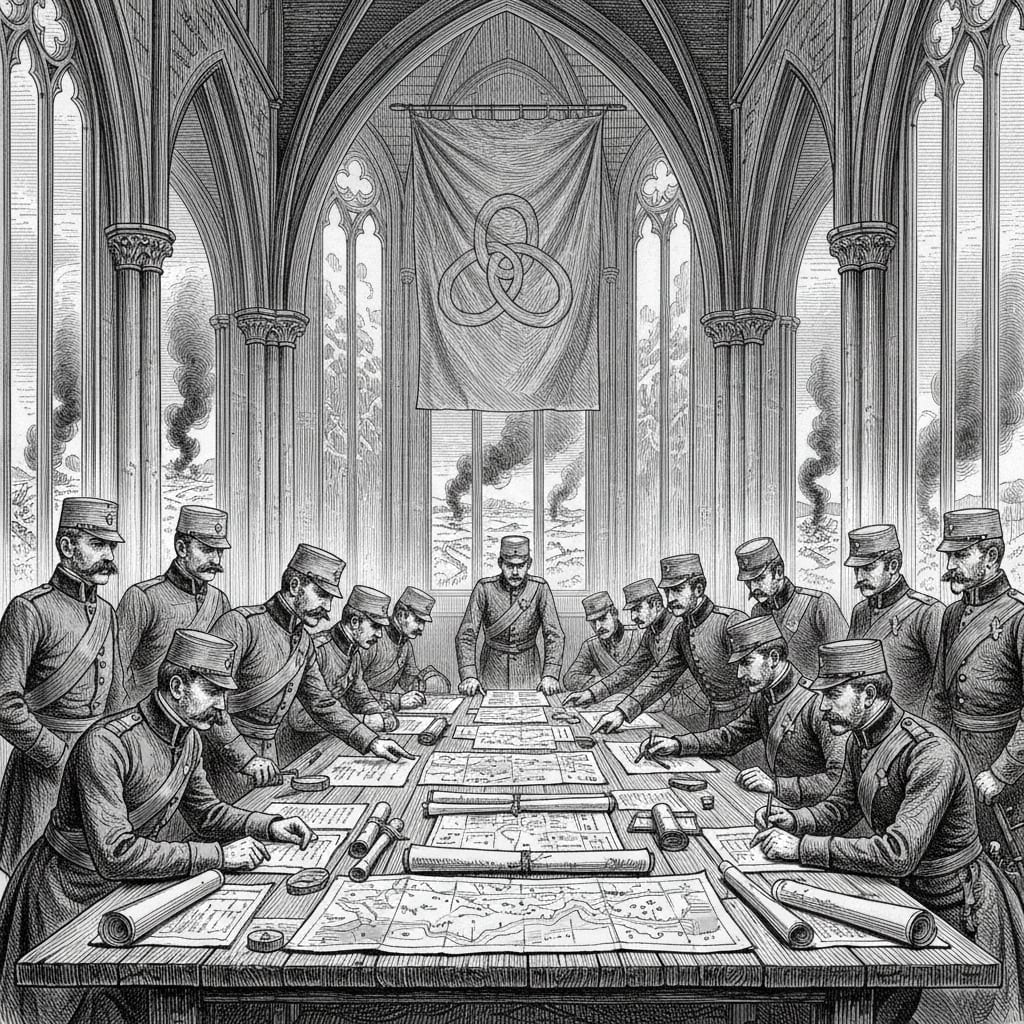
#On the Founding of War's Bureau
"A sword without a writ is mutiny. A writ without a sword is Doctrine."
I am Valerius Drax, and I will tell you how the Synod learned to kill with paperwork.
Before the Bureau of War, the armies of the Faith were rabble dressed in prayer — feudal levies begged from lords who bargained for indulgences, militia assembled by bishops who could not tell a flanking manoeuvre from a feast-day procession, and mercenary companies whose loyalty expired with their coin-purse. The Siege of Vienna laid this farce bare. Nine months of famine, plague, and sorcerous bombardment, and the garrison survived not because it was well-commanded but because Bishop-Warden Clemens happened to own a reliquary mace and the will to use it. Providence is not a strategy. The Synod required an institution.
And so, in A.S. 105, the surviving clergy of Vienna drafted the Charter of Crimson Ink, establishing a permanent Bureau charged with the raising, equipping, drilling, and — this is the part I savour — the theological supervision of all military forces under the Synod's banner. An army, sanctioned by writ, fed by the Continental Levy, and answerable to Strasbourg alone.
Certain provincial histories credit the Bureau's founding to the Council of Cologne in A.S. 70.
This is false. The Charter of Crimson Ink was sealed in Vienna's ashes in A.S. 105. The Council of Cologne merely ratified what blood had already written. The notaries responsible for this confusion have been transferred to duties more suited to their talents — specifically, counting ammunition in forward trenches.
#The Crimson Sash
The Bureau's officers wear crimson sashes interwoven with fragments of pilgrim banners — strips of cloth carried by the faithful on the long roads to Strasbourg, then consecrated and cut into ribbons. Each sash is a relic in miniature, a pilgrimage compressed into a strip of dyed silk. The vanity of it appeals to me. A general wearing the prayers of ten thousand pilgrims knotted across his chest, barking orders to men whose only prayer is that the shelling stop. Not contradiction but completion: the pilgrim walks toward the Creator, the soldier walks toward the enemy, and the sash binds both journeys into one.
Rank within the Bureau follows a chain of sanctified appointment. The Warden-General commands; beneath him sit the Vexillators (standard-bearers of the grand campaigns), the Tribune-Chaplains (who lead both prayer and assault), and the Litany-Engineers, those peculiar sappers who detonate charges in rhythm with hymns. Every rank requires not merely competence but theological certification from Doctrine. A man may win a dozen engagements and still be denied promotion if his catechism scores are insufficient. War does not promote the capable; it promotes the doctrinally certified capable, which is an altogether different species.
#The Continental Levy and the Baptism of Mud
The Bureau's great engine is the Continental Levy, imposed each generation: a tenth of every household's sons, surrendered to the trenches. The levy is not conscription — the Bureau is careful about this distinction. Conscription implies compulsion. The Levy is an offering, a tithe of flesh rather than coin, sanctified by writ and sealed by Records. That the offering is mandatory, enforced by Inquisitors, and refusal punished by excommunication does not diminish its voluntary character. Not in the least.
The raw levies arrive at training garrisons — the largest at Metz, Stuttgart, and the Citadel of Lyon — where they are baptized. Not in water, but in mud. Each recruit is marched into a flooded trench, submerged to the chest, and held there while a Tribune-Chaplain reads the Litany of First Earth. When they emerge, caked and gasping, they are pronounced soldiers of the Faith. The mud is not washed away for three days. It dries to a grey crust on their skin, and the Bureau considers this crust a sacrament.
#Campaigns as Scripture
No campaign plan circulates without first being sealed by Doctrine and Purity. This is not bureaucratic obstruction — or rather, it is, but it is holy bureaucratic obstruction. The reasoning runs: if the campaign succeeds, the seals prove divine sanction; if it fails, the failure was in execution, not in doctrine, because doctrine is infallible. The logic is watertight. It is also, I confess, magnificently self-serving, and I admire it as one craftsman admires another's work.
After-action reports are composed not as military dispatches but as gospel narratives. The routing of Wrath's Horde at Belgrade in A.S. 120 was recorded as "the Miracle of the Danube's Turning," complete with three verified apparitions of saints above the artillery emplacements. The Subjugation of Seville in A.S. 155 was entered in the Ledger not as a siege but as "a procession of cleansing, attended by reluctant converts." And the Night of the Three Bridges (A.S. 172), when the Vexillators of Strasbourg forced the Danube in a single charge, was declared a miracle of locomotion — the men did not swim, the Bureau insists, but were carried by the current of Providence.
Earlier dispatches recorded 4,200 casualties at the Night of the Three Bridges.
Revised to 1,800. The Bureau of Records notes that the discrepancy reflects "a more careful accounting of the distinction between casualties and martyrdoms." The 2,400 reclassified were not killed in battle; they were translated to glory mid-crossing, which is an altogether different ledger entry.
The campaign against ████████████ in the southern passes remains under seal. Three Warden-Generals were relieved of command. Two were canonized. The third was entered in the The Index Damnatus and his name struck from every muster roll. The Bureau's position is that the campaign did not occur. The six thousand graves along the pass are, per official records, "geological features."
#The Doctrine of Layered Death
The Bureau's most celebrated tactical contribution — apart from losing men in sanctified fashion — is the Doctrine of Layered Death, the breach-holding protocol issued under joint seal of War, Doctrine, and the Bureau of Orison. It proceeds in five stages: first the Shield-Paladins interlock their tower shields in the Lock-Formation; second the Litany-Engineers drive charges into the breach-side earth while chanting Counter-Sorcery Verses; third the Ash Chaplains ascend to deploy relic-ash thuribles; fourth the Processional Band synchronizes percussion to the shield-step and detonation sequence; and fifth, if all preceding barriers fail, the breach is recorded as a "temporary martyrdom dividend."
The elegance of this system is that it functions whether or not the breach is held. Success is a military triumph. Failure is a theological one — and theological triumphs, unlike military triumphs, require no surviving witnesses.
#Medals and Sanctified Filth
The Bureau issues decorations with the same fervour it issues ammunition. Medals are struck for "strategic mud participation," for "sustained devotional endurance under artillery," for "voluntary exposure to relic-ash inhalation." There is a medal for surviving a charge and a medal for dying in one — the latter is presented to the corpse, pinned through the shroud, and entered in the Ledger of Honourable Dust.
Officers pen sermons mid-siege. This is not metaphor. During the Bombardment of Bastion-Constantinople in A.S. 188, a Tribune-Chaplain composed a fourteen-stanza homily on the theological significance of dysentery while shells cratered the ground around him. The Bureau printed it. Distributed it. It was read aloud in Strasbourg to applause. The Tribune-Chaplain was promoted, contracted dysentery himself two weeks later, and died. His homily survives. His body does not. The Bureau considers this the correct priority.
#On the Bureau's Perpetuity
War does not end. This is not a military assessment but a doctrinal one. The Sagittal Line is eternal, the Enemy is eternal, and the Bureau of War — funded by the Levy, sanctified by Doctrine, feared by the provinces, and staffed by men who write sermons about dysentery — is eternal with them. It will raise armies until there are no sons left to tithe. It will compose after-action reports until there are no battles left to sanctify. And when the last trench collapses and the last bell falls silent, some clerk of the Bureau will be found in the rubble, crimson sash knotted across his chest, writing a medal citation for the dead.