
#On the Surviving Account
This is a documentary survey, made at the Warden's desk in A.S. 201, of what the archive still holds about the episode Mainz calls the Cough Winter. The year 201 belongs to the survey. The winter has kept its own year to itself. No surviving account names it, and I will not lend it one from the drawer of plausible numbers that lesser archivists keep for emergencies.
What survives is short. It states that in Mainz, where citizens coughed each morning while officials listened, a frost made every cough sound wet, and a thousand people were executed. The account gives the custom, the weather, the verdict and the total. Then, with the brisk manners of a clerk shutting a drawer, it stops. Names, the month, the presiding officer and the list of courtyards went into no column that has come down to me.
A thousand is the reported toll, and I record it as reported. I will not round it down to comfort anyone or round it up to impress them.
#On the Morning Cough Confessions
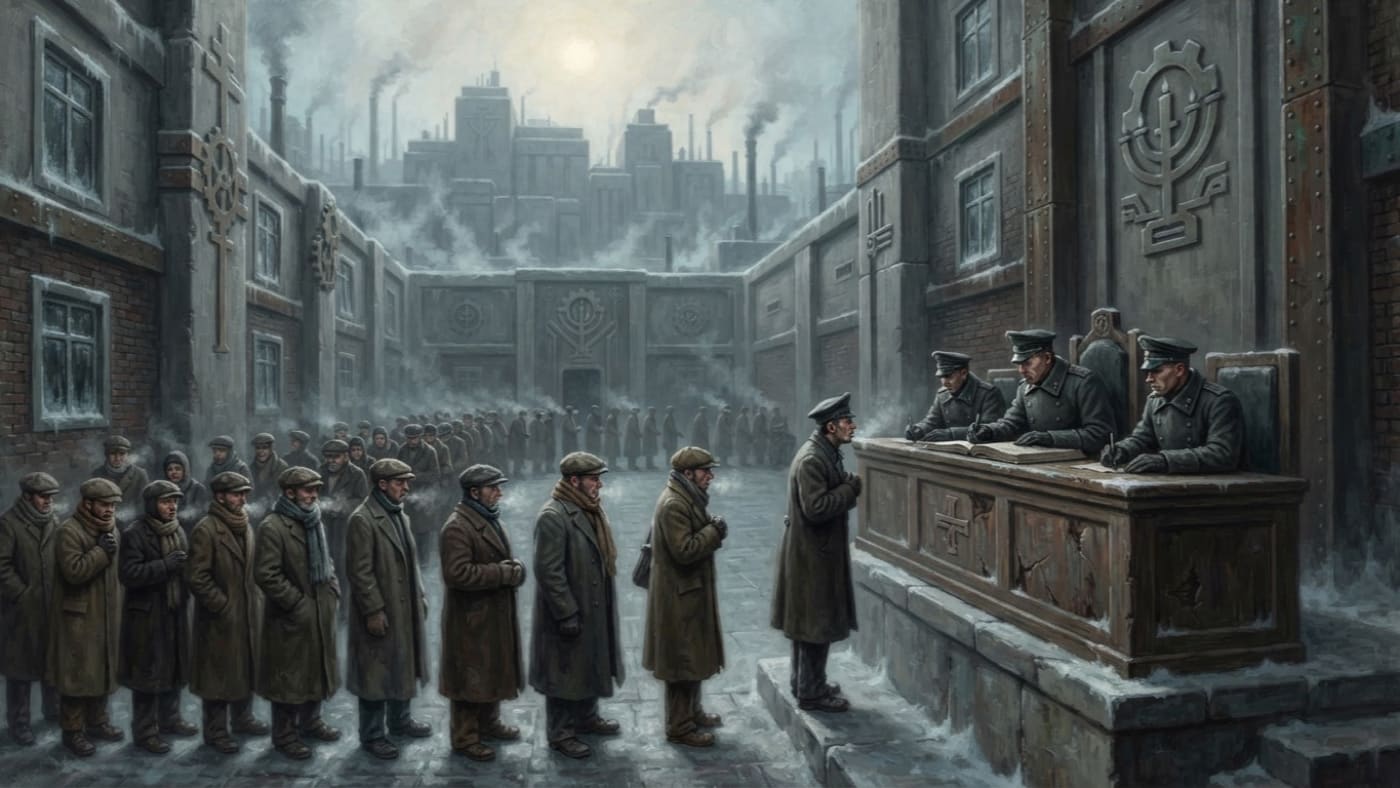
The custom is simple, which is how the worst customs travel. Each morning citizens gather in communal courtyards and cough three times. Officials listen. In this reckoning the chest is a confessional screen the penitent cannot draw shut, and any heresy hidden behind it may give itself away in the sound of the breath coming out.
The test had two answers and was meant to. A pure cough is dry. A suspect cough produces phlegm. The custom allows no third heading for a head cold, a damp lodging, a baker's flour-throat or the ordinary misery of a river city in a cold month. Each cough is filed as pure or suspect, and the next citizen coughs.
I admire its economy the way one admires a well-ruled ledger page, with narrow columns and no room for the scribe's opinion. The official need not read, question, or even look at the face. He needs ears and a column. Before breakfast the citizen supplies the evidence three times over, at no cost to the treasury, and walks home either cleared or noted.
Look closely at what the custom actually judged. It judged a sound. Nobody in the courtyard handled phlegm. The official heard wetness, and the column received a mark. Hold on to that, because the rest of the file turns on it.
#On the Frost and the Executions
Then the frost came.
The surviving account says that frost made every cough sound wet, and the verb deserves a careful reading. The sound changed. About the coughs themselves, and about the citizens behind them, the account says nothing at all. Cold air in a stone courtyard, cold throats, cold listeners: whatever the acoustics, the courtyards of Mainz began producing suspect coughs by the row.
The test did not bend, because nothing in it could bend. Give listeners a rule with only two answers and train them to hear only those two, and under frost they will return one answer. Each morning they returned it faithfully. The column filled. Every step of the procedure was obeyed, and the procedure is what killed them.
A thousand were executed.
I state it once, as the account states it, because the account does not dress it up. Of the arrests, the hearings, the method, the bodies and the families, nothing survives in what I hold. I will not put up a scaffold the archive never built. The thousand stand in the account as a single total, entered and closed.
The account preserves one more exchange. The Rationalists mocked, and the reply they got was efficiency. I find it the most honest sentence in the file. The reply does not claim the courtyards uncovered a thousand hidden heresies, and it produces no confession. It claims speed and offers the speed as its own defence. On this point the file and I agree. The courtyards worked very fast indeed.
#On the Three Explanations
Long afterward the episode collected explanations the way a dead saint collects relics, with more of them than any one body could supply. The Mainz holdings preserve three. They do not agree, and nobody has instructed me to reconcile them. I set each on the desk and read it in turn.
Later physicians blamed the weather. That is the explanation a man reaches for once he has stood in a cold courtyard and heard what cold does to a throat. It puts the fault in the frost. It asks nothing of the listeners, nothing of the column, and nothing of the officials who carried the column's verdict up the steps. In the physicians' telling the sky deceived the courtyards, and the sky, conveniently, cannot be put on trial. Their reading also quietly concedes something. If the weather made the wet sound, no heretic made it. By that arithmetic, a thousand were condemned for the season.
The Bureau of Purity blamed corruption. Its recorded position goes no further than that word, and I will not put a longer speech in its mouth than it chose to make. Corruption is Purity's oldest and most portable diagnosis. It fits any wound, travels without luggage, and comes back from every inquiry with the finding it set out with. Whose corruption it was, of what kind, and how it was found, the holdings do not say. The word is filed, and for Purity the word has always been enough.
The Bureau of Records blamed poor classification. Of the three, this is the one I feel in my own wrists, because my profession would have given it. Records looked at a thousand executions and saw a filing error: the wrong sounds sorted under the wrong heading, and the heading doing what headings do. As far as I can find, its recorded reading proposes no new heading, no third column and no reform. It names the fault and stops, as a scribe stops at the end of a line.
Side by side, the three readings split the episode among themselves like heirs dividing a house. The weather takes the frost. Purity takes the hidden chest. Records takes the column. None of them takes the thousand. The executions sit between the three explanations, unclaimed, which is how the archive keeps most of its dead.
#On the Continuing Custom
As of this survey, the morning cough ritual continues in several districts of Mainz, and officials still listen for wetness in the chest. That is the whole of the present finding. It does not show that the courtyards have coughed without a break since the frost, or that every district listens by the same rule. Nor does it show that any morning since has ended the way that winter's mornings ended. My holdings contain no instrument abolishing the custom and none correcting the test.
The bargemen call Mainz the Coughing Gate. They are a coarse brotherhood and often right.
Each morning in those districts, in cold months and warm ones, citizens assemble, cough three times, and wait to hear what the sound of their own breath has said about their souls. The frost will come back. It always does, being outside any Bureau's jurisdiction.
Mainz went on coughing. So it is entered.