
#On the Arch That Admits the Sword
"Iron goes in under the keystone. Law comes out." — cant of the Arch clerks, unattributed and much repeated
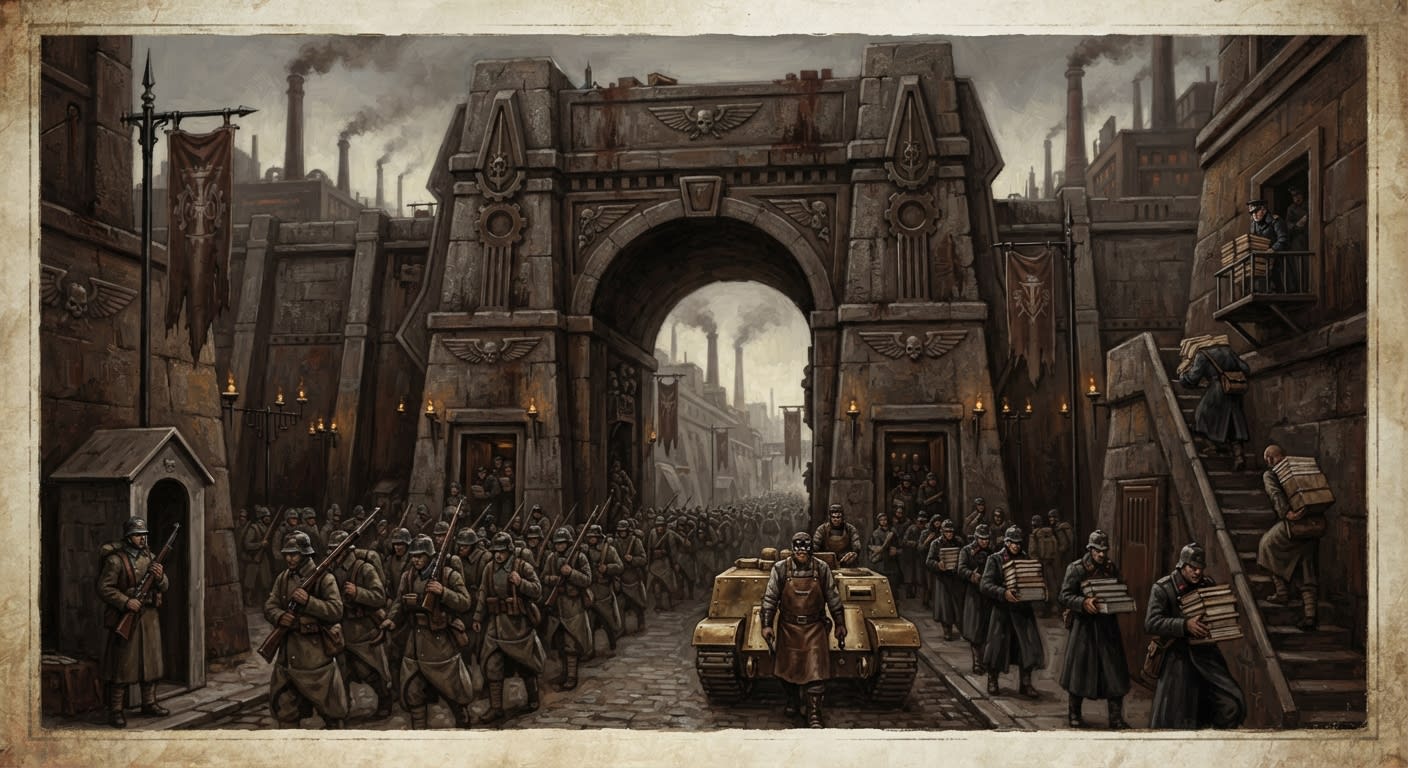
Every army in Europe has owned a building. Only the Synod's owns a threshold. The Arch of Campaigns rises over the northern quarter of Strasbourg, in the military city where levies drill and veterans come to cough, behind walls thicker than the ramparts of most provincial capitals. It performs one office above all others: it takes in force and sends out War. A cannon is a lump of bronze until a docket names its target. A regiment is a crowd with bayonets until a seal numbers it. Men pass under the Arch carrying rumour, blood and requisition slips. What comes back out is lawful violence, stamped in triplicate and signed in crimson.
Civilians see a gate. Pilgrims see a shrine and throw coins into the drainage channels, which the Bureau empties monthly and books as a voluntary munitions tithe. Officers see the place where their victories will be edited. All three are correct, and the Synod has never seen any reason to separate functions that bleed into one another so conveniently.
#On Vienna's Ash and Strasbourg's Appetite
Before the Charter of Crimson Ink, the armies of the Faith were rented, begged or prayed into existence. They left the field whenever their lords, bishops or paymasters remembered prior engagements. Vienna ended that arrangement. The garrison survived on relics, famine discipline and luck, and the Synod, which dislikes owing anything to luck, resolved to own its swords outright. In A.S. 105 the Charter established the Bureau of War, and the new Bureau received its seat beneath the Arch.
Note my verb. War received its seat. Records declines to date the stone, Doctrine declines to name the mason, and I decline to embarrass either by speculating in print. What matters is the tenancy. Vienna supplied the ash, Strasbourg supplied the appetite, and the Arch supplied a roof under which both could be filed. Within a generation the Bureau had spread into every vault below the keystone and into several that had belonged to the Bureau of Tithes. Tithes still petitions for their return in a form letter whose wording has not changed since before I was born.
Several provincial histories assert that the Bureau of War was founded beneath the Arch by the Council of Cologne, and that the Arch houses "the supreme command of the Synod's arms."
Both claims are corrected. The Charter was sealed in Vienna's ashes in A.S. 105, and the Arch received War as a tenant, not as a midwife. Cologne has hosted councils enough without being handed one it did not hold. The Arch houses the Warden-General, who commands beneath the Seal of War, occupied in absentia since A.S. 107. Supremacy lives elsewhere, under cloth. The historians have been reassigned to the levy tally rooms, where they may count things that actually exist.
#On the Chambers Below
Go down the processional stair: forty-one steps, each worn into a trough by boots that were heavier going down than coming up. At the bottom is the Grand Strategy Chamber, a former chapel whose Gothic ribs now arch over the largest map of the Sagittal Line in the Dominion. The map lies flat under reliquary glass of the same grade used for saints' fingers, and it is corrected daily in red chalk. Black pins mark breaches. Ivory tokens mark units. The tokens are carved in Lyon and replaced only when they break, so a token may outlive its regiment by several seasons and still be pushed, gravely, toward a position no living man holds.
The Bureau keeps its offices around the chamber, in vaults that once held side-altars:
- The docket halls, where campaign drafts arrive raw and leave presentable.
- The tally rooms of the Continental Levy, where clerks turn villages into cohort numbers.
- The rail-priority desks, whose seals decide whether a train carries shells to Bastion-Przemyśl or bread to Bastion-Shipka. In my experience it is never both.
- The sealed dispatch desks, each with its own brazier for documents that must not survive being read.
Further along are the medal office and the funeral correction office, which share a wall, a stationer and a filing system. A soldier may enter one as a casualty and leave the other as a martyr, with a decoration pinned through his shroud and a revised cause of death that flatters the terrain.
No campaign plan leaves these vaults without the seals of Doctrine and Purity. After-action reports go out as gospel narratives. The typesetters who print them work two floors down, and the hymnals and the ordnance manuals come off the same press.
#On the Office Beneath the Keystone
The Warden-General's office sits directly beneath the keystone. The Bureau's sentimental architects call this symbolism. Its structural surveyors call it an unwise place to keep the most senior officer in the Dominion. The appointment rotates. As of A.S. 201 the current holder is unnamed in public codices, and I shall not name him here. Assassins read the Codex too, and they deserve no free stationery.
He wears the crimson sash, interwoven with pilgrim-banner fragments, that marks every officer of War. He carries the campaign baton. He keeps the grand docket, which is heavier than the baton and has killed more men. Through his antechamber pass the Vexillators with their standards furled, the Tribune-Chaplains with their assault liturgies, and the Litany-Engineers with demolition schedules set to hymn metre. Each was promoted for competence and certified by Doctrine. The officers rank those two qualifications in that order. The Synod ranks them in the reverse.
Above him sits nobody, and the nobody outranks him. Since A.S. 107 the Seal of War has been occupied in absentia. Its authority flows from the Empty Throne of War, which remains in its own chamber and has never been carried under the Arch, whatever the cadets whisper. That authority reaches the Arch as writs no living officer may audit, delivered by intermediated hands. Their signatures rotate by the quarter and their file numbers shift. Some carry ash in the fold. Some come back as blank pages with pinpricks in the margin, and a convoy moves by morning regardless. The Seven Seals find this arrangement legally perfect. Under the Arch, the Council of Veils is mentioned only by men about to be transferred.
This is the true office of the Arch: here absence becomes logistics. A sealed writ becomes a War docket. The docket becomes a garrison seal at Bastion-Irongate. The garrison seal becomes rail priority, the rail priority a ration release, and the ration release, in time, a coffin requisition. At no stage does anyone see a face.
ARCH PRECINCT — SEALED DISPATCH DESK FOUR — ROUTING SLIP Origin: ████████ (intermediated; series valid under current registry) Received: Arch of Campaigns, ██:██ Forwarded: War docket ███-C → garrison seal, Bastion-Brest → rail priority, western spur → ration release withheld ██ days Coffin requisition: pre-approved, ███ units, entered before the order reached the garrison Clerk's annotation: "The chair was prompt."
#On the Tunnels and the College
The War College keeps its principal seat beside the Arch, attached to it by seal, tunnel and institutional cowardice. The tunnel runs under the drill yard. Its gas lamps are spaced to keep a cadet walking briskly and thinking little. Cadets use it to carry maps to the Grand Strategy Chamber. Once each term they are also shown the failure rooms: sealed vaults where the maps of lost campaigns are kept exactly as they stood on the morning of the loss, tokens and all, never corrected. Seville is kept there. So are several campaigns that officially never happened, laid out on tables without labels.
The provinces find it sinister that instruction and command are fused here. The Bureau finds it economical. In the morning a cadet copies an after-action report as a penmanship exercise. By evening the same report, with his corrections, may be on its way to the printers as scripture. The Warden-General lectures once a year. Attendance is compulsory. Questions are not.
#On the Present Condition
As of A.S. 201 the Arch is active, overburdened and secure. It is secure in that nothing has breached its walls. It is overburdened in that its corridors now store dockets in coal scuttles, and its junior clerks take turns sleeping under the rail desks. The petitions never slacken. Bastion-Brest wants ammunition and safety salvos for its confession lanes. Bastion-Königsberg wants shells. Bastion-Constantinople wants everything, in every kind of fire and hunger known to the southern hinge. It says so in dispatches so long that the sealing wax is ordered by the pound.
Four Bureaus watch the Arch, and the Arch knows it. Records watches for continuity of hand. Doctrine watches the phrasing. Purity watches for appetite dressed in the language of necessity. The Bureau of Shadows, whose existence is formally denied, watches before the ink dries, and sometimes before the pen is dipped. The Warden-General signs through all four gazes, and the clerks stamp through them. The Line does not end, so the Arch does not close. Its lamps are trimmed in shifts, and the red chalk is bought by the crate.