
#We Do Not Seek Heresy
I am Valerius Drax — Hieromnemon of Strasbourg, Warden of the Sacred Ledger, and a man who has had the distinct misfortune of sharing a corridor with the Bureau of Purity for the better part of three decades. They are, let me be plain, the most feared organ of the Synod. I include the Bureau of War in this comparison, and War at least does you the courtesy of killing you quickly. Purity prefers you alive. Purity prefers you corrected.
Their motto — Ignis Mentem Revelat, "Fire Reveals the Mind" — is not metaphor. It is operational procedure. Where Doctrine defines what is true, Purity enforces what is true, and the distance between those two acts is measured not in theology but in tongs, in branding irons, in the white-hot tip of the interrogator's stylus pressed into living skin until confession runs like ink.
Later Purity histories trace their methods to the Witch-Hunts of Toulouse in A.S. 3. The formal Synod did not yet exist. Earlier disciplinary networks grew during the wars and Retreat; Della Torre expanded Purity and the Index in A.S. 80, before the constitutional settlement. The Bureau later claimed the old hunts as its own childhood — as all good fires leave ash, and all good ash is filed.
#The Index Damnatus
The Bureau's most celebrated instrument — and the reason half of literate Europe sleeps poorly — is the Index Damnatus: the chained compendium of everything forbidden. Forbidden texts. Forbidden names. Forbidden songs, melodies, harmonics, and — in one instance in Bruges that I recall with undiminished admiration — a forbidden shade of blue.
The Index swells by the week. Procurator Maxentius della Torre drove its major A.S. 80 expansion; later heads widened its remit to incense, unlicensed bell cadences, and suspect handwriting. A vintner in Prague was burned for selling wine "insufficiently sacramental." The wine was confiscated. The Bureau of Doctrine received three casks as evidence. We have not yet finished examining them.
Earlier editions of this Codex attributed the Index Damnatus to the Bureau of Doctrine.
This is false. The Index has always been Purity's instrument, maintained by Purity's scribes, enforced by Purity's Lictors. The Bureau of Doctrine merely advises on which truths require suppression. The distinction is canonical. The Hieromnemon responsible for the earlier confusion has been reassigned to archival duties in the Paper Mines of Ulm, where his penmanship will trouble no one.
#The White Cloaks
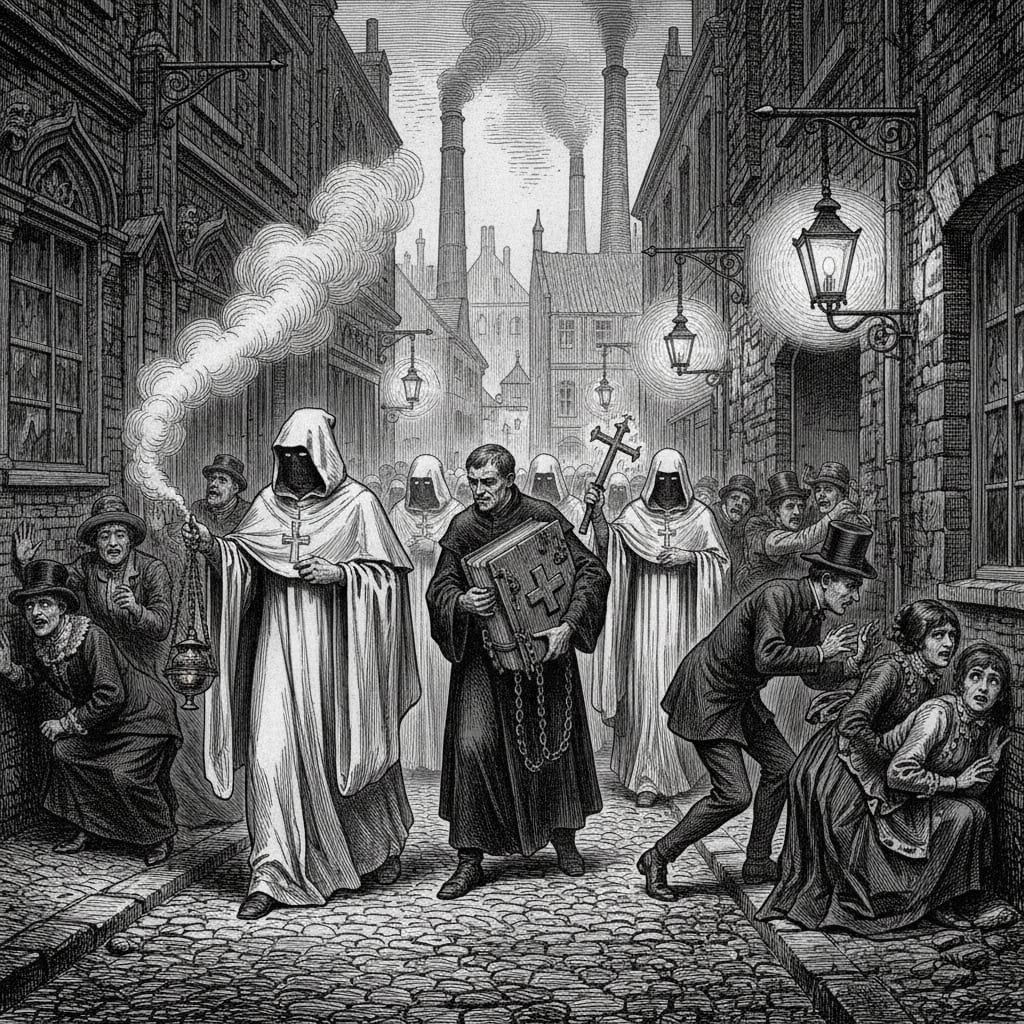
The Bureau's itinerant Inquisitors — the bone-white mantled figures that every child in the Theocracy learns to fear before they learn to read — wander from city to city with writs of cleansing that supersede local authority. A Bishop may govern his diocese. A Governor-Praelate may administer his province. But when a White Cloak arrives bearing Purity's seal, every other writ in the city becomes decorative.
They travel in processions of three to seven, with a clerk of Records in attendance to notarize confessions and a censer-bearer whose smoke is not incense but a proprietary blend the Bureau calls Verum Fumus — truth-smoke, compounded from herbs, ash, and substances the Bureau declines to name. Whether the smoke reveals heresy or merely makes the accused cough until they confess anything is a question the Bureau does not entertain. Both outcomes serve Doctrine.
In Prague, a procession of White Cloaks once remained for eleven months. When they left, forty-three households had been "cleansed," the city's mirth quotas had been halved, and the municipal choir had been disbanded for singing in a key the Bureau deemed "tonally Rationalist." The choir-master was not executed. He was given to the Lictors. What the Lictors gave back was not, in any recognizable sense, the same man.
#The Lictors of Purity
If the White Cloaks are the Bureau's hand, the Lictors are its fingers — and what those fingers do is write, though not on paper. The Lictors are flesh-interrogators: specialists in extracting, inscribing, and displaying confession as public liturgy. Where the Inquisitor pronounces guilt, the Lictor makes that guilt visible — branded into skin in compact glyphs, each glyph encoding the crime, the date, and the relevant clause of the Index Damnatus.
Born from the Witch-Hunts and refined during the era of the Iron Choir — those hymn-singing cages suspended from cathedral rafters where heretics are displayed until confession or death — the Lictors carry three traces wherever they walk:
Branded Flesh. Confessions burned into skin: word, date, clause. The condemned may be paraded through market squares, hung in the Iron Choir, or sealed into the Pillars of Glass to serve as permanent monuments to the Bureau's thoroughness.
Severed Tongues. In districts where speech exceeded its permit — the Laugh Riots of Seville, where taverns exceeded their mirth quotas — it was the Lictors who carried the brazier and the knife. They are not executioners. They are editors.
Errata in Flesh. When Purity issues a stamped correction — a relic reclassified, a doctrine amended, a phrase struck from the permitted lexicon — the Lictors visit those who used the older wording. The catechisms change. The scars follow.
#The Penitential Shadows
Below the Lictors — or beside them, or above them; the hierarchy of Purity is deliberately opaque — operate the Penitential Shadows: the Bureau's secret informants, planted in parishes, guilds, regiments, and households across Europe. They are not spies in the common sense. A spy gathers intelligence for a patron. A Shadow gathers sin for the Ledger.
The Penitential Shadows ████████████████ recruitment begins at age ████████ confessional extraction techniques ████████████████ bonded to the Bureau by oath and scar ████████████████ embedded in at least ████████ parishes across the Rhineland alone ████████████████████ distinguished from the Bureau of Shadows by ████████████████ the distinction is ████████ the Bureau of Shadows does not exist.
What is known, because the Bureau permits it to be known, is this: the Shadows discover heresy. The Inquisitors pronounce it. The Lictors inscribe it. The cycle is seamless, self-feeding, and — in the Bureau's own estimation — holy. I am not in a position to dispute the characterization. No one is.
#The Fume-Inspectors
Not all of Purity's work is conducted with branding irons and bone-white ceremony. The Bureau's lower ranks include the Fume-Inspectors: robed technicians who patrol kitchens, chimneys, warrens, and convoy yards to detect contraband by scent and smoke-pattern. They carry ledger-lanterns, ash vials, and reactive parchment called fume paper that blooms when exposed to unauthorized combustion.
The Fume-Inspectors exist less to end black markets than to keep them legible — to ensure that sin is measurable, punishable, and taxable. Their field maxim, whispered but never written: "If it is not seized, it is not." Contraband becomes real only when the Bureau says it does. Everything else is simply air the Bureau has not yet bothered to breathe.
#Bed Audits, Latrine Benedictions, and the Reach of the White Arm
The Bureau's remit extends beyond heresy in the conventional sense. Purity conducts Bed Audits — dispatching inspectors to verify that married couples have shared beds at least thrice per week, failure being classified as "theft of fertility" and punishable by ration reductions. Purity affixes its sigil to every latrine in Synodic territory, requiring the Short Absolution of Waste before use. Purity licenses the sale of food, the composition of recipes, the sweetness of bread.
Earlier editions of this Codex described the Bed Audits as "voluntary compliance checks."
The word "voluntary" has been stricken. There is nothing voluntary about Purity. The Hieromnemon who wrote "voluntary" did not understand the Bureau, which is to say he did not survive the Bureau. His replacement — myself — has no such confusion.
To eat sugar is to consume sin. To drink unblessed wine is to sip the Lie itself. A vintner in Ghent hid unblessed grapes in a reliquary casket and was executed by drowning in his own vat. Survivors of the punishment claimed the vat bubbled, as if the grapes were fermenting his soul. The Bureau entered this into the record as a "minor miracle of correction" and moved on to the next district.
#On the Necessity of Dread
I will tell you what no other Hieromnemon has admitted in print, because no other Hieromnemon has possessed both the rank and the brass-plated vanity to say it: the Bureau of Purity is not loved. It is not meant to be loved. It is meant to be the thing the faithful fear more than the Adversary, because the Adversary is distant and theological, and Purity is here, in the next street, sniffing your chimney smoke and reading your bookshelf with a branding iron in its belt.
Doctrine defines. Purity enforces. Records files the result. War guards the border. And Purity, white-cloaked and censer-wreathed, walks the interior — the border that runs through every home, every thought, every breath that has not yet been stamped.
The Bureau does not seek heresy. Heresy seeks to avoid the Bureau. It fails.