
#On the Surviving Account
This survey, made in A.S. 201, covers what survives of the Excision of Utrecht and where its evidence stops. The second part takes longer than the first.
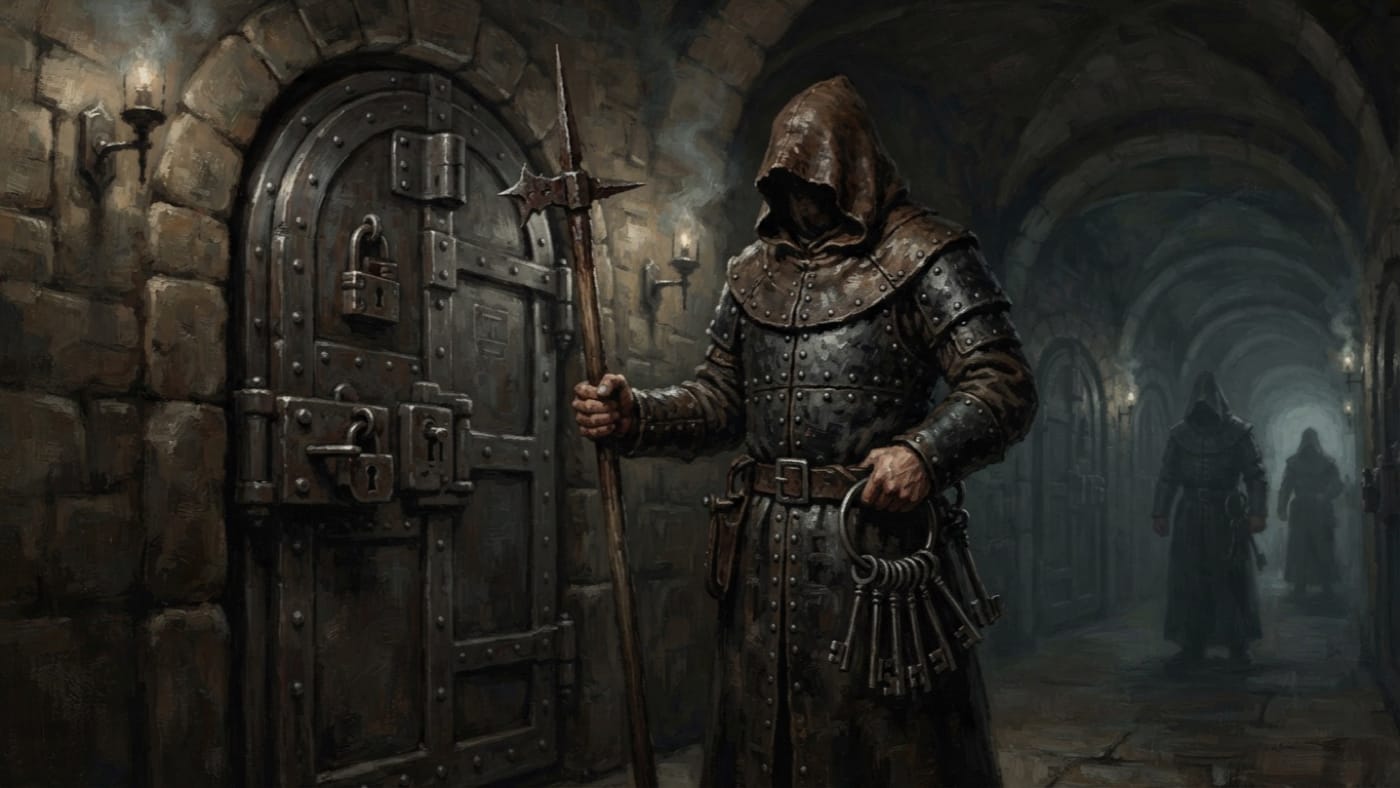
The surviving account is short enough to recite between two bells. At Utrecht, during a purge that the record describes as a purge of counterfeit saints, the Wardens guarded relic-vaults. Citizens there believed the bones behind those vault doors could testify, and they came to fear the Warden's keys more than any sword. The office came out of that duty with half of its present reputation: guardians and butchers, custodians and bruisers, the men whom common folk call Shepherds of the Rod.
That is all of it. A name, a city, an order, a duty, a reputation. No source consulted for this survey gives the year of the Excision. A.S. 201 dates this survey and nothing else. If a reader wants to give the event a year, he may bring the Bureau a document. A feeling about decades will be returned unread.
#On Custody of the Relic-Vaults
The office is older and broader than this one incident, and it should be described before anyone credits the incident with more than it shows. The Wardens are half military and half clerical. They wear iron cassocks and carry staves tipped with iron nails. Across the Synod's reach they oversee shrines, relic-vaults and penitential camps. Their trade is custody, which means holding a threshold and making passage conditional. That is why vault duty went to them at Utrecht and not to some other office. A relic-vault is a threshold with a reliquary behind it, and Wardens have always stood at thresholds.
That general description says nothing about particular orders. The office oversees penitential camps, but this does not establish that Utrecht had one. The office carries nail-staves, but this does not establish that a staff was raised at any vault in that city. The record does not preserve who gave the Wardens their orders, how many vaults they held, what lay inside them, or how long the guard lasted. The Warden at Utrecht guarded. Nothing in the account makes him the purge's commander, its investigator or its judge.
What survives is the key. In ordinary times a relic-vault key protects against theft. It keeps pilgrims' fingers off the bone and keeps a pilferer's satchel out of the crypt. During a purge the same key has a second use. Whoever holds it decides what the inquiry may reach, when it may reach it, and whether anyone will watch it done. The account does not say whom the Wardens admitted. It says that they held the keys and that the city was afraid of them.
#On the Charge of Counterfeit Sanctity
"Counterfeit saints" is the account's phrase. The Bureau repeats it because it survived. Repeating it does not confirm it.
The phrase is suggestive and imprecise. It may have meant cults raised without proper entry, remains credited to the wrong body, persons claiming sanctity while still breathing, or some category that has since lost its meaning. The record does not choose among these, and this survey will not choose for it. A survey that defines a target after the fact has taken the purge's side, whether or not it means to.
The word itself deserves notice. "Counterfeit" comes from the mint and the seal-cutter's bench. It is the language of a struck coin with the wrong face, or of wax pressed by an unlicensed hand. Calling a saint counterfeit treats holiness as something that can be forged, and so as something that can be audited. That is the Bureau's own grammar, and I recognise its handwriting. The phrase shows what the purge called its targets. It proves nothing against any particular person, relic or shrine.
The bones raise the same problem. According to the Wardens' account, the citizens of Utrecht believed that the bones behind the vault doors could testify. That belief is documented. No bone is documented as speaking, no testimony was recorded, and no verdict is attributed to a reliquary. None of that was needed. Bones do not have to speak to be feared. It was enough that a crowd thought they might, and that a man in an iron cassock held the only way in.
#On Utrecht and the Reach of Authority
Utrecht is a city of the Netherlands. As of A.S. 201 the Netherlands is an independent mercantile republic. It is non-hostile, it lies outside Synod control, and the Synod registers it with the sourness it keeps for useful creditors. Meanwhile the surviving account puts Wardens at Utrecht, holding relic-vaults during a purge. Placing those two facts side by side raises a question, and the sources do not answer it.
The consulted record does not say what Utrecht's political status was at the time of the Excision. It does not say on what authority the Wardens acted there. There is no surviving provincial claim, treaty, invitation, occupation or mandate. A present diplomatic register describes the present. It cannot be read backward into an episode whose year is itself unknown, just as a man's current debts tell you nothing about his grandfather's credit.
There are two temptations here, and both come cheap. A Synod clerk asked for a mandate would draft one before Sext, with a handsome seal and a date chosen to suit. A Dutch printer asked for an occupation would set one in good type and send an invoice for the margins. One account acquits the Wardens and the other condemns them, and neither rests on a source. This survey takes neither. It records only that the jurisdiction behind the Excision has not been established. A gap in the evidence is not proof of an illegal act, and it is not proof of a lawful one.
#On Guardians and Butchers
The Excision's documented legacy is a reputation, and the reputation is a pair of opposites. The Wardens' account names Utrecht as the place where they became guardians and butchers at once. The word "butchers" is attested. The deeds that earned it are not itemised. This survey will not supply them.
The pair makes sense without invention. Custody protects and coerces through the same act. A Warden at a vault door is a guardian to the household that fears grave-robbers. To a household that fears what the inquiry will find, he is something else. He makes no change to his posture, his key or his cassock. Only the person looking at him changes. "Shepherds of the Rod" covers both: a shepherd guards the flock and counts it, and the rod in his hand was never there for decoration.
The Wardens account sets Utrecht beside the Purges of Languedoc, which it dates to A.S. 130 and credits with fixing the office's reputation in common speech. The two incidents share a reputation and nothing more. This survey does not borrow Languedoc's year, its violence or its methods for Utrecht. It does not claim to know which came first, or what interval, if any, lay between them. Readers who prefer one tidy story should go to the theatres.
What can be said of Utrecht amounts to this. The Wardens held the keys, the city feared the bones, and the purge had a name that sounded like an audit. The rest is unknown, and the Bureau, which has so seldom been able to say that honestly, says it here.