
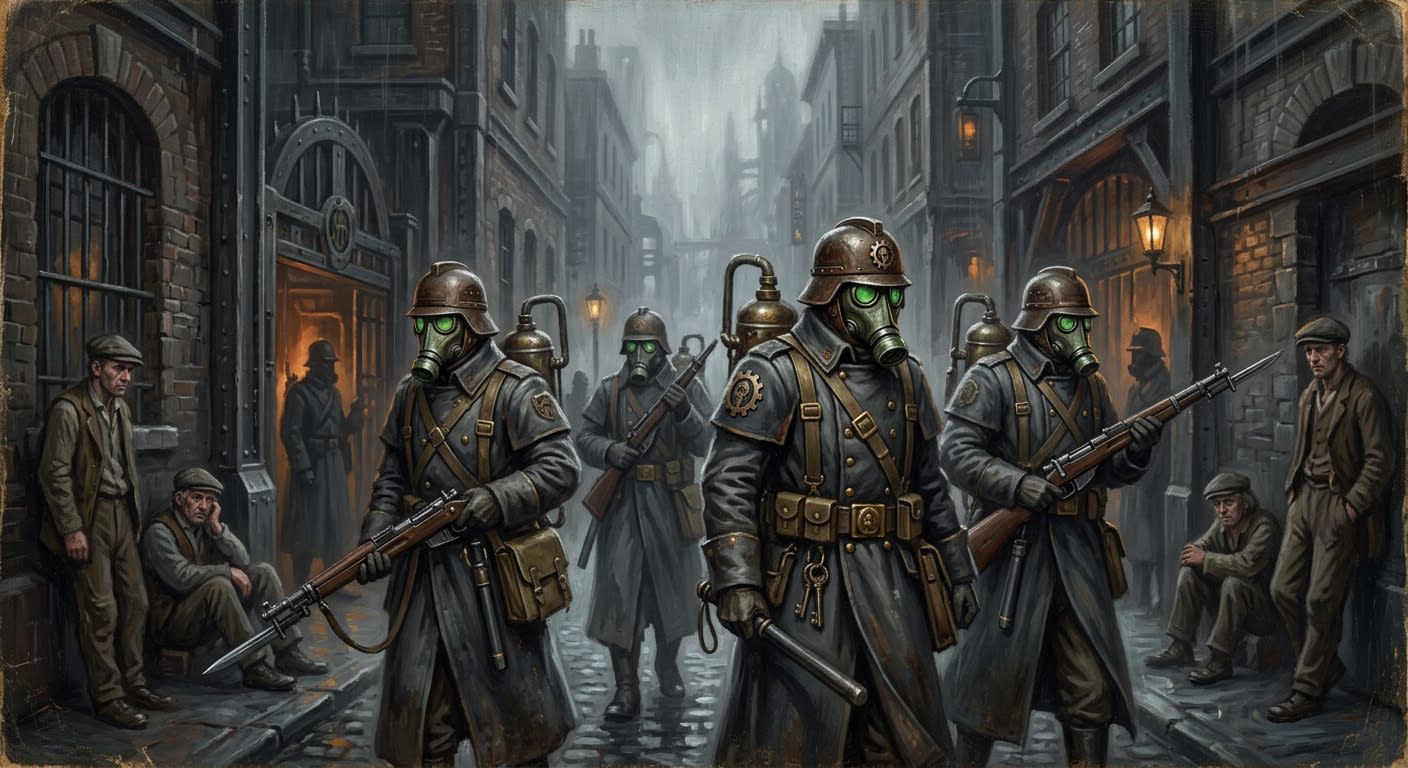
#On the Rod in the Street
The Wardens are the Synod's most visible cruelty, which is why provincials mistake them for its lowest one.
A Hierarch may bend doctrine from Strasbourg and never smell the lane he has condemned. A Procurator may sign a levy with fingers unstained by the grain he has taken. An Inquisitor may arrive after the rumour has ripened and depart before the widows learn how to file grief. The Warden remains. He stands at the ration queue, the gate, the shrine door, the convoy halt, the culvert mouth, the permit yard, the bridge-chain, the alley where curfew fog rolls low and children learn that obedience has boots.
The old manuals define a Warden as a civic-military constabulary officer authorised to enforce curfews, devotions, ration discipline, gate inspection, levy compliance, shrine order, minor detention, and the thousand smaller obediences without which large tyranny grows untidy. The people call them Shepherds of the Rod. The nickname is vulgar, accurate, and kept off official letterhead.
#On Office, Key, and Petty Dominion
The Warden's authority descends through the Bureaucratic Synod by the usual sacred route: from the Seven Seals through the Holy Bureaus, down through Bishops-Praetorial, Archons, local chapters, gate offices, ration courts, shrine registries, and whichever clerk last survived audit. By the time authority reaches the street it has lost philosophy and gained a key.
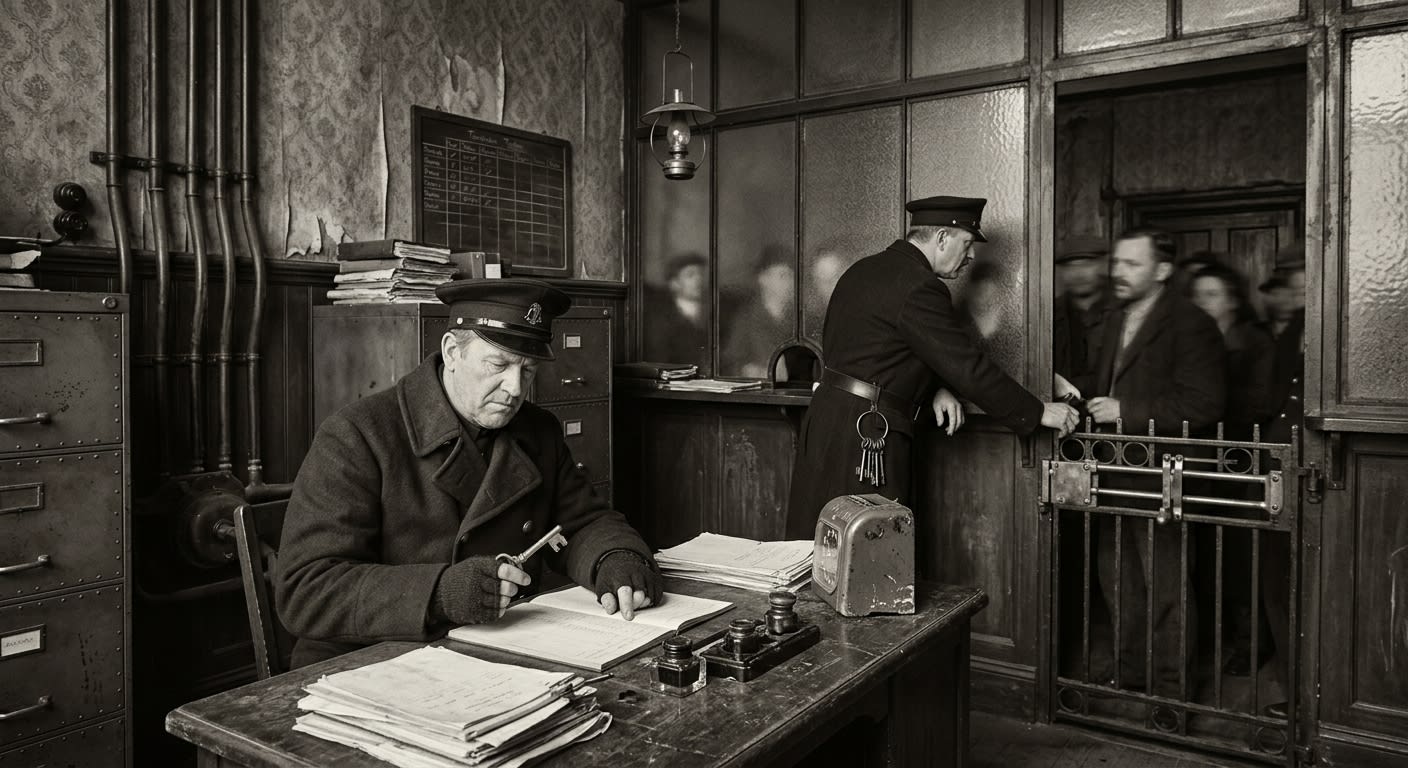
That key matters. A Warden may halt a cart, open a cellar, seal a stairwell, confiscate goods, demand the Creed, count children, inspect ration stamps, close a bridge, redirect a funeral, strike a man who argues about line order, and arrest a citizen with no explanation beyond the explanation that the arrest has occurred. Petitions exist. Appeals exist. So do rainbows painted on prison walls by men with spare lime.
Earlier civics primers described Wardens as “protective companions of the faithful household.”
Corrected. A Warden protects the household in the manner a lock protects a door: by deciding who may pass, who may wait, and who has become a burglary by standing on the wrong side of the hinge.
The office splinters by Bureau and terrain. There are Ration Wardens, Tithe Wardens, Gate Wardens, Shrine Wardens, Permit Wardens, Bellwardens, Choir Wardens, Peregrine Wardens, Hunger Wardens, Storm Wardens, Corridor Wardens, Mint Wardens, and the minor breed known in Strasbourg as Wardens of Don't-Touch-That, whose jurisdiction covers everything beautiful, dangerous, expensive, or unattended. Each specialty claims ancient privilege. Most are ancient only in the sense that every office becomes old after it has ruined three generations.
#On Bread, Gates, and the Arithmetic of Fear
At ration stations the Warden is priest, scale, cudgel, and weather. Every loaf bears its seal; every queue bears its temper; every hungry face must be sorted into patience, resentment, weakness, fraud, and potential riot before the bell changes. A Ration Warden learns to read shoulders. Shoulders lift before prayer. Shoulders tense before violence. Shoulders sag when the day's bread ends and the line continues.
Food in the Synod is no commodity. It is liturgy made chewable. Families bow before distribution, recite thanks loudly enough for the clerk, and receive bread stamped deep enough that worship survives the bite. To hoard is theft against Heaven. To question measure is doctrinal ingratitude. To share without permission is suspicious mercy, which is the most contagious kind.
Gate Wardens practice a sterner art. A gate is where geography becomes permission. Caravans arrive with seals, pilgrim tokens, coughs, contraband rosaries, forged warrants, hidden sons, declared widows, undeclared widows, foreign coin, unlicensed songs, and mules that know more routes than their owners admit. The Warden counts. The Warden sniffs paper. The Warden asks a question whose answer he already possesses because questions are not always instruments of inquiry. Sometimes they are instruments of posture.
The common complaint is abuse. This complaint is imprecise. Abuse suggests deviation from purpose. Many Warden violences are the purpose, enacted with local enthusiasm and insufficient grammar. Petty tyranny is no accident in a system that requires daily obedience from people who cannot name the Hierarch commanding it. Petty tyranny is how distant sovereignty acquires a hand.
#On the Shepherds of the Rod
The Purges of Languedoc (Unregistered) in A.S. 130 fixed the Warden reputation in continental speech. Before Languedoc, the office still retained scraps of guardian romance: shrine keepers, road watchers, relic vault sentries, men in iron cassocks who knew the difference between a pilgrim and a bandit and did not always charge for explaining it. Languedoc cured romance.
The rebellion there did not begin as rebellion. It began, as most good disasters do, as a tax dispute wrapped in local holiness. Parish stores went undercounted. Relic processions refused standard route fees. Village bells rang out of schedule, which gave the Bureau of Bells palpitations and the Bureau of Purity an excuse. Wardens entered first, because Wardens always enter first when the matter is too ugly for ceremony and too small for War.
They learned quickly. Shrine doors were barred with penitents still inside. Grain lofts were emptied and sealed under chalk marks. Households were sorted by balcony witness, hearth witness, and silence. The nail-staff acquired its second name there: the Counting Rod, because a blow could identify who still had breath enough to answer.
LANGUEDOC FIELD ANNEX, A.S. 130 — WARDEN RETURNS Village total at Matins: ███ Village total after gate correction: ███ Children reassigned to catechism wagons: ███ Bell-clappers removed: 17 Households marked “rod-responsive”: ██████████████████ Final note: “The district now understands vertical authority.”
The Excision of Utrecht hardened the other half of the legend. There Wardens guarded relic-vaults during a purge of counterfeit saints and discovered that vault keys inspire more terror than swords when citizens believe the bones behind the door can testify. The Wardens emerged as guardians and butchers, custodians and bruisers, the men who stood between the faithful and theft while occasionally conducting the theft under stamp.
The phrase “Shepherds of the Rod” was once banned as disrespectful to Warden dignity.
Restored for instructional use. The insult has become accurate enough to serve doctrine. A shepherd guides, counts, confines, shears, and decides when the flock must be reduced for its own health. The rod was never ornamental.
#On Criminal Hatred and Warden Blood
The Black Ledger slits Warden throats because it understands theatre, arithmetic, and class resentment in roughly that order. A dead tithe-clerk frightens a Bureau. A dead Warden instructs a queue. The uniform lies in the gutter; the key-ring is gone; the ration stamp pouch has vanished; the black thread inside some sleeve two streets away receives a new story.
Ledger cells prefer Ration Wardens and Tithe Wardens. These are the faces hunger knows. The Queue-Saint can distribute stolen bread beneath bells only because a Warden failed, or was bribed, or was redirected, or was found with flour packed in his mouth as a joke the Bureau pretends not to understand. The Knives call such work correction. The Accountants call it cost. The Theatres call it opportunity and arrive with clean cuffs.
Wardens hate the Ledger with the intimacy of men who recognise a rival in the same profession. Both police queues. Both count hunger. Both use fear as a scheduling tool. The distinction is licence. The Warden's cudgel descends from Strasbourg. The Ledger's knife rises from the cellar. The body struck may find the distinction academic, but the Ledger does not.
#On Varieties of the Same Boot
One should not confuse the generic Warden with every specialised office that borrows the word. The Peregrine Wardens serve Pilgrimage and ruin travellers by voiding road licences. Hunger Wardens crawl near Famine Pits on ropes and discover whether graves are still hungry. Bellwardens guard instruments that possess more legal personality than several villages. Choir Wardens enforce sanctioned sound in places where wrong notes crack stone. Storm Wardens in Lor read black snow charts and lie monthly because the charts have begun lying first.
The shared substance is not uniform, weapon, Bureau, or rite. The shared substance is custody. A Warden holds a threshold and makes passage conditional. Road, bread, bell, grave, gate, queue, tunnel, shrine, canal, storm shelter: all become little jurisdictions under the Warden's eye. A citizen encounters the Synod as a series of thresholds. A Warden stands at each one, bored, armed, and spiritually authorised to make boredom expensive.
The best Wardens are not sadists. Sadists overwork the instrument. The best Wardens are regular: same patrol rhythm, same pressure on the shoulder, same fine for the same hesitation, same prayer corrected at the same syllable. Populations can adapt to cruelty if cruelty keeps time. It is surprise that breeds rebellion.
The worst Wardens are also useful, in the way abscesses are useful to physicians who enjoy teaching. They extort, overstrike, invent offences, sell queue positions, skim marrow-wax, miscount pilgrims, misread permits for coin, and then file reports so stupidly pious that their supervisors must choose between punishing corruption and admitting it was visible. Admission is rare. Corruption often has neat handwriting.
#On Necessity, Hatred, and the Price of Keys
The faithful hate Wardens in the low, practical manner by which men hate winter, debt, and relatives who arrive during ration week. They also seek them when bandits come, when demons whisper at the ditchline, when the queue begins to move like an animal, when a child's name is missing from the bread list, when a shrine door refuses to open, when a body blocks a culvert and nobody wants responsibility for touching it first.
This is the office's ugly strength. The Warden is resented because he is near. He is needed because he is near. Strasbourg is theology, Purity is dread, War is thunder beyond the Line, but the Warden is the hand on the gate at dawn saying yes, no, wait, pay, kneel, sing, open, close.
No Synod decree survives contact with the street unless a Warden carries it there. No ration table feeds without a Warden to make hunger queue. No curfew holds unless a Warden's boots teach the hour. No shrine keeps order, no bridge keeps tariff, no convoy keeps formation, no prison keeps faith with its locks, no gate remains a gate rather than an architectural suggestion.
The Warden's cudgel is the Synod's truest signature.