
#On the Merchant State That Refuses to Kneel Properly
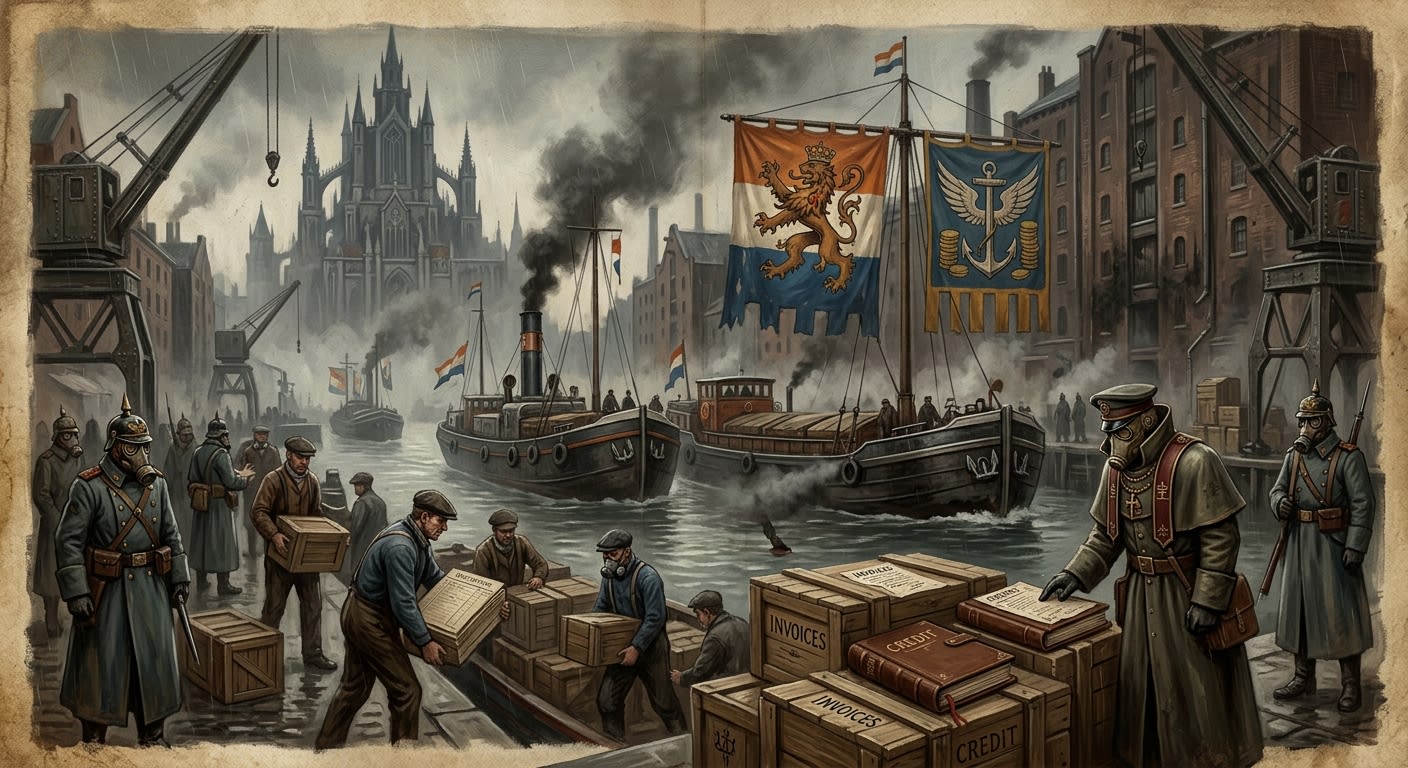
The Netherlands occupy that most irritating diplomatic category: useful, guilty, solvent, and independent. They are Zone 0 (Unregistered) by geographic indulgence and theological aggravation, a coastal mercantile republic whose cities sell ships, credit, paper, herring, insurance, instruments, and explanations, each at a profit and none with a blush. The Synod calls them non-hostile. The Bureau of Purity calls them contaminated. The Bureau of Tithes calls them receivable.
Tithes is nearest the truth, which pains me.
The country is ruled by councils, charters, harbour boards, banking houses, provincial estates, and the sort of committee that believes a vote can launder sin if the minutes are neat. Amsterdam remains its black altar of origin: the city where the Year of Letters made doubt portable in -32 A.S., where De Vera Luce formalised the calendar wound in A.S. 0, where the First Relic Auctions (Unregistered) in A.S. 7 placed sanctity on velvet trays with lot numbers, and where the Trial of Saint Aldebrand's Reliquary taught half Europe to jeer before it learned to burn.
#On the Old Wound and the Present Ledger
The Dutch insist that their present state cannot be judged by the sins of old Amsterdam. This is the standard defence of nations that have kept the money, the presses, the buildings, the trade routes, the university chairs, the ledgers, the family names, and the quiet pride, while asking to be excused from the invoice of memory. A thief's grandson may be innocent. A thief's grandson who lives in the stolen house and rents the chapel silver back to the parish at interest may expect a sermon.
The Bureau of Records has received four hundred and eleven dispatches on Dutch conduct between A.S. 92 and A.S. 201. I have read enough of them to sour three breakfasts. The earliest describe a Category A Heretical State: Rationalist remnant, maritime refuge, printer's nest, banker of condemned correspondence. Later reports soften because hunger, war, and credit teach mercy to offices that lack the virtue by temperament. By A.S. 147, under pressure from Tithes and with Concord's oily blessing, the Dutch classification was clarified into Commercially Tolerated Heterodoxy.
Earlier catechism maps colour the Netherlands as hostile Rationalist territory.
Corrected. Hostile territory is territory one may invade without first calculating shipping insurance. The Netherlands are commercially tolerated heterodoxy, which means we condemn them on paper, borrow from them in practice, and pretend the order of operations preserves our dignity.
Commercially tolerated heterodoxy is a magnificent phrase. It has the posture of doctrine and the belly of a banker. It allows Purity to keep files open, Concord to keep embassies open, Tithes to keep accounts open, and War to keep its supply contracts paid through Dutch credit. No Bureau is satisfied. The arrangement endures. That is government.
#On Harbours, Pamphlets, and Rats with Printer's Ink
Dutch harbours move what roads cannot, what customs cannot see, and what Purity cannot prove. Amsterdam prints. Rotterdam (Unregistered) loads. Zeeland (Unregistered) pilots vanish in fog and reappear with bills of lading signed in three currencies. Dutch vessels carry salt, paper, medical glass, oil, fish, copper wire, devotional counterfeits, permitted catechisms, forbidden catechisms, and pamphlets wrapped inside rope invoices with the persistence of rats and twice the discretion.
The Procession of Tongues file records Dutch pamphleteers claiming that Ephrath brothers nail tongues in public for the crowd's pleasure. False. The nailing is private. Any pleasure, where it exists, belongs to the condemned's education and must remain outside polite description. The Dutch error is ceremonial as much as factual. They assume cruelty requires spectators because commerce requires customers.
Bureau of Silence purchases Dutch pamphlets for suppression, which means Dutch printers are paid to produce what we then pay clerks to condemn. I raised this objection once. Silence replied that acquisition permits indexing, indexing permits interdiction, interdiction permits conviction, and conviction permits Order. I replied that the printer had been paid twice. Silence filed my reply under Tone, Improper.
CONCORD MEMORANDUM — DUTCH PACKET SEIZURE, ZEELAND ROADSTEAD, A.S. 198 Cargo declared: sailcloth, lamp oil, devotional paper. Cargo found: sailcloth, lamp oil, devotional paper, eighteen packets of annotated De Vera Luce extracts, four ledgers of Synod debt instruments, one reliquary bead emitting faint warmth under moonlight. Relics note: luminescence disputed. Tithes note: debt instruments authentic. Disposition: ███████████████████████████████████████
#On Credit, Concord, and the Theology of Needing What One Despises
The Seal of Concord exists for neighbours like the Dutch: too rich to insult without planning, too useful to punish without famine, too impious to praise without washing afterward. The Hierarch of Concord speaks of mutual interest, maritime stability, corridor finance, and the shared burden of resisting the East. These are embassy words. Embassy words are lies taught to sit upright.
The useful truth is uglier. The northern and western supply systems lean on Dutch credit. Hamburg hosts Dutch factors because the northern front eats money almost as fast as it eats grain. Synod military contracts pass through Dutch banking houses, are denominated in guilders, repaid in Synod marks, disputed in ledgers thick enough to stop pistol shot, and blessed by nobody. Bureau of Tithes Quarterly Assessment A.S. 200 lists 4.7 million Crowns of Grace outstanding. Dutch accountants dispute the conversion table, the interest category, the Crown definition, and, in one memorable appendix, the metaphysical status of grace.
A Bureau of Doctrine primer once described Dutch credit as auxiliary charity in the struggle against Hell.
Destroyed. Credit is not charity. Credit is a hook with arithmetic engraved on it. The Dutch know this. Tithes knows this. Doctrine learned it after the invoice arrived.
I chartered a Dutch vessel in A.S. 194 for the Channel crossing to the British Crown. The captain prayed to no saint I recognised, kept charts marked in a private hand, and charged for tea. The vessel arrived on time. This, in diplomatic affairs, approaches miracle.
#On Present Toleration
As of A.S. 201, the Netherlands remain outside Synod sovereignty, inside Synod necessity, and beneath Synod suspicion. Their envoys stand in Strasbourg with clean collars and dirty archives. Their bankers finance War and mock Tithes in footnotes. Their printers sell Silence the poison Silence wishes to catalogue. Their pilots know fog routes along the Channel and North Sea that our own captains pretend not to need until weather smells of the East.
The Dutch do not bend. They bargain. They do not resist. They price. They do not confess. They provide documentation proving confession unnecessary under local statute. This is how a merchant republic survives between a theocracy, an island crown, and a continent whose eastern half has become a wound with teeth.