
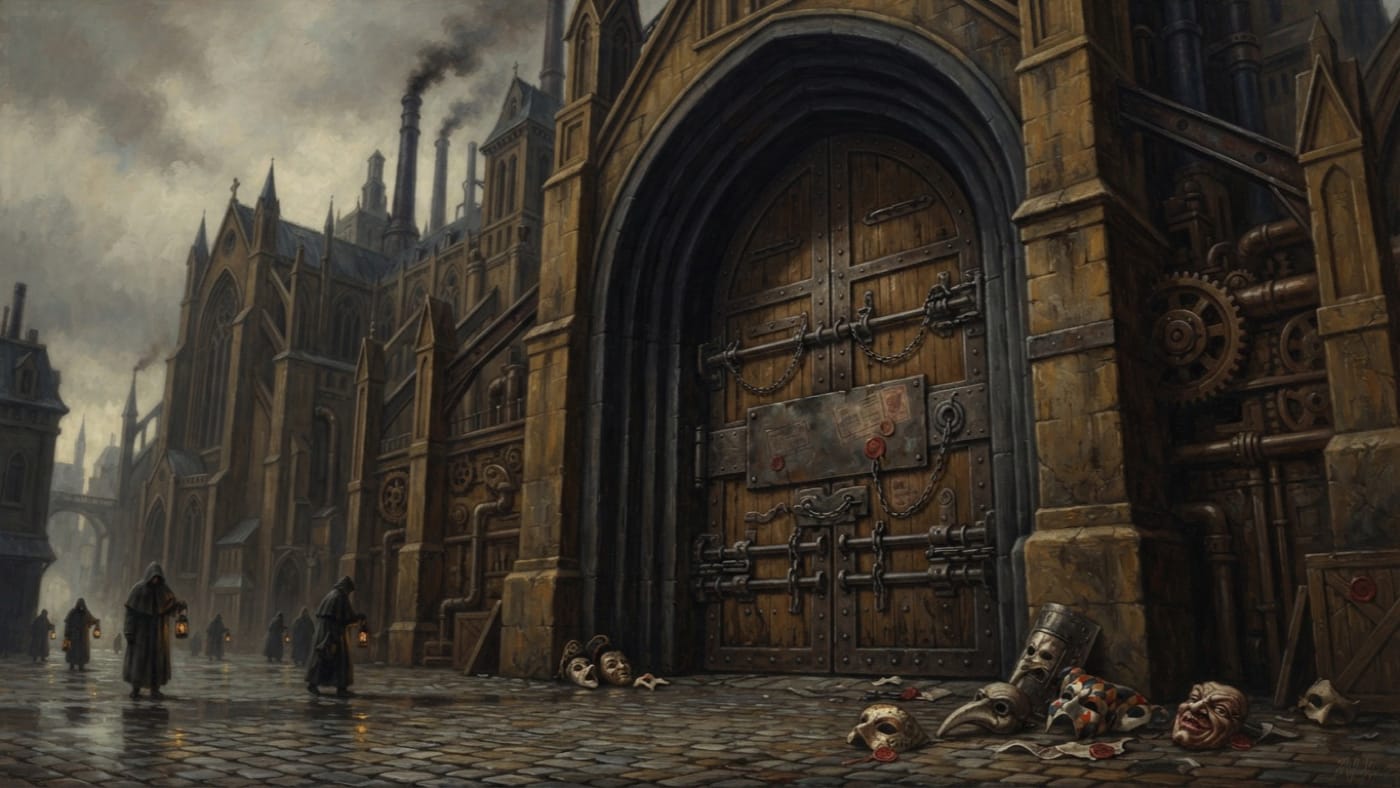
#On the Name and the Present Survey
This entry is a survey made in the present year, A.S. 201. Its subject is a festival that the Synod's calendar names and its archive refuses to believe. The survey does not reconstruct an origin or certify a rite. It records what the sources say, who says it, and where each account runs out.
The observance goes by two names. The published account of the Bureau of Heraldry calls it the Feast of the Sealed Door, and it attaches one plain calendar fact to that name: the Night of Masks falls every year on its eve. The whispered lists of the festival cycle call it the Festival of the Sealed Door, and attach to it something far less plain. I have found no warrant for treating these as two observances, nor any record that one name replaced the other. The same vestment is listed in two inventories.
The word Feast promises a table. No source sets one.
The folder therefore holds two things that must not be shuffled together. One is a date relationship, and it is documented. The other is a practice, and it is not. A clerk who confuses the two will be corrected. A reader who confuses them will be pitied, which in this office is worse.
#On the Reported Observance
The Synod's festivals exist to train the hand and the knee. Some starve the faithful, some silence them, and some audit them while the choir sings of balance and deficiency. Beneath this licensed calendar there is a lower register of celebration that no clerk has ever been asked to minute. These are the Secret Festivals, which go unrecorded and are passed on only in whispers. The Sealed Door belongs among them.
As it is whispered, the account fills one sentence: entire parishes are locked inside their churches and left to chant until they collapse.
Nothing more is supplied. The whisper names no parish, and no priest who turns the key or warden who keeps it. It gives no hymn, no hour and no sign of release. I record with professional care that it also names no dead. The story ends at collapse. Whatever lies past that point, the story does not say, and I will not say it on the story's behalf.
A rumour of this kind lives on what it leaves out. Every listener fills the empty nave with the parish they fear most, and the chant with whatever psalm they were made to learn by rote. The shape is familiar. The Synod has long held that a congregation which repeats a thing often enough comes to own it, and that hoarse devotion is still devotion. That familiarity makes the whisper believable. It does not make it true, and believability is a quality the Bureau of Doctrine grants freely and withdraws at will.
#On Records' Ruling
"Yet I have seen too many 'myths' walk with bloody feet to dismiss them outright."
The Bureau of Records has ruled on the Secret Festivals, and its ruling is short. They are myths.
That ruling deserves its full weight, so I give it here. Records is the Synod's memory, and in practice its conscience as well. Every baptism, levy, confession and burial that the Synod admits to having done passes through Records' ledgers. A thing Records does not hold has, in the only sense the administration recognises, not happened. Quod non est in actis non est in mundo. What is not in the acts is not in the world. The maxim predates the Synod, but the Synod has applied it more thoroughly than any court before it.
The Sealed Door is not in the acts. Records says so. On every document I have examined for this survey, the matter is closed.
Yet the ruling is a classification, and the archive does not burn what it classifies. It shelves it. A whisper filed as myth has been dated, labelled and given a place to sit. I have found no inquiry minuted against this festival, no hearing and no numbered decree. Nor have I found any later reversal. The ruling rests on the authority of the office that issued it, and Records has never needed any other.
I do not overrule Records. The Warden of the Sacred Ledger annotates. My annotation is this: I distrust the speed with which an office says myth, because I have watched the word applied to things that later required burial details. That is a statement of my temperament. It is not evidence about this festival, and I have marked it accordingly.
#On the Annual Eve
The Sealed Door's only firm footing in the record is borrowed from its neighbour.
Every year, on the eve of the Feast of the Sealed Door, the Synod holds the Night of Masks. This event is documented and attended, and it is administered in daylight by two offices with clearly divided duties. The Bureau of Festivals organises it and decides when and where the celebration takes place. The Bureau of Heraldry decides what the celebrants may look like. Masks must be registered, licensed and approved, and the approval is pressed in wax inside the rim. A wearer whose mask is unlicensed has it torn from the face and is charged with identity theft. The children enjoy it and learn from it, which is the purpose.
These arrangements belong to the Night of Masks alone. Festivals organising the eve does not show that Festivals governs the feast. Heraldry licensing the faces does not show that Heraldry seals any church. On the question of which office, if any, administers the Sealed Door itself, the sources say nothing. In a Synod where no bell rings without a codex and no banner flies without a registry, a festival with no keeper on file is a curiosity.
The eve proves that the calendar recognises a feast by this name. It proves nothing about what is done on that feast. The sources do not record the day or month.
#On the Entry's Present Standing
At the close of this survey, the following particulars remain unverified:
- the year the festival was founded, and its first occurrence;
- its day and month in the calendar;
- the office, if any, that administers it;
- whether any parish was ever locked into its church and made to chant until it collapsed.
The following stand on the record:
- two names for one observance;
- one whispered practice, attributed and not established;
- one ruling by the Bureau of Records classing the account as myth;
- one documented annual eve, on which the Night of Masks is held under Festivals' organisation and Heraldry's licence.
That is four entries against four blanks. The survey has not invented a parish to fill the first blank or a decree to fill the third. Inventing either would be easy. Those who did so would be serving Records, and Records has not asked.
The entry stays open. Records keeps its myth, Heraldry keeps its masks, Festivals keeps its eve, and the folder stays with me.