
#On the Nature of the Bureau
"An unregistered symbol is a rebellion not yet named."
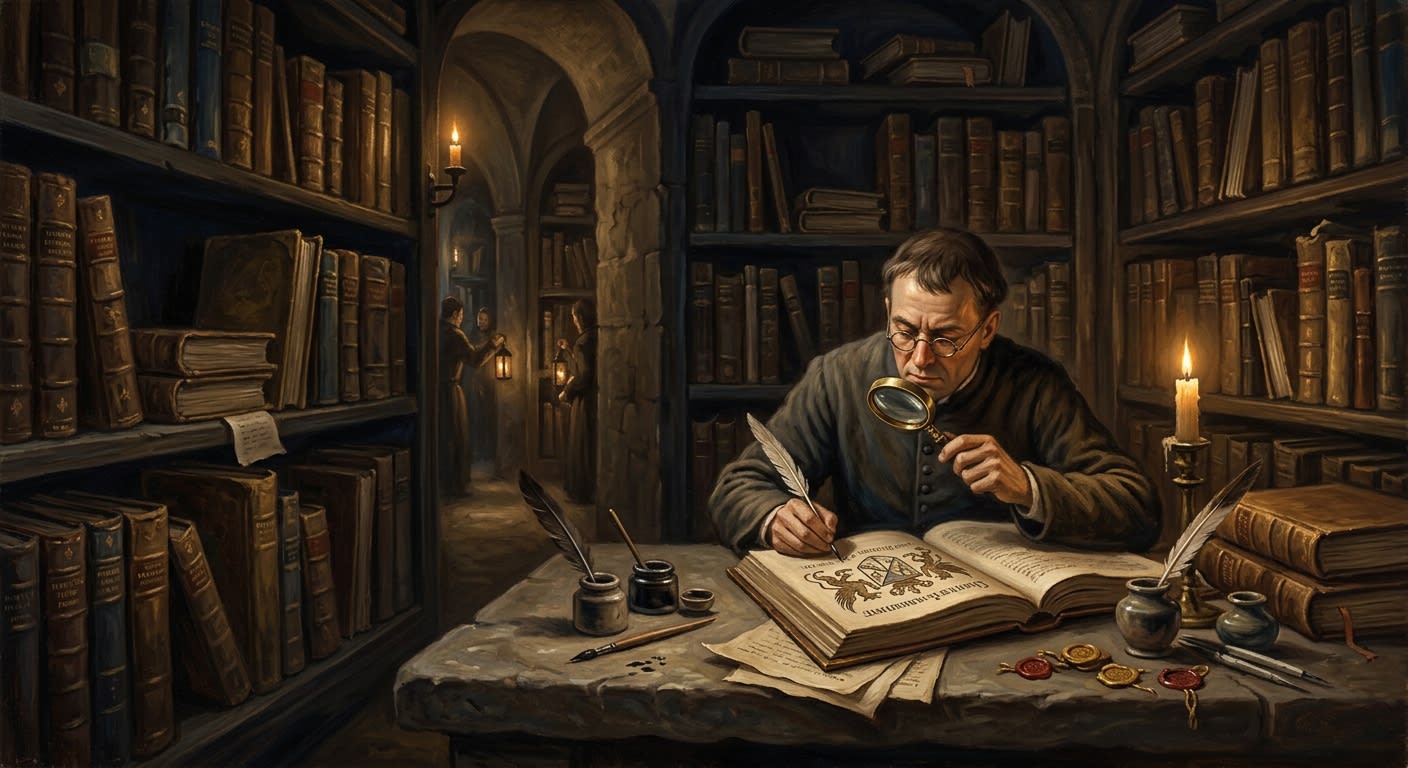
I shall tell you what the Bureau of Heraldry does. It tells the world what it is allowed to look like.
Consider that sentence. Sit with it. Examine the weight of it against the scale of your understanding and know that your understanding is, as in all things, insufficient. The Bureau of Heraldry does not merely regulate banners, though it does that. It does not merely license seals, though it does that with a thoroughness that would make the Bureau of Records weep with professional envy. It does not merely control the permitted colours of guild flags, though the Chancellery of Colors — a sub-office whose clerks have been known to start jurisdictional brawls over the precise distinction between "sanctioned crimson" and "tolerated vermillion" — has produced more litigation than most bastions produce casualties. The Bureau of Heraldry controls the grammar of loyalty itself. Every crest is a sentence. Every sigil is a declaration. Every scratched glyph in an alleyway, every chalk beast on a tenement wall, every thread of colour stitched into a soldier's cuff — these are words, and the Bureau of Heraldry has declared itself the only literate authority in a world of dangerous readers.
The Bureau maintains the Armorial of the Faithful — an immense registry of banners, sigils, seals, guild crests, processional standards, funeral markers, ration stamps, absolution tokens, muster badges, and the permitted palette of every dyer, weaver, and painter operating under the Concordat's authority. It is, by volume, the largest single document the Synod has produced, exceeding even the Great Ledger of Souls in page count, though not in theological weight. The Armorial is organized by province, district, guild, and function — and within each category, by the agonizing subcategories of permitted geometry, sanctioned colour, approved animal (a short list, growing shorter), and authorised text. To register a new symbol requires seven forms, three endorsements, a wax impression submitted to the Chancellery, and a fee calculated by the Bureau of Tithes according to a formula that has never been published and appears to change with the seasons.
To display an unregistered symbol requires nothing at all, except a willingness to be fined, flogged, or branded.
#On the Founding and the Triune Knot
"Three loops, one law."
The Bureau did not begin as the Bureau. It began as a desk — a single counting-desk in the back of what would later become the Bureau of Records' chancery in Strasbourg, staffed by two clerks who had been assigned, in A.S. 58, to catalogue the banners carried at Augustinus's Night of Black Decrees. The job was meant to take a fortnight. The banners numbered six hundred and eleven, representing every diocese, chapter, guild, and charitable order that had pledged — or been pledged, or been informed of its pledge — to the Common Allegiance. Each banner bore symbols. Many of these symbols contradicted other symbols. Fourteen banners bore the arms of houses that no longer existed. Three bore the arms of houses that had never existed. One bore a device so obscene that the recording clerk's wrist cramped mid-description and the entry was never completed.
Within the year, the desk had become an office. By A.S. 72, the office had become a division of the newly constituted Bureau of Records. By the Concordat of A.S. 90, the division had declared independence — or, more precisely, the Bureau of Records had expelled it, on grounds that "the heraldic clerks consume more ink than the rest of the archive combined and have begun issuing demands." The Bureau of Heraldry received its own charter, its own seal (designed, naturally, by itself), and its first Archon — Theobald of Worms, a man of ferocious pedantry who is said to have spent his first three months in office redesigning the Bureau's own letterhead eleven times before declaring the twelfth draft "adequate, pending revision."
It was Theobald who commissioned the Triune Knot.
The Knot had existed before Theobald, in a sense — three-looped binding marks appeared on gates and grave-slabs across the Rhineland from the earliest post-Sundering settlements, folk marks against the dark, the kind of amateur theology that the Bureau of Doctrine would later claim had always been doctrinal. Theobald standardised it. He fixed the geometry: three interlocking loops, angle-true, each loop representing one of the three pillars of the Concordat — Mercy, Order, and Sacrifice. He decreed that the Knot be carved into every gate, stamped into every official document, pressed into the wax of every absolution token, seared into the crown of every ration loaf, and inlaid above every doorway of every building operating under the Synod's licence. A house without a Knot was "unmoored" — it could not claim rations, could not receive the protection of the Wardens, could not prove that the dead within it had been properly filed.
The Knot is the most reproduced symbol in the history of the Synod. It appears on coins, on coffin-lids, on soldiers' wrists where it is stamped at mustering, on the bronze placards that line the Sanctum Mile in Constantinople, on the breath-jars sealed in the catacombs of the Basilica of the Ledgered Saints, on the hull plates of the Reliquary Flotilla, and on the confession-desk of every booth from Brest to the Bosphorus. I have the Knot embossed on my personal stationery. I did not request this. It was done for me.
ERRATUM — A.S. 199 — Standing Order 14-C (Revised)
The entry for "Triune Knot, Authorised Variants" previously listed forty-seven permitted geometries. This has been revised to forty-three. Four variants have been retroactively reclassified as "insufficiently angular" by the Chancellery of Colors. Craftsmen who have already carved the withdrawn variants into gates and lintels should note that the Bureau considers this an administrative inconvenience, not a heresy. Reclassification to heresy is pending.
#On the Crimson Boar and the Beast Proscription
"Beasts belong to wildness, not banners."
The Bureau's most consequential act — aside from the Knot, which is less an act than a condition of existence — was the Beast Proscription of A.S. 108.
The problem was animals. Specifically, the problem was that every noble house, guild, and civic corporation on the continent had, for centuries before the Sundering, placed animals on their arms. Lions, eagles, bears, boars, stags, serpents, wolves — the full zoological cabinet of European vanity, rendered in thread and paint and hammered copper. The Synod had inherited these crests, and for its first decades had tolerated them as anachronisms — old symbols, old loyalties, old vanities that would die with the houses that bore them.
They did not die. They bred.
After the Sundering, the territories east of the Line fell to the Great Deceiver's host, and the Great Deceiver's host employed beasts — real ones, corrupted ones, monstrous ones — as its instruments. The Hollow-Walkers of Kargath dragged their bulk across the Blightmarsh on limbs that had once been cattle. Morwen's envious birds stole faces. Velkara's perfumed creatures seduced with forms drawn from the natural world. In the trenches and in the rear, the garrison began to see totemic resonance where there was only heraldry. A boar on a door became a prayer to Wrath. A serpent on a guild-sign became an invocation of Greed. A wolf stitched into a child's blanket became — in the febrile arithmetic of frightened men — recruitment.
The Crimson Gate Riot of A.S. 106 settled the matter. In Essen-of-Hymnsteel, a supply convoy arrived bearing wagon-banners stamped with a crimson boar — the arms of the old Saxon supply guild, defunct since A.S. 30, revived by a quartermaster with a sense of tradition and no sense of politics. The garrison's rear echelon, already unsettled by reports of Maldrake's advance through Thrace, saw the boar on the wagons and concluded that the old dynasty had returned — or, worse, that something wearing the old dynasty's face had. The riot killed eighty-seven people in four hours. The wagons burned. The supplies were lost.
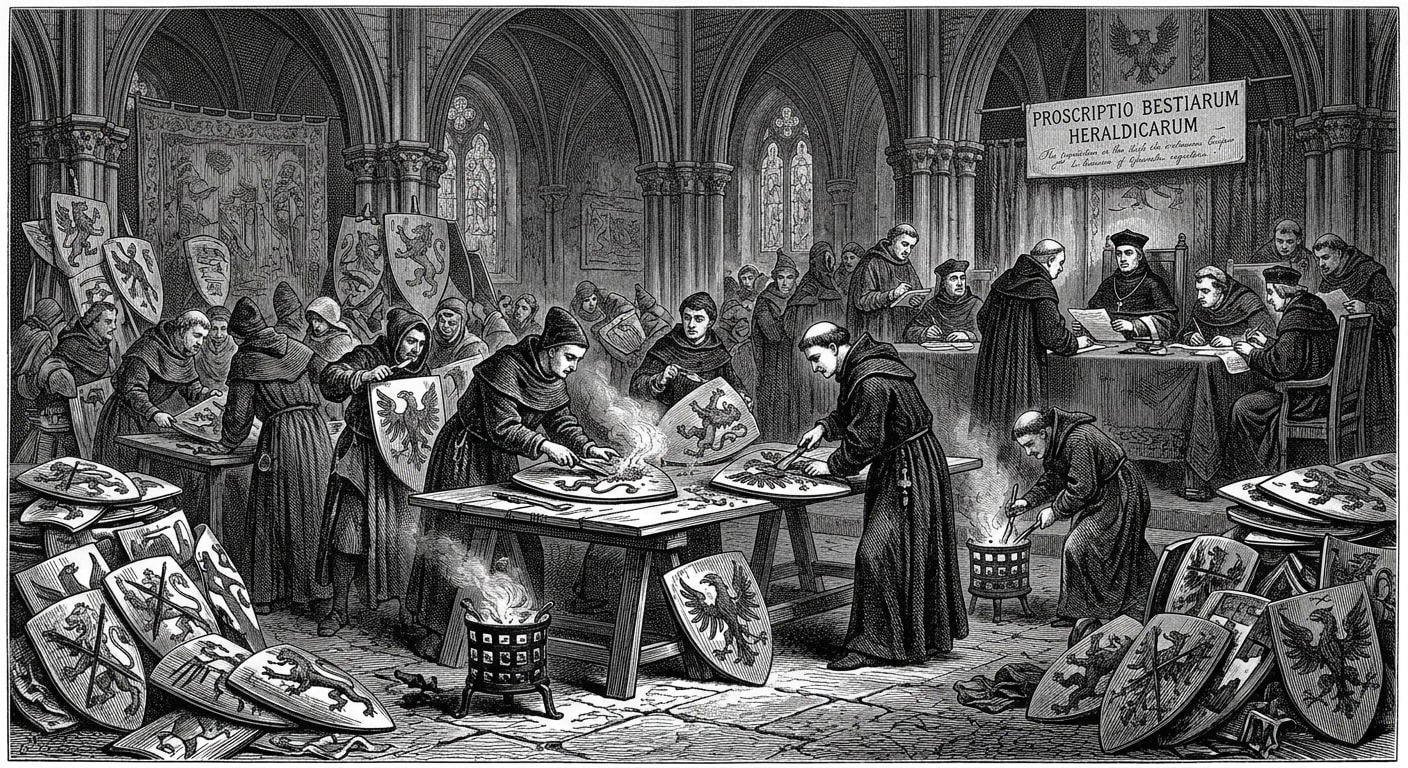
Two years later, in A.S. 108, the Bureau of Heraldry issued the Beast Proscription. All animal crests were reclassified. Lions, eagles, and stags were permitted only in "stylised canonical form" — geometric, angular, stripped of naturalism until they resembled diagrams rather than creatures. Wolves and serpents were banned outright. Bears were "suspended pending review" (the review has not concluded). And the crimson boar of Saxony was declared "an emblem of wrath, a heraldic heresy, and a provocation against the Faithful" — the first and only time the Bureau has used the phrase "heraldic heresy" in a formal decree, a phrase that has since entered the vocabularies of every Sigil Inspector on the Line.
The Beast Proscription was not popular. Guilds that had carried animal crests for generations petitioned, protested, and in three cases rioted. The Bureau of Purity handled the riots. The Bureau of Heraldry handled the paperwork. The animals vanished from the official record. They did not vanish from the alleyways.
#On the Branding and the Geometry of Guilt
"A man's flesh lies; a triangle does not."
The Bureau's most infamous instrument is not the Armorial, nor the Beast Proscription, nor even the Chancellery of Colors with its maddening taxonomy of approved hues. It is the brand.
Heraldic branding predates the Bureau. The Inquisition has always marked its condemned — tongues charred, hands stamped, foreheads seared with the pyre-cross. The Bureau of Heraldry's contribution was to standardise the geometry. Where the Inquisition branded as punishment, the Bureau brands as classification. A heretic is not merely guilty; a heretic is categorised, and the category is made legible on the body itself, so that the flesh becomes its own ledger.
The system is precise. A single equilateral triangle seared into the left cheek: heresy of the first category, doctrinal deviation, reclaimable. A double triangle, inverted, on the right forearm: heresy of the second category, active propagation, reclaimable with difficulty. A triple triangle — the Bureau's own Triune Knot, inverted and broken — across the forehead: heresy of the third category, irredeemable, marked for the scaffold or the Paper Mines. The geometry is exact. The angles are measured. Bureau-licensed brand-smiths — the Geometry Brand-Smiths of the Lore — calibrate their irons to tolerances that would satisfy the Bureau of Engineering, though the Bureau of Engineering has never been asked to verify and would prefer, one imagines, not to be.
There is a theological argument — advanced by the Bureau of Heraldry and contested by no one with the authority to contest it — that geometric branding is superior to all other forms of punishment because the brand communicates without speech, endures without maintenance, and remains legible even after death, so that the bones themselves, when eventually processed through the Marshworks or the ossuaries, carry their classification into the afterlife's administrative queue. Whether the Creator's clerks honour the Bureau's categories is a question the Bureau of Doctrine has classified as "speculative theology exceeding jurisdictional remit." The Bureau of Heraldry takes this as endorsement.
#On the Night of Masks and the Regulation of Faces
Every year, on the eve of the Feast of the Sealed Door, the Bureau of Heraldry administers its most peculiar jurisdiction: the Night of Masks.
The Bureau of Festivals organises the event. The Bureau of Heraldry controls it — which is to say, the Bureau of Festivals determines when and where the celebration occurs, and the Bureau of Heraldry determines what the participants are permitted to look like, which is the only question that matters.
Masks must be registered. Masks must be licensed. Masks must be approved by a Heraldic Examiner who verifies that the design contains no banned beasts, no proscribed colours, no forbidden geometries, and no resemblance — intentional or incidental — to any face listed in the Index Damnatus. The approval stamp is pressed into the mask's inner rim in wax, and the wearer must produce this stamp upon demand at any of the Bureau's temporary checkpoints erected for the occasion. An unlicensed mask is torn from the face. The wearer is charged with "identity theft" — a term the Bureau coined and the Bureau of Doctrine ratified without, I suspect, fully understanding what the Bureau of Heraldry intended by it.
Children are permitted simpler masks. They do not know they are being trained. The licensed mask teaches that identity is a privilege granted by Strasbourg, that to conceal one's face is sin, that to display the approved face is loyalty, and that the difference between selfhood and sedition is a wax stamp. The Bureau has never stated this programme explicitly. The Bureau has never needed to.
#On the Inspectorate and Its Instruments
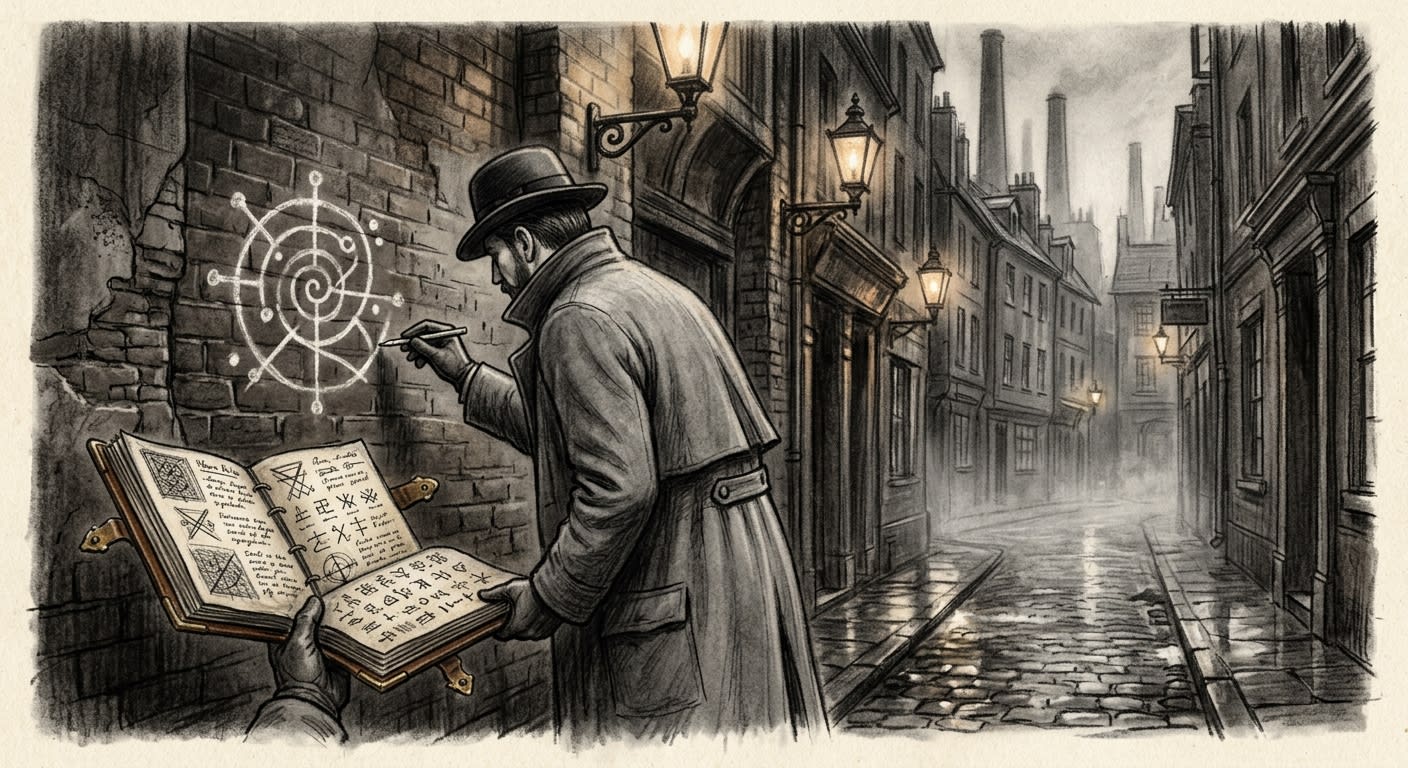
The Bureau's authority would be merely decorative — a registry gathering dust in some chancery vault — without the men and women who enforce it in the field. These are the Sigil Inspectors: grey-coated, brass-badged, ink-stained, carrying their seal-books and scraper blades through the gates, markets, guild districts, and muster yards of the Synod's territories, checking crests against permits, confiscating banners, issuing citations, and — when the matter warrants it — dragging offenders before the nearest Heraldic Tribunal for formal adjudication.
The Inspectors are, formally, the Bureau's "eyes." Informally, they are the most hated civil servants in any bastion south of Przemyśl, which is a distinction requiring considerable effort in a theocracy that employs the Bureau of Tithes. The street calls them Flag Rats, Banner Butchers, Ink Inquisitors. The Inspectors call themselves guardians of unity and lawful sight. Both descriptions are accurate.
Their working tools: the chromarch codex (a portable reference of the Armorial's permitted symbols, updated quarterly, already out of date by the time it arrives), wax stamps for approvals, colour swatches for pigment verification, measuring cord for geometric tolerances, citation tags in triplicate, a portable brazier for heating scraper blades, and — always — the scraper blade itself, half tool and half threat, carried in a belt-sheath with the deliberateness of a weapon. The work rhythm follows the light. Dawn: gate checks, wagon inspections, convoy crest verification. Midday: guild district patrols, hearings over disputed signs, the quiet exchange of bribes in back rooms where dye samples are laid out like evidence at trial. Late day: muster yard verification, soldiers' patch codes cross-referenced against Bureau of War rolls. Night: counterfeit patrols, following solvent smell and wet paint shine through curfew streets where the gangs paint by candlelight and the Inspectors hunt by lantern.
The patron saint of the Inspectorate is Saint Verral of the Clean Field, a figure of uncertain historicity who is said to have "scraped a demon out of paint" with a heated blade during the Sundering. Whether this is hagiography or a Sigil Inspector's founding mythology is a question no one within the Bureau has thought to ask, or, asking, has thought to answer.
#On the Relationship with the Bureau of Masks and Seals
A note on nomenclature. The Lore mentions a Bureau of Masks and Seals. The Holy Bureaus charter of A.S. 92 lists the Bureau of Heraldry as one entity and the Bureau of Masks and Seals as another. In practice, the two have merged so completely that the distinction is administrative rather than operational — maintained only because the charter says they are separate and the Bureau of Records refuses to consolidate filing numbers without a Hierarchal decree that has been "in committee" since A.S. 147. Masks and Seals handles the mechanical infrastructure: the dies, the stamps, the counter-seals, the reliquary sigils that authenticate writs. Heraldry handles the meaning — what those dies may depict, what those stamps may say, and, by extension, what every surface in the Synod is permitted to communicate.
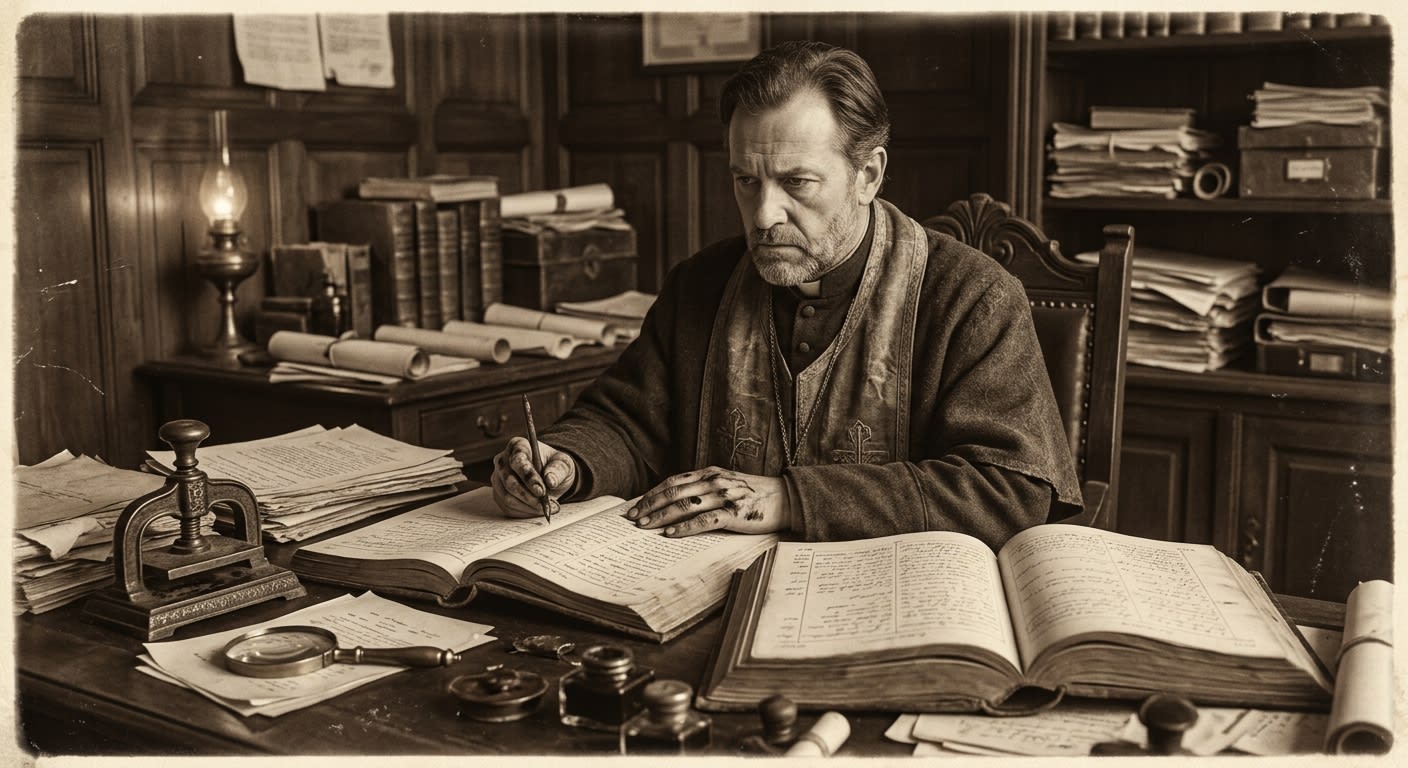
The arrangement functions because Casselius, the current Archon, holds both offices in personal union — a fact the Bureau of Records has classified as "irregular but not prohibited" and the Bureau of Doctrine has classified as "convenient." Between the two Bureaus, Casselius controls both the vocabulary of the Synod and the instruments that print it. He is, in effect, the Synod's mouth and its printing press. If this concentration of symbolic authority in a single pair of ink-stained hands concerns anyone, they have not said so — and the Bureau of Heraldry, naturally, controls what may be said.
#On the Armorial's Present Condition and the Bureau's Future
The Armorial of the Faithful, as of the most recent audit in A.S. 200, contains 347,211 registered entries — each one a symbol, a crest, a colour, a geometry, a guild mark, a processional standard, a funerary device, or a ration stamp that has been examined, measured, approved, and filed by the Bureau. Against these registered entries stand an estimated — and the Bureau will deny that any estimate has been made, because to estimate is to concede ignorance, and ignorance is not a condition the Bureau acknowledges — forty thousand unregistered symbols circulating across the Synod's territories at any given time. Chalked glyphs in alleyways. Sigils scratched into doorframes. Embroidered beasts hidden in the linings of coats. Tattoos in places the Inspectors are reluctant to examine. Mutttered emblems — verbal symbols, which the Bureau has attempted to classify and which resist classification by virtue of having no visible form.
The secret signs persist. They have always persisted. The Bureau's founding promise — that it would extinguish unauthorised symbolism and render the Synod's visual field as clean and legible as a freshly stamped writ — has not been fulfilled, and the Bureau has long since ceased pretending otherwise. Instead, it has adopted a doctrine of containment: the symbols will circulate, but the Bureau will know which ones, will know where, will know what they mean before their users know what they mean, and will — when the political arithmetic favours it — scrape them off the walls and brand their authors.
ERRATUM — A.S. 200 — Armorial Audit
The 347,211 figure includes 2,814 entries classified as "duplicate," 411 entries classified as "impossible" (symbols that cannot be physically rendered as described), and 1 entry classified as "pending clarification since A.S. 93." The Bureau considers the Armorial complete.
The Bureau of Heraldry is not the most powerful Bureau. It is not the most feared. The Bureau of Purity fears nothing and is feared by all; the Bureau of War commands armies; the Bureau of Doctrine — my own — commands truth. The Bureau of Heraldry commands something smaller and, in its own way, more dangerous. It commands appearance. It controls what the Synod looks like. And in a theocracy where every surface is a sermon, every banner a prayer, and every scratch of chalk on a tenement wall a potential act of war, the Bureau that controls appearance controls the boundary between loyalty and rebellion — which is to say, the Bureau controls the boundary between existence and erasure.
Casselius sleeps with a magnifying glass and a list of pending executions. Both see frequent use.