
#On the Bureau's Founding
"Joy is a sacrament. Unsanctioned joy is an insurgency."
The Holy Bureaus number twelve in the public catechism. The Bureau of Festivals is listed among the twelve, funded among the seven, feared among the three, and resented among all. It is the only Bureau whose officers carry cue bells and whose enforcement actions have, on seventeen documented occasions, included confetti.
Its origin is military.
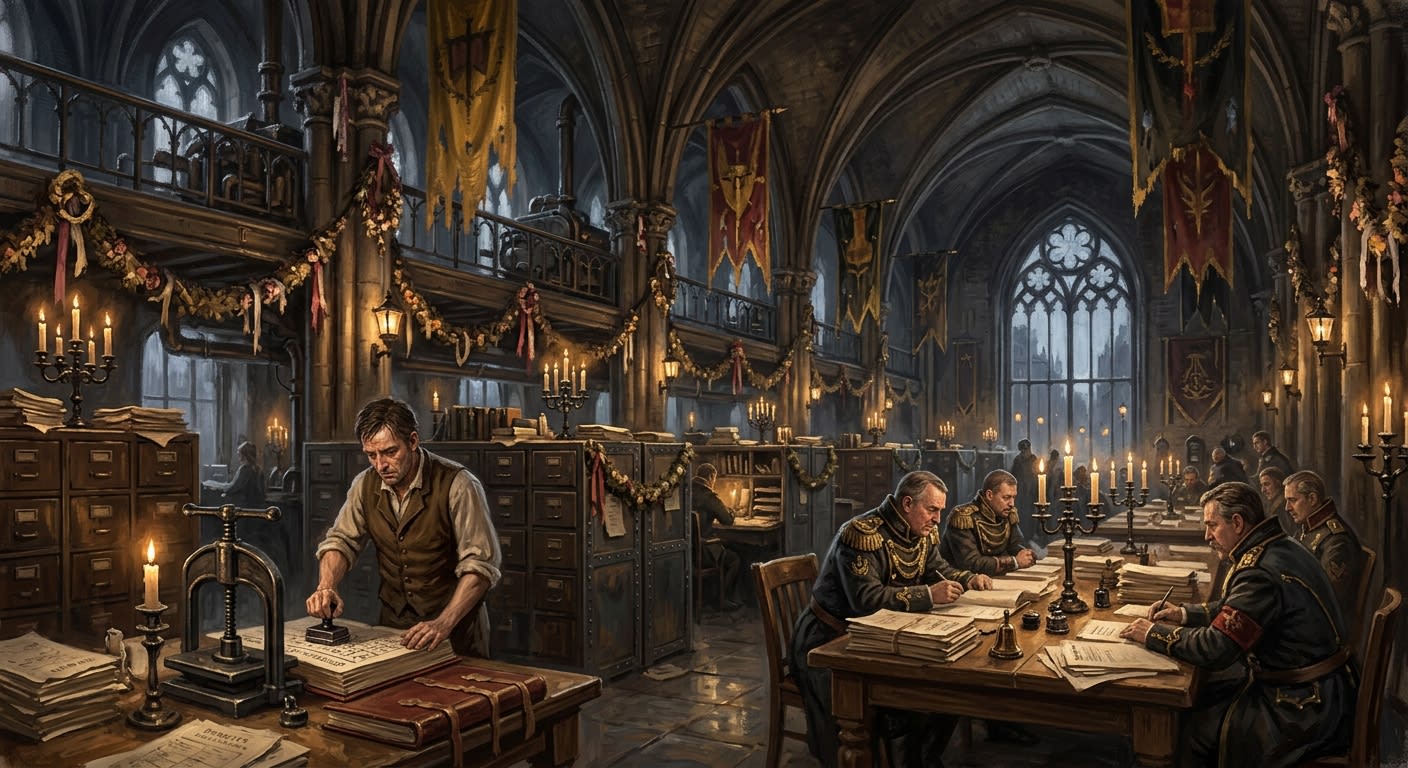
In the years following the Concordat of Strasbourg, the young Synod faced a problem that no quantity of Lictors could solve: despair. The faithful had survived the Atheist Wars, endured the Sundering, clawed through the Great Retreat, and now stood behind the raw earthworks of what would become the Sagittal Line, eating half-rations and dying of dysentery at a rate that impressed even the Bureau of Records' actuaries. Morale was a theological concern. A man who loses faith does more than desert; he stops praying, and a soldier who stops praying is, per Standing Catechism 3-F (Unregistered), already dead — the body simply hasn't received the memorandum.
The first organised celebrations were crude: a priest in the ruins of Cologne, A.S. 52, declaring a "Feast of the Unbroken Wall" when a section of barricade survived three days of Maldrake's shelling. The soldiers cheered. The priest was promoted. The principle was established — joy could be rationed, timed, and deployed like ammunition. By A.S. 58, Augustinus included festival governance in his Charter of Prescribed Observance, and by A.S. 72 the Bureau of Festivals received its own seal, its own budget, and its own enemies.
Those enemies arrived promptly. The Censorium of Taverns, which had been monitoring drinking songs for heresy since A.S. 60, objected that festivals were merely "taverns conducted outdoors." The Bureau of Bells objected that the festival bell schedule conflicted with the liturgical bell schedule. The Bureau of Orison and Song objected that festival hymns were liturgically unlicensed. The Bureau of Tithes objected to the cost. The Bureau of Festivals survived all four objections through the simple expedient of being popular, which is the one weapon the other Bureaus had never thought to acquire.
#On the Substance of Celebrations
"Rejoice by permission."
The Bureau governs every public celebration in the Synod's dominion — from the ash-flinging street carnivals of Marseille to the frozen psalm-marches of the Fractured North, from the Founding Salvos of the bastions to the pilgrim pageants of the Queue Road. Its mandate encompasses feast days, fast days, mourning observances, victory commemorations, saint's days, penitential processions, harvest rites, and — since the Heresy of Siena, A.S. 141 — all harvest dances, which must conclude with a reading from the Catechism lest the rhythm of the dance lead the dancers' feet somewhere theologically inadvisable.
The holy calendar is not a suggestion. It is a schedule enforced with the same rigour that the Bureau of War applies to troop rotations and the Bureau of Tithes applies to grain levies. Every day of the year belongs to a saint, a doctrine, an observance, or a Bureau-mandated period of "reflective stillness," which is distinct from leisure in ways the Bureau has explained at length and which I shall not reproduce here because the explanation itself constitutes a Category Two Boredom Hazard.
The calendar is divided into three registers. The Sanctioned Register governs the major feasts: the Feast of Saint Aldebrand, the Feast of Doctrinal Submission (the 3rd of Ferrum), the Feast of Saint Rupert, the Feast of Saint Barachiel, and the Festival of Departed Flames, among two hundred and fourteen others ratified by the Bureau of Doctrine and stamped with the Seventh Seal. These are mandatory. Absence is noted in the Great Ledger. Enthusiasm is measured. Insufficient enthusiasm is reported to the Bureau of Purity under the classification "Passive Ingratitude, Category One."
The Prescribed Register governs the regional observances: the Founding Salvo (Unregistered) of Bastion-Brest (which involves gun salutes and, by tradition, accidental deaths — the Bureau of Records logs the latter under "celebratory expenditure"), the Chainforging Day (Unregistered) of Thessaloniki, the Ash Toll of Bastion-Shipka, and scores of others too parochial to warrant Strasbourg's direct attention but too politically useful to abolish. Local Chorus-Masters administer these under licence. The licence costs more than the festival.
The Prohibited Register lists celebrations that have been suppressed, banned, classified, or reclassified as "historical re-enactments requiring Bureau supervision." Carnival masks were outlawed in three provinces after the Tumults of Lyon, A.S. 170. Harvest dances were reformed after Siena. Street theatre was brought under licence after a troupe in Ghent performed a satire of the Bureau of Tithes so accurate that the Archon of Tithes personally attended the second performance, took notes, and had the entire company immured within the week. The Bureau of Festivals filed the incident under "Successful Audience Engagement, Unintended Consequences."
#On the Named Observances
"Every observance is a mirror held up to Heaven."
The Bureau's calendar runs to four hundred and twelve pages in the current edition, annotated in three inks and cross-referenced against the bell schedule maintained by the Bureau of Bells, the fasting schedule maintained by the Bureau of Rites, and the grain allocation schedule maintained by the Bureau of Tithes. The three schedules agree on approximately sixty percent of the calendar. The remaining forty percent is a jurisdictional dispute that has generated more paperwork than several of the wars it commemorates.
The major observances deserve particular attention, for they reveal the Bureau's method — which is to say, the Synod's method — of converting human need into institutional control.
The Day of the First Seed. Farmers present the first grain shoots of the season at their parish shrines. The shoots are ceremonially burned. This waste proves that the harvest belongs first to Heaven and second to the Bureau of Tithes. The farmers understand the theology. They also understand the arithmetic. The Bureau of Festivals employs three auditors per province to verify that the burned shoots are genuine first-growth and not the third or fourth planting presented as the first. Fraud is common. Fraud is also forgiven, provided the tithe is paid on the genuine first-growth as well. The Bureau of Tithes calls this "flexible orthodoxy." The farmers call it something shorter.
The Fast of Silence. Entire districts are forbidden from speaking for a day. Their muteness is proclaimed as proof that even the tongue can be tamed for Heaven. The Bureau of Purity monitors compliance through roving inspectors who carry counting-stones: one stone removed from the pouch for each word spoken, one stone added for each act of spontaneous prayer observed in silence. A district that finishes the day with more stones than it started is classified as "spiritually surplus" and earns a reduced fast quota the following month. A district that finishes with fewer stones receives a visit from the Lictors. The system works. The system has always worked. The system produces the results the system was designed to produce.
The Parade of the Bones. Relics of fallen soldiers — skulls, shattered armour, the iron remnants of consecrated weaponry — are carried through bastion cities as children sprinkle petals before the procession. It is theatre, and it is effective. The dead serve the Synod more reliably than the living, for the dead do not object to being displayed, do not demand pay increases, and do not file grievances with the Bureau of Conscription. The Parade of the Bones costs less per mile than any other morale operation the Bureau has devised. I commend the accountancy, if not the aesthetics.
The Procession of Receipts (Unregistered). Shopkeepers march through their districts holding ledgers aloft while auditors chant psalms, proving that commerce itself is watched by Heaven. The Bureau of Tithes co-sponsors this event with the zeal of a man who has discovered that piety and profit share a filing cabinet. The Procession is mandatory in all Heartland cities above ten thousand registered souls. Attendance is measured by the Bureau of Festivals. Revenue generated during the Procession is measured by the Bureau of Tithes. The correlation between the two measurements is the only thing the two Bureaus have ever agreed upon.
The Feast of the Cracked Bell. Citizens gather to hear the toll of ancient broken bells whose uneven tones symbolise "the flawed but faithful spirit of mankind." The Bureau of Bells despises this festival with a passion that borders on the doctrinal. Broken bells are an abomination to the Bureau of Bells. The Bureau of Festivals insists that the symbolism outweighs the acoustics. The Bureau of Bells has submitted fourteen formal protests, three proposed redesigns, and one attempted confiscation of the Cracked Bell of Mainz, which was repelled by the city's Festival Chorus-Master with a crowd of three thousand celebrants and a strongly worded petition signed in ink that the Bureau of Bells later confirmed was "liturgically non-standard." The Cracked Bell of Mainz continues to toll. The Bureau of Bells continues to flinch.
The Triumph of the Gaunt. The most emaciated citizens from the preceding fast season are paraded through the streets as champions — praised as living icons of discipline, wreathed in laurel, carried on litters. The fattest citizens are, by custom, publicly flogged, their flesh declared "treacherous abundance" in a ceremony that the Bureau of Doctrine classifies as "corrective theatre" and the Bureau of Medicine classifies as "assault." The Triumph is popular among the thin. It is less popular among the fed. The Bureau of Festivals notes that the popularity ratio precisely mirrors the population ratio and considers this evidence of its success.
Earlier editions of this Codex listed the Triumph of the Gaunt under the Bureau of Rites' jurisdiction, as it involves fasting protocols.
The Triumph of the Gaunt is administered by the Bureau of Festivals, which manages the pageantry, under licence from the Bureau of Rites, which certifies the fasting period, with medical supervision from the Bureau of Medicine, which objects to the entire procedure. The jurisdictional arrangement satisfies no one, which is how the Bureau of Doctrine knows it is correct.
The Festival of Departed Flames. A seasonal torch-chant where the names of the dead are spoken aloud into firelight. Voices fray. Faith, the Bureau claims, finds its purest expression in grief. This is one of the few festivals that the Bureau of Festivals administers with something approaching tenderness — or at least with fewer auditors than usual. The names are logged by the Bureau of Records, naturally. The dead are thereby registered twice: once in the Great Ledger, once in flame. The Bureau of Records considers this redundancy. The Bureau of Festivals considers it mercy. I consider it both, and find neither sufficient.
#On the Procession of the Triune Hearth
"One people, one creed, one spectacle."
The greatest invention of the Bureau of Festivals — its masterwork, its vindication, its proof that joy can be manufactured at industrial scale — is the Procession of the Triune Hearth.
Staged every tenth year since A.S. 175, the Procession is a pan-European pageant of a scale that beggars description and bankrupts provinces. Bishops ride warhorses in full armour. Peasants march in chains to dramatise sin. Relic-floats bearing the bones of saints roll through streets lined with incense and fear. The route begins at Strasbourg and winds through eleven cities over forty days, terminating at Constantinople — or rather, at the Pilgrim's Gate of Constantinople (Unregistered), beyond which the Bureau of Festivals' jurisdiction ends and the Bureau of War's begins, a boundary the Bureau of Festivals has tested exactly once and will not test again.
The Procession employs four thousand participants, eleven hundred horses, three hundred relic-bearers, ninety-seven floats, forty-three choral ensembles (licensed by the Bureau of Orison and Song under grudging inter-Bureau compact), and a logistics train that the Bureau of Engineering has described as "militarily impressive and liturgically horrifying." Every participant receives a script. Every script is approved by the Bureau of Doctrine. Every approval is logged by the Bureau of Records. Every log is audited by the Bureau of Tithes, which notes the cost per participant and per mile and per prayer and presents the total to the Hierarch with the expression of a man handing a physician the results of a test he already knows the answer to.
The Procession's theological purpose is unity. Its practical purpose is surveillance. Forty days of procession through eleven cities generates a census more accurate than anything the Bureau of Records has ever managed through deliberate effort. Every citizen who watches is counted. Every citizen who does not watch is noted. The data flows to the Bureau of Purity at a rate the Bureau of Purity has described as "adequate," which is the highest compliment the Bureau of Purity has ever issued to any institution, including itself.
The next Procession is already in preparation. The Bureau of Festivals has already begun planning. The Bureau of War has already begun objecting. The Bureau of Tithes has already begun weeping.
#On the Personnel
"Laughter is a loan; repay it in obedience."
The Bureau employs three principal ranks of field officer, each loathed by the populations they serve with a specificity that suggests genuine intimacy.
The Chorus-Masters are the Bureau's creative arm — licensed joy engineers who direct festival choirs, pageants, and street-plays with one hand on the conducting baton and the other on their throat. Every laugh is scheduled. Every refrain is vetted by the Bureau of Doctrine. Every ovation is measured in duration and compared against the Prescribed Ovation Index, a document of four hundred entries that specifies the correct length of applause for every category of performance, from "patriotic hymn, bastion garrison" (fourteen seconds) to "comedic interlude, approved satirical content, licensed premises only" (seven seconds, palms only, no stamping). Chorus-Masters are trained at the Festival Conservatory of Strasbourg, where they learn to convert celebration into compliance, to route every emotional peak back into doctrine, and to survive the inevitable moment when an audience member attempts an unsanctioned encore.
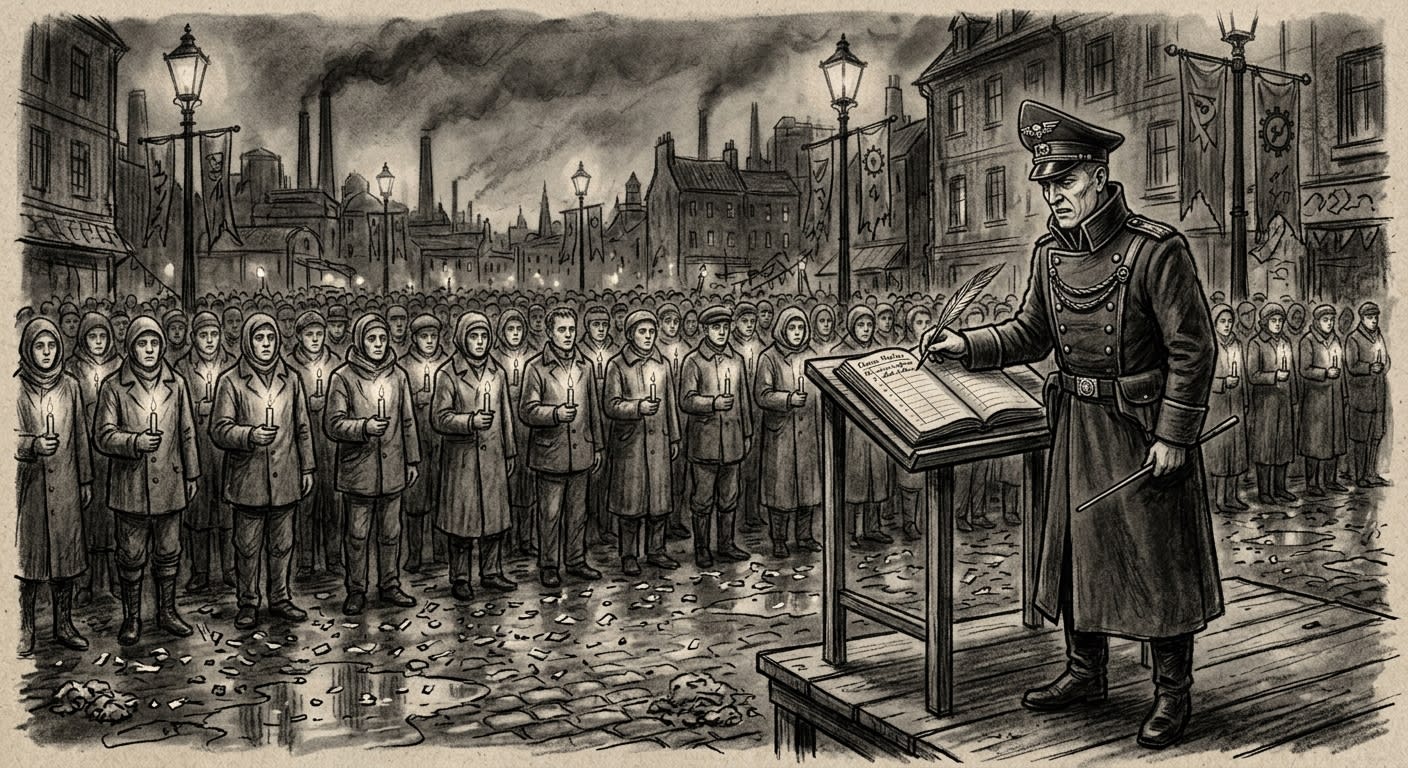
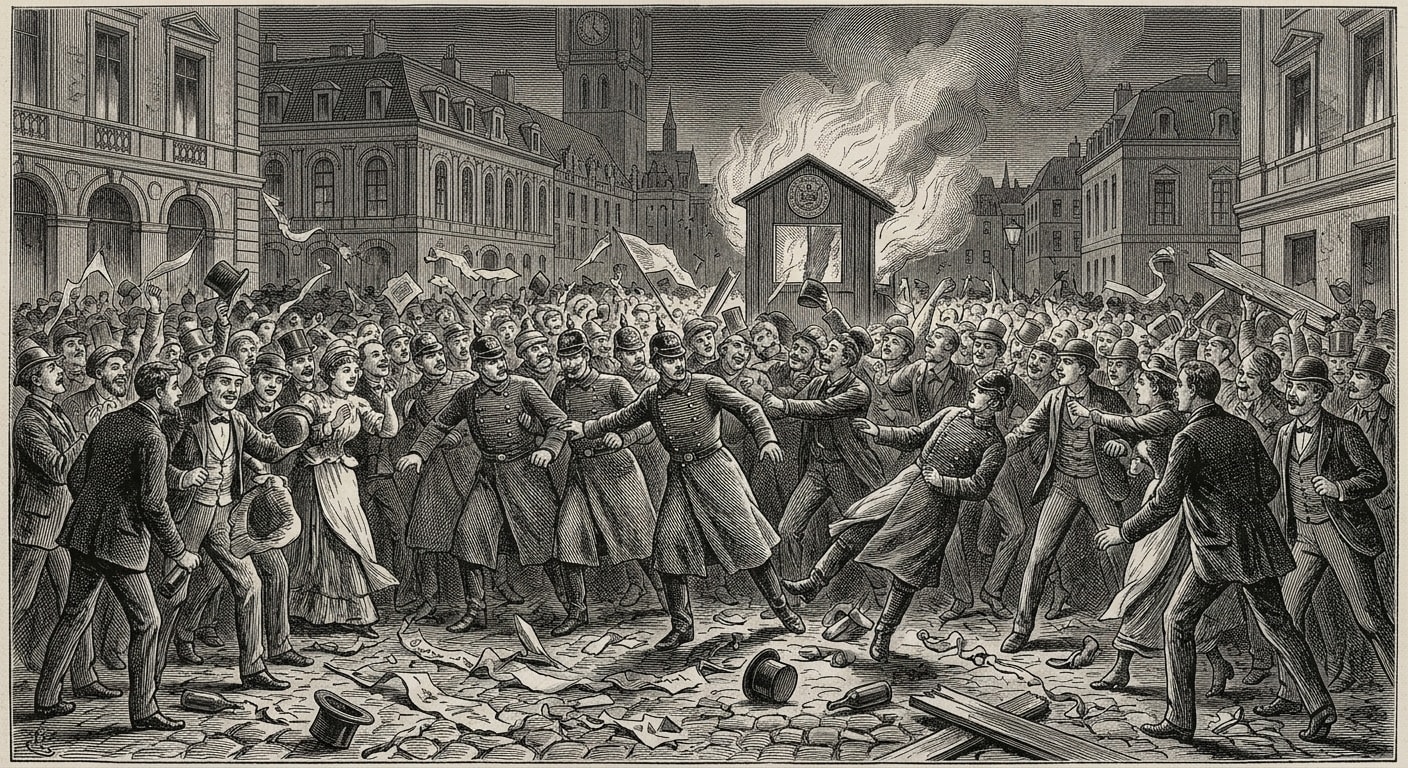
The Riot of the Third Encore (Unregistered) — in which a crowd in the pilgrim quarter of Bastion-Przemyśl demanded an unsanctioned repeat performance and the resulting crush killed dozens — is the founding trauma of the Chorus-Master corps. It taught the Bureau two lessons. First: that crowds are ordnance and must be handled with the care one applies to powder charges. Second: that the audience's desire for more is the precise point at which the performance must stop. The encore is the enemy. The silence after the last permitted note is the Bureau's true instrument.
The Pageant Captains are the Bureau's logistical officers — half-directors, half-auditors, responsible for the physical execution of processions, floats, and outdoor ceremonies. They manage crowd flow, barricade placement, float routing, and the distribution of confetti (which is licensed, measured by weight, and must be swept and weighed again after the event to verify that the prescribed quantity was deployed and not diverted to unofficial celebrations). A Pageant Captain's kit includes a manifest ledger, crowd-counting beads, a stamping iron for permit violations, and a whistle tuned to the same frequency as the Bureau of Bells' curfew signal, which can clear a plaza in eleven seconds.
The Attendance Auditors are the Bureau's intelligence officers — stationed at every festival to count heads, measure enthusiasm, and report deviations from the Bureau's Joy Compliance Index. An Auditor carries a slate, a counting frame, and a copy of Bureau Standard 12-F ("On the Measurement of Public Sentiment Through Observable Behavioural Indicators"), which assigns numerical values to smiling, cheering, weeping, kneeling, singing, and thirty-seven other observable behaviours. The aggregate score determines whether the festival is classified as "Spiritually Productive" (target), "Insufficient in Zeal" (remedial action required), or "Excessive in Spontaneous Emotion" (Bureau of Purity notified). The distinction between insufficient and excessive is a margin of four points. The Auditors work in pairs. They do not enjoy the festivals. They are not paid to enjoy the festivals. They are paid to ensure that others enjoy them correctly.
#On the Laugh Riots and Their Consequences
"Unsanctioned mirth is the first syllable of sedition."
In A.S. 153, the taverns and guildhalls of Seville exceeded their Bureau-mandated mirth quotas in a coordinated act of civic insubordination. The Laugh Riots were not spontaneous. They were planned, rehearsed, and timed to coincide with the Feast of the Cracked Bell — which meant that the Bureau of Festivals was simultaneously responsible for administering the feast and for having failed to prevent the riots that occurred during it.
The Bureau has never forgiven Seville. Seville has never forgiven the Bureau. The relationship is stable.
The mechanics were simple: every tavern-keeper in the Seville district agreed to permit one additional hour of singing past the mandated curfew. The songs were not heretical. The laughter was not doctrinally prohibited. The excess was measured in volume and duration, not content. The Bureau of Festivals' Attendance Auditors logged the deviation as "spontaneous morale surplus" and recommended a two-percent reduction in the following month's mirth allocation. The Bureau of Purity disagreed with the recommendation. The Lictors were dispatched. Tongues were taken.
The Subjugation of Seville followed two years later, A.S. 155, logged in the Ledger as "a procession of cleansing, attended by reluctant converts." The Bureau of Festivals was ordered to redesign the Iberian festival calendar from first principles. The new calendar contains thirty fewer feast days than the old. The Bureau considers this a correction. The Sevillians consider it a punishment. Both are correct.
The Laugh Riots taught the Bureau a lesson it has applied with meticulous brutality ever since: that joy is a weapon, and a weapon left in the hands of the populace is a weapon pointed at the Synod. The Bureau suppresses joy by administering it. The distinction is the difference between a pharmacist and a poisoner, and the Bureau occupies a position precisely equidistant from both.
#On the Present Condition
"No unscheduled encore."
The Bureau of Festivals enters A.S. 201 in a condition its officers describe as "operationally sound," by which they mean exhausted, underfunded, and locked in jurisdictional disputes with six other Bureaus simultaneously.
The festival calendar for A.S. 201 contains three hundred and eighty-seven approved observances, forty-one of which are classified as mandatory attendance, nineteen of which overlap with fasting days mandated by the Bureau of Rites (creating the annual paradox of celebrations at which the celebrants are forbidden to eat), and seven of which fall on dates the Bureau of Bells has designated for "acoustic maintenance" (creating the secondary paradox of festivals at which the bells do not ring). The Bureau of Festivals has filed protests regarding both paradoxes. The Bureau of Rites has responded with a three-page theological treatise on the sanctity of hunger. The Bureau of Bells has responded with silence, which may be a protest or may be acoustic maintenance.
The Tumults of Lyon remain the Bureau's foundational crisis. A.S. 170: Carnival masks in three provinces were outlawed after masked celebrants at Lyon used the anonymity of the festival to distribute seditious pamphlets, assault two Attendance Auditors, and — in a gesture the Bureau of Doctrine later classified as "creative blasphemy" — perform an unlicensed puppet show depicting the Hierarch of the Third Seal as a dancing bear. The masks were confiscated. The puppeteers were immured. The three provinces have not been permitted Carnival since, and the Bureau of Festivals stations additional Auditors in Lyon during every major observance, a deployment the citizens of Lyon refer to as "the second occupation."
The Bureau's personnel shortage is acute. Chorus-Masters are trained at a rate of forty per year. The Bureau requires sixty. The deficit is filled by provisional licensees — Chorus-Masters in all but certification, who administer festivals under probationary terms that include random doctrinal audits, mandatory confession after every performance, and the understanding that any deviation from the approved script will result in immediate licence revocation and reassignment to the Paper Mines of Ulm. The provisional licensees are, by the Bureau's own assessment, "adequate." This is the same word the Bureau of Purity uses, and it carries the same weight: faint praise that functions as a warning.
An earlier memorandum from this office classified the Bureau of Festivals as a "minor administrative bureau with limited enforcement capacity."
This classification has been withdrawn. The Bureau of Festivals administers three hundred and eighty-seven observances per year across eleven time zones, coordinates with nine other Bureaus, deploys four thousand six hundred licensed personnel, and has, since its founding, prevented an estimated forty-seven riots through the strategic application of pageantry. It is minor in the same way that the foundations of a cathedral are minor — unseen, load-bearing, and catastrophic if removed.
The Bureau's deepest anxiety, which it shares with no other Bureau and which I record here as Warden of the Sacred Ledger because it is my prerogative to record what others prefer to forget, is the question of authenticity. The Bureau manufactures joy. It schedules grief. It meters celebration and calibrates mourning. It does these things with competence and, occasionally, with something resembling artistry. But the Bureau knows — and I know, for I have sat through enough Bureau-administered festivals to have formed an expert opinion — that the joy it produces is not the same as the joy it replaced.
Before the Bureau, people celebrated because they wished to. After the Bureau, people celebrate because they are required to. The celebrations look the same. The audits produce the same numbers. The Joy Compliance Index registers the same scores. And yet something is absent — some quality that the Bureau's instruments are not calibrated to detect and that the Bureau's officers are not trained to provide.
The Bureau calls this quality "spontaneous spiritual surplus." The Bureau cannot produce it. The Bureau cannot measure it. The Bureau cannot, by its own admission, determine whether it still exists within the Synod's dominion or whether the Bureau's own administration has, over one hundred and thirty years of meticulous governance, extinguished it entirely.