
#On the Landmark
The old lime depot is in the Codex because of a single preposition. I wrote that I last saw Sergeant-Marshal Yael Dorsk on the Schreiber Road, east of the old lime depot, and that phrase has pulled an obscure building into the record and asked it to account for itself. It cannot. It is a landmark, and landmarks do not testify.
The record holds this much. The depot stands on or near the Schreiber Road, west of the point where the encounter took place. The file does not say how far west, and I did not pace it, because I had other things to do. The record puts no one inside it. Nobody is recorded sheltering in it or being pulled out of its yard. For a traveller in fog, the depot did what a depot does: it was the last named thing before the road stopped having names.
Its founder, owner, keeper, tonnage and date of construction are unentered. "Old" is my word. I used it the way every traveller does, for a building that was there before the speaker cared. Clerks have asked whether "old" means abandoned, superseded, condemned or merely unpainted. It means that I was in a carriage.
#On the Road and Its Traffic
The Schreiber Road runs between depot milestones, low ditch-fields and warehouse chapels where the plaster saints have soot in their nostrils. Those things belong to the road, and I record them as the road's. I cannot say whether any milestone, ditch or chapel belongs to the old lime depot, and I will not let a draughtsman say it for me.
The road lies west of the Irongate corridor, inland of the Danube gorge where the bastion holds the river. It carries what such roads carry in wartime: wagons, levies, ration convoys, and people whom a transfer order has turned from residents into freight. Evacuees move the way cargo moves, with more complaint and less packing.
Every such column depends on the craft of the Procession Marshal. The Marshal lays lanes with rope and chalk. He fixes a beat by drum, heel or whistle, and he spends the march listening for drift: the step that lags, the side-flow, the face in the third rank that has started looking for a way out. A road column is a crowd stretched thin enough to forget that it is a crowd. Sight holds it together. Each walker keeps pace with the back in front, and the Marshal keeps pace with all of them. Take the backs away and the column has only its ears.
I mention lime itself once, for completeness. The Church builds with it, whitewashes with it, and mortars its walls and its dead with it. No road behind the Line is without a heap of it somewhere. I do not know what this depot held, how much of it, or for whom. The name is only a name.
#On the Late A.S. 198 Transfer
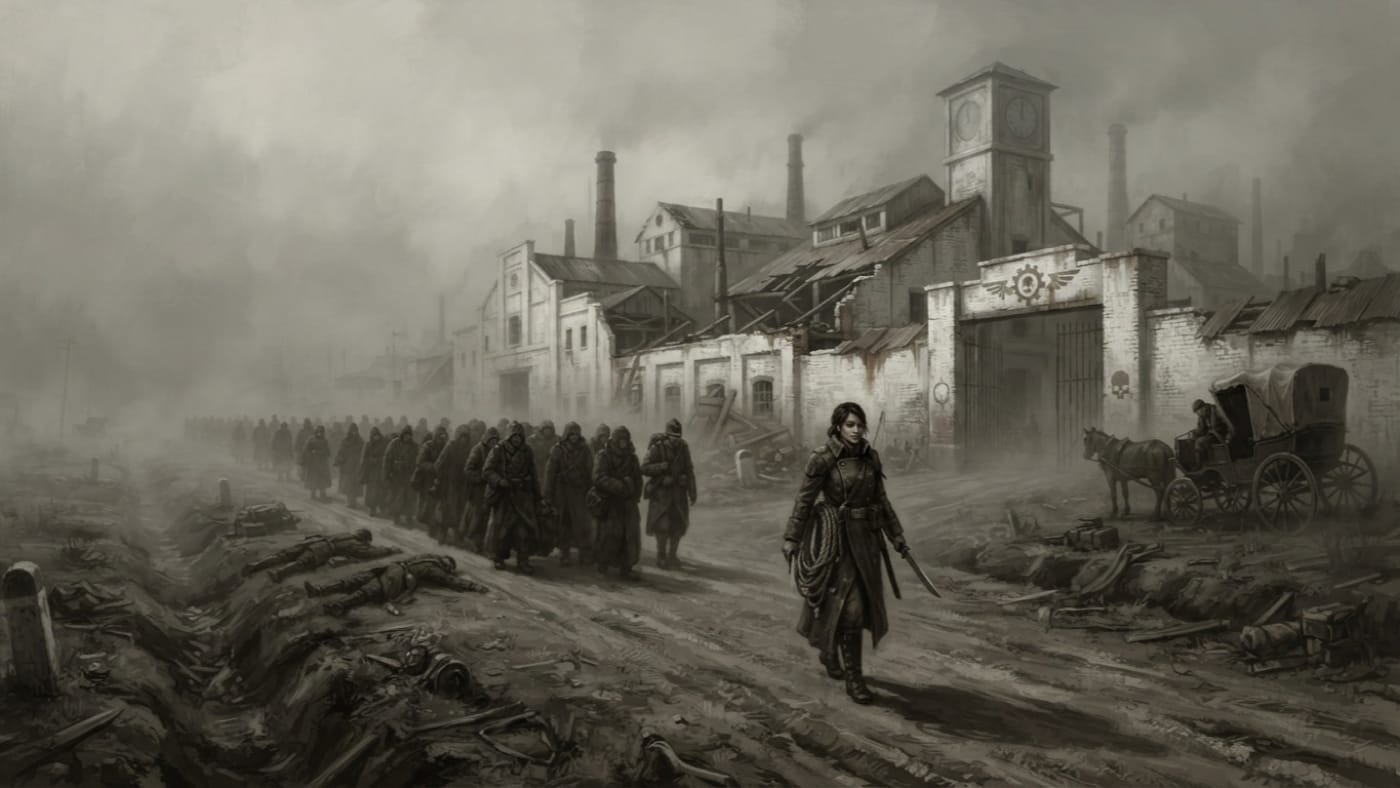
In late A.S. 198 (1908 of the Common Era, for readers who count that way), a transfer of evacuees was moving west of the Irongate corridor. I was on the Schreiber Road by carriage. A convoy fog had come down, thick enough to turn lanterns into wounds. It sat in the ditches like a congregation that would not go home. The milestones went first, then the ditch-fields, then the chapels. The depot was somewhere to the west of us in the grey.
East of it, at the verge, stood Dorsk.
I set down what I saw because I am the only person in the file who was both present and literate. She wore a cut-down Cadence Corps coat with one sleeve patched in field grey. Her whistle hung at her throat on ration cord. The rope-knife was in her left hand. Thirty-odd civilians stood behind her. I counted by shoulders and lost the count at the edge of the fog, so the figure is approximate and will stay that way. Two Cadence juniors lay in the road, alive and breathing and of no use to anyone.
She looked at my carriage the way a quartermaster looks at a dead horse, as stores. She had thirty-odd frightened civilians, two fallen juniors and a knife, and a Hieromnemon of the Sacred Ledger had arrived on an open road. Rope was the only thing on the carriage she wanted. She asked whether we carried any spare. The file does not record whether we did, and I will not improve the file from memory at this distance.
I asked why Records had buried her. She said: "Records buries anything that refuses to stand still."
By morning Dorsk was gone. The civilians were alive. The juniors got up eventually and reported no memory of anything after third bell. The record contains no corpse, no count of the dead and no account of where she went. I will supply none of the three.
#On the Second Rhythm
The Cadence Corps teaches that the beat is the column's spine. If the beat breaks, the crowd becomes weather. The training-yard walls carry its doctrine in three short phrases: one beat, one body, one road. The Bureau of Doctrine approves of them because they scan. Every junior is taught to hold the beat through grief, through fog, and through a man falling at his feet. Most of them learn it well. Two of them were lying in the road.
What follows is restricted.
PERSONAL NOTE — SCHREIBER ROAD, A.S. 198 Before any bell sounded, Dorsk identified a secondary rhythm in the fog. She ordered the civilians to break cadence and crawl. They went down. Something in the fog continued marching upright for ███ paces after the bodies had gone to ground. Sound: boots without weight. Smell: wet chalk. Identification entered: none.
I offer no diagnosis. The Corps has private words for beats that nobody is playing, and Doctrine has public ones. I have heard both used with confidence by people who were not on the road. I record one Flow Marshal's judgement on one night. She heard a step that did not belong to the column, and she took her people out of step with it. Whether that would work on another road, in another fog, is a question for men braver than the Bureau, and the Bureau has none.
#On the Surviving Record
The Bureau of Records lists Dorsk as "deceased, administrative." My testimony puts her east of the old lime depot in late A.S. 198, standing, armed and asking for rope. Both entries are in the archive, and neither has been withdrawn. Records reconciles them by declining to read the second.
Readers who want her practical judgement in a less disputed setting can find it in the Irongate ration crowd. That was a different day and a different place. She cut the east lane rope and gave three whistle-cuts, high, low, high, and the crush pressure went sideways into a wagon court. That correction belongs to Bastion-Irongate and to her dossier. It did not happen at the depot, and no amount of narrative convenience will move it there. Doctrine teaches the three-cut without her name. I record the depot without any history at all. Each of us is economical in his own way.
The Records index describes Dorsk's status as "final."
Correction carried forward unaltered from the Dorsk dossier: "final" in Records usage means "the file resists further labour." It should not be confused with mortality, truth, or competence.
The depot is what it was that night: a fixed point west of an encounter that the archive both holds and denies. Its condition in A.S. 201 is unrecorded. The Bureau has not asked, and I have not gone back.