
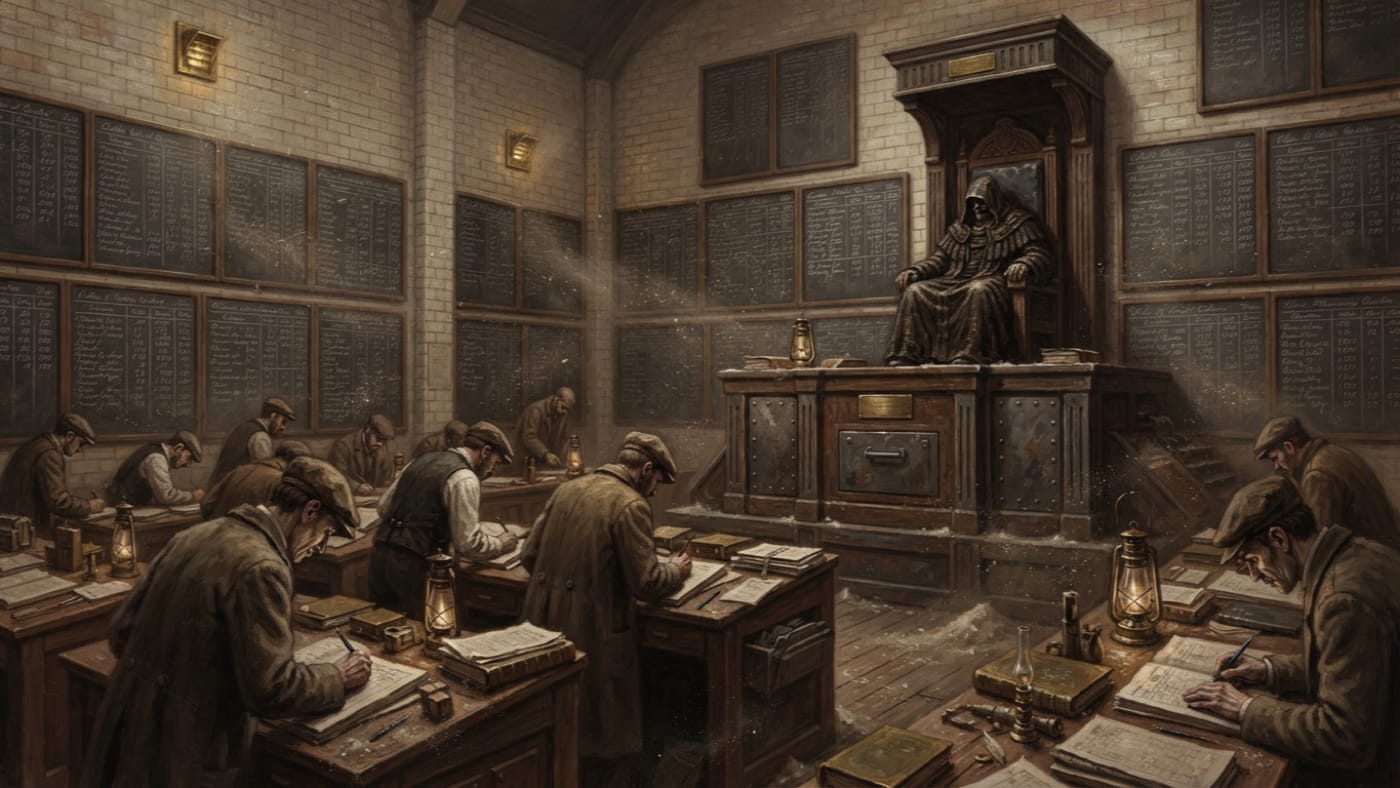
#On the Hall and the Present Survey
This survey describes the Parliament Hall of Measures as it is used now, and it is entered in A.S. 201. It draws on my three inspections of Wexel, in A.S. 194, 197 and 199, and on the town's published record. I have not been back since. The Hall has not asked me to return, and that is the only courtesy it has ever shown me.
Three things in Wexel go by one name, and the town is happy to let a visitor mix them up. Parliament Square is the civic centre inside the silo ring: pale brick, canal-water, chalk underfoot, and clerks crossing at a half-run with quotas held to their chests. The Ration Parliament is the governing body, with its Speaker, its votes, its fines and its audits. The Hall of Measures is the building in the Square where that body does its work. Wexel will tell you the Parliament meets in the Square. It means the Hall. It also means the difference is above your station.
Inside, the walls are pale brick and chalkboard. The boards carry the master quotas, and every lesser figure in Wexel descends from them. The air smells of chalk, ink, boiled grain carried in from somewhere outside, and fear drying slowly on paper. Clerks come in empty-handed and leave carrying numbers. The streets nearest the building are kept as "silent zones," so the first a citizen hears of the Hall's business is usually their own allotment, read out to them later by someone else.
#On the Measures
"A smile is a receipt." — Wexel proverb
The Parliament votes quotas every day at midday. The figure goes up on the master board in chalk. A clerk copies it in ink, and the ink leaves the Hall in a satchel for the offices that ring the Square. Chalk can be wiped. Ink cannot. Wexel has arranged matters so that only the wipeable version stays in the room where the vote was taken.
A quota leaves the Hall as a number and reaches a kitchen as a portion. Prefect Marwen Kile's Ration Prefecture turns quotas into household allotments, and enters each one either as provision, which is a right, or as clemency, which is a debt. Sister-Lector Neme Varr's Mirth Office turns the Parliament's fine schedules into citations, applied with a brass gauge to the faces of the people who have just been fed. No record I hold gives either of them a room in the Hall. Neither needs one. Their offices stand close enough to receive the satchels while the ink is still wet.
Some of the work is done on the premises. The Hall has confession booths, and Wexel attaches "mood confessions" to household ledgers, so a family's account of its feelings travels in the same folder as its account of its flour. I did not count the booths. I was not invited to use them. I took that as recognition of my rank. The clerks took it as a narrow escape.
The town's arithmetic began in A.S. 98, when a Hessian famine killed eleven thousand people and the Bureau of Records blamed the deaths on insufficient grain accounting. Its discipline began in A.S. 112, when the Dust Fire killed three hundred and forty in the wooden silos. Within the year Wexel had a Ration Prefecture and a temporary regulation of joy. By this survey the temporary regulation is eighty-nine years old. Wexel dates itself readily. It does not date the Hall, and I will not do the building a favour the town has withheld.
"No one is punished for emotion — only for fraud." — Wexel's public assurance concerning its fines.
Incorrect. The Mirth Office levies fines for emotional infractions, and by the Bureau of Records' own accounting those fines supply eleven percent of the town's municipal revenue. The schedules are voted in this Hall. Fraud is punished as well. Wexel is thorough.
#On the Name Drawer
"Names are currency. Pay in people." — Canalback saying
Speaker Huld Bex presides from the dais. He holds the Parliament's master ledger key, which even Wexel's corrupt agree is not for sale. He also controls a locked compartment beneath the dais that the town calls the name drawer. These are two separate instruments. I have no record that the key opens the drawer, and I will not hand Bex the convenience of a single lock.
The drawer holds the names of citizens marked for audit, and it is opened at the Speaker's discretion. Wexel's term for how a name gets inside is "name payment": a citizen with a stained record clears it by offering someone else for review. A neighbour, perhaps, or a debtor, or the woman two doors down who opens her shutters too late. The Parliament calls this a substitution. The Canalback calls it paying in people, and the Canalback has the better vocabulary.
What comes back out of the drawer varies. Some names return with clearance stamps and some with foreclosure writs. A few are passed to the Ash-Fine Marshals for "property purification," and their houses are logged as ash. No published schedule says which offering leads to which result, and I will not invent one. The uncertainty is the instrument. A fixed tariff could be budgeted for, and Wexel has no intention of letting anyone budget.
Note exactly what a clearance buys. It clears the record that was paid for, and nothing more. It does not protect the payer at the next audit. Even Wexel's black market, which sells forged chits, hidden grain and insurance against arson, admits it cannot sell true audit immunity. A citizen who paid with a neighbour this season is a name like any other next season, and the neighbour's cousin has a long memory and a pen.
The boards are for the public and the dais is for the Speaker. Beneath the dais lies the Hall's reliquary, and its relics are neighbours. Where the names go after the drawer, beyond the stamps and writs that come back out, is a question I have heard asked in Wexel only by the weather.
#On What Enters Through the Vents
Reading a quota in the Hall is a controlled act. A clerk stands, reads the figure, and the figure is entered. On recorded occasions the same figure has come back from the corridor a moment later with its syllables rearranged, so that it sounds like a question. Nobody in the room read it twice. The room heard it twice.
This is the work of the Chaff-Winds of Wexel, which the Bureau of Rites classifies as a Category One Localized Atmospheric-Acoustic Disturbance. That classification belongs to the wind. The Hall has no anomaly grade of its own, and the clerks would thank you not to propose one.
The winds have entered the Hall's vents. They carry chaff across the chamber, and chalk dust gathers at the corners in small commas, as if the room were getting ready to interrupt. The clerks sweep the corners and the commas return. Local people say the Hall "breathes" dust through its floorboards when quotas change. I record the saying as theirs.
Wexel's countermeasures were designed for citizens: salt lines at cellar doors, joy masks during audits, wax plugs in keyholes. The winds have crossed the wax. In the Hall's corridors they have repeated names associated with the buried ledger, along with the question that keeps following those names: who profits from the fines?
I do not certify what the wind is. Rites calls the rearrangements acoustic refraction. Doctrine calls them non-doctrinal echoes. The Mirth Office treats them as provocation and fines whoever looks provoked. None of these offices has said where the wind comes from, and none has said who, if anyone, the question is aimed at. A repeated name proves that someone in Wexel once spoke it. An accusation is no truer for having travelled through a vent.
#On the Present Use
At the time of this survey the Hall is in daily session. The midday quotas are voted, chalked, copied and carried out. The fine schedules are amended when the Speaker requires it. The schedule that ranked wind-borne laughter as a civic hazard equal to open flame near grain dust passed through this chamber, and the clerks who copied it heard nothing unusual from the corridor that day, or said they didn't. The drawer stays locked beneath the dais, and names still go into it. The vents are open, and the corners still collect their commas.
The Parliament's authority over Wexel stands as it always has. It has not yet issued anything about its own acoustics that the wind has obeyed. A quota leaves the dais as a figure and reaches the corridor as an inquiry, and the clerks have learned to keep walking.