
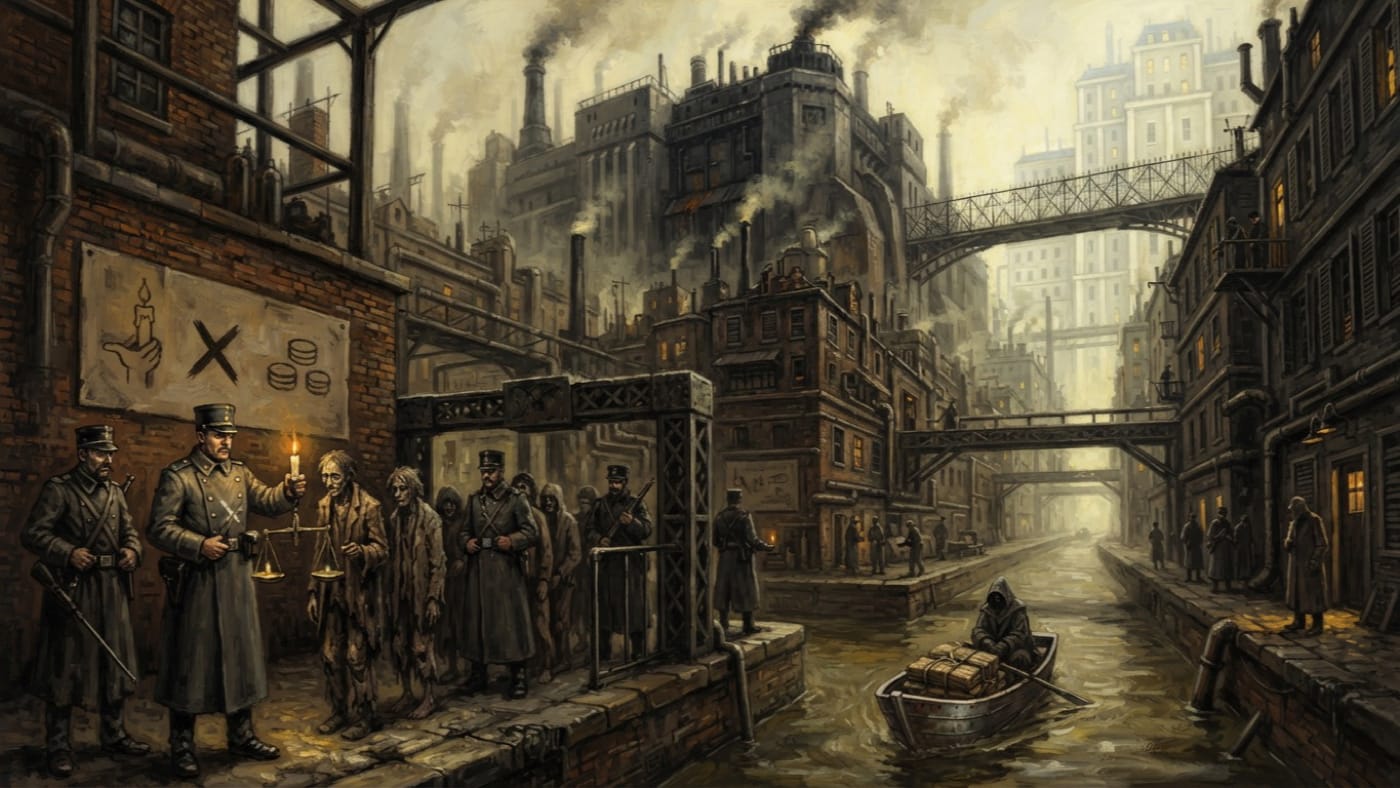
#On the Compact's Station
"May your wick gutter." — a curse of the Wickmarket, now spoken mostly by people who cannot afford the wick
The Candlewright Compact is a trade guild. It holds the Wickmarket of the Candle-Sump District, the ward of candle stalls and tallow auctions where the air smells of warm wax and singed hair. Officially, its business is making light. In practice, it owns what light is made from. The district survey lists a monopoly on wick fiber and tallow as the Compact's aim. My assessment of the Sump records that monopoly as already in force. Both entries are correct. Once a guild has won a monopoly, the work becomes keeping it.
Every household in Lower Vire that burns a candle depends on this guild. Upper Vire Heights buys Sump candles in bulk and credits them to its own chandlers, and the Sump exports candles for heat as well as for light. That is the customer base: the wards above, the poor below, and the dead, who are owed candles of their own. Light costs bone, as the tollgate says. The Compact sets how much.
As of A.S. 201, the Compact has declared a wick blight and tripled its prices. Fires are going out across Lower Vire.
#On Wick and Tallow
Tallow begins as fat, and in the Sump that includes bone-fat, which the parent survey names plainly and I will not dress up. The district turns the dead into usable things: tags for the Registry, lime for the masons, broth for Marrow Row and light for everyone. The candle trade is the warmest part of that work and the greasiest. Rendering vats sit within thirty yards of the broth kitchens. In a white-damp winter, the steam from both settles on the same brick.
The vats belong to the Compact. The rendering is done by renderers, and the wicks by wick-braiders, a district type whose fingers are burned smooth. I record the trade's two classes separately because the trade does not. The renderer works the vat and the braider twists the fiber. The guild owns the vat, the fiber and the stall where both are sold, and it owns the auction where the tallow changes hands before any of that begins. Labor makes the candle. The Compact makes the price.
Wick fiber is the narrower of the two holdings, and the more dangerous one. Tallow can be scraped, saved, hoarded in a jar under a cot. A wick has to be braided. Whoever controls the fiber controls the moment a lump of fat becomes a candle and the levy falls due. The Compact understood this before I did. It deserves credit for the insight, and it collects it.
Candles go up the floodwall stairs to the Heights. Refuse comes down. The skiffs carry tallow to Dockchain Quay and bring grain, soap and lye back. Everything the guild sells has to pass a gate, a checkpoint or a clerk on the way, and the Sump has a great many of all three.
#On Inspection and Privilege
The district's law of flame is short. Open flames must be registered, and an unregistered flame is a charge of arson or heresy, at the discretion of whoever finds it. A candle levy is assessed per wick. Each day at the Wick Blessing, inspectors mark approved candles with an ash-cross. Each midday, between the tag queues and the skiff rush, the wicks are inspected.
The Compact keeps inspectors. The district keeps a Blessing at which inspectors mark candles. Whose inspectors hold the ash on a given morning, under whose authority, and who takes the levy, the documents before me do not say. I decline to supply the answer. A Hieromnemon who guesses at jurisdiction ends up holding it.
What the record does show is the method. The Compact squeezes prices, it sabotages, and it pays inspection bribes. The record names no victim, date or technique for the sabotage, and I add none. The bribes need no further description. In a district where every flame must pass inspection, a candle the inspector approves is worth more than one he rejects, whatever its tallow, and the difference has a price.
The privilege runs both ways. Sluice Wardens at the checkpoints take bribes in tallow, and the Quarantine Provosts take them in tallow, soap, clean paper and tincture. The street calls a bribe paid in candles wick-pay. The Compact's product is also the district's small change for corruption, which makes the guild a supplier to both the law and the lawbreakers. Its goods still move by skiff, under gate timings it does not set, through cordons that shift every week. A guild that sells the bribes can still be held up at Gate IX. I have no record of any arrangement between the Compact and the Prefecture, and I invent none. I note only that the vats are in Candle-Sump and the buyers are upstairs, and the water decides when the two meet.
#On the Declared Blight
The Compact has declared a wick blight. That much is established. On the strength of the declaration it has tripled its prices: a candle now costs three times what it cost before. I have no record of the old price, the currency, the day the new price took effect or how long it will last. The district pays in ration chits, stamped paper, bone tokens, care credits and, rarely, coin, and every one of them is now worth a third as much at the Wickmarket.
I record next what the declaration does not show. It names no affected fiber, no source of the disease, no test, no cure and no boundary for the spread. I have not been shown a diseased wick. In the autumn of A.S. 197 I walked the Wickmarket and smelled its tallow and its singed hair. There was no blight in the Sump then, and none had been declared. Whether there is one now, the guild has said and nobody has checked.
The effects need no verification. A household that could afford one candle can now afford a third of one. The law against unregistered flame means the poor cannot turn to some cheaper fire that the levy does not see. A rag in a dish of fat is still a flame. An unregistered flame is still a charge. So they go without, and the fires go out across Lower Vire. The Paper Loft Quarter reports rot-lung rising. The Care crews have threatened to strike if rations are cut again. The registry lines are long and cold, and in a quarter where warmth counts as wealth, Lower Vire is poorer by two thirds of a candle per house.
The dead are charged as well. Sump funerals burn candles in three stages, for the name, the debt and the silence. Bone tags enter the deceased into the Great Ledger through the Bone-Tag Registry, which answers to the Bureau of Records. The candles beside the tag cost three times what they did. Families now have to choose which of the three stages to leave dark, and I am told the silence is the one they keep.
Who gains from a declared shortage is an inference, and I label it as one. The guild that declared it controls the supply it says is failing. It sets the price that tripled. It employs inspectors who look for the shortage. Each of those facts is on record. Taken together they prove nothing. I have filed them together anyway, in one folder.
#On the Present Application
Three powers govern Candle-Sump. Prefect Sera Mott holds the gates and the floods. Chief Clerk Dalen Voss holds the stamps and the names. Matron Ilka holds the kitchens and the calories. The Candlewright Compact holds the light. It is not a fourth signatory to their compact, and none of the three has granted it a seat. It does not need one. Mott can drown a street. Voss can erase a man. Ilka can starve a queue. The Compact can make the district dark, and that power does not depend on any treaty.
The present quarrels of the district run through the Wickmarket without starting there. The Registry and the Prefecture dispute the seized clean slips. Matron Ilka is pressing for the Kitchens' autonomy. The Washhouse is reported to be preparing a mass identity swap, by way of the Wickmarket back lanes among other routes. I have no evidence that the Compact directs any of these, and I assign it none.
The Wickmarket also sells counterfeit blue-burn candles. No record says the Compact makes them or knowingly sells them, and I make no such claim. Blue-burn reports are rising, and the Provosts drag residents from their beds by name on the strength of them. Near the crypt mouths, candles gutter in patterns that resemble letters, and reading them falls to the Bureau of Bells. A candle inspector in the Sump has to decide whether a flame is legal, approved, counterfeit, an omen or simply a cheap candle. The Compact profits from that uncertainty, as merchants generally profit from uncertainty about their own goods.
The transfer order for Halvyr is still moving through Purity's approval chain. It has not been executed. What the Inquisitor will audit, and in what order, has not been decided, and I have not been asked. The Compact's vats are running. Its inspectors are inspecting. Its price list is posted. The Wickmarket still smells of warm wax and singed hair. Fewer people can afford the wax.