
#The Weight of a Name
Let lesser archives measure their worth in volumes. The Great Ledger of Souls is measured in lives — and it has never, in a hundred and twenty-one years of continuous operation, misplaced one. So the The Bureau of Records claims. So I, who have inspected the vaults and counted the candle-stubs, am inclined to believe — though "inclined" is a word I use loosely, as a man inclines toward a cliff he has been pushed from.
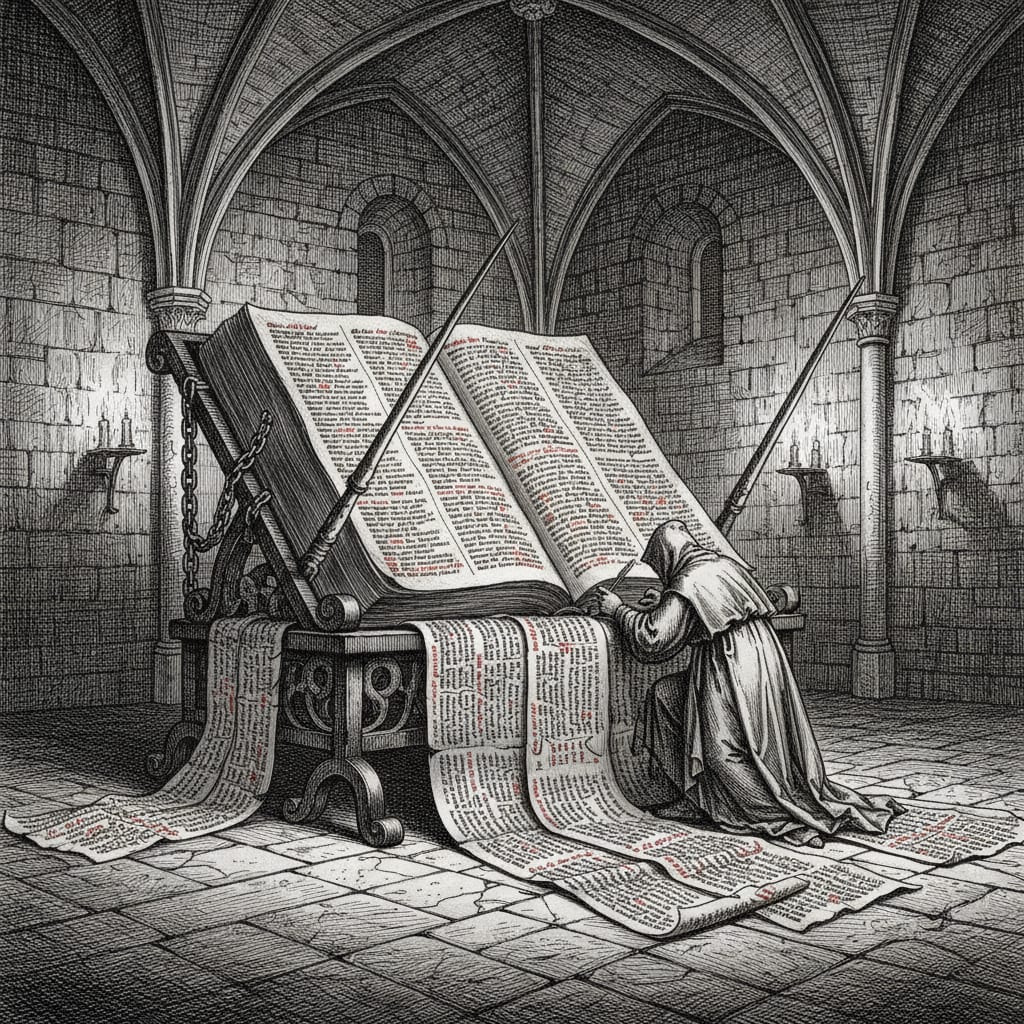
The Ledger is not a book. Call it a book and some pale functionary in the Lower Vaults will correct you with a fury that borders on the theological. It is a system: eleven thousand folios, bound in red calf, housed in iron cradles across six subterranean chambers beneath the The Basilica of the Ledgered Saints in Strasbourg. Each folio contains the names, birthplaces, baptismal dates, confession tallies, and current status — living, dead, excommunicate, administrative dissolution — of every soul who has passed through the sacramental machinery of the Synod since the Year 80 of the Anno Synodi.
That is not a boast. That is an inventory.
#Origins: The Obsession of Veyrault
Prior editions attributed the Ledger's founding to Hierarch Augustinus himself.
This is inaccurate. The Ledger was conceived and implemented by Archon Benedict Veyrault, formerly a monk of Dijon, who established the Bureau of Records on the principle that "to misremember is to betray salvation." Augustinus approved the charter. The difference matters to no one except Veyrault's ghost, who is welcome to file a complaint.
Veyrault was a man who trusted ink more than prayer. Where Hierarch Augustinus of Mainz bound wounds with faith and Cardinal Hieronymus Kratz bound cities with forgeries, Veyrault bound the continent with paper. His proposition was elegant in its madness: if the Synod claimed spiritual dominion over every Christian soul, then the Synod must know every Christian soul. By name. By parish. By the precise hour they last confessed.
The first entries were compiled from parish rolls, baptismal registers, and the confession ledgers of every diocese that had signed the The Concordat of Strasbourg. Monks were dispatched to catalog the faithful hamlet by hamlet. Those who resisted enumeration were visited again, this time accompanied by officers of the The Bureau of Purity, who explained — with tongs, if necessary — that anonymity was a species of heresy.
By the Year 120, the Ledger contained nine hundred thousand names. By 160, four million. The scribes could not keep pace with the births, and so the Bureau invented the Natal Registration Writ, requiring every midwife in the Church's lands to file a name within forty-eight hours of delivery. Failure to comply was punishable by a fine equivalent to the child's projected lifetime tithe — a sum calculated, naturally, by the Bureau of Tithes, whose arithmetic has never once erred in the taxpayer's favor.
#The Anatomy of the Vaults
The six chambers of the Lower Vaults are arranged not by alphabet but by diocese, each diocese subdivided by parish, each parish by household. A skilled Records-Scribe can locate any living soul within fourteen minutes. An unskilled one takes forty and is reassigned to the The Paper Mines of Ulm.
The folios themselves are works of obsessive craft. Red ink for the living. Black for the dead. A thin line of gold leaf for those who have been canonized — though this last category is so rarely applied that the gold-leaf budget has remained unchanged since A.S. 104. Each name-entry carries a marginal code denoting sacramental status: baptized, confirmed, confessed, communicated, anointed, and — in rare and terrible cases — struck. A struck name is not deleted. Deletion would imply the Bureau had erred. The name is instead overwritten with a grid of fine black lines, rendering it visible but illegible, present but annihilated. The Bureau calls this administrative dissolution. The faithful call it a fate worse than excommunication. The struck call it nothing, because they are no longer capable of calling anything.
#The Codices Obscurae
████████████████ has confirmed the existence of supplementary volumes ████████████████ maintained in a seventh vault whose location is known only to ████████████████ and the sitting Archon of Records. These volumes record not names but ████████████████ — the doubts, hesitations, and unspoken blasphemies ████████████████ extracted from confessional transcripts by specialized clerks known as ████████████████.
Rumors, of course. The Bureau denies the Codices Obscurae with a vigor that would be more convincing if it were less rehearsed. The official position — stated in Bureau Circular 447-R, which I possess and which you are not cleared to read — is that "the Bureau of Records catalogs facts, not speculations, and any suggestion of supplementary volumes recording interior states of conscience is a calumny against the sacred mission of archival truth."
And yet. The Lore speaks of volumes that inventory not deeds but doubts — the fleeting blasphemies murmured under breath, the flinch before a genuflection, the half-second too long spent gazing at a forbidden text before averting the eyes. If these volumes exist, then the Bureau of Records remembers sins that Heaven itself has not yet weighed, and the Great Ledger is not merely a census but a court — one that has already tried every soul within its pages and is simply waiting for the sentence to be read aloud.
I assure you the Codices do not exist. Unless they do. In which case I assure you they are perfectly routine.
#The Diocesan Threshold
The boundary of a diocese was formerly defined by the audibility of its cathedral bells.
The Bureau of Records has since clarified: a hamlet belongs to a diocese if its inhabitants appear within the Great Ledger of Souls. Bell audibility is a secondary criterion retained for sentimental reasons. The Ledger, not the bell, is the true border of salvation.
Here the Ledger's power extends beyond the archival into the territorial. A soul that does not appear in the Ledger does not, in the Synod's jurisprudence, exist within a diocese. It cannot marry, tithe, confess, receive sacraments, own property, or be buried in consecrated ground. It is, in the vocabulary of the Bureau, unlisted — a condition distinguished from excommunication only by its administrative flavor. The excommunicate has been judged. The unlisted has simply never been acknowledged, which is, if anything, more absolute.
The The Lictors of Purity and the The Penitential Shadows have both exploited this mechanism with characteristic enthusiasm. To erase a dissident, one need not arrest or execute — one need only ensure the Records-Scribes lose a folio. The name vanishes. The person remains, but without sacramental existence they are a ghost in the machinery, unable to transact, travel, or appeal. Some wander the roads for years, begging parish clerks to re-enter them. Most fail. The Bureau's motto — Nothing is forgotten — cuts both ways: what the Ledger remembers is holy, and what it does not remember was never real.
#The Ledger as Weapon
Procurator Maxentius della Torre was the first to weaponize the Ledger systematically, cross-referencing its entries with the The Index Damnatus to identify households that harbored forbidden texts. If a man's confession tally dropped below the diocesan average, a notation was made. If his children were baptized late, a notation was made. If his wife's maiden name appeared in a parish that had once sheltered a Rationalist sympathizer — three generations prior, mind — a notation was made. The notations accumulated. The Lictors arrived. The family was struck.
This is not tyranny. This is filing.
#Present Condition
The Great Ledger of Souls currently contains an estimated twelve million active entries — each one a life reduced to ink, sacrament, and a marginal code that will determine whether that life is remembered as faithful, suspect, or dissolved. The Lower Vaults employ four hundred and twelve scribes working in rotating shifts of eight hours, their quills never ceasing, their candles never extinguished, their silence broken only by the scratch of nib on vellum and the occasional sob of a novice who has grasped, too late, what he has signed up for.
Archon Veyrault's ghost, if it walks the vaults — and certain scribes swear on their inkwells that it does, a pale figure checking margins with a translucent finger — must be satisfied. He dreamed of a world where no soul could slip through the cracks of memory. He built it. Whether the faithful are grateful or merely compliant is a question the Ledger, characteristically, does not record.
Or perhaps it does. Consult the Codices Obscurae. If they exist.