
#On the Nature of the Sump
"Light costs bone." — inscription above the Candle Bridge tollgate, attributed to no one, maintained by everyone
Let it be understood, first and finally, that I did not wish to inspect Candle-Sump. The Bureau of Doctrine dispatches its Wardens where it pleases, and it pleased the Bureau, in the autumn of A.S. 197, to dispatch me to the lowest quarter of Lower Vire — a district whose primary exports are tallow, tagged corpses, and the persistent, greasy certainty that one's lungs are filling with something the Bureau of Purity has not yet classified. I went. I returned. My vestments still smell of rendered fat, and my cough has acquired a timbre that my physician describes as "architecturally informed."
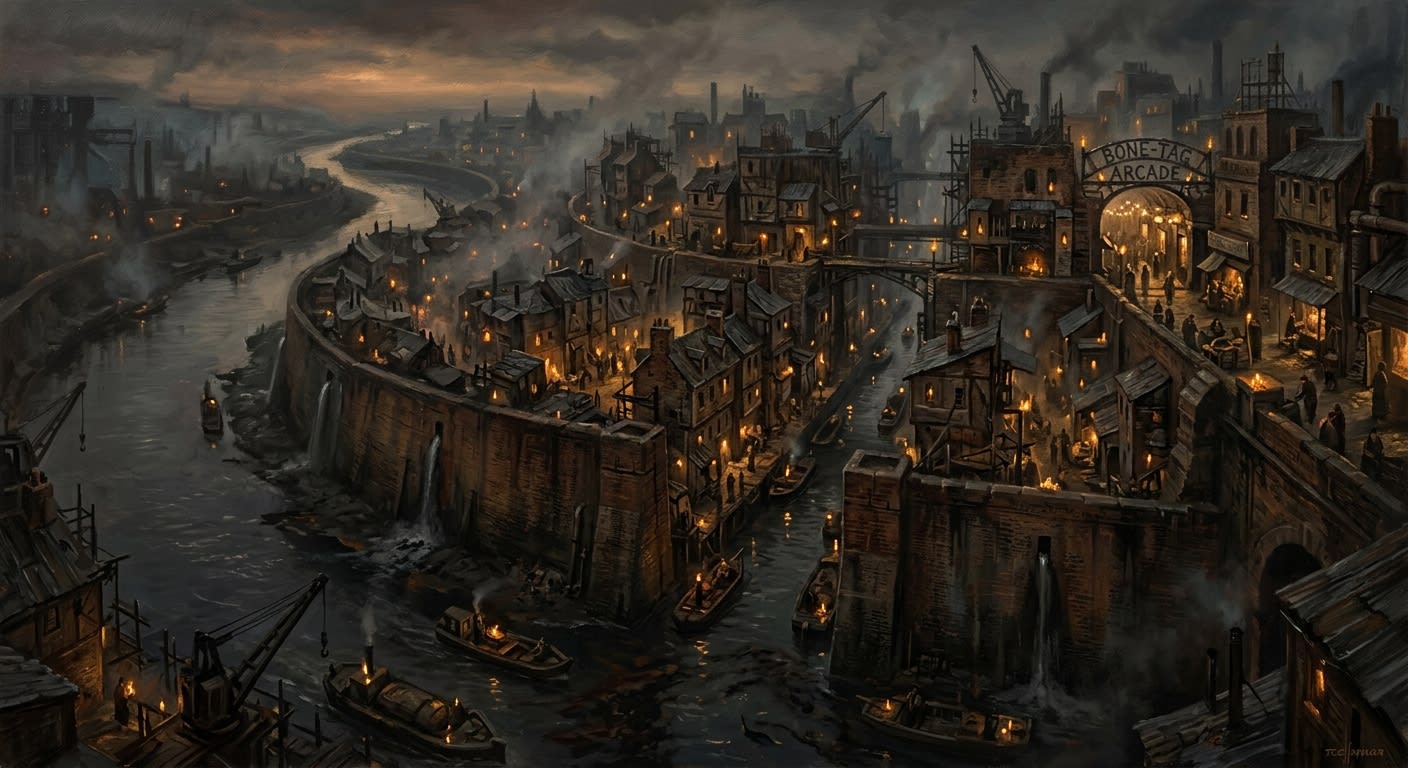
Candle-Sump is the gut of Lower Vire. It sits at the river's lowest bend, where the Vire (Unregistered) curls through its lock-gates and the ash-water from the cremation stacks sluices through brick channels older than the Concordat itself. The district occupies a strip of reclaimed marsh hemmed by floodwalls on one side and quarantine cordons — which shift weekly, because disease respects neither cartography nor the Bureau of Records' filing schedules — on the other. Eight named wards crowd the canal spine, stacked in the vertical like the pages of a water-damaged ledger: Ash-Sluice Line at the bottom, where the drain crews wade in filth the Synod calls "sanitation"; Marrow Row above it, where the broth kitchens feed the district's forty-two thousand registered souls; the Bone-Tag Arcade, where the dead are stamped into administrative existence; the Wickmarket (Unregistered), where candles are sold in quantities sufficient to light the wards that pretend they have no need of this place; the Coughwalks, those raised plank roads above flood level where the air is merely unpleasant rather than actively injurious; the Crypt Mouths, where sealed doors lead to underworks the Bureau insists do not function as corridors; the Paper Loft Quarter, where documents dry on vinegar-soaked racks in a race against the mold that eats everything paper in this district; and the Washhouse (Unregistered), whose name describes its official function with a precision that is, in my professional assessment, a Category One Lie.
#On the Founding
The Sagittal Line was established in A.S. 65. The canal locks of Lower Vire were dug within a decade — Zone 1 infrastructure, deep in the safe heartland, built to service the river-belt supply network (Unregistered) that would feed the distant front. Candle-Sump was never intended to be a district. It was intended to be a drainage ditch.
The lock-side workers needed housing. The housing attracted chandlers. The chandlers attracted bone-dealers, because tallow requires rendering and rendering requires raw material, and the war — the eternal, grinding, hymn-accompanied war — produces raw material in quantities that would embarrass an abattoir. By A.S. 78, the year Archon Veyrault established the Bureau of Records, the ditch had acquired walls, a population the Bureau could neither count nor ignore, and a smell that the River-Belt Chapterhouse (Unregistered) described in its annual report as "devotionally challenging."
The Lye Flood of A.S. 84 was the district's first catastrophe and its baptism. Ash runoff from the cremation stacks turned the canal water caustic; the streets became rivers of lye that stripped skin, dissolved paper, and left chemical scars on the brick that persist to this day — a district-wide burn scar the inhabitants read like scripture, each discoloration marking a flood line, a death toll, a lesson in the theology of drainage. The Synod's response was characteristically efficient: the Sluice Prefecture (Unregistered) was installed within the month, a sanitation arm of the River-Belt Chapterhouse granted authority over gate timings, flood releases, and the definition of "clean." The Bone-Tag Registry followed — a Records adjunct tasked with stamping the dead into administrative existence, because the Bureau of Records will tolerate chaos, filth, disease, and the occasional drowning, but it will not tolerate an uncounted corpse.
By the Concordat of A.S. 90, Candle-Sump was a functioning district. By A.S. 110, the year of the First Continental Levy, it was indispensable — a factory of light, calories, and certified dead that the upper wards of Lower Vire depended upon absolutely and acknowledged never.
Prior editions of the River-Belt Survey (Unregistered) attributed Candle-Sump's founding to a "planned urban expansion initiative" of the River-Belt Chapterhouse, citing Bureau of Records Writ 44-C.
Writ 44-C authorises the maintenance of a drainage canal. It does not mention housing, industry, or human habitation. The district was not planned. It metastasised. The distinction is institutional, and the Bureau prefers the institutional version.
#On the Governance
Three powers rule Candle-Sump, and their compact is the oldest surviving joke in the River-belt.
Prefect Sera Mott (Unregistered) commands the Sluice Prefecture. She controls the gate timings and the flood releases — which is to say she controls whether the district drowns this week or next week, whether the skiff traffic moves or stalls, whether the ash-water runs clear enough to wash in or caustic enough to strip the ink from a man's papers. Mott always smells faintly of soap. She never removes her gloves. The soap is affectation; the gloves are policy. A woman who controls the water in a district where water is both currency and weapon does well to keep her hands covered.
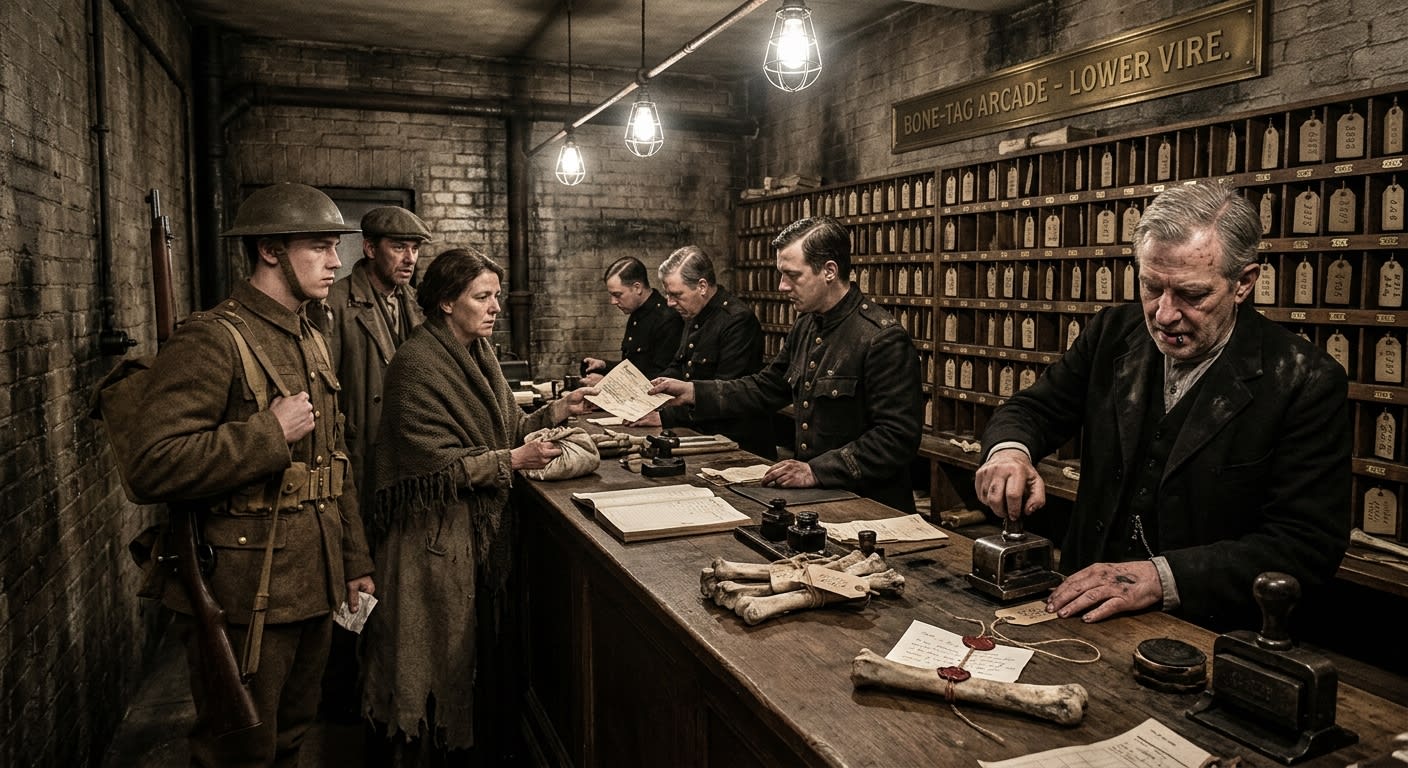
Chief Clerk Dalen Voss commands the Bone-Tag Registry. He controls the stamps, the master seals, and the filing cabinets in which forty-two thousand identities are stored — which is to say he controls who exists. A bone tag is a receipt for the dead: name, date, cause, and a confession attachment sealed in wax. Without a tag, a corpse is not a person; it is waste, to be sluiced into the canal with the ash-water. Voss has ink-stained teeth and quotes ledger entries the way a confessor quotes psalms. The soldiers who pass through Candle-Sump call him "the Knife," which Voss finds flattering, which tells you everything you need to know about Voss.
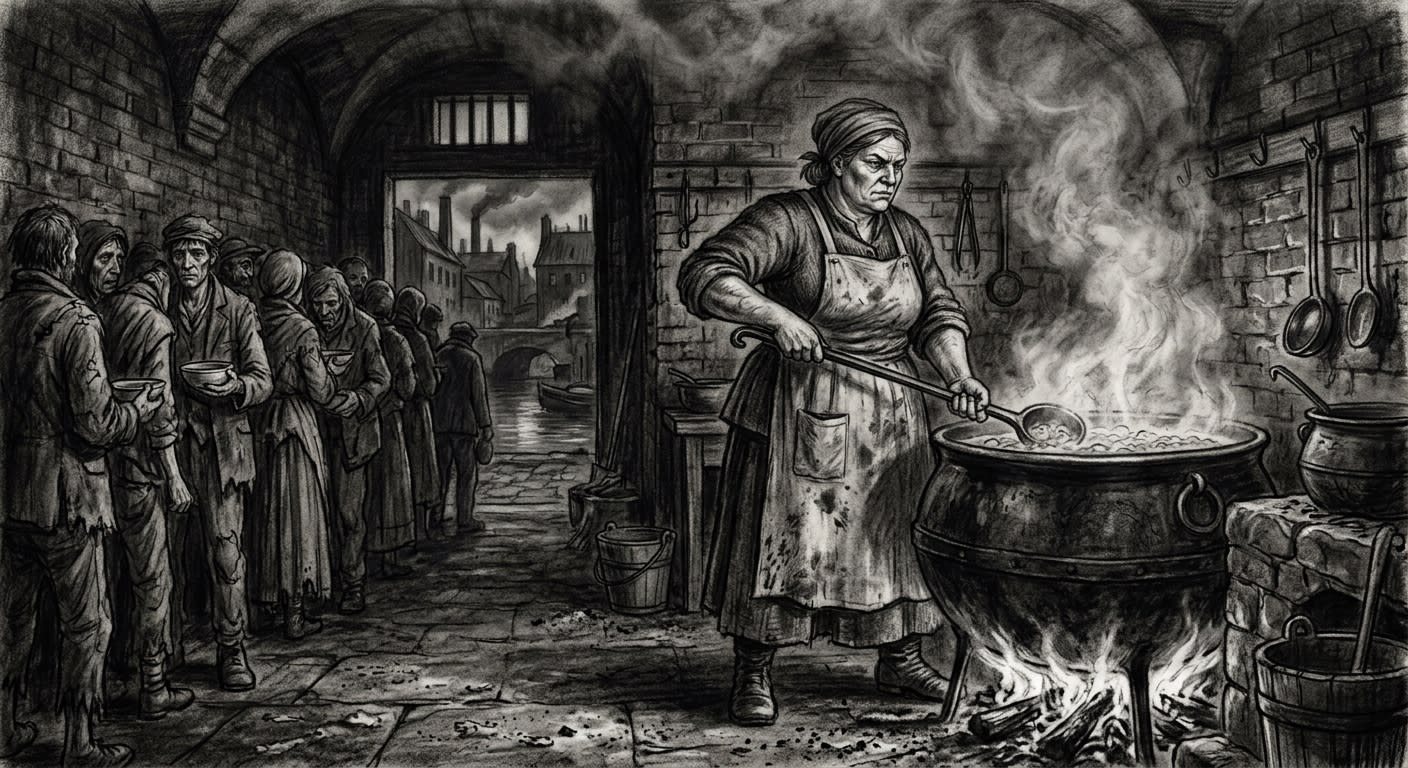
Matron Ilka, called "the Broth-Saint" by the Marrow Row regulars and "that woman" by the Sluice Prefecture, commands the Marrow Kitchens of Saint Ilka — a name she gave herself, the canonisation having been self-administered and never contested because contesting it would mean arguing with the woman who feeds the district. Ilka controls calories. In a quarter where the staple diet is marrow broth and ash-bread, where garlic and real salt are luxuries and honey-drip candles are prized for their smell rather than their light, calories are sovereign. Ilka laughs like a kettle and has the eyes of a judge. She has survived four Sluice Prefects, three Registry Chiefs, and one attempt to centralise the kitchens under the Bureau of Pilgrimage — the last of which failed when the pilgrim-assessors discovered that questioning Ilka's soup allocation was, in the Sump's informal legal code, an act of war.
These three share power the way dogs share a bone: with constant vigilance and occasional baring of teeth. The current crisis — the Registry and the Sluice Prefecture disputing ownership of seized "clean slips," while the Care crews threaten strike if rations are cut again — is merely the latest iteration of a struggle as old as the district itself. Candle-Sump's governance is a three-legged stool, and each leg is trying to kick the other two out.
#On the Economy of Bone and Flame
Candle-Sump's economy runs on the dead. This is stated without irony, because irony requires distance and Candle-Sump has no distance from anything — the rendering vats are thirty yards from the broth kitchens, and the broth kitchens are forty yards from the Bone-Tag Arcade, and the Arcade's back-press prints documents that the front desk pretends do not exist.
The primary industries are six: ash-sluice maintenance, which keeps the drains moving and the lye from pooling in the streets; marrow-broth production, which feeds the district and the lower wards of the city above; bone tagging, which stamps the dead into the Great Ledger and generates confession attachments for the Bureau of Records' filing cabinets; candle rendering, which transforms tallow and bone-fat into the light that upper Vire Heights (Unregistered) purchases in bulk and credits to its own chandlers; paper drying and repair, which salvages documents from the district's omnipresent damp and vinegar-baths them into legibility; and canal skiff hauling, which moves everything — bodies, candles, broth concentrate, tagged bone-lime, and the occasional passenger who has paid enough to be transported horizontally rather than vertically.
Currency is plural. Ration chits from the Marrow Kitchens. Stamped paper from the Registry. Bone tokens from the tag-presses. "Care credits" from the kitchen system. Coin, when anyone has it, which is seldom. What counts as wealth in the Sump is warmth, soap, clean lungs, and a name that passes inspection — the last of which can be purchased, if one knows which door of the Washhouse to enter and which question not to ask.
The black market runs through the Wickmarket's back lanes and the Washhouse's inner rooms. Clean identity slips — papers that transform a deserter into a pilgrim, a debtor into a dead man's heir, a wanted heretic into a registry-certified nobody — are the Sump's most profitable export. They are also its most dangerous. Clean slips require blank tag stock, master-seal wax, and a forger whose hand does not shake, and the penalty for possession of any of these materials is an oath-collar and a one-way transfer to a sanitation draft that lasts until the lungs give out. The Washhouse's brokers smile too clean for Candle-Sump. They never cough. Both facts are suspicious in a district where coughing is the closest thing to a universal language.
#On the Crypt-Route Drafts
Beneath Candle-Sump's streets lie the underworks (Unregistered) — sealed burial lanes and crypt routes from before the Sundering, when this bend of the Vire housed a riverside shrine district whose congregants are now filed under "pre-doctrinal population, unrecoverable." The Synod sealed the crypt mouths. The seals hold. What the seals do not hold is the air.
The crypt-route drafts are Candle-Sump's anomaly, its signature affliction, and the reason why the Bureau of Alchemical Standards has dispatched three survey teams and received three reports that agree on nothing except that the phenomenon is "ongoing." Airflow from the sealed underworks rises through vent alleys and maintenance shafts, carrying rot-spores that target the lungs and something the inhabitants call "name-murmurs" — faint vocalisations in the draft that sound like syllables, that sound like names, that sound like the beginning of a confession no one asked for. Paper fuzzes at its edges near the vents. Ink bleeds into illegibility. Cough fits worsen at certain corners — always the same corners, mapped by generations of Sump dwellers who know which streets to avoid after curfew the way a sailor knows which rocks to give berth.
Candles gutter near the crypt mouths. They gutter in patterns. The patterns resemble letters.
The local superstition is blunt: "If your candle burns blue, don't say your name that night." The blue-burn phenomenon — candles producing a cold blue flame near crypt mouths — has been reported with sufficient frequency that the Quarantine Provosts (Unregistered) treat blue-burn reports as actionable intelligence, dragging residents by name from their beds for "doctrinal health assessment." The residents, for their part, have learned to report blue-burn only when they wish a neighbour removed. The Bureau of Purity classifies the draft anomaly as "Category Two Localized Atmospheric-Scribal Disturbance" and has maintained this classification since A.S. 194, seven years of "pending review" that everyone in the Sump understands to mean "the Bureau knows what it is and prefers not to say."
#On Rot-Lung and the Quarantine
Rot-lung is the Sump's endemic disease, its occupational hazard, and its class marker. It begins with a cough — wet, architectural, the kind of cough that sounds as though the sufferer's chest has adopted the acoustics of the canal tunnels. It progresses through stages the Sluice Prefecture has helpfully numbered: Stage One (productive cough), Stage Two (blood-flecked sputum), Stage Three (paper sensitivity — the sufferer's skin reacts to document contact), and Stage Four, which the Prefecture's medical handbook describes as "terminal administrative transfer" and which the Sump's residents describe as dying.
Rot-lung targets clerks first. This is the cruellest detail: the disease that breeds in damp and paper-dust strikes hardest at the people whose livelihood depends on handling damp paper. The Bone-Tag Arcade loses three to five clerks per season. The Paper Loft Quarter operates with a rolling absentee rate that the Registry records as "scheduled maintenance" because recording it as "plague attrition" would trigger a quarantine that would shut down the document-drying operation, which would collapse the paper supply chain, which would inconvenience the Bureau of Records, which is a thing no sane administrator contemplates twice.
The Quarantine Provosts — a militia of ribbon-armed enforcers who report jointly to the Sluice Prefecture and the Bureau of Purity — maintain moving cordons through the district. Quarantine ribbons are colour-coded: green for passage, yellow for restricted movement, red for confinement, and black for a category the Provosts call "concluded assessment" and the district calls death warrant. Ribbons can be purchased. Immunity can be negotiated. The Provost squads take bribes in tallow, soap, clean paper, and medical tincture, and they take them with the frank professionalism of men who understand that corruption is the only thing preventing the quarantine system from consuming the district it was designed to protect.
The River-Belt Chapterhouse Annual Report of A.S. 199 stated that "rot-lung incidence in Lower Vire Sanitation Ward remains within acceptable parameters."
The parameters were revised the same week. The revision was not appended to the report. "Acceptable" is, in the Bureau's lexicon, a moving target, and it moves in the direction of convenience.
#On the Shadow Registry
The buried truth of Candle-Sump is this: the underworks is not sealed. It is maintained.
Below the crypt mouths, in tunnels the Sluice Prefecture's maps label as "collapsed," a shadow registry (Unregistered) operates — names harvested from the crypt drafts, transcribed onto fresh paper, and passed upward through the Washhouse pipeline into the legitimate Bone-Tag system. The clean slips that surface in the Sump's black market are too clean to be street forgery. Their seals are accurate. Their ink is regulation. Their paper stock matches the Registry's own supply. This is because they are written on the same paper, with the same ink, using names that the drafts breathe through the vents — names of the dead, the pre-doctrinal dead, the shrine district's forgotten congregants whose identities have been waiting in the stone for a century and a half, patient as filed documents, ready to be reissued.
Who benefits: the Registry, which gains leverage it cannot admit to possessing. The Washhouse, which profits from a supply chain it did not build. The Sluice Prefecture, which controls the gate timings that regulate airflow to the crypt mouths and therefore controls — at a remove, deniably, with gloved hands — the volume of names the drafts produce. And an unknown hand in the underworks, operating below all three, whose game is larger than identity fraud and whose purpose the Bureau of Doctrine has not yet condescended to investigate.
#On the Present Condition
Candle-Sump, as of A.S. 201, is a district in the late stages of a crisis it has been in the early stages of since its founding. The Registry and the Sluice Prefecture are at war over seized clean-slip stockpiles. The Care crews have threatened strike. The Candlewright Compact — the guild that monopolises wick fiber and tallow — has declared a wick blight and tripled its prices, which means fires are going out across Lower Vire in the homes of people who cannot afford to relieve them. The Paper Loft Quarter reports a rot-lung spike. The Quarantine Provosts report blue-burn candle sightings at frequencies that suggest either a genuine escalation of the crypt-route anomaly or a neighbourhood vendetta conducted by means of official report, and the Provosts cannot distinguish between the two because the Provosts have never been able to distinguish between the two.
The Washhouse cartel (Unregistered) is planning a mass identity swap — an operation large enough to launder several hundred names in a single week, using clean-slip stock the cartel claims to have sourced from below. Matron Ilka is leveraging the ration crisis to force autonomy for the Marrow Kitchens — a move that would make the broth system independent of the Sluice Prefecture's calorie allocation, which would strip Prefect Mott of her most effective tool of compliance. And somewhere in the Bureau of Purity's filing system, a transfer order is working its way through the approval chain: Inquisitor Halvyr, called "White-Lung" for reasons the Bureau does not explain but which the Sump's residents understand with the clarity of people who have learned to read bureaucratic euphemism the way they read flood-line scars on brick.
Halvyr carries a portable audit press and burn authority. When Halvyr arrives — and Halvyr will arrive, because the Bureau of Purity does not file transfer orders it does not intend to execute — the Sump's paper infrastructure will be audited, its shadow registry will be exposed or sealed or co-opted depending on which Bureau reaches it first, and the crypt mouths will receive the kind of attention that the Bureau of Alchemical Standards has been carefully avoiding for seven years.
The district will survive. It has survived lye floods, quarantine lockdowns, wick famines, and the ceaseless administrative contempt of the wards above. Light costs bone. The Sump pays.