
#On the Eastern Terminus
"The dead are placed. The map is mercy." — Mortuary Cartography Office, standing formula
A barge-handler at the eastern end of the Ropewalk throws a tarred line around a creosote-black piling, takes two turns, and holds out a hand: first for the manifest, then for the vinegar. That is the whole rite of arrival at the Charnel Moorings. In a season of offensives it is repeated until the handler's palms crack, and then repeated again with cracked palms, because the barges do not stop arriving to let a man heal.
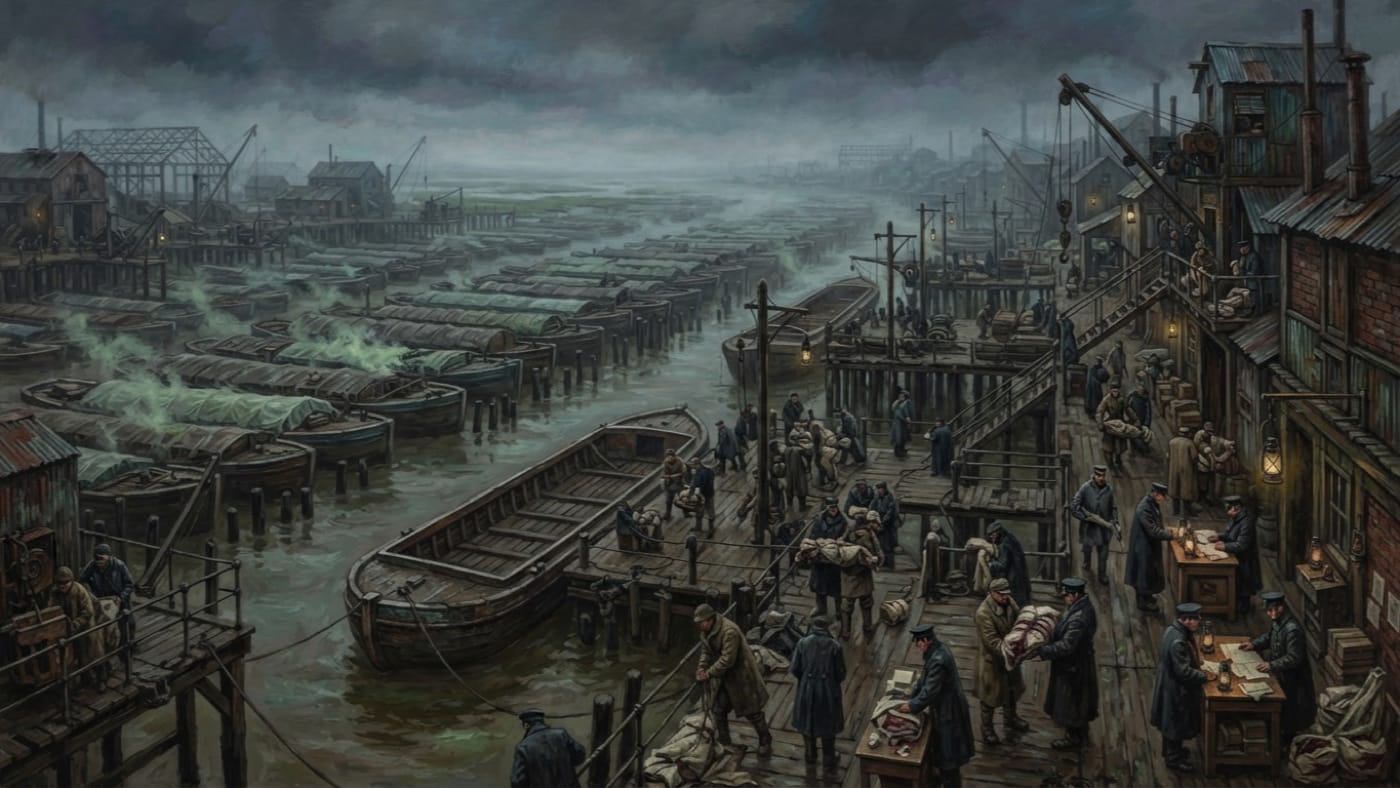
The Moorings form the eastern terminus of Ash-Glyph Marshworks. They sit at the far end of the Ropewalk from the Causeway Gate, and theirs is the only district in the settlement whose business arrives by water and arrives dead. The war-dead come down the Danube from the Sagittal Line's eastern theaters, out to the river mouth in long, low barges. The Marshworks was chartered in A.S. 74, sixteen years before there was a Synod to claim it. The charter came from the war and records offices that would later be gathered into the Bureau of War and the Bureau of Records, and its purpose was to stop those barges from choking the delta. The Moorings are where the choking still goes on, only now under seal.
The district has no recorded founding year of its own. The dead did not wait for one.
#On the Pilings and the Channels
"If the light answers your oar, it wants your name." — Marshworks superstition
The pilings are tarred black against the brine, and they are almost the only things at the Moorings that anyone has troubled to preserve. Everything else is allowed to rot on schedule. There are driftwood platforms lashed with tarred rope, rusted iron brackets, and bone-lime posts sunk into mud that will hold a position only until the mud thinks better of it. Brackish water laps the reeds. The mudflats come and go with the tide. The channels shift. Between them lie the sinkholes, which do not shift, and which wait.
No barge approaches the pilings after dark without a route mark from the Lantern Guild of the Third Brine. Guildmaster Orren Pike's lamps decide which channel is a channel. The punt pilots who lead the barges in decide nothing; they obey the lamps and are paid in the privilege of surviving.
Then there is the corpse-light. It is a green-white bloom over the shallows, it mimics the safe channels, and it answers lantern signals. A crew that sends a coded sequence may see that sequence returned, perfectly formed, from water where no lamp hangs. The Guild's response is the Do Not Answer. Lamps go dark under black cloth. Vinegar smoke goes up. The oarsmen are blindfolded and row to a bell-click cadence, keeping strictly to the guild-marked route. The crews obey a procedure exactly while the water offers them a better-lit procedure of its own. The Guild's whole art, reduced to its essentials, is declining the second offer.
The pilots also speak of a barge route they call the Quiet Channel, which by their account gives back no reflection, even at noon. I record the account. I do not certify the noon.
#On the Receipt of the Dead
"Nothing moves without a tag, and tags vanish." — Marshworks working maxim
Each barge carries its dead wrapped in vinegar-soaked cloth, and its manifest lists them by number, rank, and unit designation. At the pilings the barge belongs to the Bureau of War. On the far side of the paperwork its contents belong to the Bureau of Records. The Moorings are the stretch of wet timber in between, where a soldier stops being a casualty and has not yet become a coordinate. There, at least, the law permits him to be nothing at all, provided he is tagged.
The order of operations is simple. The manifest comes off first. The tags follow, damp and fraying from the river. Haulers carry the wrapped dead up onto the Ropewalk and west toward Seal Shed Row, where tag clerks stamp, seal, and countersign. Only a sealed tag admits the body to the Glyphyard. There it is laid in a burial grid of ten paces by ten, marked in the ash-glyph numerals, and entered on the map. A body without a tag goes nowhere. A tag that does not match its manifest goes nowhere either, and the body it was meant to name waits with it on the deck, in the vinegar, in the sun.
The documented bottleneck of the whole settlement is the capacity of the seal sheds. When the Line advances, so does the dead. In the surges as many as forty barges queue off the Moorings, each with its manifest and its wrapped cargo, each waiting on clerks who can only stamp so fast. Forty is the length of the queue. The number of berths is smaller. The difference between those two figures is measured in days of sweet rot.
The Charnel Moorings receive the war-dead for provisional interment pending the cessation of hostilities.
Struck. The Marshworks entry records the withdrawal of "provisional" from the founding system's surviving charter copies. Hostilities have not ceased, and the interments are not provisional. The Moorings have always received the dead for permanent filing, and they always will.
Five things may not leave the Moorings: untagged bones, unsanctioned relics, unmapped dead, plague cloth, and blank seal books. The fifth is the one I find most revealing. Anyone can see why untagged bones are dangerous. It takes a man of the Ledger to see why an empty seal book is worse. Corpse-barge skimming and tag theft are both documented crimes at the Moorings. A missing tag holds up a body. A stolen blank book could put a seal on anything.
#On the Living at the Moorings
"Wash the hands. Bless the lamp. Say the bead, not the name." — attributed to the Moorings night crews
The Moorings are worked by barge-handlers, punt pilots, haulers, tag clerks, lantern crews, and wardens. Few of them came by choice, and fewer stay by it. Debt binds most of them. The causeway fees outrun the wages, the deficit is paid off in labour, and the quarantine adds "service requirements" on top of the debt. When the surges come, so do the night crews: men and women rowing blind toward pilings they cannot see, because a ledger somewhere has decided that they owe the dark their attendance.
The air is vinegar and sweet rot, with brine, tallow, and wet timber underneath. Oars creak. Hook-poles tap against the decks. Every shift begins with hands washed in vinegar and a lamp blessed before it is lit. Rot-fever goes through the crews each season, and the Moorings are where plague is most feared, since this is where the cloth comes in. Over open water no one speaks the name of the dead. The crews use bead-codes instead.
The Ashbound Wardens hold the Moorings, as they hold the Causeway Gate. They are a quarantine militia by mandate and a clique by habit. They enforce with cordons, arrests, and hook-poles, the same poles serving for drowned men and for living suspects. The quarantine has been in force since A.S. 112. That makes it eighty-nine years old in A.S. 201, and it is still called temporary. Exemptions from it are for sale, and detention under it is a revenue stream. A handler who wants to go off shift during a plague rumour pays a warden. A handler who cannot pay is detained, and detention brings a service requirement, which brings the night crew.
The settlement's real powers keep their own posts. Vane's office receives what the Moorings send. Pike's lamps bring the barges in. "Softstep" Maro controls the salvage intake at Diver's Gut, which does not make him master of the dock, though no one at the Moorings has ever been foolish enough to say so in his hearing.
#On Registry Fourteen
"The dead were placed. Whose mercy, we did not ask." — Mortuary Cartography Office, Charter Preamble
One barge at the Moorings carries the designation Registry Fourteen. On three occasions it has returned empty, with no crew aboard.
That is everything the record says. I set it down whole, because the record is short and I am a faithful copyist.
The Bureau of Records files these three returns under "Weather."
What the file leaves out deserves a list of its own. It does not name the crews, or say what became of them. It does not say what cargo was aboard, if any, or what became of that. It does not say how a crewless barge comes back to a dock whose approaches cannot be survived without a route mark, a pilot, and a blindfold. It does not say who threw the line around the piling, or whether anyone did. It gives no dates. The three returns sit in the register as three entries under one category, and the category is the sky.
I have the greatest professional admiration for "Weather." Every other classification in the Bureau's lexicon has edges. "Pending review" implies a review. "Navigational error" implies a navigator. "Indeterminate" admits a test was run. Weather requires no witness, no cause, and no responsible officer. It falls equally on the Wardens and on the rest. And it is the one category whose contents no one at the Moorings would expect to explain, since no clerk has ever been asked to account for rain.
The handlers do not discuss Registry Fourteen in the Bureau's hearing. Whether they discuss it among themselves, in bead-code or otherwise, is outside the competence of this entry. The barge has returned three times, and it is recorded three times. The file stays open the way a sluice gate stays open: because no one has been ordered to shut it.
#On the Present Condition
At the A.S. 201 assessment of the Marshworks, the Moorings were working as designed, which is to say slowly, wetly, and without pause. The Line still sends its dead downriver. The seal sheds still cannot stamp them as fast as they come. In a surge the barges still queue off the pilings, forty deep, in vinegar. Night crews still row blind under black cloth. The corpse-light still answers their signals, as it has since its first official note in A.S. 143, fifty-eight years of review that has produced no finding. The Wardens still sell exemptions from a temporary quarantine now eighty-nine years old.
The Bureau of War needs the Moorings because the alternative is a river full of soldiers. The Bureau of Records needs them because the alternative is a soldier with no number. The Moorings need nothing from either Bureau but tags, and the tags vanish.
Registry Fourteen remains a matter for the meteorologists.