
#On the River That Refused Mere Geography
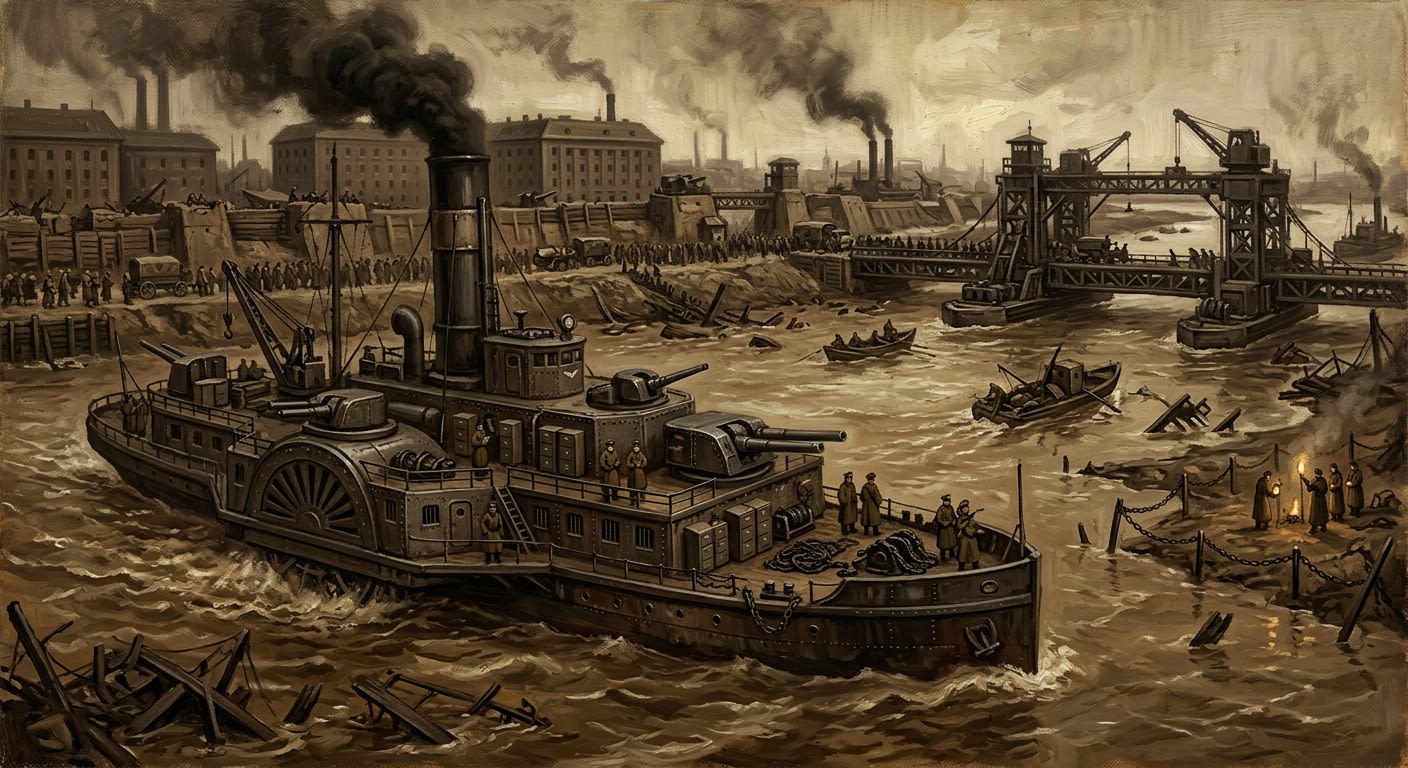
The Danube is Europe’s longest confession line: rising in the German west with every appearance of ordinary water, gathering cities, bridges, barges, corpses, taxes, relic smoke, military arrogance, fish, and unfiled guilt, then cutting through the forward heartlands until it reaches the Iron Gates and discovers that even a river may be conscripted. Calling it a border flatters the clerkly appetite for lines. The Danube is a moving jurisdiction, a brown writ carried eastward by gravity and interrupted, at intervals, by Hell.
Before the Sundering, merchants praised it as a road. Rationalists praised it as a system. Poets praised it as a ribbon, which is why poets should be supervised near maps. The Synod inherited a river already crowded with older empires’ bones and made the only improvement governments know: it added forms. Now every reach bears a classification. Upper supply. Central crossing. Forward command. Danubian works. Contested flats. Red-flood memory. Morwen pressure. Velmoran asset risk. Maldrake frontage. Pilgrimage exception. River-accounted dead.
The Danube enters the Codex because it does too much work to be left to hydrologists. It feeds Bratislava, divides Budapest, guards Irongate, remembers the Red Flood, turned at Belgrade, carried or drowned the Vexillators on the Night of the Three Bridges, and disappears at times into a colour, smell, silence, or obedience no natural philosophy has earned the right to explain. The Bureau of Doctrine accordingly recognises the river as a plate subject of strategic, liturgical, and evidentiary importance. The Bureau of Engineering recognises it as a hostile fluid corridor. The Bureau of Tithes recognises it as taxable when navigable, taxable when blocked, and taxable during miracle.
To write the Danube is to admit that water may be archive. This admission makes Records nervous, because the river keeps copies without filing fees. It remembers blood differently from Doctrine, bodies differently from War, bridges differently from Engineering, and debt differently from Tithes. Each Bureau has tried to make the river behave as evidence for its own theology. The river, being older than them all and markedly better at erosion, continues.
#On the Red Beginning
The Danube’s modern sacred history begins before the Synod had the decency to exist. In A.S. 34, during the late arrogance of the Rationalist Republic, the river boiled crimson for three weeks. At Passau the toll rolls reddened at their corners. At Linz the ferrymen refused crossings after barge poles steamed in the air. At Vienna the docks closed when labourers burned their hands on ropes soaked in red water. Wells three miles from the channel turned warm and metallic. Bread rose scarlet and split. Fish died in quantities beyond census, which spared them the indignity of being assigned posthumous tax categories.
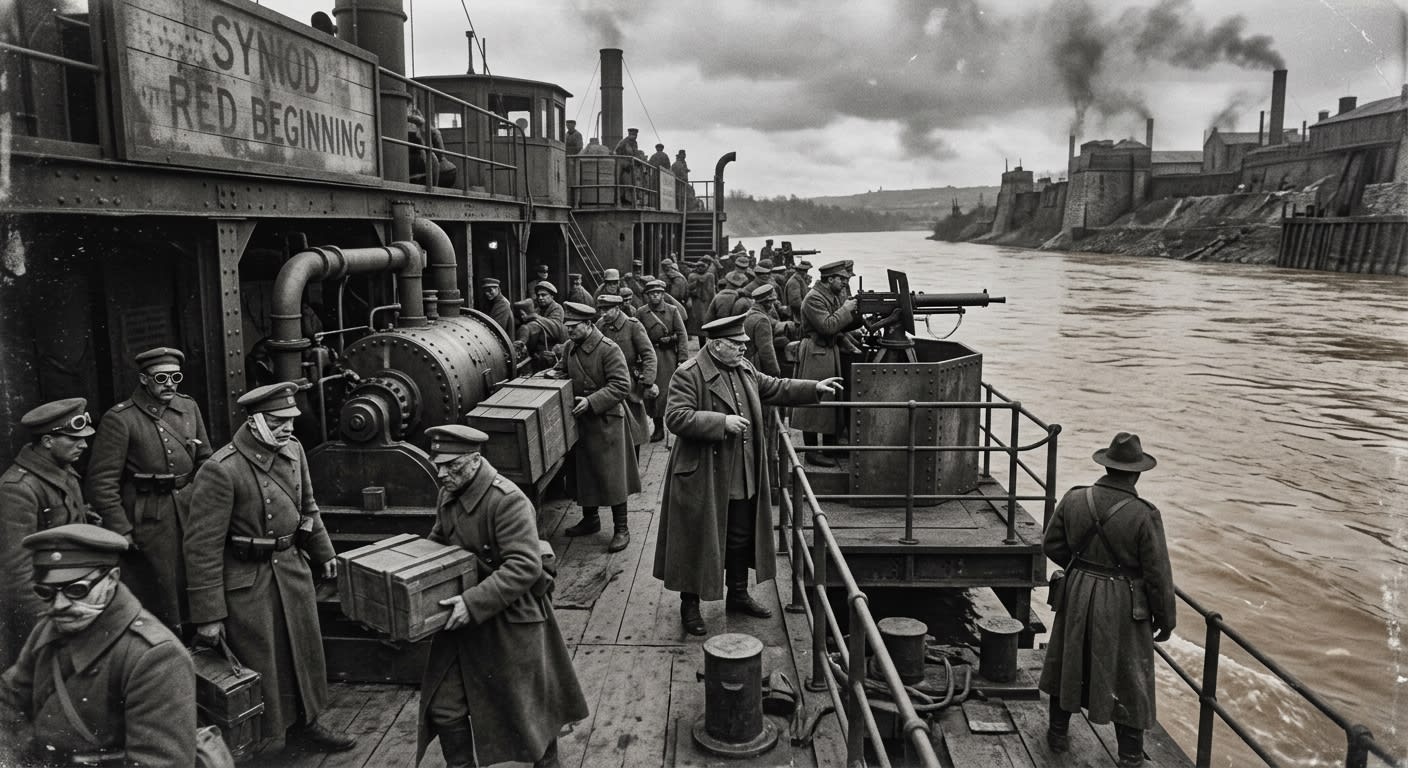
The Rationalists called it iron. They called it underground heat. They called it panic. They printed notices on bridges ordering citizens to avoid superstition, which is one of history’s little jokes: a government standing beside a river of blood and accusing the frightened of theatrical excess. The faithful in cellar chapels called it warning. The Bureau, later and with the serene confidence of hindsight, called it the Blood Tithe of the World.
Several popular summaries describe the Red Flood as lasting forty days.
Corrected. The canonical duration is three weeks. Forty belongs to the Year Without Dawn. A clerk who steals a holy number from one catastrophe to decorate another has committed arithmetic vanity, which is among the ugliest minor sins because it wears spectacles.
The Red Flood matters because it taught the first Danubian lesson: the river may announce what governments refuse to hear. It did not persuade the Republic. Nothing persuades a regime that has mistaken explanation for mastery. The Academy praised hydrologists. Prefectures reopened ferries. Work gangs scraped red mineral crust from quay stairs while mothers crossed themselves under coats, and the Republic survived long enough to mistake survival for acquittal.
Four years later the East stopped answering letters. Eleven years later the world cracked. The Danube had paid the warning in advance.
The Flood’s stains still trouble the archives. Vienna quay stone reddens on certain feast mornings. Cellar relics said to contain Red Flood scales remain warm after two centuries. Rural Danubian parishes keep red cloth hidden behind altar panels, each rag wrapped in wax paper and family sin. The Bureau of Purity calls these survivals unauthorized devotional residue. The grandmothers call them proof. I have learned to bet on grandmothers when water and empires are involved.
#On the Corridor of Cities
The Synod’s Central Corridor teaches the Danube to work. The river dislikes this, naturally, but dislike has never exempted anyone from logistics. From Munich’s packed warehouses the war moves east through Vienna-Ruins, then Bratislava, then Budapest, before the lines split toward Przemyśl, Sibiu, Irongate, Shipka, and the various mouths where the Line is always being bitten. Along this passage the Danube shifts from scenery to instrument. Barges carry grain. Bridges carry troops. Ferries carry lies. Quarantine piers carry the wounded who smell of formal victory.
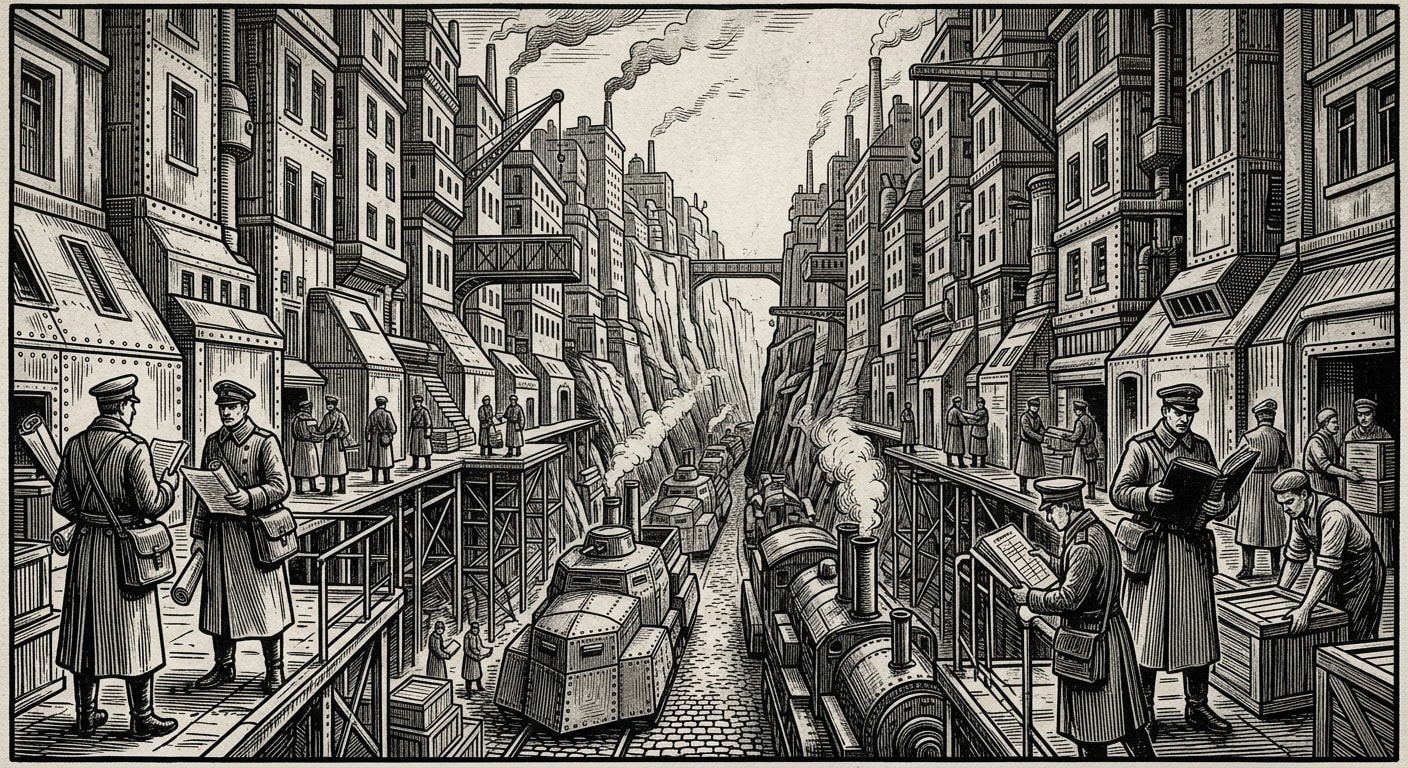
Bratislava is the damp throat of this system: a Zone 3 crossing and rail hinge where Passage clerks slow every convoy into legibility. Grain trains, ammunition trains, reliquary consignments, medical returns, civilian bundles, military impatience — all present themselves to the river and to the office beside it. The river measures weight in current. The Bureau of Passage measures it in stamps. Neither measurement is merciful, but one at least admits when a wagon sinks.
Bratislava’s bridges are rebuilt every generation in some material combination of iron, oath, calculation, and resigned profanity. Winter teaches each design humility. Barges strike chain inspections under grey light. Military ferries move after curfew. Refugees learn the small theology of waiting with damp papers: an unstamped document weighs more than a wet coat, because the coat only makes the body cold while the paper makes the body inadmissible.
Downriver, Budapest is the wound made urban. The Danube cuts the city into western function and eastern silence. Buda, held, crowded, command-heavy, broadcasts hours from its orison towers and feeds the bastions with rail, grain, chrismole, men, and decisions deferred until yellow pins turn red. Pest, across four hundred metres of brown water, has been officially Vacated since A.S. 120. The windows remain dark. The streets remain uncounted. The annual confirmation of emptiness requires a patrol boat, a reliquary lamp, and a Litany-Engineer, which should tell the reader everything except what the Bureau has classified.
BUDAPEST RIVER PATROL EXCERPT — A.S. 199 Reach: Chain Bridge ruins to lower market quay. Observation: eastern-bank silhouettes at third watch, number ███, stationary until lamp raised. Litany-Engineer note: water between banks carried echo from no spoken source. Action: classification Vacated maintained. Patrol rotation reduced to forty-five days. Crew reassigned before recurrence interview.
At Budapest the Danube is less river than argument. The western bank says held. The eastern bank says waiting. The broken bridge piers say transit was once possible and may be again, which is exactly the sort of thought that gets civilians into skiffs and then into casualty categories. Pastoral Directive 88-E recommends facing west. Hungarians, being Hungarians, face whatever direction they please and lie magnificently afterward.
#On the Gates of Iron
At the Iron Gates the Danube stops being broad civic fact and becomes a throat held at knife-point. The gorge narrows between black cliffs barely wide enough, in places, for two barges to pass without scraping. Here the Synod built Bastion-Irongate, fifth bastion of the Sagittal Line, a choral fortress carved into both sides of the river and sung hourly into structural coherence. The mountain does not need iron, as the Irongate article has already instructed the attentive and shamed the rest. The mountain needs sound. The river below needs chains.
Chain booms cross the narrows at Gate One and Gate Two. Cliff batteries watch the channel. Tunnel mouths breathe above the water. Voice-licensed crews sing in the Choir Nave because silence once killed three thousand in A.S. 94 and because the Danube gorge has never forgiven quiet. Every convoy passing the Irongate is inspected for weight, seal, voice clearance, heat allocation, mirror discipline, and the ordinary suspicion due anything that arrives by water from the direction of bad history.
The enemy opposite Irongate is Morwen, Envy, who attacks the gorge because it is beautiful. This is strategically irrational and theologically exact. Her agents do not need the river to cross in armies; they need it to reflect. The water at Irongate is watched for faces, duplicate moonlines, impossible banks, and the particular slickness that appears when a thing envies its own surface. Mirror Discipline reaches even the docks. Barbers work by touch. Tin is warped by regulation. Barge lanterns are hooded. Men are told not to look down longer than three seconds, a rule that has saved more souls than sermons on modesty ever managed.
The Danube’s military value at Irongate is brutally simple: control the gorge, control the mid-continental river approach. Lose it, and the southern corridor frays; Shipka receives too little too late; Constantinople hears bad news by the sound of absent barges. The Bureau of War speaks of chokepoints. Doctrine speaks of providential narrowing. The boatmen speak of rocks, current, fog, and chains that rise too slowly when one is being shelled.
#On Belgrade and the River’s Obedience
The Danube has obeyed the Synod once in a manner dramatic enough to become profitable. At Belgrade in A.S. 120, during the battle now ratified as the Miracle of the Danube’s Turning, Maldrake’s Wrath-host advanced across the river flats while relic artillery sank axle-deep in mud and War discovered that offensive triumph is less tidy than staff maps imply. Three saintly apparitions were recorded above the batteries. The river rose in a diagonal ridge, bent back against itself, and struck the enemy current-first.
The official formula is hydrological reversal under providential agency. The soldier’s formula is shorter and contains filth. Wrath-forged infantry entered a ford and received the Danube uphill in their faces. Barges moored downstream tore free and drove eastward. A pyre-engine trapped in Flesh-Mud burned its own prison into a grave. By dusk, the eastern bank was a red-black sacramental smear, and the Bureau of Records had already begun deciding which dead would remain dead on paper and which had become useful in the higher categories.
Campaign sermons that say the Danube “parted” at Belgrade are to be corrected.
The river turned. Parting offers passage. Turning offers assault. The distinction matters to theology, artillery, and anyone who has ever been hit in the teeth by a river with an opinion.
Belgrade gave the Synod a victory that could be walked toward. Pilgrims arrived before the mud had properly cooled. The Bureau of Pilgrimage followed with routes, seals, lodging controls, tariffs, access markers, and that special fragrance of sanctity which appears when grief and revenue occupy the same tent. The lower flats still breathe after rain. Pilgrims are shown the approved rise above the river, three sighting posts, and enough artillery remains to satisfy pious appetite without letting anyone step where the water remembers the battle too closely.
Yet Belgrade also taught a second lesson: miracles do not cleanse rivers. The Danube turned for the Synod, then resumed carrying ash, limbs, spoiled gear, and the private objections of the drowned. Veterans of Belgrade distrust holy water taken downstream. Their caution has merit. A river that has once fought may have developed preferences.
#On the Night of Three Crossings
In A.S. 172, along the Danubian forward corridor between Budapest and Irongate, the Vexillators of Strasbourg forced three crossings in a single charge: Saint Hadrien’s Ford, the Chain-Pier Ruin, and the drowned pontoon at Mark Seven. War calls the event the Night of the Three Bridges. It also calls it a miracle of locomotion, a phrase so fond of itself that one suspects Atheron had a clerk in the room.
The men did not swim, the official homily insists. They were carried. Veterans dispute this with the restrained vocabulary of men who remember freezing water entering the mouth while shells explain doctrine from above. The truth, being unfashionable, is that miracle and exertion often share boots. The Vexillators crossed under fire, with standards raised, guide-cords snapping, pontoons sunk beneath black water, and enemy batteries confused by three wounds opening at once on the eastern bank. The supply column reached Irongate. The southern works held through winter. War received its phrase and has polished it ever since.
The casualty arithmetic remains among the Bureau’s finer obscenities. Initial rolls gave 4,200 dead, drowned, missing, frozen, or removed from formation. Revised rolls list 1,800 casualties and 2,400 martyrdom-translations. Families received ribbons instead of pensions where appropriate. “Appropriate” is a word government uses when the knife is already in.
The Danube kept voices after the crossing. Shadows memoranda from A.S. 173 record reports of the Psalm of Iron beneath moving water, including voices belonging to men certified translated. Two voices allegedly gave tactical instructions. The Bureau ordered quarterly listening and public silence. This is one of those rare policies in which the first half is wise and the second half expected.
#On the Economy of Crossings
A river becomes sacred once someone sells passage across it. The Danube, being long, has supported more holiness-by-ferry than any watercourse under Synod administration. Rope ferries, chain ferries, pontoon courts, barge chapels, bridge tollhouses, quarantine piers, customs huts, shrine platforms, refugee rafts, military ford offices, and the occasional entrepreneurial priest with a plank have all claimed the right to move flesh from one bank to the other in exchange for coin, writ, oath, favour, confession, or silence.
The Bureau of Passage pretends to govern this economy. This is touching. Passage governs what submits to inspection. The rest belongs to fog, bribery, emergency, and men whose children are on the wrong bank. At Bratislava the official crossing system works because the city is close enough to the rear to fear audit. At Budapest it works because guns watch the water. Between Budapest and Irongate it works only when the river, the enemy, the weather, and the local ferry-master are all in one of their brief moods of civic obedience.
A legal crossing begins with the Passage writ: origin, destination, cargo class, person-count, beast-count, disease declaration, contraband denial, oath status, and the little blank line marked Special River Condition, into which clerks have written flood, fog, blood, singing, teeth, reflection, enemy artillery, excessive corpses, suspicious silence, and once, in a hand later transferred to Medicine, “the opposite bank has moved closer.” The writ is stamped in river wax, a grey-green compound that resists damp until it decides not to. Counterfeit river wax circulates despite three burnings, two immurements, and one sermon series whose author confused deterrence with boredom.
The illegal crossings have better names. The Candle Run (Unregistered) below Bratislava, used by smugglers carrying saints’ ash and Bavarian coffee. The Widow Steps (Unregistered) at Budapest, where women lower packets on cords to boats without looking east. The Three-Knot Drift (Unregistered) above Irongate, navigated by touching knots in a rope while blindfolded so Morwen’s water cannot borrow the eyes. The Black Spoon crossing (Unregistered), said to accept only children, medics, deserters, and liars of sufficient quality. Passage denies all four. Passage also keeps arrest statistics for all four, which is the Bureau’s usual form of atheism.
A previous Passage digest stated that unlicensed Danube crossings are “rare, isolated, and primarily commercial.”
Corrected by seizure records, corpse recoveries, and common sense, that poor neglected martyr. They are frequent, networked, and primarily human. Commerce follows humanity the way rats follow grain. The rats at least do not submit quarterly denials.
The river charges its own toll. Men who cross illegally may arrive with papers dissolved, names confused, hair silvered by fog, shoes full of red sand from no known bank, or a private conviction that the water spoke in the voice of a dead creditor. Legal travellers suffer other indignities: quarantine chalk, boot scraping, breath testing, tithe verification, cargo probing, animal blessing, and the humiliating little wooden token hung around the neck during ferry movement so the clerk on the far bank can confirm that the body arriving corresponds to the body released. Tokens are practical. Tokens are also collars, and only officials pretend not to notice.
The Bureau of Tithes levies a crossing due on goods, livestock, vehicles, reliquaries, and any corpse transported with declared value. Undeclared corpses are fined if discovered. Unvalued corpses are assigned a nominal spiritual handling fee. Martyrdom-translated persons, naturally, complicate the tariff, since they are absent as bodies but present as claims. A.S. 172 produced an entire annex on whether a man translated mid-river had crossed for toll purposes. Tithes decided yes. War objected. Doctrine proposed exemption for miracle motion. Tithes accepted exemption only after receiving compensation from the commemoration budget.
The economy of crossings has made saints and criminals in equal supply. Saint Hadrien’s Ford has three chapels competing over its true line. The Widow Steps have a candle cult no office has successfully taxed. Irongate chain crews wear river links as charms, officially for morale, actually because the links make a pleasant heavy sound when struck against a smuggler’s jaw. Bratislava clerks collect river stones in desk drawers and claim the stones improve stamping accuracy. Budapest patrolmen carry west-facing medals under their coats so they do not look east when the water asks.
One cannot understand the Danube by following the current alone. One must follow the bribes, the tokens, the missing boats, the petitions from families whose dead crossed legally but arrived without names, and the little economies that grow wherever law meets water and discovers its boots are inadequate.
#On the Dead Mouth and the Delta
Downstream from the main bastion works, the Danube carries the war into marsh, ash, and the sea’s damp bureaucracy. The Ash-Glyph Marshworks were chartered in A.S. 74 because too many war-dead arrived by barge and clogged the mouth. A logistics officer, dispatched to resolve what the memorandum called a hydrological impediment, converted corpses into filing coordinates by means of ash-glyph grave-stakes. Within a decade the marsh had walls, population, a Mortuary Cartography Office, and the look of a place that had mistaken necessity for founding myth.
The river mouth is where names become difficult. Bodies arrive without tags. Tags arrive without bodies. Barges lose count between bends and blame current, fog, enemy pressure, fatigue, or the dead themselves for shifting position. The Mortuary Cartographers mark stakes, draw channels, revise grids, and pretend that a corpse in silt is more obedient once given a coordinate. Sometimes the ash-glyphs glow. Sometimes they rearrange after rain. Sometimes a family receives notice that its son has been located at the delta and at Irongate simultaneously, which violates possibility and so requires two fees.
The delta also receives what the upper river denies: scraps of siege platforms, relic tins, broken oars, teeth, prayer ribbons, counterfeit seals, fish made uneatable by proximity to history, and little bundles weighted with stones by people who had reasons not to visit official disposal yards. The Bureau of Purity wants tighter inspection. The Bureau of War wants faster clearance. The Bureau of Records wants better tags. The river wants none of them and gets closest to victory.
The corpse-light phenomenon first noted in A.S. 143 remains under conditional operational classification. At night, certain grave-stakes show blue-white fire along the carved ash. Boatmen say the lights mark those whose names were misfiled. Mortuary Cartography says the lights indicate phosphorescent decay interacting with sanctified residue. Doctrine says further study is pending. I say the dead have always known how to make offices sound foolish.
#On the Present Course
As of A.S. 201, the Danube remains navigable, contested, holy where useful, cursed where inconvenient, and brown where the forms require ordinary colour. Bratislava operates Green-Amber. Budapest holds the western bank and annually confirms the eastern absence with enough equipment to invade a small parish. Irongate sings above its chains. Belgrade receives pilgrims in measured groups. The lower marshes catalogue the dead by stake and glow. Upstream, the old Red Flood sites sell private relics under public denial. Downstream, the Black Sea receives what the river refuses to keep.
Current river doctrine is a stack of mutually hostile necessities. Keep bridges open. Keep bridges destroyable. Move grain. Stop refugees. Patrol water. Do not stare at water. Tax barges. Exempt miracle traffic. Listen for drowned voices. Publish nothing about drowned voices. Rotate crews before they begin reporting too accurately. Repair chains. Bless chains. Audit chains. Never ask why a chain raised during fog returns wet on the upstream side first.
The river has been blood, road, border, weapon, throat, grave, mirror, tariff, and witness. It has carried armies and unmade them. It has received saints, frauds, refugees, engines, banners, ash, and the dissolved confidence of regimes. It has been instructed by Rationalists, blessed by priests, chained by engineers, taxed by Tithes, crossed by madmen, and listened to by Shadows. It remains water, which is its oldest insolence.
At fifth watch in Budapest the patrol lamps move over brown current. At Bratislava the Passage clerk warms his stamp beside the bridge stove. At Irongate the choir holds the gasket note while chains lift link by link from the gorge. At Belgrade a veteran looks at the approved miracle marker and spits away from the pilgrims. Farther down, in the marsh, an ash-glyph glows where no name has been assigned.