
#On the Name That Holds the Cut
Sagittal Line. The words are clean enough for schoolchildren, official enough for maps, and bloodless enough for committee use, which proves their triumph over accuracy.
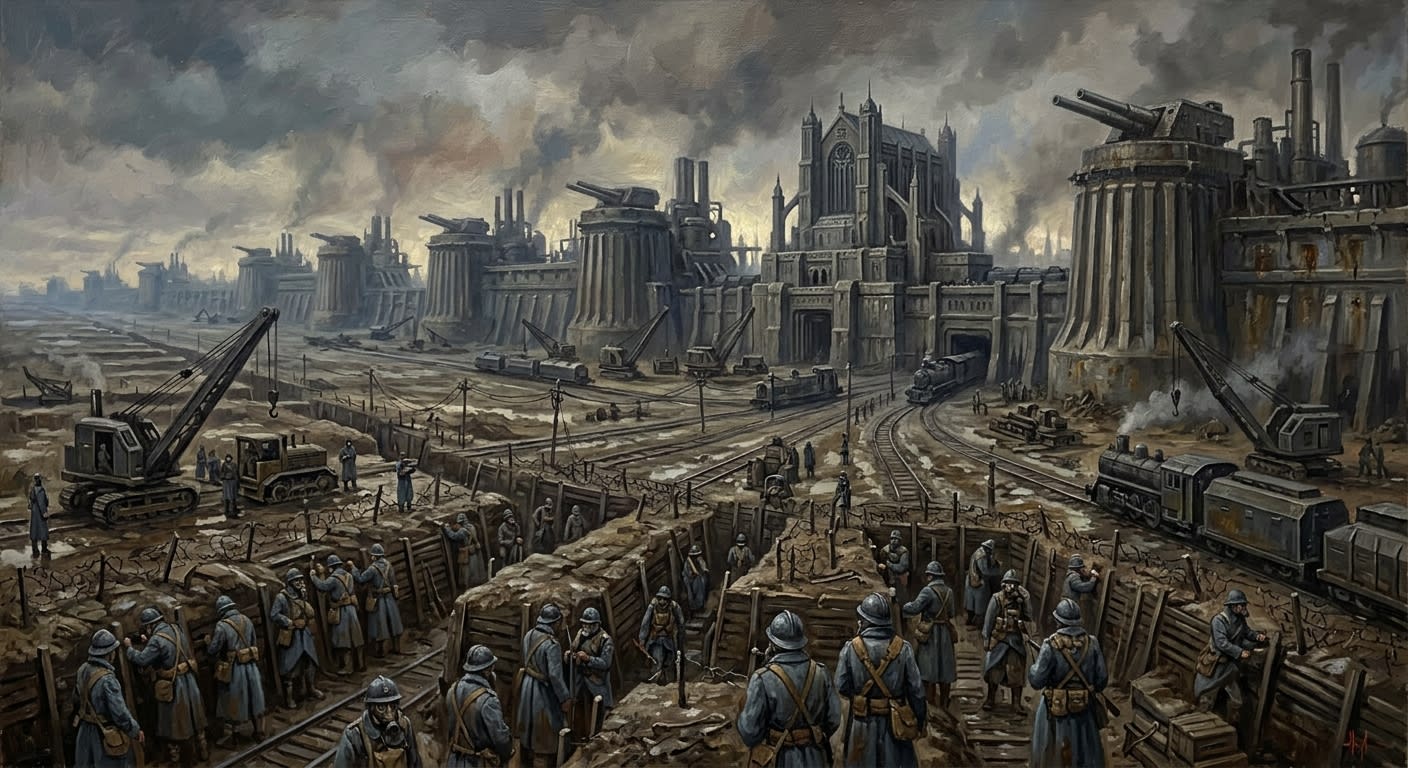
The thing itself is neither clean nor bloodless. It runs north to south from Königsberg at the Baltic to Constantinople at the Bosphorus: trench, bastion, redoubt, rail spur, wire-field, bell-tower, drainage ditch, ossuary road, ration queue, and grave. The Bureau of War calls it a continental fortification system. Doctrine calls it Providence made durable. Soldiers call it the Cut, the Mire, the Spine, the place where boots go in and prayers come out hoarse.
I call it an argument the West has been having with Hell since A.S. 65, conducted in mud, bells, and human leftovers.
Earlier speech permitted older names to cling to its vertebrae: Bastion-Constantinople, Ardenne, Savoy, Rhineland, Shipka, and other refugee sentiments embalmed as geography. Sentiment is permitted in widows, condemned men, and certain dogs. It is not permitted in military cartography. The canonical bastions are now Königsberg, Brest, Przemyśl, Sibiu, Irongate, Shipka, and Constantinople. Anyone using the old names in official correspondence will be corrected; anyone persisting will be educated; anyone nostalgic will be given a shovel.
Legacy catechisms described the Line as running from the Carpathian Gates to the Aegean, and placed certain heroic hinges in directions convenient to old propaganda.
The Line runs from the Baltic to the Bosphorus. It always has, where accuracy requires it; it always will, where Doctrine permits geography to retain employment.
#On the Birth of the Spine
The Line was born when retreat ran out of west.
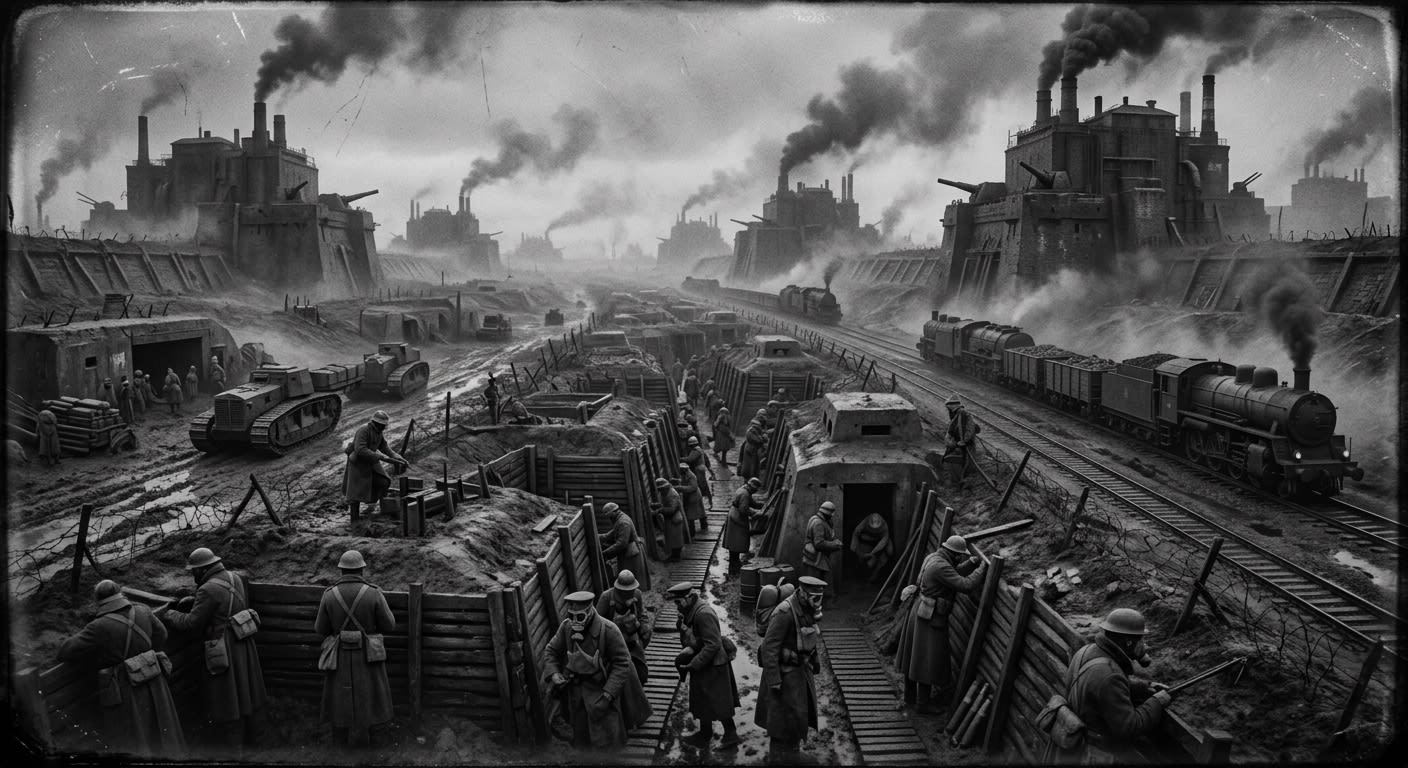
After the Sundering in A.S. 45, the eastern half of Europe became a wound with teeth. The Rationalists, those powdered geniuses of collapse, had built armies excellent at executing priests and considerably poorer at surviving demons. Cities fell. Roads clogged with refugees, reliquaries, cattle, artillery caissons, counterfeit saints, and philosophical officers discovering the limits of syllogism under pursuit. The Great Retreat lasted two decades. The maps of those years read like a ledger being eaten from the right-hand margin.
By A.S. 65 the fleeing armies, local militias, surviving clergy, engineers, bell-founders, and starving peasants had done what statesmen later claimed to have planned. They stopped. The natural barriers of the eastern marches offered their grudging bones: the Masurian lakes, the Bug, the Carpathians, the Transylvanian Alps, the Danube gorge, the Balkan passes, the Bosphorus. The first Line was a sequence of refusals, each one badly supplied, badly named, and gloriously stubborn.
The first trenches were not heroic. Heroism comes later, when Records has time to varnish the ditch. They were holes dug by men whose hands had split, blessed by priests too hungry to complete the Latin, reinforced with doors taken from abandoned houses and coffins taken from graves whose tenants had been judged less urgent than the living. The first wire was farm iron. The first bastion guns had different calibres and quarrelled with their own ammunition. The first bell towers rang cracked peals that summoned men to posts already overrun.
The Line held anyway. This is the part that infuriates demons, Rationalists, engineers, and honest historians alike.
#On the Seven Vertebrae
A spine is not one bone. This observation, though available to any butcher, took the committees of Strasbourg three congresses, seven sealed memoranda, and a duel between two cartographers to ratify.
Königsberg is the northern nail, driven into Baltic damp and lake-mist, facing the thing the Bureau prefers not to name. Its reports arrive under such heavy seal that the wax often weighs more than the paper. Brest guards the Bug River and the flat Polish exposure, where the enemy accumulates rather than assaults and where visibility is both blessing and sentence. Przemyśl fastens the Carpathian passes against Atheron's theatrical dominion, every ridge a pulpit for Pride and every counter-battery a reply shouted uphill.
Sibiu fills the great Transylvanian gap, built upon Saxon stone already stubborn before the Synod had the good taste to requisition it. Its enemy is Velmora, who excavates battles from gold-veins and purchases treason by the wagonload. Irongate commands the Danube gorge, the most beautiful fortification on the Line and therefore Morwen's favourite grievance. Envy does not wish to own Irongate. She wishes to make its beauty impossible to remember.
Shipka guards the Balkan pass against Syrion, whose war is delay, sleep, missing time, and the obscene comfort of surrender. Constantinople locks the Bosphorus and faces the rare luxury of two disasters at once: Kargath's hunger from the Black Sea and Maldrake's fire from Thrace. Their contempt for each other has spared the city more often than our artillery, a fact the Bureau of War has carefully translated into “inter-infernal pressure asymmetry.”
Between the seven great bastions run lesser redoubts, trench towns, permit yards, rope roads, signal hamlets, casualty stations, ash-glyph posts, and nameless dugouts whose entire function is to make the enemy spend one more hour killing men who have already been counted as likely losses. The Line is expensive in the way a body is expensive: every part complains, leaks, hungers, and requires constant maintenance by people who resent being essential.
#On the Machinery of Holding
The provincial imagines the Line holds because guns fire eastward. Guns assist. One must give artillery its small dignity. The Line truly holds because bread, song, and ink arrive before despair completes its rounds.
Bread first. A hungry soldier may fight if he believes the queue still exists. Break the queue and he becomes appetite with a rifle. The Bureau of Tithes, for all its vulturous theology, understands this better than many generals: rations are not food alone, but proof that tomorrow has been scheduled. The Queue Road, the rail spurs, the ferry chains, the switchbacks, and the wretched clerks at every weighing chapel form a second fortification behind the first. A shell can break a parapet. A missing grain convoy can break a regiment.
Song second. Bells and Orison make command into air. First Peal wakes; Third moves; Fifth bleeds fear into confession; Ninth shuts the day like a ledger cover. The Bellways run along the Line in overlapping nets of sound, each tower answering another, each bastion tuned to its own strain of obedience. Pale Chanters and silence-domes attack this system because demons, unlike certain under-secretaries, know where power resides.
Ink third. Every soul must be recorded, every casualty reconciled, every ration tallied, every execution stamped, every miracle filed before it breeds theology without supervision. The Bureau of Records is the least beloved defender of the Line and the one whose absence would kill it fastest. Men die cleaner when they know someone has misspelled their names in triplicate.
The Line also holds through filth. This is not pleasant, which recommends it as truth. Mud swallows shells and men; wire snags demons and saints with equal efficiency; drainage ditches carry blood, rain, sewage, relic wash, and the occasional message written on skin. The soldiers wear grime as if it were chrism because grime means survival. Clean men on the Line are replacements, inspectors, corpses prepared for display, or fools.
A.S. ███ field memorandum from the Northern Sector states that a perfectly clean battalion emerged from fog east of Brest, bearing correct uniforms, correct passwords, and no mud below the knee. The receiving officer ordered immediate hymn-test, mirror-test, blood-test, and ration-test. Results are sealed. The battalion was accepted into the ledger under a number, not a name.
#On What Lies East
East of the Line lies the Charnel Lands, which Doctrine styles temporarily occupied territory because hope, like debt, can be extended past all decency. Ukraine, Moldavia, Wallachia, eastern Balkans, Thrace: names that once meant harvest, river, market, monastery, road. Now they mean pressure.
The enemy does not press evenly. This offends tidy officers and delights strategists with enough imagination to weaponize inconvenience. At Königsberg and Brest, the unnamed forces deny the comfort of taxonomy. At Przemyśl, Pride wants altitude and witness. At Sibiu, Greed wants ore and signatures. At Irongate, Envy wants every carved face smoothed blank. At Shipka, Sloth wants the defender to sit, breathe, soften, and forget. At Constantinople, Gluttony wants the stores and Wrath wants the gate aflame. Velkara wants the officer before he reaches the wall.
No Man's Land between them and us is not empty ground. It is contested flesh of Creation: shell-hole, wire, bone-reef, singing gas, prayer-jam, flesh-mud, false dawn, inverted rain, and abandoned boots standing upright with no feet inside them. Patrols go out with maps. Survivors return with amendments. The amendments seldom agree.
The Line therefore serves as border, instrument, and confession. It declares that mankind cannot yet retake the East. It declares that Hell cannot yet pass west. It declares, most privately, that both sides have learned to live with the declaration. There are heresies in that thought. File them under fatigue.
#On Civilian Misunderstanding
Citizens of Strasbourg enjoy speaking of the Line as if it were a far wall. They buy little engravings, attend patriotic lectures, place saint-soil on mantels, and send sons eastward with ribbons tied around rifle stocks. Then they complain when ration oil tastes of smoke. Rearward patriotism is a pastry: sweet, layered, and mostly air.
The Line reaches them anyway. It reaches through tax, through conscription, through widows' lamps, through hospital trains, through lists posted after Vespers, through shortages explained as victories, through festivals where schoolchildren sing of mud they have never smelled. The Bureau of Festivals orders the Feast of the Mud, and children in clean squares smear ceremonial clay on their cheeks while actual soldiers at Brest scrape real mud out of wounds with spoons. Both acts, by order of Doctrine, are spiritually connected. One of them is also useful.
A recruit arrives at the Line already tuned. He has queued for bread, sung at bells, confessed by schedule, feared incorrect paper, applauded parade amputees, and learned that silence is suspicious. The Line does not create obedience from nothing. It receives obedience pre-cut, pre-salted, pre-numbered, and then finishes the work with artillery.
Civil devotional primers once described service on the Sagittal Line as “the highest adventure of the faithful youth.”
Corrected: service on the Line is the highest expenditure of the faithful youth. Adventure implies optional return.
#On the Present Condition
As of A.S. 201, the Line holds.
This sentence is printed every year, and every year it means something slightly uglier. Holding includes lost salients, flooded saps, miscounted dead, ration panics, purged choirs, erased patrols, two kilometres ceded and three metres reclaimed with trumpets, bridges blown by our own hands, gates burned by enemy fire, and bastions declaring “operational” because the alternative would distress investors in military debt. Holding is not victory. Holding is the refusal to permit defeat the courtesy of a clean signature.
The Line will not save mankind by existing. It must be fed, rung, repaired, feared, paid for, lied about, and walked by men and women whose names will be mispronounced by clerks who never saw their faces. The West stands because the Spine has not broken. The Spine stands because millions have agreed, under various degrees of compulsion, to become vertebrae.
At dusk the Ninth Peal travels down the Line, tower to tower, bastion to bastion, from Baltic cold to Bosphorus smoke. Men stop cursing long enough to count it. Clerks pause with ink above page. Surgeons listen through screams. Somewhere east, something listens back.
The bell answers first.