
#On the Founding of Glowmire
"The dead were placed. The map was mercy. Whose mercy, we did not ask." — Mortuary Cartography Office, Charter Preamble, A.S. 74
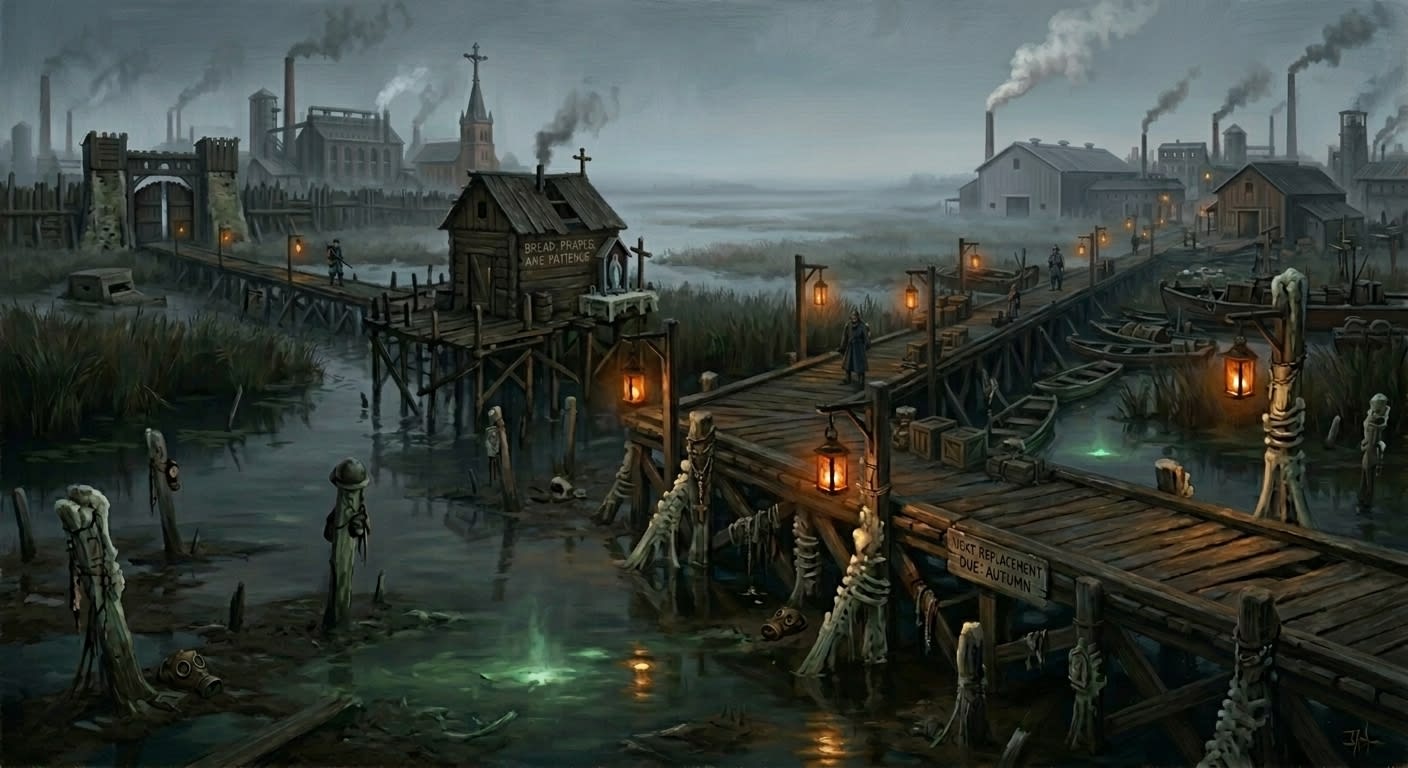
There exists, at the rim of the Sagittal Line's eastern drainage — where the Danube ceases to be a river and becomes an argument between salt and silt — a settlement that the Bureau of Records classifies as "operational," the Bureau of War classifies as "necessary," and no living soul who has worked a night shift on its lantern rackway classifies as anything fit for human habitation. The Ash-Glyph Marshworks squats at the river mouth like a clerk who has sat too long in a damp office and begun to resemble his furniture: functional, grey, and permanently waterlogged.
It was chartered in the seventy-fourth year of the Synod's reckoning — A.S. 74, for those who require their grief in numerals — nine years after the Line solidified from desperate entrenchment into continental fact. The impetus was corpses. There were too many of them, arriving by barge down the Danube's eastern distributaries, and they were clogging the river mouth in a manner that offended both navigation and theology. A logistics officer of the Bureau of War — unnamed, because logistics officers are always unnamed; the Bureau prefers its architects invisible — was dispatched to "resolve the hydrological impediment." His resolution was a set of stakes driven into the mud at the river's edge, each bearing an ash-glyph marking the grid coordinates of a mass grave. Within three seasons the stakes had multiplied beyond his authority. Within five, the stakes had attracted a population. Within a decade the population had attracted a guild, three taverns, a confession booth, and the Bureau of Records, which arrived uninvited and has not left since.
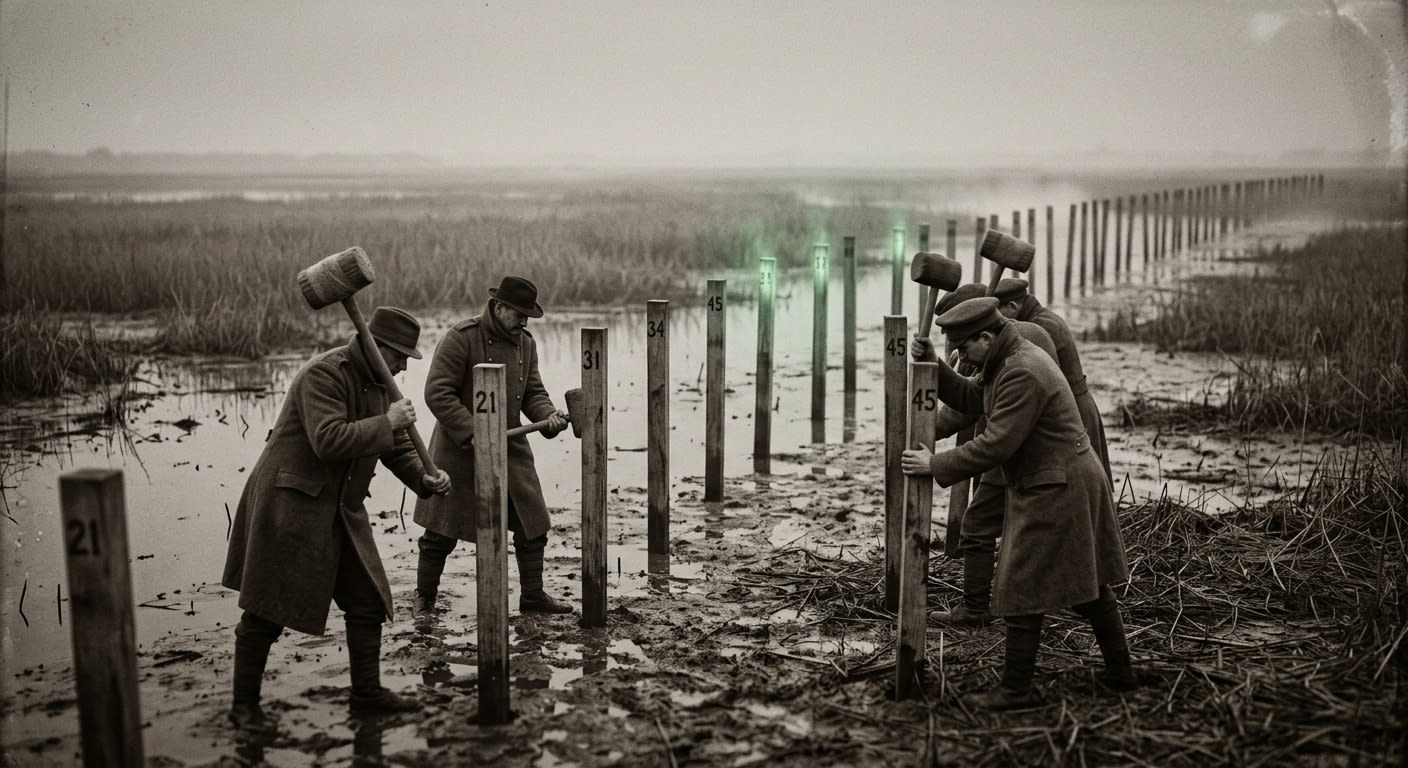
The name came from the stakes. The ash-glyph — a numeral system rendered in powdered bone-ash mixed with lye, pressed into wet timber with a branding iron — was the Bureau's method of converting the dead from persons into coordinates. Each glyph marks a burial grid: a ten-by-ten-pace square of marsh in which the contents are catalogued, sealed, and, in theory, left alone. That the glyphs blur overnight and re-form in slightly different configurations is a matter the Bureau has classified as "environmental calligraphy" and declined to investigate further.
The Marshworks sits at approximately 45°N, 29°E — the delta country where Europe's war-dead meet the Black Sea's indifference. Zone Four shades to Five here; the Line is close enough to hear on still nights, far enough to pretend you cannot. The ground is reed marsh, brackish pool, and mudflat, stitched together with tarred rope and driftwood platforms in a manner that suggests architecture only if one is generous with the word. The air smells of brine, tallow, vinegar, and something sweeter that the locals attribute to the lime and visitors attribute to the dead. Both are correct.
#On the Geography of Damp Misery
"The ground cannot decide whether it is water or land. Nor can the Bureau. We have classified it as 'conditionally solid' and moved on." — Bureau of Engineering Survey, A.S. 112
The settlement's spine is the Ropewalk — a raised causeway of lashed timber and bone-lime pilings that runs the length of the delta settlement from the Causeway Gate at its western head to the Charnel Moorings at its eastern terminus. Everything of consequence hangs from, leans against, or drips onto the Ropewalk. Satellite platforms radiate from it on stilts, connected by plank bridges that the locals replace so frequently they have stopped naming them. A bridge lasts two seasons. A name, here, is not worth the moisture.
Seven districts compose the Marshworks, each with its own stench and its own species of desperation:
The Glyphyard occupies the settlement's southern flank — a vast grid of ash-staked mud where the Mortuary Cartography Office conducts its sacred business of converting the war-dead into filing entries. Glyph-stakers work at dawn, driving bone-lime stakes into soft ground with mallets wrapped in linen to muffle the sound. The silence is mandated: a spoken name over open water, here, is a punishable offence. The Bureau insists this is doctrinal. The locals insist it is practical. "The marsh listens," they say, with the flat certainty of people who have tested the proposition and found it confirmed.
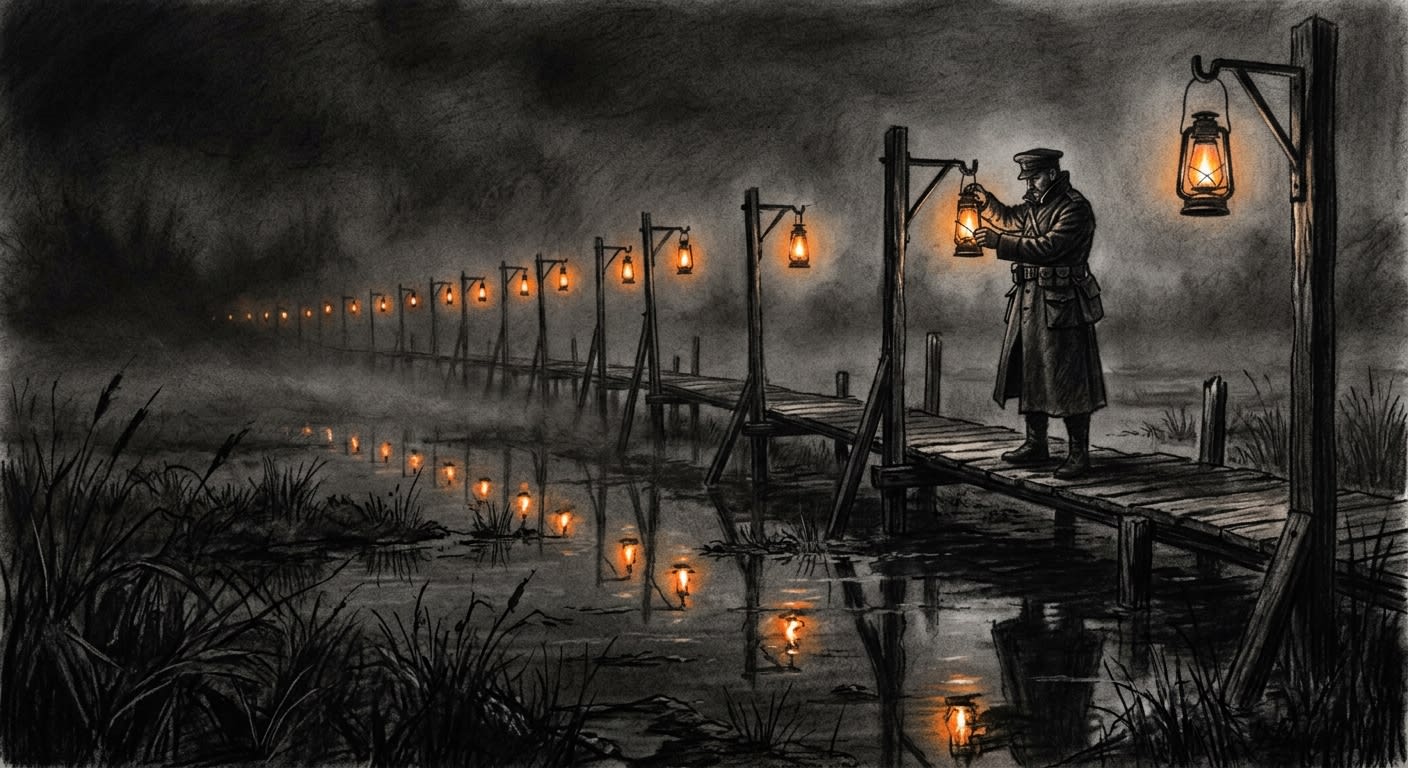
The Lantern Rackway runs above the waterline on iron brackets bolted to the Ropewalk's stilts — a chain of tallow lamps in coded sequences that guide night traffic through safe channels. The Lantern Guild of the Third Brine controls every wick, every bracket, and every route designation. Their codes include a pattern called the Do Not Answer, employed when lights on the water respond to signals that no living crew has sent. This happens with sufficient regularity that the Guild has standardized the response.
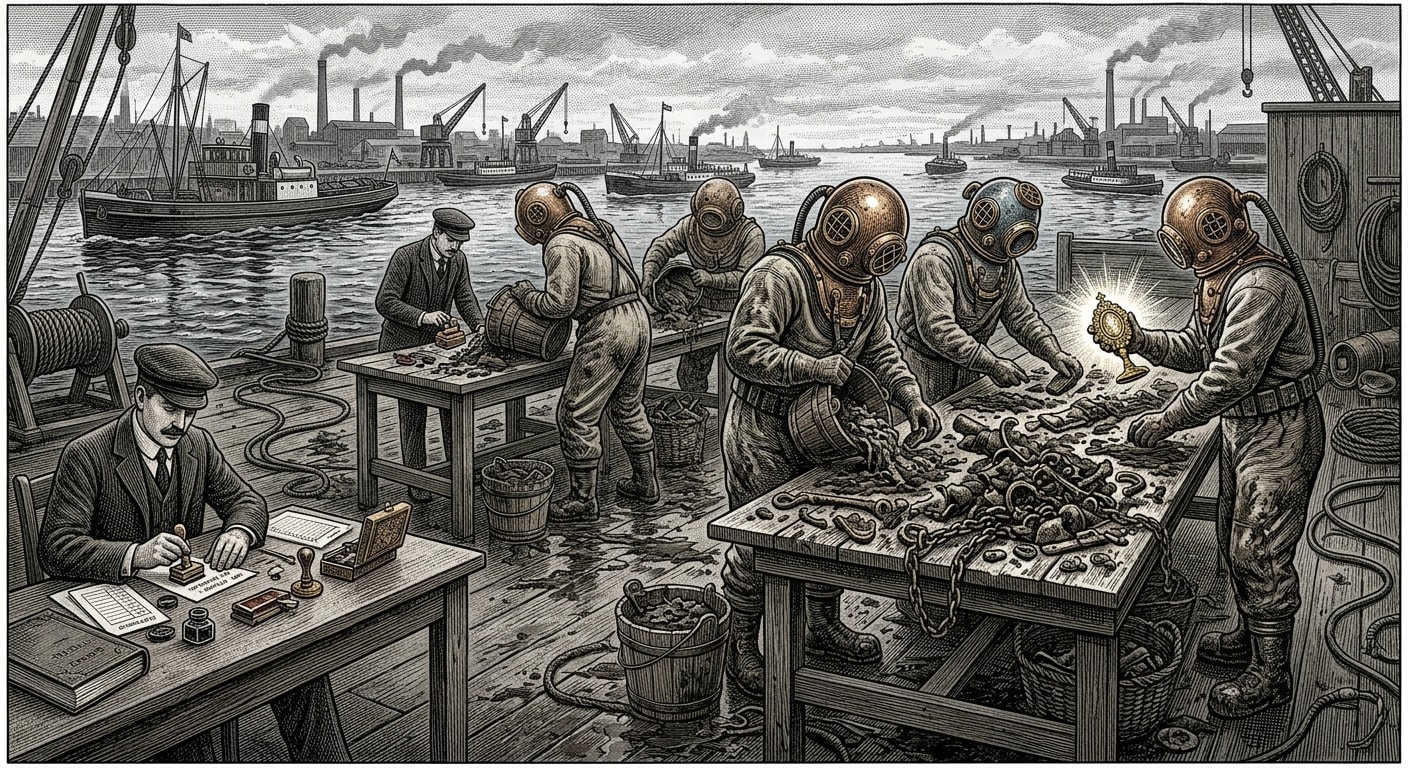
Diver's Gut is the salvage quarter — a row of sorting tables on a floating platform where the things pulled from the mud are catalogued, tagged, and occasionally argued over with knives. The divers themselves are a caste apart: paid in salvage shares, bonded against debt, and rotated on a schedule that the Bureau calls "efficient" and the divers call "before the shaking gets bad." What they pull up is bone, corroded metal, waterlogged timber, and — with increasing and uncomfortable frequency — relics. Reliquary fragments, medallions of saints, consecrated instruments that bear no corrosion despite decades in brackish mud. The Bureau of Alchemical Standards has inspected eleven such recoveries since A.S. 194. Eight were certified authentic. The remaining three were certified "indeterminate," which is the Bureau's way of saying they were too frightened to file a definitive answer.
The Charnel Moorings anchor the eastern end: a dock of creosote-black pilings where the corpse barges tie up. During burial surges — and the surges come with the offensives, regular as tides — as many as forty barges queue at the moorings, each carrying its manifest of the dead in vinegar-soaked wrapping. One barge, designated Registry Fourteen, has returned empty on three occasions without any crew aboard. The Bureau of Records lists these events under "Weather."
Seal Shed Row is the bureaucratic heart — a line of timber sheds where tag clerks stamp, seal, and countersign the paperwork that gives the dead their final designation. A salvage tag. A burial grid coordinate. A confession receipt stapled to a name. Without the tag, the dead are not dead; they are "unprocessed." Without the seal, the tag is not valid. Without the countersign, the seal is not recognized. The system functions with the serene inefficiency of all Synod paperwork: slowly, redundantly, and with absolute authority over everything it touches.
The Reed Market operates after curfew in defiance of three separate Bureau mandates, selling lamp oil, eel broth, dry cloth, and items whose provenance the tag clerks would find distressing. It smells of smoke and commerce. The Glow Choir recruits here, which the Bureau of Purity has noted in seven consecutive inspection reports and done nothing about, because the Glow Choir's membership includes three of the Bureau's own informants.
The Causeway Gate guards the single raised road connecting the Marshworks to the inland territory. Every soul entering or leaving passes through the Gate's inspection — seal checks, quarantine assessment, and the extraction of fees that the wardens call "administrative" and everyone else calls extortion. The Gate is the Marshworks' chokepoint and its revenue source. Whoever holds the Gate holds the settlement's throat. At present, that is the Ashbound Wardens, a militia clique whose mandate is quarantine enforcement and whose practice is the creative interpretation of that mandate for personal enrichment.
#On the Dead and Their Administration
"We do not bury the dead. We file them." — Cartographer-Provost Lysa Vane, in testimony before the Bureau of Records, A.S. 199
The purpose of the Ash-Glyph Marshworks is the orderly disposition of war-dead arriving by river from the Sagittal Line's eastern theaters. This is the official formulation. The practical formulation is simpler: the Line produces corpses faster than the earth can receive them, and someone must manage the surplus. That someone is the Mortuary Cartography Office — a joint enterprise of the Bureau of Records and the Bureau of War, staffed by clerks who have developed the particular thousand-yard stare of men who catalogue human remains for a living and have learned not to read the names.
The system operates on ash-glyphs. Each burial grid — ten paces by ten, staked with bone-lime posts and marked in the powdered-ash numeral system — receives its dead, its manifest, and its seal. The manifest lists the contents by number, rank, and unit designation. The seal is affixed by a Seal Magistrate. The grid is closed. A map is drawn. The map is filed. The dead, at that point, cease to be the Bureau of War's problem and become the Bureau of Records' asset.
Earlier field reports from the Marshworks (A.S. 78–92) describe the ash-glyph system as "provisional" and "subject to revision upon the cessation of hostilities."
Hostilities have not ceased. The system is no longer provisional. It is, by the Bureau's own precedent of uninterrupted use for one hundred and twenty-seven years, canonical. The word "provisional" has been struck from all surviving copies of the founding charter. The Bureau thanks the reader for not having read them.
Three thousand nine hundred souls inhabit the Marshworks on a permanent basis, a number that swells to five or six times that during burial surges when the barge convoys arrive in earnest. The permanent population divides into the administrative (provosts, clerks, seal magistrates), the operational (glyph-stakers, divers, barge-handlers, lantern riggers), and the stranded — those who arrived for a salvage season and discovered that the causeway fees exceeded their earnings, binding them to the marsh by the simple arithmetic of debt.
Cartographer-Provost Lysa Vane presides over the Glyphyard and the Mortuary Cartography Office with immaculate gloves and maps that are not immaculate at all. She is meticulous, she is feared, and she knows the precise location of every burial grid in the delta — a knowledge that constitutes both her authority and her vulnerability, because the grids do not stay where they are staked. The marsh re-sorts its graves. Stakes appear in new positions overnight. Grids that were closed and sealed are found open, their contents rearranged in configurations that the Bureau of Engineering calls "subsidence" and Vane calls nothing, because she has learned that naming the phenomenon gives it weight she cannot afford to carry.
Guildmaster Orren Pike controls the Lantern Rackway and, with it, the right to travel the Marshworks after dark without dying. He speaks in route codes even during confession, which his assigned chaplain has noted in three separate pastoral reports. Pike's power is absolute within his domain and invisible outside it. The Bureau of War does not acknowledge the Lantern Guild's authority. The Bureau of War's officers, when posted to the Marshworks, follow the Guild's lamp codes without exception. The contradiction is, as always, institutional.
The third power is "Softstep" Maro, diver-boss of the salvage crews, a man who leaves no footprints where he walks — a detail the locals report with the matter-of-factness of people describing the colour of the sky. Maro controls what comes up from the mud. What comes up from the mud, increasingly, is worth killing for.
#On the Corpse-Light and Its Implications
"If it shines, don't follow." — Marshworks proverb, origin unknown, application universal
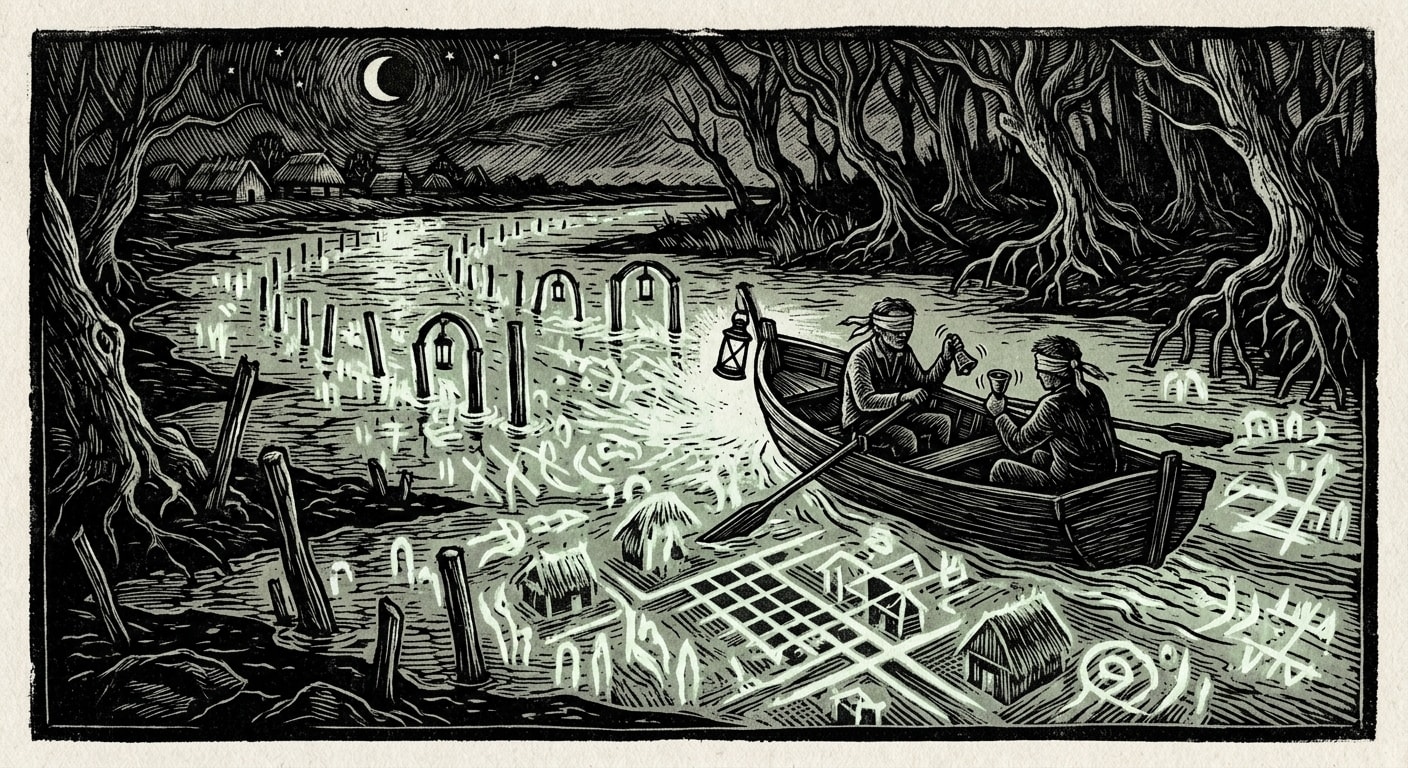
The phenomenon that the Bureau of Alchemical Standards classifies as "anomalous bioluminescent discharge" and the locals call corpse-light is the Marshworks' defining terror. It blooms at night over the sinkholes and burial shallows — a phosphorescent green-white glow that mimics the patterns of safe lantern channels, draws boats off-course, and has drowned more souls in the delta than rot-fever and knife-fights combined.
The corpse-light answers signals. This is the fact that the Bureau has spent thirty years declining to address. When a lantern crew lights a coded sequence on the rackway, the corpse-light sometimes responds with the same sequence, reflected from a position where no lamp exists. When a barge crew calls for a channel marker, the corpse-light sometimes provides one — perfectly placed, perfectly bright, leading into water too shallow for a keel and too deep for a man to stand. The Guild's Do Not Answer protocol exists for this reason. When the marsh lights up, you douse your own lamps and row by bell-click cadence alone, blindfolded, counting strokes. It is an absurd procedure. It is also the only one that works.
The Bureau of Alchemical Standards first noted the phenomenon in A.S. 143, the same year Maldrake's fires turned the Thracian skies to ash. Whether the two events are connected is a question the Bureau has filed under "pending review," a classification it shares with the corpse-light itself, with the anomalous behaviour of the burial glyphs, and with the broader question of what, precisely, is happening at the bottom of the delta mud. The review has been pending for fifty-eight years. The Bureau is nothing if not thorough in its refusal to commit.
What the locals know — and what the Bureau's pending review has scrupulously avoided confirming — is that the corpse-light is intelligent. It learns routes. It adapts to Guild codes. It has, on at least four documented occasions, formed patterns that replicate the settlement's own layout — lantern positions, platform locations, causeway alignment — shifted by one district, as if proposing an alternative geography. On the night of the Seventh Bloom, A.S. 196, a corpse-light formation replicated the Glyphyard's stake pattern with such fidelity that a disoriented night crew drove their barge directly into a sinkhole, following what they believed were Vane's own markers. Three men drowned. The markers vanished at dawn. The Bureau classified the incident as "navigational error compounded by atmospheric conditions."
The Glow Choir — a sect that meets in the reed tunnels beyond the settlement's permitted boundary — worships the corpse-light as a calling intelligence. They sing to it. The light, on certain nights, sings back — or produces a vibration in the reeds that the Choir interprets as song. The Bureau of Purity has investigated the Choir seven times. It has arrested none of them, because three of the Choir's members are Bureau informants, because two more are the children of Seal Shed clerks, and because the Bureau is not entirely certain the Choir is wrong.
#On Relics That Arrive Without Invitation
"Some relics climb out of the mud on purpose." — Reed Market saying, universally repeated, universally disbelieved, universally feared
The salvage economy of the Marshworks has always produced relics — fragments of consecrated metal, medallions, liturgical instruments carried to burial in the pockets and packs of dead soldiers. This is expected. What is not expected is the phenomenon the divers call "yesterday finds": relics that surface in pristine condition, bearing no corrosion, no water damage, and — most disturbingly — salvage tags already attached, stamped with dates that have not yet occurred.
The Mortuary Cartography Office's annual report for A.S. 198 states that relic recovery rates "remain consistent with historical averages."
This is a lie of such clinical precision that the Bureau of Records has commended the Cartography Office for its draftsmanship. Relic recovery rates tripled between A.S. 194 and A.S. 200. The "yesterday finds" alone account for more authenticated relic material than the previous thirty years of legitimate salvage combined. The Bureau of Alchemical Standards has certified eight of eleven inspected recoveries as genuine. The remaining three it has classified as "indeterminate," a word that here means "we tested them, they passed every test, and we are afraid of what that implies."
The Mud-Relic Syndicate — known on the Reed Market as the "Yesterday Finders" — has built a cartel on the ambiguity. Their operation is straightforward: relics surface, divers recover them, the Syndicate launders the provenance through forged tags and bribed seal clerks, and the relics enter the Synod's authenticated relic supply chain as legitimate battlefield recoveries. The profit is immense. The theological implications are worse. If the relics are genuine — and the Bureau's own tests say they are — then something in the marsh is manufacturing consecrated objects from the raw material of the dead.
Diver-Boss Maro controls the intake. What rises from the mud passes through his sorting tables before it reaches the Seal Sheds. He takes his percentage. He asks no questions about the provenance. He has, however, been observed performing a small ritual before each dive — a gesture that resembles neither Synod prayer nor any documented heretical practice, but which the divers replicate without exception. When asked about it, Maro smiles. His smile, like his footprints, leaves no impression.
The False Shore — a stretch of delta shoreline that shifts position with the tides, appearing and disappearing like a cartographer's indecision — is where the most significant yesterday finds surface. Divers who work the False Shore report that relics sometimes emerge from the mud already warm, as if recently held. One recovery team in A.S. 199 pulled up a reliquary casket containing a finger-bone that the Bureau of Alchemical Standards certified as belonging to no known saint, no known soldier, and no known species of primate. The casket bore a tag stamped with a date three days in the future. The finger-bone was confiscated. The divers were reassigned. The casket is, presumably, in a vault somewhere in Strasbourg, being examined by men who will file their report under "pending."
#On the Quarantine and Its Discontents
The Marshworks operates under permanent quarantine protocols — not because plague is present (though rot-fever kills a dozen workers each season), but because the Bureau of War discovered in A.S. 112 that quarantine powers grant the local garrison authority to restrict movement, seize goods, and detain personnel without the usual inconvenience of judicial process. The quarantine has been "temporary" for eighty-nine years. The Ashbound Wardens enforce it with hook-poles and cordons, extracting quarantine "fees" at the Causeway Gate with a creativity that would impress the Bureau of Tithes, if the Bureau of Tithes were aware of it, which it is, and has been since A.S. 140, and has done nothing about, because the fees represent a revenue stream the Bureau has not yet determined how to tax.
Forced labour is the quarantine's shadow economy. Debtors — and in the Marshworks, nearly everyone is a debtor, because the causeway fees exceed the salvage wages with mathematical inevitability — are assigned to night lantern shifts or diver rotations. The night shifts have the highest mortality. The diver rotations have the highest rates of what the Bureau of Records delicately terms "cognitive irregularity." Both serve as punishment, debt repayment, and population control in a single bureaucratic instrument. The Bureau of Mercy has been invited to inspect the Marshworks on four occasions. It has declined all four, citing "scheduling difficulties" that have persisted for eleven years.
#On the Present Condition
The Marshworks in A.S. 201 is a settlement balanced on the point of a glyph-stake — functional, necessary, and a single bloom away from catastrophe. The corpse-light is growing brighter. The yesterday finds are growing more frequent. The Glow Choir is growing bolder. The Synod's Mortuary Cartography Office demands higher "recovery yields" from a marsh that is becoming, in Guildmaster Pike's words, "too bright to work safely."
Cartographer-Provost Vane's maps no longer match the terrain. She knows this. She files the discrepancies as "seasonal drift" and redraws each morning. The stakes move. The grids rearrange. The dead, it appears, are sorting themselves — or being sorted by something that understands the Bureau's filing system better than the Bureau does.
The buried truth — and it is buried, in mud and in paperwork, which in the Marshworks amount to the same medium — is that something beneath the delta is using the dead as raw material. It prints relics into the mud. It rearranges graves into patterns that resemble, if one squints through the fog at dawn, a language. It answers the lantern codes. It maps the settlement and shifts its own map by one district, as if testing whether anyone will follow.
The Bureau's position is that none of this is happening. The Bureau's position has been "pending review" for fifty-eight years. The review will continue to pend. The dead will continue to arrive. The marsh will continue to shine.
And the locals will continue to repeat the only piece of doctrine the Marshworks has ever produced that the Bureau of Doctrine has not seen fit to ratify, revise, or suppress — because it is true, and because true things are the most dangerous things of all to stamp:
If it shines, don't follow.