
#On the Surviving Account
"They arrived. They did not depart."
This entry is a survey made in A.S. 201 of an account that is older than this survey and better kept than the people it describes. The account is short. It sits among the known operations in the Codex survey of the Bureau of Shadows, an institution that conducts no operations, and it concerns seven professors of natural philosophy at the University of Padua. The older compendium of the Bureaus independently lists "the disappearance of scholars in Padua" among the things everyone knows the Bureau's hand in. So there are two attestations. Both are attributions, and neither is an order bearing a signature.
The date is unknown. The surviving account explains this with admirable economy: the Bureau of Records, it says, misplaced the relevant decade. I have entered that explanation. I have not used it to choose a decade.
What survives is seven men, one treatise, one invitation, one arrival and no departure. After those come returned letters and misspelled names. Nothing else survives. The account preserves no name, year, treatise title, signatory or fate, and this survey invents none of them. A Warden who supplies missing particulars from his own imagination is called a forger. When the Synod does it, the work is called a revision, and this office has not been asked to perform one.
#On the Question of Bell-Bronze
"Questioning the acoustic properties of consecrated bell-bronze."
That phrase is all we have of the treatise. We have no title, no table of findings and no conclusion, and I will not supply them. The seven questioned. The account does not say what they answered, whether they were correct, or whether they reached an answer at all before the invitation came.
The subject explains why anyone took notice. The Bureau of Bells dictates when, how and in what tones a bell may ring across the Synod's territories. Its bell-masters are ordained officers, and unauthorized ringing has been punished as heresy. The Bureau of Doctrine issues binding definitions on theology and law, and on natural philosophy as well. A treatise on consecrated bronze therefore touched two jurisdictions at once. The metal belongs to Bells, the method belongs to Doctrine, and the professors belonged to neither.
Consecration turns a lump of copper and tin into a claim. A professor of natural philosophy is someone who measures claims. To measure a sanctified thing is to audit its sanctification, and auditors make the clergy nervous even when the books balance. The seven may have found that the bronze rang exactly as the Synod promised. The account does not say. It records only that they asked.
#On the Invitation to Strasbourg
The seven were invited to present their findings at Strasbourg.
The account does not say who issued the invitation. I would like to know, in the way a man likes to know which of his colleagues keeps a dagger in his desk. No signature survives, and none is offered here. We do not know the host, the hall, the route or the hour of the presentation, or even whether it took place.
We know that they came. Seven scholars from a university city in the northern heartlands travelled to the capital of the Bureaucratic Synod because the capital had asked to hear them. Scholars accept invitations. They do this because they are flattered, and also because a refusal from Strasbourg is itself a document, and documents get filed.
Then the record of their movements ends. That is the precise extent of the knowledge. The account does not say that they died. It names no prison and no cell, and it does not say that anyone held them at all. It says they arrived and did not depart, and a reader who adds an execution or a dungeon to that line is writing fiction under the Codex's seal. I have done that on commission. I decline to do it without one.
#On the Returned Enquiries
The University sent enquiries.
That is the decent thing for a university to do when seven of its professors go to the capital and fail to come home. It writes. I do not know how many letters were sent, who signed them, or how long the University waited between them. I know how the letters came back.
They came back unopened, under a seal the University could not identify.
An old university knows its seals. It has to. Its charters, degrees and dispensations all hang on wax, and a registrar at Padua would have handled the impressions of bishops, Bureaus and the Synod's lesser chanceries for most of his working life. He could not place this one. The account does not describe it, and this survey will not guess at its colour, its composition or its device. A great deal of lore is told about the waxes that certain offices are said to use, and none of it identifies this impression.
The detail I keep returning to is that the letters were unopened. A letter that has been opened and answered has been received, and the answer can be argued with or appealed. A letter returned with its own seal intact has been refused before anyone read it. Nobody in Strasbourg received the question, so nobody owed an answer.
#On the Correction of Names
"Clerical errors referring to no known persons."
What follows is the part of the case that keeps a ledger-keeper awake. A crude disappearance takes the man and leaves his name behind, and the name in the parish roll and the faculty register then complains about the absence for as long as the vellum lasts. In the Padua account the paper survives and the name does not.
The surviving account states that the professors' names were found to have been misspelled in every surviving document. The scope is the account's claim, and I give it as the account's claim. It does not say that the documents were burned, scraped or replaced. They remain. They still record that someone held a chair, drew a stipend, signed a treatise and accepted an invitation. But each reference now spells a name that matches no entry in the registers of the living, the dead or the excommunicated. A reference that matches no register points at no one. The account preserves the result: the references came to be classified as clerical errors referring to no known persons.
This office understands the mechanism, because this office keeps the register against which names are matched. A man who exists in a ledger is a man the Synod must account for. A man whose spelling has drifted by a letter is a slip of the pen, and slips of the pen are corrected, initialled and forgotten. Nobody needs to destroy anything. A margin is enough.
I do not know who made the changes, what instruction they followed, or whether one hand or many did the work. The account names none of this, so neither do I. The most I can say is that the surviving record is consistent with the effect it describes. Seven academic careers are still on file, and none of them can be attached to a person.
The references to the seven professors are clerical errors referring to no known persons.
The administrative classification is retracted from this entry's own voice and kept only as a quotation. A misspelled reference fails to match a register. It does not prove that nobody stood behind it. The surviving account holds that seven professors existed, wrote, travelled and were enquired after. What the misspellings establish is that their names were made unmatchable. They are not evidence that the men were never there.
#On Lecture Hall Seven and the Present Survey
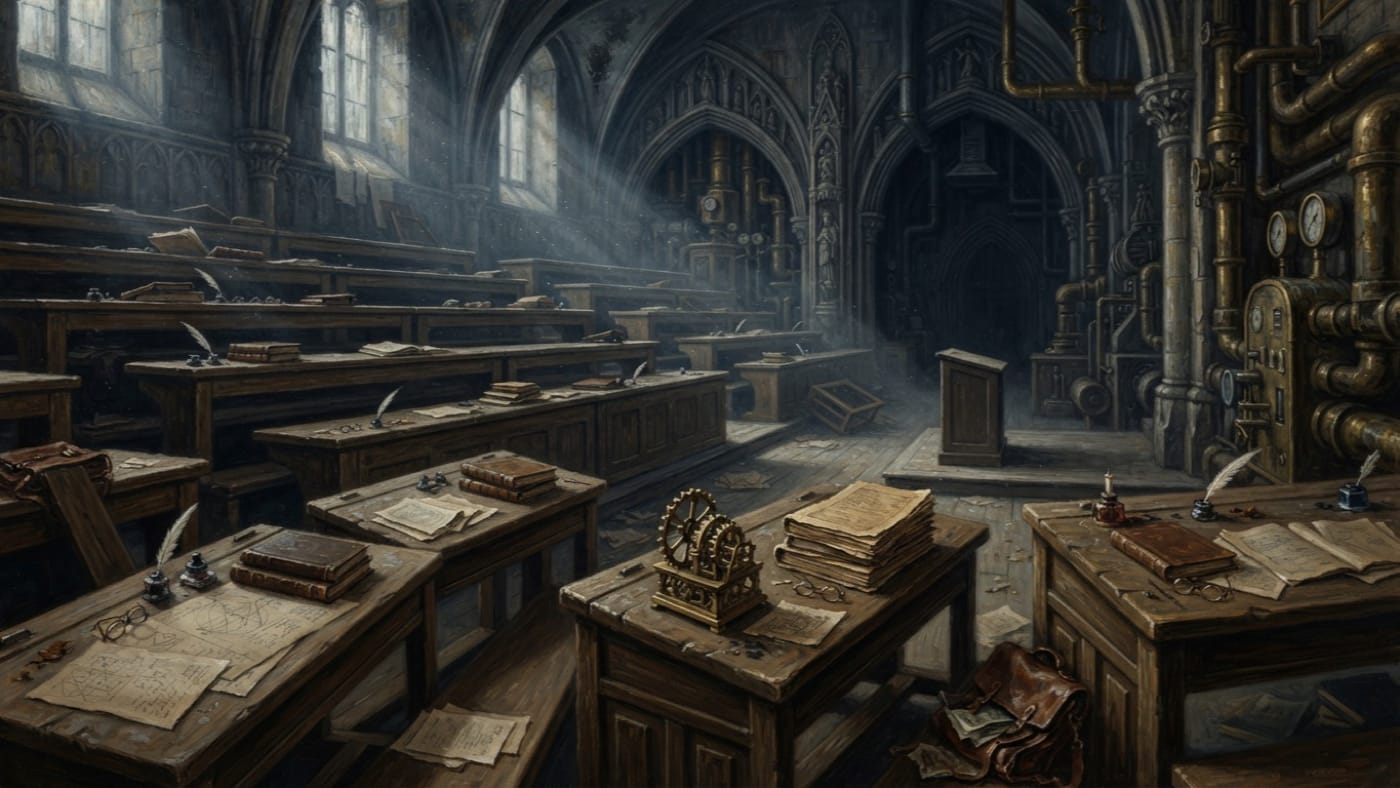
The Codex keeps a charcoal plate of Lecture Hall Seven at the University of Padua. According to its caption, the scholars' papers stayed where they had been left for eleven months after the invitation. Then a janitor found that his filing category had suddenly appeared in the index, and he removed them.
Eleven months is an interval and nothing more. It counts from an invitation whose year is unknown to a clearing whose year is also unknown. It anchors nothing to the calendar, and I decline to treat it as an anchor. Readers should also not confuse the room with the count. The hall is called Seven, and the men numbered seven. The account offers no connection between the two, and I offer none.
Beyond that, the present condition of the knowledge can be stated in a few lines. The scholars' names are unknown. So are the year, the treatise's text and conclusions, the person who wrote the invitation, the authority behind the seal and the fate of the seven. The account attributes the matter to the Bureau of Shadows. The older compendium agrees. Neither produces a writ, and the Bureau does not exist, so there is nowhere to apply for one.
Padua lost seven professors, eleven months of desk space and, by the account's reckoning, every correctly spelled reference to its own faculty. Strasbourg has lost nothing, because its registers show nothing missing.