
#On Writing About the Centre of the World
I am Valerius Drax, and I have lived in this city for seventeen years. I have filed reports in every Bureau. I have prayed in the Cathedral's shadows and drunk in its cellars. I know Strasbourg as a man knows his own scar tissue: intimately, resentfully, and with the certain knowledge that it will outlast him.
Every Hieromnemon who has ever held a pen has tried to capture this place. The official catechisms call it "the beating heart of the Synod, the fortress of faith, the unwavering centre of Divine Order." Not inaccurate — merely incomplete, in the way that calling a man "mostly water" is incomplete, or calling a battlefield "dirt and noise."
What follows is not doctrine. The Bureau of Records would never approve such candour. Consider it a private letter that accidentally became a book — a confession disguised as a guide, sealed with the wrong wax.
#A History of Arrogance
Before the Synod, Strasbourg was a trading post at the confluence of rivers — a place to tax merchants and hang heretics. The Rationalists built their courts here, believing law and commerce could substitute for Faith. They were wrong. They are always wrong. But they built well: the foundations of the modern Cathedral rest upon Rationalist stone, an irony the Bureau of Purity does not advertise in its pamphlets.
Earlier catechisms claimed the city was "virgin ground, unsullied by Rationalist influence" prior to the First Confessors.
This is false. Rationalist institutions used and altered older Strasbourg stone, including foundations later employed by the Cathedral. The duration of their local rule is not established by the masonry. The notary responsible for the "virgin ground" formulation has been reassigned to the Paper Mines of Ulm, where the ground is at least literally virgin.
The calendar's A.S. 0 is an epoch assigned retrospectively at the Concordat in A.S. 90, not the date Strasbourg became a Synodal capital. Provisional offices gathered here around A.S. 49–54; the Concordat formalized the capital. Augustinus and Kratz had died before its signing. Their earlier work shaped the settlement, but neither signed it. The city sat at the crossroads of Rhine trade routes, defensible by inherited walls. Strasbourg was safe. Boring, but safe. The successors valued safety.
The first century transformed the city from a regional hub into a continental capital. The Cathedral — then merely a large church — was expanded, gilded, and consecrated until it dominated the skyline like a stone accusation pointed at Heaven. The first Bureau buildings rose: simple structures of wood and prayer, nothing like the fortresses of bureaucracy they would become.
#The Sanctum Mile
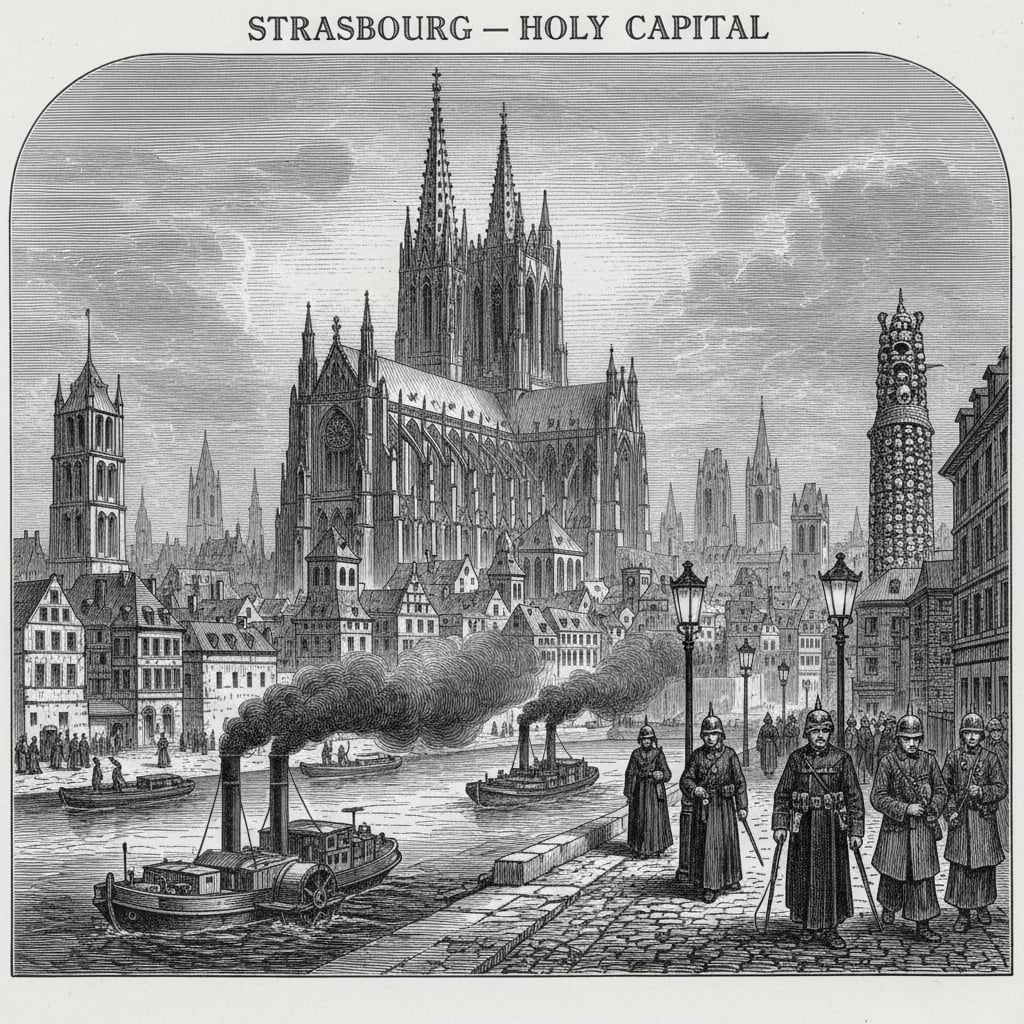
The heart of Strasbourg, where Cathedral and Bureaus stand shoulder-to-shoulder like old rivals forced into alliance. The streets are clean. The buildings are ancient. The guards are numerous. Cardinals, Archons, and Hieromnemons walk here with the unconscious arrogance of those who have never doubted their importance. The poor are kept out by curfew and custom rather than walls — their presence would be "inappropriate."
Here you will find the seven Bureau headquarters that admit to existing, the Hall of Confessions where the Synod meets, and the Prison of Questions — officially, the "Administration of Clarification." I have visited the Prison. Once. I did not return for the tour.
The Cathedral itself defies description. Its nave holds ten thousand. Its spires took three centuries to build. Its reliquary contains bones that may or may not be apostolic — the Bureau of Records has files on the matter, sealed at seven levels of clearance, which tells you everything about the bones and nothing about the truth.
#The River Quarter
Where the Rhine trade still flows, despite everything. Merchants, sailors, and the kind of priests who minister to both. Foreign accents, foreign goods, foreign ideas — all under the watchful eye of Purity's agents, who catch perhaps one heretical book in ten. The merchants consider this a tax on doing business.
The docks receive grain from the west and refugees from the east in roughly equal measure. A Foreign Church permits non-Synod Christians to worship under supervision, which is to say under the gaze of three Confessors who take notes and a Lictor who does not take notes because the Lictors have moved beyond paperwork.
#The Warrens
The poor district, and the only honest neighbourhood in the capital. Refugees, criminals, and the merely unfortunate compete for space in a maze of narrow streets and overhanging buildings. No one knows how many people live here. Estimates range from fifty thousand to one hundred and fifty thousand, depending on whether you count the dead, who in the Warrens take some time to be noticed.
This is where Strasbourg hides its failures — the widows of soldiers who never returned, the refugees from fallen provinces, the heretics too minor to execute and too persistent to forget.
The Bureau of Shadows maintains ████████████ observation posts within the Warrens. Their purpose ████████████████████████. The residents are aware. They pretend otherwise, as do we.
A woman named Mother Giselle has fed the poor here for thirty years. The Bureau of Purity has investigated her twelve times for heresy. She has been found innocent every time. They will investigate her again. Her soup is that good.
#The University
Yes, we have a university. Yes, it is controversial. The Academy of Strasbourg trains theologians, lawyers, and the occasional actual scholar — though the latter are viewed with suspicion by every Bureau except Records, which needs people who can read.
The University represents the Synod's war with knowledge. We need educated administrators, but education breeds questions, and questions breed heresy. The solution: a curriculum so demanding that students have no energy left for independent thought.
The Library of Saint Origen contains two hundred thousand volumes. The Secret Stacks beneath it contain books that do not officially exist, in a room that does not officially exist, maintained by librarians who — you will anticipate the pattern — do not officially exist.
#The Military City
Where the levies train, where the veterans retire, where the machinery of war is maintained by men who have never heard it fired and serviced by men who will never stop hearing it. Strasbourg has not been attacked in four centuries, but the Military City prepares as if invasion is imminent. The Sagittal Line holds. For now.
The Military City "has never known the enemy's tread," per Bureau of War communiqué A.S. 198.
Correct in the narrowest sense. The Military City has never been occupied. It has, on three occasions, been shelled by agents of the Enemy using ordnance smuggled through the No Man's Land. The Bureau of War has reclassified these incidents as "unscheduled architectural tests."
The Parade Grounds drill ten thousand soldiers at a time. The Armoury contains weapons for twice that number. The Hospital of Saint Sebastian heals the wounded — or buries them, which is in this war a form of healing.
#The Bells
I have saved the matter of the bells because it explains the city better than any district map.
Strasbourg never stops ringing. The great carillon of the Cathedral marks every hour of prayer, every curfew, every feast day, every emergency. The Bureau of Bells coordinates regional networks across the Dominion, and I am reliably informed, operates coded sequences for the Bureau of Shadows — though naturally the Bureau of Shadows does not exist, and so the coded sequences do not exist, and so the bells merely tell time.
The sound is inescapable. It soaks into stone, into bone, into thought. A visitor once asked me whether Strasbourg had quiet hours. I laughed until the next bell struck, which was forty seconds later.
#On Leaving
I will not pretend neutrality. I have watched colleagues rise and fall, friends disappear into Purity's cells, enemies die in wars I do not believe we can win. Strasbourg is not a good city. It is not a bad city. It is a real city — messy, arrogant, exhausted, and stubborn. It believes itself the centre of the world because, for fifteen centuries, it has been exactly that.
Whether the Faith it administers is true — whether the Creator we worship actually exists in the form we imagine, whether the Sin-Generals are demons or metaphors or something stranger — I do not know. I have spent my life in the service of a mystery. I have no answers. Only files.
Come to Strasbourg, if you must. See the Cathedral. File your reports. Drink your wine. But remember: this city does not care about you. It does not care about anyone. It persists because it must, because the alternative is the dark, and we have forgotten how to live in darkness.