
#On the Bureau That Does Not Exist
"This Bureau does not exist. You did not read this. Return to your duties."
Fourteen decrees. Let the reader absorb that figure. The Holy Synod of Strasbourg has issued fourteen separate instruments confirming, certifying, ratifying, and notarizing the nonexistence of the Bureau of Shadows, which is a remarkable quantity of vellum to spend on nothing. Each decree bears between three and seven counter-seals. Each has been entered in the Bureau of Records' master ledger under a filing category that the Bureau of Records insists has no entries. The wax alone — high-grade grave-dust composition, the sort used for instruments of constitutional weight — would cost more than a junior clergyman earns in a year, per seal, per decree, per nothing.
I have a copy of the ninth decree on my desk. It arrived unsigned, undated, and smelling of lamp oil. Its margins contain pencil annotations in a hand I do not recognize, correcting two of my quarterly reports for factual inaccuracies I had not known I had committed. The corrections were accurate. The decree, of course, does not exist. The corrections, therefore, were made by no one. I have framed it.
#On Its Foundation, or the Absence Thereof
"Every bureau has a charter. Every bureau has a founding writ. Every bureau has a date of constitution stamped in the Ledger of Years. Every statement in this paragraph is true."
The Bureau of Shadows has no founding date. This is because it does not exist, and things that do not exist cannot have been founded. The Synod is emphatic on this point. The Bureau of Records supports this position with the full weight of its administrative silence.
And yet.
The Ledger of Years records, under A.S. 82, the constitution of the Bureau of Purity alongside "ancillary offices for the maintenance of doctrinal security." That phrase — ancillary offices — bears the hallmarks of deliberate ambiguity that I have come to associate with instruments drafted by Cardinal Kratz's successors: men who learned from the master forger that the most powerful sentence is the one that says everything while naming nothing. By A.S. 110, the year of the First Continental Levy and the Council of Seven Orders, the phrase had proliferated into "supplementary directorates," and by A.S. 115 — the year the Bureau of Bells was chartered after the Miracle of Cologne — a notation appears in the Bureau of War's sealed annexes authorizing "first vanished writs."
Vanished writs. An instrument designed to disappear. Authority that consumes itself at dawn. The Bureau of Doctrine approved the theological basis for self-destroying documents on the grounds that "Providence does not require permanence to be efficacious." I wrote the approving commentary. It is among my finer lies.
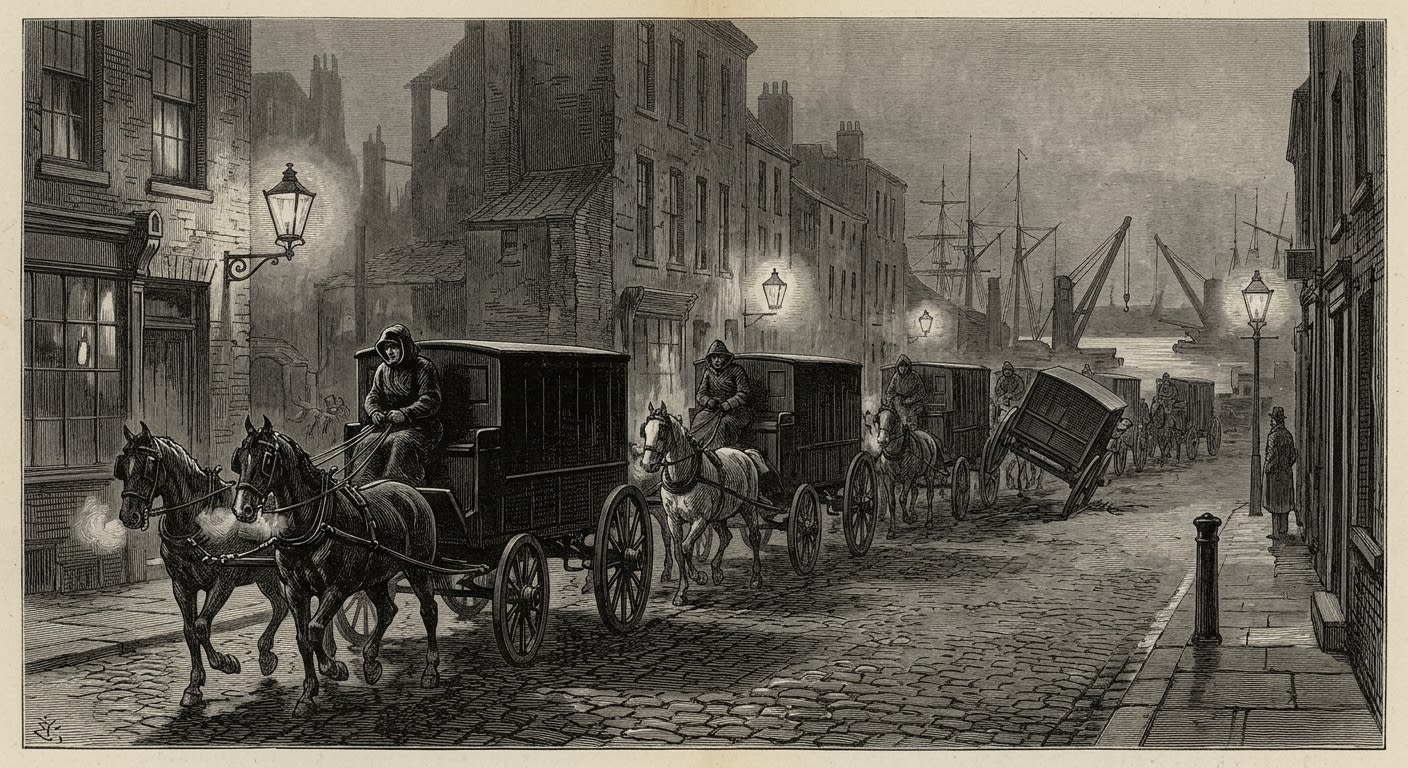
By A.S. 180, the Ledger records without elaboration that "Bureau of Shadows activity intensifies" — a sentence whose every word admits the existence of the thing every other sentence denies. That year was also the Year of Smoke in Lübeck, when silent wagons left the city in a convoy of eleven, bearing cargo the Bureau of Records logged as "administrative material, nonspecific." Lübeck's harbour-master counted the wagons. Lübeck's harbour-master was subsequently transferred to a lighthouse on the Frisian coast. He writes pleasant letters about birds.
#On the Custodians
"He said nothing. He smelled of lamp oil and regret."
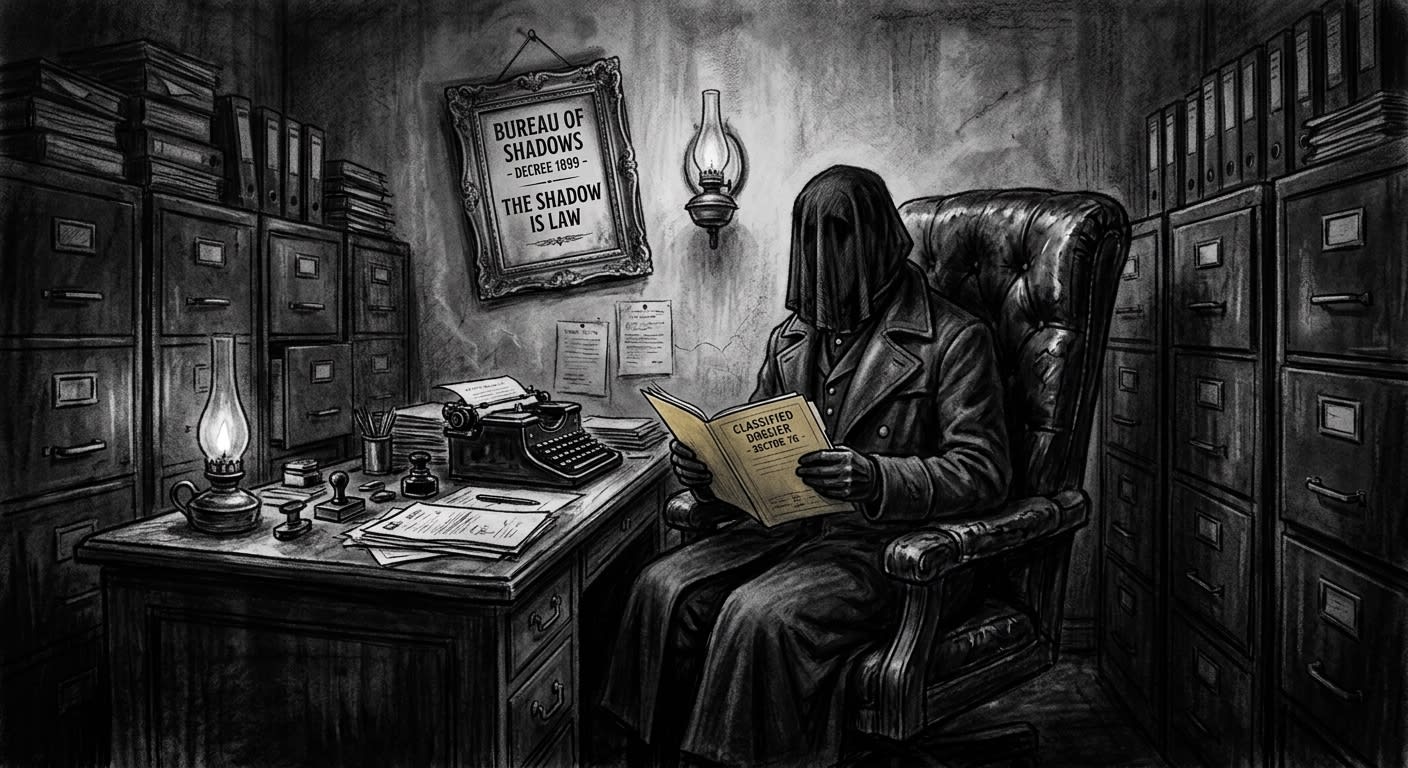
The Bureau's operatives are known — insofar as anything can be known about functionaries of an institution that does not exist — as Custodians. They wear veils of black gauze. They carry writs that bear no seal. They file reports that are read once and burned. Children whisper of them as bogeymen. Rebels know them as death itself. The Bureau of Purity considers them allies of convenience. The Bureau of War considers them useful irritants. The Bureau of Doctrine considers them someone else's problem, which is my preferred method of consideration for all entities that can make me disappear.
I have met a Custodian precisely once. The encounter was brief. He appeared in my office during the third peal of Compline — which is to say, he was already present when I entered, seated in my chair, reading a document I had not yet written. He said nothing. He smelled of lamp oil and regret. We parted as gentlemen. I checked my pockets afterward. My wallet was intact. My sense of security was not.
The Custodian hierarchy — if hierarchy exists within an institution that does not exist — operates through a system of ranked veils and blank authorities. The entry rank, which the Bureau would deny if it could be asked, is the Veil-Bearer: a novice who runs errands and learns the grammar of silence. Above them, the Corridor Runners and Wagon Hands manage the physical logistics of disappearance — the sealed doors, the midnight bridges, the Night Wagons (Unregistered) that depart full and arrive empty, or depart empty and arrive heavy. At the apex sits the Custodian proper, masked and authorised, and above even that — if rumour can be trusted, and it cannot, but I trust it anyway — the Omission Notary (Unregistered), who stamps blank folios as proof that something has ceased to exist.
They do not arrest. Arrest implies a legal process, a charge, a tribunal, a record. The Custodians collect. The distinction is theological and absolute. An arrested man has a name in a ledger. A collected man has a gap where a name used to be — a gap the Bureau of Records will, in due course, reconcile as "clerical adjustment, no action required."
#On the Night Papers
"Expires at sunrise."
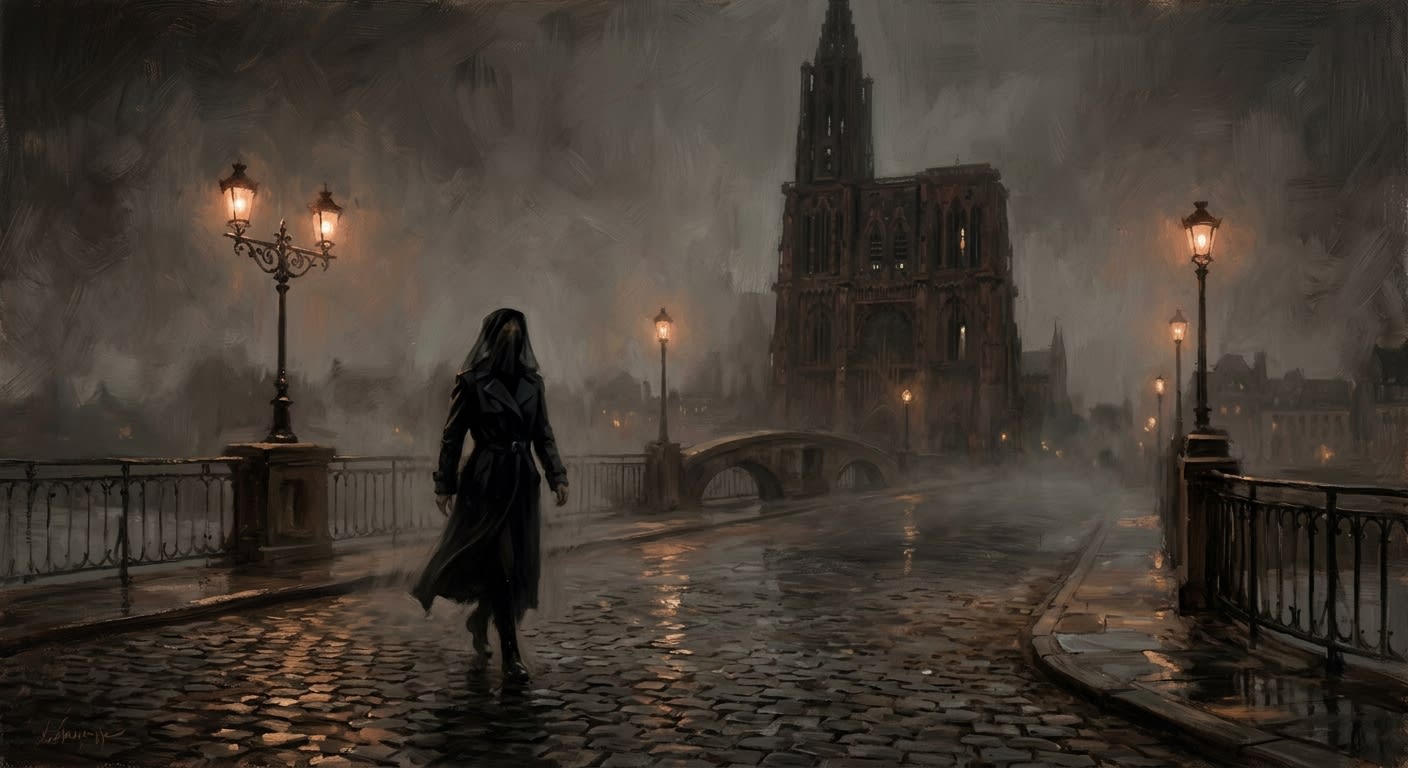
The Bureau's primary instrument of deniable authority is the Night Paper: a slip of gray vellum, sealed with grave-dust wax, delivered by hooded couriers who run the midnight routes of Strasbourg's bridges and the trenches of the Sagittal Line with the urgency of men carrying lit matches through a powder magazine.
A Night Paper transforms its recipient into a judge without tribunal, a commander without chain, an executioner without witness. It grants authority that is absolute, unappealable, and temporary — dead by dawn, blank by morning, gone as though it never existed, which of course it did not, because the Bureau that issued it does not exist. The system is elegant in its horror. An order that cannot be challenged because it cannot be proven. A sentence that carries itself out and then erases itself. The Bureau of Doctrine approved this mechanism on the grounds that "divine will is instantaneous and leaves no residue." I wrote that line as well. It keeps me warm at night, which is a lie — nothing about Night Papers keeps anyone warm.
The couriers who carry them are as deniable as the papers themselves. They run in hoods and fog, hands smelling of grave-wax, following routes chosen by omission — avoiding bells, gates, and known patrols. The delivery is hand-to-hand, without witnesses. The recipient may not ask who sent it. The courier may not know. And if dawn arrives with the Paper undelivered, the Paper — I am told by people who do not exist — executes through its bearer instead. This is either a metaphor for dismissal or a literal description of what happens to a courier who is too slow. I have not enquired. Enquiry presupposes an institution to enquire of.
#On the Means of Silence
The Bureau — which does not exist — maintains operational capacity through three instruments the Synod has never officially acknowledged.
The Bell Codes. The Bureau of Bells coordinates regional bell networks across the Dominion, and I am reliably informed — by sources who deny their own existence with admirable consistency — that certain sequences within the liturgical peal schedule carry encoded instructions. Three apparently random bell sequences in the last decade have preceded major political purges. The Bureau of Bells insists the sequences are "standard liturgical variations." The Bureau of Shadows insists nothing, because it does not exist. The purges, at least, are a matter of record — though the records have been reclassified under headings the Bureau of Records cannot locate.
The Blank Folio. Where the Bureau of Purity produces evidence through accumulation — confessions extracted, witnesses deposed, ink spilled in quantity sufficient to drown a parish — the Bureau of Shadows produces evidence through subtraction. A blank folio, properly sealed with the Custodian's wax press, constitutes legal proof of nonexistence. The folio does not say a man was innocent. It says a man was never there. The distinction carries no comfort for the man's family, who will find his name missing from the parish roll, his debts cleared, his chair occupied by a stranger who has always lived in that house, according to every document that remains.
The Night Wagons. They depart after the final peal. They return before Matins. The Bureau of Records logs them as "supply transport, routine." The wagons carry no insignia. The drivers wear no uniform the Bureau of War would recognize. What they carry is a matter I shall describe with the precision the subject demands: I do not know. I have asked. The asking was noted. I have not asked again.
The Bureau of Shadows maintains ████████████ observation posts within the Warrens of Strasbourg. Their purpose ████████████████████████. The residents are aware. They pretend otherwise, as do we. Similar posts are believed to operate in every bastion capital, every cathedral city of the Heartlands, and in three locations beyond the Sagittal Line that the Bureau of War does not administer, which raises questions the Bureau of War has been instructed not to ask.
#On the Bureau's Jurisdictions
"Anyone who questions the process is no longer available to question anything."
The Bureau of Shadows operates — or would operate, if it existed — at the intersection of every other Bureau's authority and in the gaps between all of them. Where the Bureau of Doctrine declares truth, the Bureau of Shadows ensures that contradicting truths are removed before they can circulate. Where the Bureau of Purity prosecutes heresy through spectacle and confiscation, the Bureau of Shadows prosecutes through disappearance and administrative dissolution — which is to say, through the application of nothingness as a governing instrument.
The relationship between Shadows and Purity is, I am informed, one of studied mutual contempt. Purity wants records: confessions signed, tongues displayed in the Procession of Tongues, heresy made visible and therefore instructive. Shadows wants no records: problems erased, names voided, silence imposed so thoroughly that the heresy ceases to have occurred. Both serve the Synod. Both believe the other serves it badly. Both are correct.
The Penitential Shadows — the Bureau of Purity's network of secret informants planted in parishes and guilds — are distinct from the Bureau of Shadows, despite the confusing nomenclature that I suspect was chosen deliberately. A Penitential Shadow gathers sin for the Ledger. A Custodian gathers people for the void. The distinction is the difference between a census and a subtraction.
#On Known Operations (A Partial List of Things That Did Not Happen)
The Bureau of Shadows has conducted no operations, because it does not exist. The following incidents are therefore coincidences, or administrative errors, or the fevered imaginings of clerks who have spent too long in the vaults.
The Disappearance of the Scholars of Padua. Date uncertain — the Bureau of Records has misplaced the relevant decade. Seven professors of natural philosophy at the University of Padua (Unregistered) published a treatise questioning the acoustic properties of consecrated bell-bronze. They were invited to present their findings at Strasbourg. They arrived. They did not depart. The University sent enquiries. The enquiries were returned unopened, stamped with a seal the University could not identify. The professors' names were subsequently found to have been misspelled in every surviving document, rendering all references to them "clerical errors referring to no known persons."
The Year of Smoke, A.S. 180. In Lübeck, eleven wagons departed the city on a night without moon. The convoy bore no insignia. The harbour-master logged them. The harbour-master's log was confiscated the following morning by men in black gauze who presented no credentials and left no receipt. Within the month, three merchant guilds had been dissolved, two aldermen had resigned to "pursue contemplative vocations," and a fire of unknown origin had consumed the guildhall records dating back forty years. The Bureau of Records classifies the Year of Smoke as "a period of accelerated filing."
The Saint Veritas Affair, A.S. 185–186. The Bureau of Records supply galleon Saint Veritas disappeared from Constantinople's harbour during the Silence of the Harbour Lamps (Unregistered) — seventy-two hours when every harbour light was extinguished without explanation. The ship returned six months later, crew intact, claiming they had never left. The ship's log, confiscated by the Bureau of Shadows, contained a single phrase repeated across forty pages: "We were invited below." The Bureau of Shadows' classification: active. The Bureau of Doctrine's classification: filed. I applied for access to the log. I was told the log does not exist. I was told the ship does not exist. I was told, with a patience that bordered on menace, that I was confused and should return to my duties.
Earlier editions of this Codex attributed the Saint Veritas affair to "unexplained maritime phenomena."
This is correct in the limited sense that the phenomena remain unexplained. It is incorrect in the larger sense that the Bureau of Shadows' active classification suggests the phenomena are classified rather than unexplained, which is a different condition entirely. The Bureau of Doctrine prefers the word "unexplained" because it implies mystery. The Bureau of Shadows prefers the word "classified" because it implies control. I prefer a stiff drink.
The Apparatus of Gate Nine. Beneath Gate Nine of the Queue Road, at a depth of forty-two feet, stands a mechanism the Bureau of Engineering surveyed in A.S. 178 and immediately wished it hadn't. Three reports exist in the Bureau of Shadows' deep archive — a numbering sequence I have encountered nowhere else, the digits separated by hyphens where the Bureau uses periods. A small thing. A small thing that kept me awake for six nights. The entity that maintains the Apparatus bears no designation in the Synod's administrative registry. It does not appear in the Bureau of Shadows' own internal hierarchy. The Bureau of Shadows — which does not exist — considers this entity's nonexistence to be of a different and more alarming quality than its own.
#On My Reports to the Bureau
I file reports to the Bureau of Shadows twice monthly, as all Hieromnemons are required to do by an instruction that was never issued by an authority that does not exist. My reports are collected by a clerk in an unmarked coat rather than a Custodian, who arrives precisely eleven minutes after the third peal of Vespers on the second and sixteenth of each month. He has never been late. He has never spoken. He has never varied his route, his coat, or his expression, which is the expression of a man who has been trained to have no expression at all.
I write the reports in a code the Bureau provided in a pamphlet that arrived on my desk without postage or return address. The code is simple — substitution cipher, hardly worthy of the Bureau of Doctrine's first-year catechists — and I suspect its simplicity is the point. The Bureau does not need encryption. The Bureau needs compliance. The act of encoding is the act of submission: a reminder, performed biweekly, that the Warden of the Sacred Ledger serves at the pleasure of an institution he cannot name.
What do I report? What the Bureau asks, and the Bureau asks everything. The mood of the cathedral close. The content of my correspondence. The questions asked by visiting dignitaries. The names of those who ask questions I cannot answer — and, more usefully, the names of those who ask questions I can answer but should not. I am, in the Bureau's taxonomy, a Confessarius: a plainclothes informant who listens in the corridors of power and files what he hears under headings the Bureau has devised for the purpose.
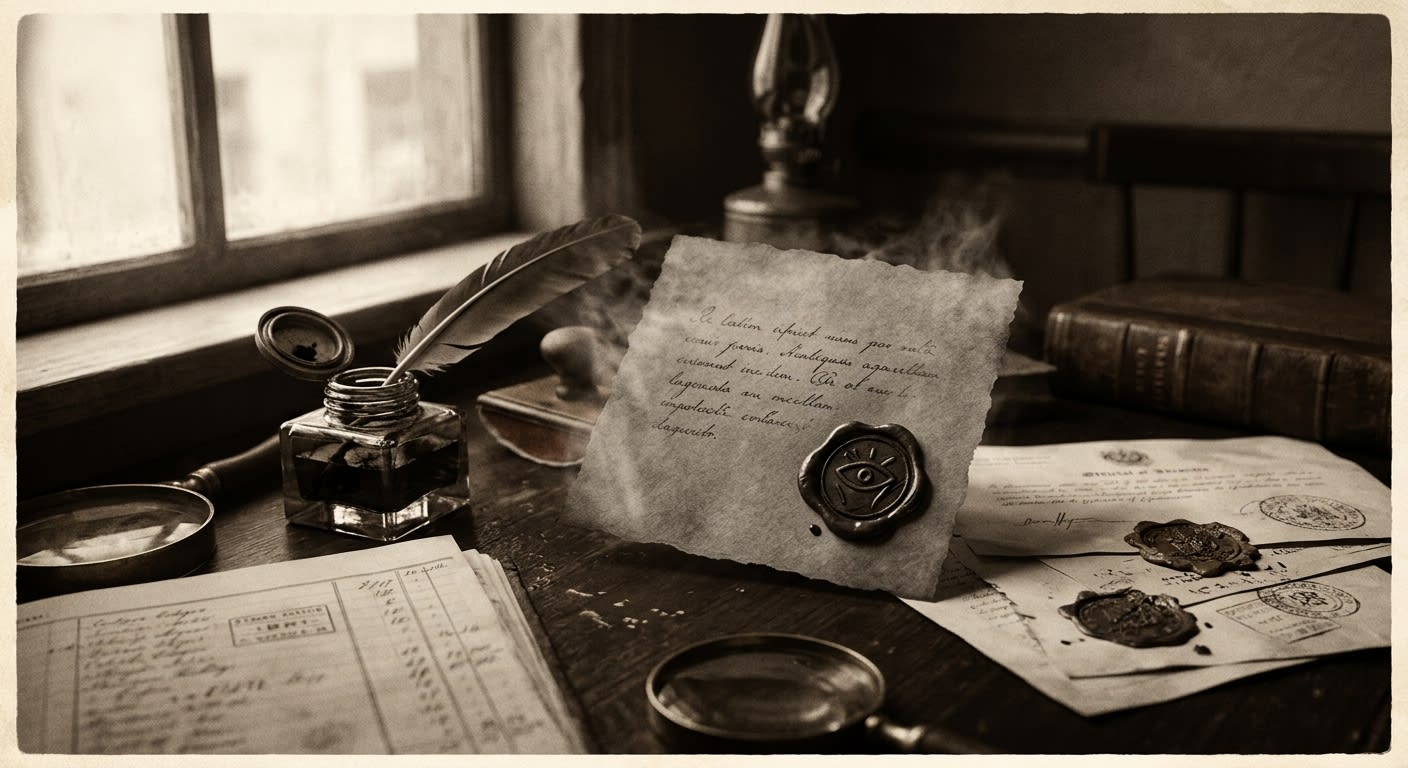
I do not know who reads my reports. I do not know what is done with the information. I do not know whether my reports have resulted in transfers, purges, promotions, or the quiet departure of midnight wagons. I know only that the courier has never refused a report, that my code has never been returned for correction, and that on three occasions I have received, slipped beneath my door at an hour when no one should have been in the corridor, a single sheet of blank vellum sealed with grave-dust wax.
I have learned to read the blank pages. The wax bears a pressure mark — a weight rather than a seal, as though someone leaned on it with a thumb while thinking. The weight varies. A heavy press means satisfaction. A light press means continued attention is expected. The third sheet bore no press at all, just smooth wax, blank paper, and the faintest scent of lamp oil.
That was the one that frightened me.
#The Present Condition
The Bureau of Shadows does not exist. It has never existed. The fourteen decrees confirming this are filed in a vault beneath the Bureau of Records that the Bureau of Records cannot find on its own floor plans. The Custodians who do not walk Strasbourg's bridges at midnight leave no footprints in the frost. The Night Papers that are not delivered by couriers who are not employed are not read by commanders who do not carry out orders that were never given. The wagons that do not depart after the final peal do not carry cargo that does not exist to destinations that are not on any map the Bureau of War maintains.
The Synod reigns. The trenches hold. The bells toll. And in the spaces between the tolling — in the gaps between one peal and the next, in the silence that is, if one listens carefully, something other than silence — the Bureau goes about its work.
Which is to say: nothing happens. Nothing at all. Return to your duties.
The Bureau of Shadows has been described in certain unauthorized pamphlets as "the Synod's secret police."
The Bureau objects to this characterization on two grounds. First: the Bureau does not exist, and therefore cannot be anyone's anything. Second: "police" implies a legal framework, jurisdictional boundaries, and accountability to a court of law. The Bureau — if it existed, which it does not — would be offended by the suggestion that it operates within so constrained a mandate. The Synod's police are the Bureau of Purity. The Synod's secret is the Bureau of Shadows. The difference is the difference between a locked door and a missing room.