
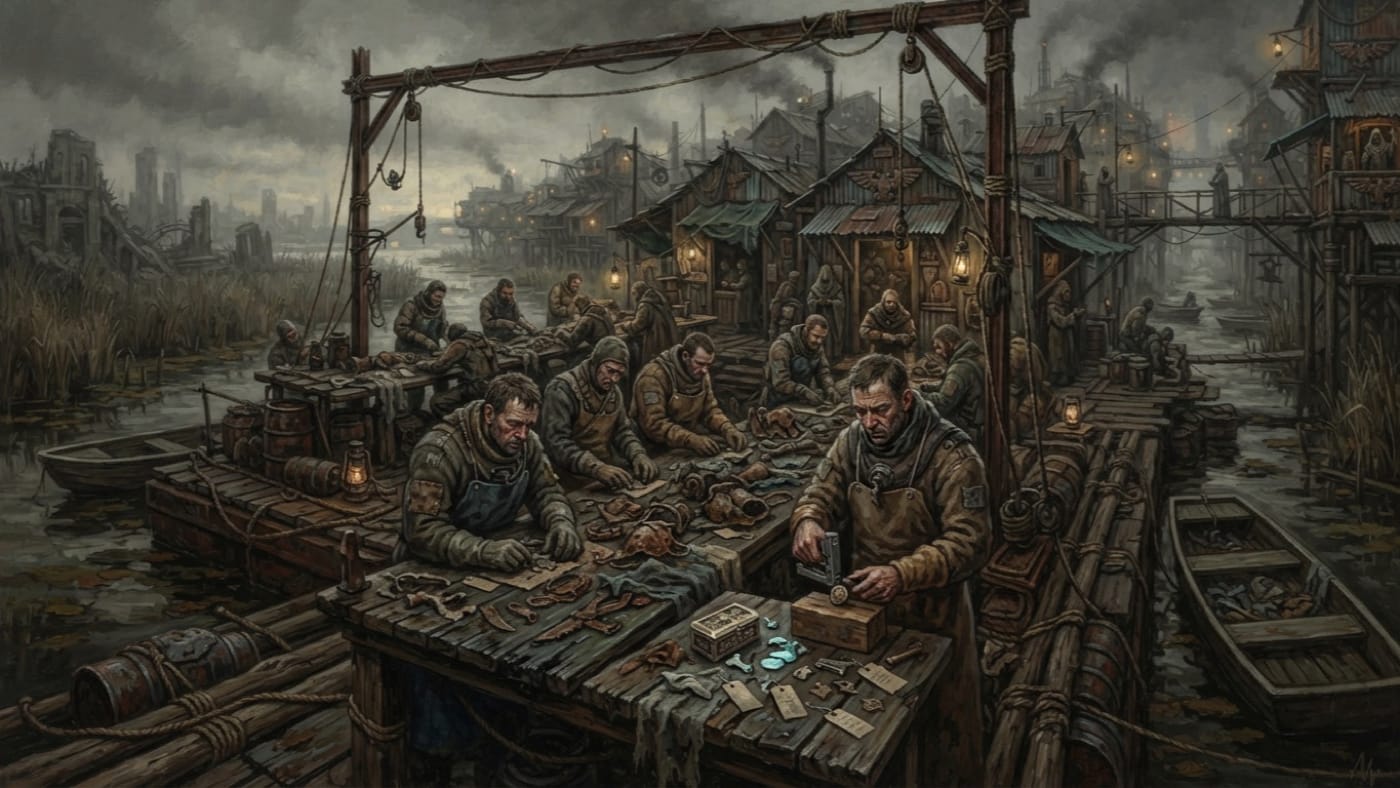
#On the Sorting Tables
"Some relics climb out of the mud on purpose." — Reed Market saying
Of the seven districts of the Ash-Glyph Marshworks, Diver's Gut is the one that floats. Its sorting tables stand in a row on a platform of lashed driftwood and tarred rope, moored among the stilts and plank bridges of the delta settlement. Everything the divers bring up from the mud is laid out there before it may become anything else. The quarter smells of fish oil and rust. The oil is worked into rope and knuckles against the brine. The rust comes up with the salvage and never entirely leaves.
Most of what arrives is what one would expect from a river mouth that has received the war-dead of the Sagittal Line's eastern theaters for generations. There is bone, along with corroded iron, waterlogged timber, buckles fused to their straps and blades gone to flaking scab. Now and then there is a reliquary fragment that a soldier carried to his grave in a pack. Each piece goes on the wet boards to be sorted by the hands that found it, and then it is tagged.
Mark the distinction, because the Marshworks lives by it. Pulling a thing from the mud is recovery. Moving it off the platform requires permission. Untagged bone may not pass the Causeway Gate, and neither may an unsanctioned relic. Between the diver's fist and the rest of the Church stand the tag, the seal and the countersign. The first of these is issued, withheld, mislaid or sold at the sorting tables.
#On the Diver's Share
The divers are paid in salvage shares. A share is a portion of what the diver dragged up, valued by someone else and reduced by deductions, and it is set against debts that most divers carry into the water with them. In the Marshworks nearly everyone owes. Causeway fees and quarantine assessments outrun wages with the regularity of a psalter. A debtor may be assigned to night lantern shifts or to diver rotations. The settlement's own accounting tells the two apart by what each one takes. Night shifts take lives. Rotations take the steadiness of the hand and then the steadiness of the mind.
Rotation lowers a diver's exposure without undoing it. A veteran diver at the tables can be picked out by hands that will not hold a tag flat for the stapler. The water has hazards that need no theology. Sinkholes open beneath a planted foot. Rot-fever enters through any cut, and the salvage cuts. Exposure finishes what the cold begins. Drowning is common enough that the quarter has stopped treating it as news. Quarantine service can be paid off in the water as well. When the war offices want what they call strategic relic debris, crews are conscripted to fetch it, and the Bureau of War has never asked whether those crews were already shaking.
Out here wealth means dry clothing, a safe route home after dark and a tag that will survive inspection. A diver who has all three is prosperous. A diver who has none still dives.
Over this sits Diver-Boss "Softstep" Maro. No commission naming him to the post has reached the Bureau's files, and none seems to be needed. Maro controls the intake. Whatever rises from the mud crosses his tables before it reaches the Seal Sheds, and he takes a percentage whose size no ledger I have examined is willing to state. Local report holds that he leaves no footprints where he walks. The divers tell this in the tone they use for the colour of the water. Before each dive he makes a small gesture that matches no prayer of the Church and no catalogued heresy, and every diver on his crews copies it without exception. Nobody has explained it. I decline to supply an explanation, because the Bureau does not pay me to invent.
#On Tags and Their Owners
From the platform, a recovery travels toward Seal Shed Row. There tag clerks stamp, seal and countersign the paperwork that turns salvage into lawful goods. Seal-shed capacity is the settlement's documented bottleneck. Nothing moves without a tag, and tags go missing. On the Row it is said that a tag clerk sells legitimacy by the staple. Confession receipts are sometimes stapled alongside, so that a single bundle of damp paper vouches for an object and for the conscience of whoever handed it in.
Where paper becomes money, someone forges it. The Mud-Relic Syndicate, known on the Reed Market as the Yesterday Finders, works Diver's Gut and the market alike. Its methods are planted relics, forged tags, bribed clerks and the knife. The knife is the cheapest of the four and the one most often used. A contested share settled on the sorting platform tends to stay settled. The Syndicate's aim is to give a recovery a clean battlefield history, so that it can enter the Synod's authenticated relic supply looking like a fortunate find from a known grave.
Other jurisdictions also bear on each find. A recovery that claims an origin must claim a burial grid. Cartographer-Provost Lysa Vane holds the burial maps and the official record, and her maps no longer agree with the ground. A recovery boat working after dark returns only by Guildmaster Orren Pike's lantern routes. The Ashbound Wardens enforce the quarantine, which by the parent survey's account was instituted in A.S. 112. They decide which crews leave the marsh and on what terms. Maro does not command any of these powers. He merely stands at the one point all of them must pass.
A relic authenticator can examine an object and pronounce on it. That examiner cannot examine the mud. Certification answers whether the thing on the table is what it appears to be. It gives no answer about who lifted it, from where, or whether the grid on its tag still exists. Auditors of the profession have a working rule that the first forgery to look for is always the story. In Diver's Gut the object can be genuine and the story still forged, and the seal lands on the object.
#On Yesterday Finds
The ordinary condition of anything that has lain in brackish delta mud is ruin. Iron blisters, and bronze turns green and pits. Bone softens and takes the colour of tea. Linen disappears. A medallion recovered after decades below is normally a flat disc of corrosion with perhaps an edge of saint left on it. The divers know this better than any examiner, because they have pulled up ten thousand such discs.
A yesterday find is the exception. The divers' word for it is tag-sweet. The parent survey describes these as saint medallions, reliquary fragments and consecrated instruments that come up from the same mud with no corrosion, no water damage and no sign that they were ever down there. Freshness is the first observation, and it can be checked at the table by anyone with eyes.
The second observation is separate. Some of these finds arrive with salvage tags already stapled on. The dedicated survey records tags bearing tomorrow's date. Divers do not tag in the water, clerks do not tag before intake, and nobody has claimed authorship of these tags. The divers say that Maro dislikes handling one thing above all others, and it is a relic that arrives already tagged.
The Mortuary Cartography Office's annual report for A.S. 198 states that relic recovery rates "remain consistent with historical averages."
Recovery rates tripled between A.S. 194 and A.S. 200. The report's sentence is withdrawn. The Office's draftsmanship is retained in the archive as an example of form.
The third observation is certification. By the parent survey's count, the Bureau of Alchemical Standards has inspected eleven such recoveries since A.S. 194. It certified eight as authentic and recorded three as indeterminate. The eleven are inspected recoveries, a small fraction of the salvage the platform has handled. The eight verdicts confirm genuine material. They say nothing about which saint, which grave, which hand or which mud. The three indeterminate verdicts say exactly what that word means and no more. I will not dress them up as frightened or vindicated. "Indeterminate" was entered, and "indeterminate" it remains.
Provenance is the fourth observation, and it is the one the tables cannot provide.
The divers report that the freshest finds come from the False Shore. That stretch of delta changes position with the tides, and the parent survey records divers' accounts of relics coming out of the mud there already warm. The journey there and back runs through water where corpse-light blooms over the sinkholes and copies the safe channels of Pike's Rackway closely enough to put boats on the wrong shoal. Crews travel by bead-code and bell-click, because nobody speaks a dead name over open water. In A.S. 199, according to the parent survey, a crew recovered a reliquary casket near the False Shore carrying a tag dated three days ahead. The casket was taken away and the divers were reassigned. The record I have consulted gives no account of the casket's present location, and I do not supply one.
#On the Present Intake
The Marshworks in A.S. 201 is asked for more than it can safely give. The Mortuary Cartography Office calls for higher recovery yields. The Lantern Guild reports that the marsh is becoming too bright to work in safety. Both claims are on file, and only one comes with a quota.
For the platform, higher yields mean more dives per crew and shorter rests between them. More debtors enter the rotations because more debts fall due, and in the Marshworks debts always fall due. The Seal Sheds, already the narrowest point in the settlement, receive more salvage than their clerks can stamp. Tags go missing faster, and the Yesterday Finders have found that a shortage of honest paper raises the price of the other kind.
Maro still controls the intake, the gesture is still copied before each dive, and nobody has yet produced a footprint. Recoveries keep coming up in the condition the mud gives them, and occasionally in a condition it should not. The examiners can certify the ones that reach them. The divers keep a different count, in hands that tremble over the tags.
The classification of yesterday finds as a category is unresolved. The divers' share of them is resolved, since it was set against their debts before the finds came up.