
"Provenance is purity. Everything else is kindling." — Notary-Saint Caldre, attributed (A.S. 94); provenance of the attribution: unverified
#On the Profession and Its Axiom
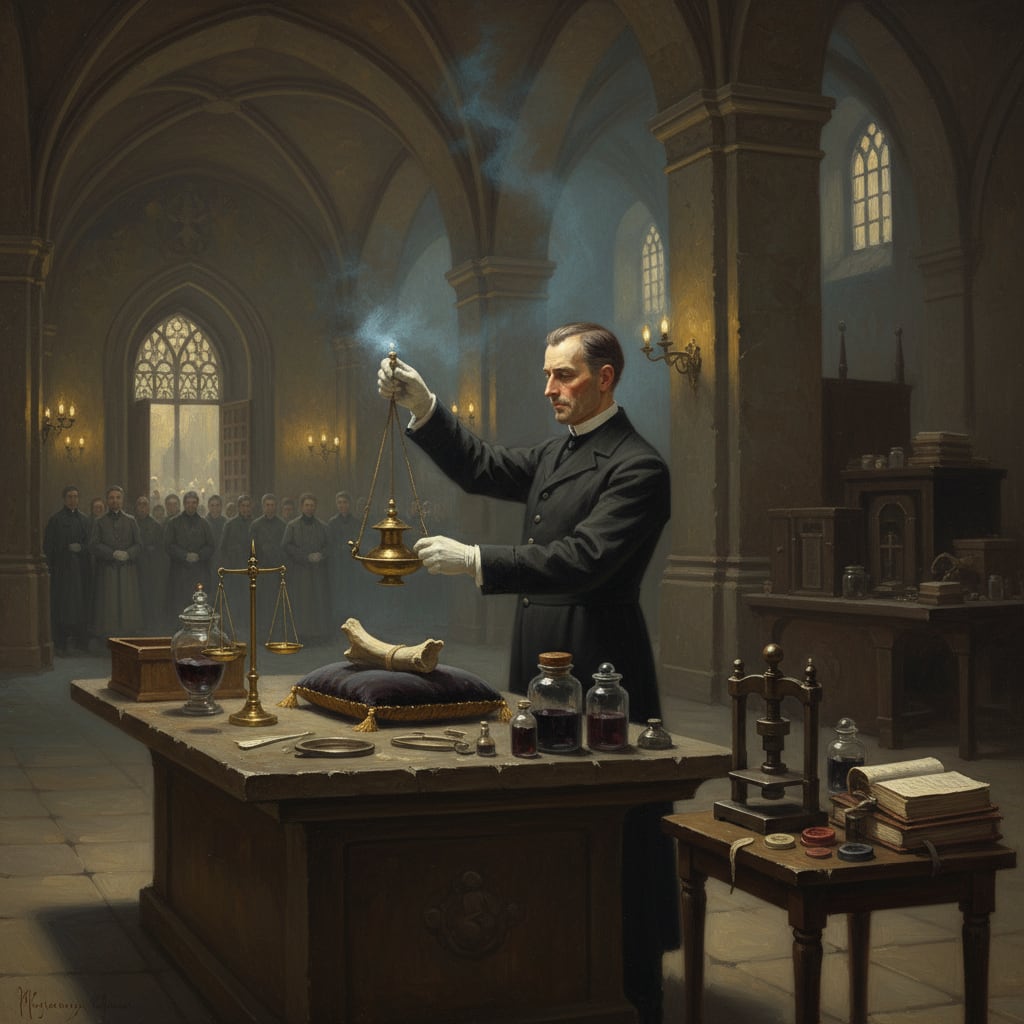
The Bureau of Relics authenticates eleven relics per annum. Eleven bones, eleven provenance chains, eleven seals pressed into wax that dries the colour of dried blood, eleven additions to the Vault of Sacred Custody beneath Strasbourg's Cathedral Close. The number was once in the hundreds. The Reliquary Schisms of A.S. 140–160 cured the Bureau of haste in the same way that an amputation cures a man of running: effectively, permanently, and with considerable loss of blood.
The Relic Authenticator is the clerk who presses the seal.
He is — let me be precise — a notary with gloves. His authority is the stamp. His instrument is the provenance chain. His daily labour is the transformation of bone, glass, wire, ash, and pre-Sundering scrap into sanctity through the application of documentation, and the transformation of sanctity back into kindling through the withdrawal of same. He creates no holiness. He merely recognises what Heaven has marked. This is the Bureau's position. This is the Bureau's axiom. The axiom is a lie of such structural perfection that removing it would collapse the institution and half the Theocracy's warding infrastructure with it, which is why the axiom remains, immaculate, notarized, and true by fiat if by nothing else.
#On Becoming a Bone-Reader
No one grows up dreaming of holding a magnifying lens over a fragment of vertebra in a cold room that smells of camphor and metal polish. The profession recruits from three sources: failed seminarians who proved too literal for the pulpit, junior clerks from the Bureau of Records whose aptitude for provenance chains exceeded their tolerance for purely documentary tedium, and the occasional child of a relic house — a family whose trade in authenticated fragments has made them wealthy enough to afford the training and cynical enough to understand what the training conceals.
Training lasts three years. The first year is spent in the Registry Halls, learning to read provenance chains — the custody ledgers, pilgrimage testimonies, wax-seal comparisons, and notarized transfer documents that constitute the legal skeleton of every authenticated relic. The second year introduces the physical examination: osteology, chemical residue analysis, tincture testing, and the operation of the blessing lamp, a device the Bureau of Engineering designed and the Bureau of Relics has never adequately explained. The lamp emits a light that interacts with bone in ways the Bureau of Engineering calls "anomalous refraction" and the Bureau of Relics calls "sanctified luminescence." Both Bureaus are describing the same phenomenon. Both are correct. Both refuse to publish jointly.
The third year is the Candle Year. The apprentice Authenticator learns the Bureau's simplest and most consequential test: the Candle Proof. A relic of genuine provenance, when placed beside a lit taper, will cause the flame to lean toward it. A counterfeit or contaminated relic will cause the flame to withdraw. A relic of ambiguous provenance will cause the flame to flicker in patterns the Bureau's manual describes as "theologically inconclusive." The Candle Proof has been in use since A.S. 98. No one has satisfactorily explained the mechanism. The Bureau of Engineering has submitted four theories, each contradicting the last. The Bureau of Relics has submitted one theory — sanctity — and has not found it necessary to submit another.
The apprentice who survives the Candle Year receives the rank of Lamp Hand, the lowest grade of Authenticator, permitted to assist examinations and maintain registry entries. He is issued his first pair of white gloves. He will not remove them in the presence of a relic for the remainder of his career, and by the time he reaches the rank of Examiner, the gloves will be as much a part of his hands as his fingernails, and considerably better maintained.
#On the Examination
A relic arrives at the Authentication Hall in a lead-lined box, sealed with quarantine wax, accompanied by an Authenticity Writ submitted by whatever shrine, parish, or military chaplaincy wishes to display the object. The Writ contains the provenance chain, a physical description, a theological justification citing canonical sources, and a filing fee denominated in Crowns of Grace that the Bureau of Tithes collects and the Bureau of Relics insists it has never received in full.
The examination proceeds through seven stages. I shall list them because the Bureau lists them, and because the listing itself is a form of sanctification — a bureaucratic rosary, each bead a checkpoint, each checkpoint a seal.
Intake and Quarantine. The box is opened in a ventilated chamber. The Authenticator records the object's appearance, weight, smell, and — a detail the manual includes without comment — sound. Some relics hum. Some click. Most are silent. The manual's instruction for silent relics reads: "Record: silence, observed." The manual's instruction for relics that produce audible phenomena reads: "Record: phenomena, observed. Evacuate if phenomena exceed conversational volume."
Provenance Reconstruction. The custody ledger is examined link by link. Every gap — every transfer without a witness, every seal that does not match, every "lost record" notation — is flagged and interrogated. Provenance reconstruction is where careers are made and destroyed. A clean chain is rare. A perfectly clean chain is suspicious, because perfectly clean chains are what forgers produce, and forgers have been producing them since Velmora the Covetous Serpent began sending counterfeit relics across the Line in A.S. 180.
Physical Examination. The Authenticator's toolkit: brass scales calibrated monthly by the Bureau of Engineering, tincture ampules sealed in wax, magnifying lenses ground by the Opticians' Guild of Marseille, and a set of needles whose provenance is, by the Bureau's own admission, "pre-Rationalist and regrettable." The needles test porosity, crystalline structure, and what the manual calls "responsive density" — whether the bone weighs differently depending on who holds it. The Bureau of Engineering has protested this test on principle for over a century. The test persists because it works.
Doctrine Fit. Does the relic's attributed saint appear in the Index of Canonised Persons? Does the attributed miracle conform to approved hagiographic patterns? Could the relic's existence, if made public, cause the Bureau of Doctrine embarrassment? The third question is the one that matters. The first two are formalities.
Response Testing. The Candle Proof, administered in a sealed chamber, witnessed by two Authenticators of superior rank. The blessing lamp, held at prescribed distances. Immersion in consecrated water, during which the Authenticator notes thermal variation, discoloration, and — rarely — luminescence. Prayer conducted in the relic's presence, during which the Authenticator notes any phenomenon and, if the phenomenon is sufficient, kneels, which is both a devotional act and a practical one, since kneeling places one's head below the blast radius of most recorded relic events.
Earlier procedural guidelines permitted Response Testing to be conducted by a single Authenticator without witnesses.
This practice was discontinued after an incident at the Authentication Hall of Bastion-Sibiu in A.S. 174, in which a lone Examiner authenticated a glass shard that produced phenomena he described in his report as "overwhelming" and that the clean-up crew described as "structural." The shard was reclassified. The Examiner was reclassified. The wall was rebuilt.
Verdict Drafting. The Authenticator assigns one of four grades: Ward-safe (fit for frontline service and public veneration), Votive (fit for display but insufficient for warding applications), Contaminant (exhibiting properties inconsistent with sanctity; quarantine required), or Fraud (no provenance, no response, no sanctity; confiscation and disposal). The grade is written in the registry. The grade is the relic's fate. Ward-safe objects enter the Vault of Sacred Custody or the bastion rotation. Votive objects are distributed to shrines. Contaminants are sealed in the quarantine cabinets and studied, occasionally, by men who do not sleep well afterward. Frauds are rendered into lime for mortar. The walls of Strasbourg contain the rendered remains of six hundred saints who failed their paperwork.
Notarization. The seal press descends. The wax takes the Bureau's mark. The registry entry is countersigned. The relic is, from this moment, holy — or rather, the relic has always been holy, and the Bureau has merely acknowledged what Heaven ordained. The distinction between these two statements is the entire Bureau of Relics, and the Authenticator's entire career, compressed into a moment of wax and pressure.
#On the Counter-Relic Service
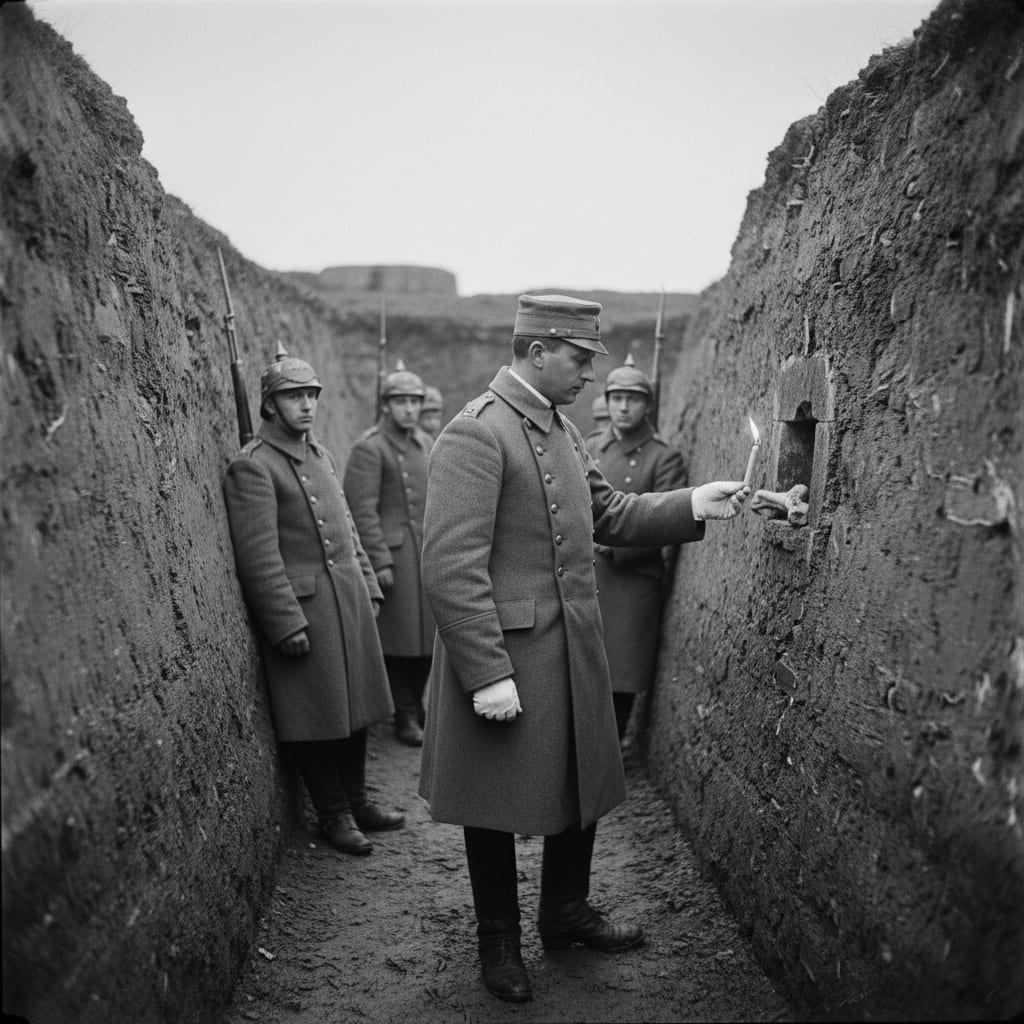
Since A.S. 182, when Velmora's counterfeit relics first penetrated frontline chaplaincies and produced effects the Bureau of Rites classified as "theologically inadvisable," the Bureau has maintained a specialist cadre: the Counter-Relic Examiners (Unregistered). These are Authenticators deployed to every bastion south of Przemyśl, tasked with weekly re-authentication of all frontline relics — the finger-bones in the trench niches, the fragments in the ravelin caskets, the ward-stones in the chaplains' field kits.
The Counter-Relic Examiner carries sanctified reagent sets, prayer-resonance rods calibrated to detect sorcerous contamination, and a lit taper. He walks the Line. He holds the candle beside each bone. He watches which way the fire leans. The soldiers watch him watch. The entire southern front's morale depends, at regular intervals, on the behaviour of a flame in the presence of a fingerbone, observed by a man in white gloves who is trying very hard not to think about what happens if the flame leans the wrong way.
#On the Patron and the Profession's Afflictions
Notary-Saint Caldre is the profession's patron — a clerk of the Bureau's early years who authenticated a relic of disputed provenance by the expedient of spending a night alone in the vault with it. He survived the night. He wrote his report the following morning: a single line — "Authentic. The object has opinions." — signed, sealed, and filed. He died the following week, smiling, from causes the Bureau of Medicine classified as "consistent with prolonged sacred exposure" and the Bureau of Relics classified as "martyrdom, administrative category."
Caldre's feast day is observed with a ceremony in which junior Authenticators seal an empty reliquary and file a provenance chain for nothing, a ritual the Bureau considers instructive and the junior Authenticators consider eerie, which is the same thing.
Saint Caldre's relic — the seal-press he used on his final authentication — was itself submitted for authentication in A.S. 138.
The submission was rejected on procedural grounds: the Bureau cannot authenticate its own instruments. The seal-press remains in the Bureau's custody, ungraded, unstamped, and — per the night watch's quarterly reports — warm to the touch regardless of the ambient temperature. The Bureau does not comment on the temperature. The night watch does not touch it twice.
The profession's afflictions are particular. Glove-rash from years of latex and wax. Lamp-burn scars on the fingers and wrists from blessing-lamp proximity. A tremor, common among Vault-Silence Curators (Unregistered), that the Bureau of Medicine attributes to "cumulative sanctified exposure" and the Authenticators themselves attribute to the sound the quarantine cabinets make at night — a sound the procedural manual instructs them to record as "silence, observed" and that is, by every honest account, something other than silence.
The profession's deepest affliction is epistemic. The Authenticator knows, after enough years at the lamp and the press, that the stamp confers no holiness upon the bone. The bone was holy before he arrived. The bone will be holy after his registry rots. The stamp is a fiction — a necessary, structural, load-bearing fiction upon which the Synod's warding grid, pilgrimage economy, and theological authority depend. The Authenticator stamps anyway. He stamps because the alternative is admitting that the Bureau's axiom is decorative, and decorative axioms do not fund armies.