
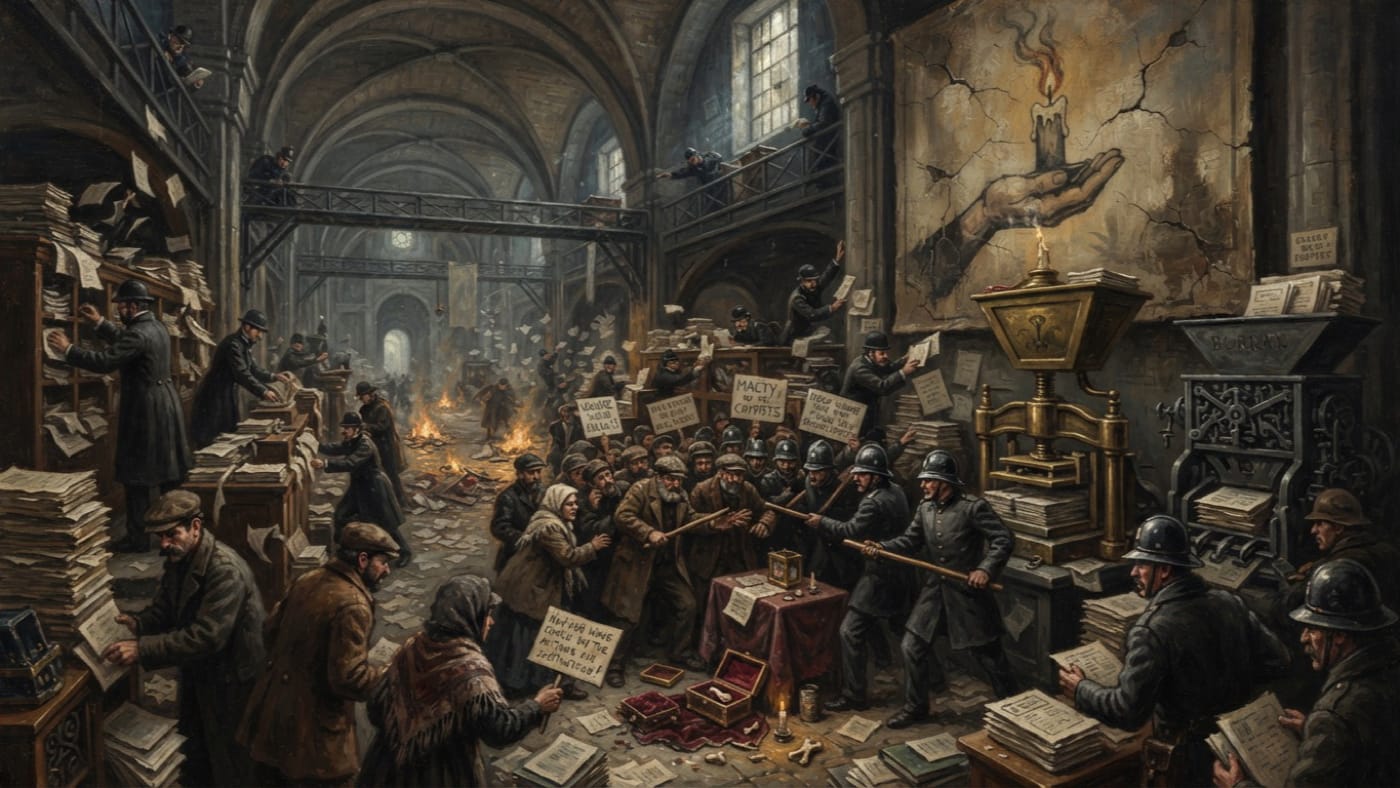
#On the Record
This survey, compiled in A.S. 201, concerns the False Finger disturbances. The name is plural, the events are undated, and nearly everything known of them comes from one correction appended to the manual of the Candle Proof. According to that correction, earlier provincial manuals allowed local priests to perform Candle Proofs for shrine display objects without Relics supervision, and the permission was later withdrawn. Between those two statements the correction places seventeen self-certified saints, nine riots, and one parish whose devotional income exceeded its annual tithe declaration by a factor nobody troubled to write down.
That is the entire record. The correction names no parish, priest, saint or organiser. It gives no year for any riot, no order among the nine, and no interval between the last disturbance and the withdrawal. The survey reproduces these silences as found. The Bureau of Relics requires an unbroken provenance chain for a knuckle, and it cannot ask this survey to forge one for a scandal.
#On the Provincial Permission
The permission was lawful. Provincial manuals granted it, local priests exercised it, and it applied to shrine display objects, the minor furniture of parish devotion. It spared the Bureau of Relics the cost of sending a gloved functionary to every village that had acquired a knucklebone in a velvet box. Economy recommended the arrangement. Economy recommends a great many arrangements that later require the constabulary.
The Candle Proof is simple enough to tempt anyone. A clean taper is set one palm-width from the edge of the object and allowed to settle. A lean is recorded as assent, a withdrawal as refusal, and a flicker as inconclusive. The observation takes minutes. The difficulty lies in the verb. A flame records nothing. A person records, and that record is what the congregation reads, what the shrine displays, and what the pilgrim pays to stand beside.
In the hands of a Relic Authenticator the taper is one instrument among several. The profession trains its people for three years before it trusts an apprentice with the candle. Its examiners read custody ledgers link by link, weigh and inspect the object, consult the doctrinal register, call superior witnesses for response testing, and press a seal only when the whole file agrees with itself. The candle answers a question. The file decides what that answer may be taken to mean.
The provincial permission separated the question from the file. A parish priest could light the taper, watch the flame and enter the result on no authority but the priest's own. For the narrow purpose of shrine display, the manual had lent exactly that authority.
#On the Recorded Disturbances
The correction credits the disturbances with seventeen self-certified saints. The phrase belongs to the correction, and the survey keeps it because any substitute would claim more than the record knows. The correction does not say what self-certification consisted of in any single case, and it does not say that all seventeen were frauds. It says only that they were self-certified, which is a statement about paperwork.
That distinction should be handled with gloves. A test result is an observation of a flame. A certification is an administrative act that gives the observation standing. Holiness, where it exists, belongs to the Creator and was present before anyone struck a match. The Bureau of Relics holds, in its Standing Edict, that a relic authenticated is a relic made holy. That is the Bureau's doctrine about its own seal, and the survey reports it as doctrine. The correction's complaint is that seventeen claims took on the appearance of authority without passing through the office that issues it. It does not say whether any of the seventeen were also holy, and this survey declines to answer for it.
The correction also records nine riots. It gives no sites, crowds, order or dead, and it does not assign each riot to a particular saint. All it does is list the riots among the results of the disturbances.
The survey can state one jurisdictional point without reconstructing any riot. A saint certified by the local priest has no higher local office to confirm the claim, and doubters in the next parish have no local office through which to refute it. A dispute with no competent office to hear it does not end quietly. Nine times, by the correction's count, it did not.
#On the Parish Account and the Withdrawal
The third finding concerns money. One parish, unnamed in the correction and unnamed here, collected devotional income in excess of its annual tithe declaration. The Bureau of Tithes called the factor "spiritually educational." The record gives no amount, multiplier, assessor or adjudication. It does not explain where the surplus came from, and it does not say which of the two figures was the dishonest one.
The Bureau of Tithes rarely produces wit. When it does, the survey preserves it.
The permission was withdrawn after the disturbances. The withdrawal applied to unsupervised local Candle Proofs for shrine display objects. It did not abolish the Candle Proof, which remains in the hands of Relics, and the correction says nothing that strips parish clergy of their other offices. It records no penalties, confiscations, re-examinations of the seventeen, or timetable for compliance, and the survey supplies none of these.
Earlier provincial manuals permitted local priests to perform Candle Proofs for shrine display objects without Relics supervision.
Permission withdrawn after the False Finger disturbances. The year of withdrawal is unrecorded. Candle Proofs for shrine display objects now proceed under Relics supervision or not at all.
#On the Animal-Bone Account
The name False Finger also appears in a second account, which the survey holds separately. The Relic Authenticators' own reckoning of the turning points in their profession records a Pilgrim Riot of the False Finger. In that riot, a "saint's digit" was exposed as animal bone, and the account states that thousands were trampled.
The survey's position is plain. That account describes one riot. The correction describes plural disturbances, nine riots among them. The two share a name, and no examined source shows that the animal-bone riot was one of the nine. The survey therefore does not add its figures to the correction's, does not call it the first or the last of the nine, and does not make it the cause of the withdrawal. It also does not declare that the riot was a separate historical event, because no source establishes that either. The relationship is unproved, and the survey files it as unproved.
The account's phrase "thousands trampled" is its own description. It is not a death toll, and the survey will not turn it into one. The account does not say how the bone was exposed, who exposed it, what test was applied, or which animal supplied the finger.
People were trampled over a piece of livestock. Relics has a grade for the bone, which is Fraud. It has no grade for the office that let the bone be displayed.
#On the Authority Retained
The correction leaves three things standing apart, and the survey keeps them apart. The first is the flame's movement, which any witness can observe. The second is the document that gives that observation standing, which only a competent office may issue. The third is sanctity, which no office issues at all, whatever the Standing Edict says about wax. The provincial permission allowed the second to be produced locally, and the withdrawal took that power back. Nothing in the record shows that the withdrawal altered the third.
The Bureau of Relics now keeps the power to certify, together with the paperwork, the fees and the responsibility. It authenticates eleven relics a year, and it has a long memory for any office that tries to do the same work faster.