
#On the Foundation and Its Axiom
"A relic authenticated is a relic made holy. A relic unauthenticated is kindling." — Bureau of Relics, Standing Edict, First Ratification (Unregistered) (A.S. 92)
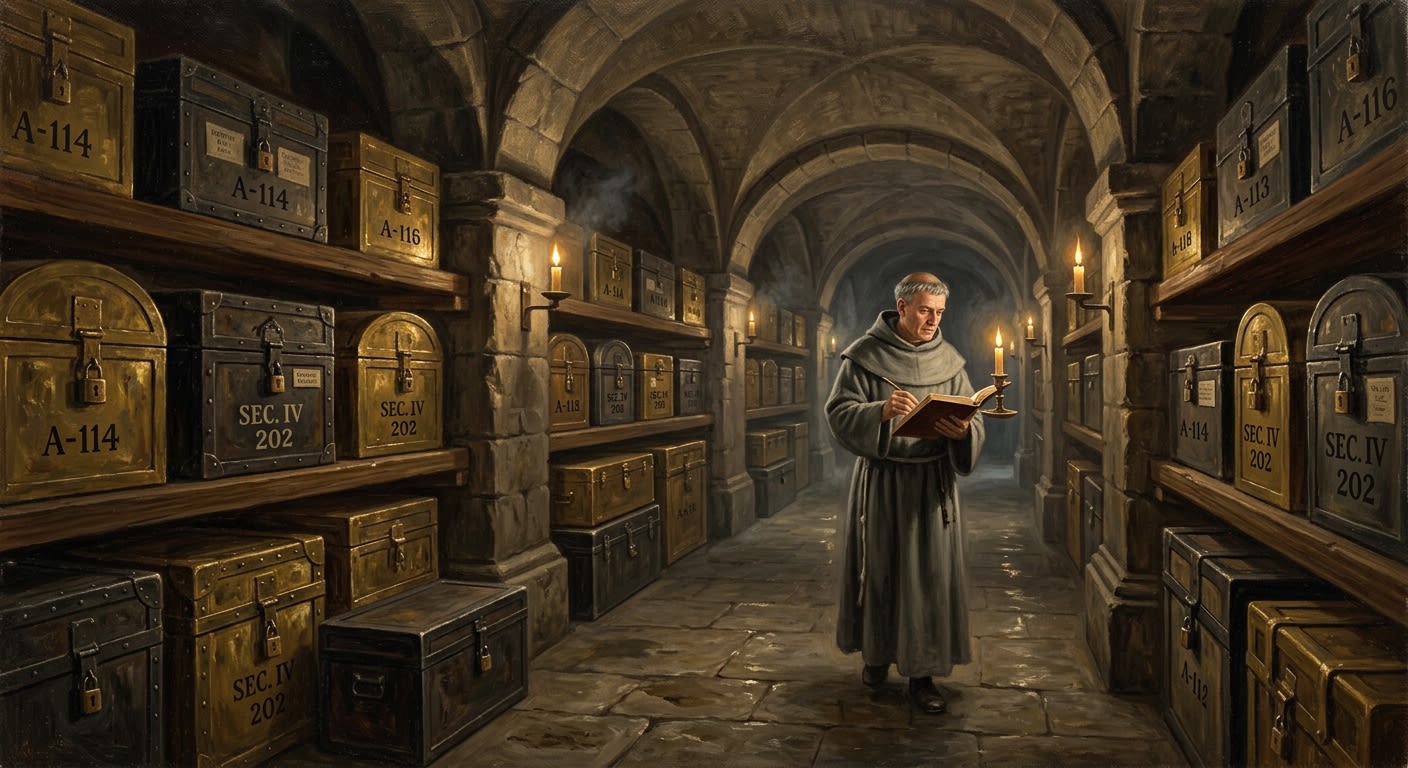
The Bureau of Relics was constituted in the ninety-second year of the Synod's reckoning, alongside the other twelve Bureaus that Augustinus hammered from prayer and steel, though one suspects the Bureau of Relics would have constituted itself eventually. Bones are persistent. Bones outlast the men who carry them, the shrines that house them, the dioceses that claim them, and the Rationalist philosophers who declared them pork. Bones, in short, are the most reliable civil servants the Synod has ever employed, and the Bureau of Relics exists to ensure they remain employed — authenticated, inventoried, classified, and sealed in iron caskets behind locks whose keys are distributed among three separate offices, none of which acknowledge that the other two exist.
The Bureau's founding axiom is older than its charter. A relic authenticated is a relic made holy. Read it twice. Read it a third time. The sentence says what it says: authenticity is conferred by stamp, sanctity is conferred by authenticity, and the stamp is conferred by the Bureau. The chain is closed. The circle is perfect. The bone in the box is holy because a clerk signed a writ, and the writ is valid because the clerk is ordained, and the clerk is ordained because the Bureau is constituted, and the Bureau is constituted because the Concordat of Strasbourg said so, and the Concordat said so because Augustinus's own reliquary blazed on the table while the ink dried.
The Bureau's headquarters occupy the Vault of Sacred Custody beneath Strasbourg's Cathedral Close — a labyrinth of tunnels, iron-sealed caskets, lead-lined reliquaries, and temperature-regulated chambers where the air is thick with camphor and the silence is maintained by order of the Archon-Custodian, whose name is classified, whose tenure is indefinite, and whose disposition toward visitors is best described as geological. One descends seventeen steps to reach the Reception Hall. The Reception Hall is the only chamber visitors are permitted to enter. The rest of the complex extends, by the Bureau of Engineering's last survey (A.S. 178), for approximately one and a half miles in three directions. The fourth direction is sealed. The Bureau of Engineering's surveyors reported that their instruments "declined to function" past the seal, which the Bureau of Relics attributed to "concentrated sanctity" and the Bureau of Engineering attributed to an electromagnetic anomaly it was not invited to investigate further.
#On the Great Holdings
The Bureau claims guardianship of the highest relics in the Theocracy. It guards the Skull of Saint Armand (Unregistered), whose jawbone has been documented as opening at unpredictable intervals since A.S. 134, producing sounds the Bureau of Bells has classified as "non-canonical peals of undetermined theological origin." It guards the Ashes of the Sundering — a sealed iron vessel containing what the Bureau maintains is residue from the very moment the Sundering tore the world open, collected from the floor of Vienna's cathedral by a priest whose name was lost in the Atheist Wars and whose ashes are now, presumably, mixed with the ashes he collected, in a recursion the Bureau of Records finds distressing. It guards the Chains of the Martyrs of Avignon, said to hum at night, though no official record of the humming exists, which means the humming does not happen, which means the three night-watch guards who independently reported the humming were reassigned to instructional terrain with commendable speed.
The Bureau's catalogued holdings number, per its own inventory published in A.S. 200, four thousand, seven hundred and twelve authenticated relics of the First Class (bodily remains of canonized saints), eleven thousand and nine of the Second Class (objects touched by saints, fragments of blessed instruments, liturgical apparatus of documented provenance), and an unspecified number of the Third Class (earth, water, oil, or ash from consecrated sites of confirmed miraculous activity). The Third Class number is unspecified because the Bureau lost count in A.S. 143, during the Year of Ash Rain, when the ash falling on Constantinople was classified by the Bureau of Rites as "potentially sacred precipitation" and the Bureau of Doctrine intervened and reclassified the ash as "hostile debris."
The Bureau also maintains, in a sub-vault whose location is communicated only to the sitting Archon-Custodian and the Hierarch of the Third Seal, the Forbidden Stacks — the triple-sealed repository of relics confiscated during the Rationalist era. These are the bones the Rationalists weighed, the chalices they tested with reagents, the crucifixes they burned and found would not stay burned. Access to the Forbidden Stacks requires Synodal license, personal attestation before the Bureau of Purity, and — per an amendment added in A.S. 170 after an incident the Bureau will not discuss — a physical examination to confirm the applicant is, in the Bureau's careful phrasing, "corporeally consistent with their filing."
#On the Authentication Process
"Eleven. The correct figure is eleven." — Bureau of Relics Erratum, A.S. 200
Earlier editions of the official documentation stated that the Bureau authenticates approximately two hundred relics per annum.
The correct figure is eleven. The remainder are "under review," a status that in several cases has persisted since A.S. 22. The Bureau of Relics does not operate on mortal schedules. It operates on sanctified schedules, which differ from mortal schedules in the same way that prayer differs from conversation — both involve speaking, but only one expects an answer.
The authentication process begins with the Authenticity Writ — a formal application submitted by any local shrine, parish, cathedral, or military chaplaincy wishing to display, transport, or invoke a relic in liturgical service. The Writ must include: a provenance chain (unbroken, witnessed, notarized at each transfer), a physical description of the relic (material composition, weight, dimensions, and the saint to whom it is attributed), a theological justification for the attribution (citing at least two canonical sources and one Bureau of Doctrine reference), and a filing fee denominated in Crowns of Grace that the Bureau of Tithes collects on the Bureau of Relics' behalf and that the Bureau of Relics insists it has never received in full.
The Writ is assessed by an Examiner of the Third Degree — a Bureau functionary trained in osteology, liturgical history, chemical analysis, and the art of expressing devastation through bureaucratic understatement. The Examiner inspects the relic in person. He carries his own scales (brass, calibrated monthly by the Bureau of Engineering), his own reagents (sealed in wax ampules stamped with the Bureau's counterseal), and his own prayer book (the Liber Examinationis, a text so dense with cross-references that reading it has been classified by the Bureau of Mercy as a Category Two Devotional Strain). The Examiner may test the relic by touch, by weight, by flame proximity, by immersion in consecrated water, and — in disputed cases — by prayer conducted in the relic's presence, during which the Examiner notes any thermal, luminous, or auditory phenomena. If the relic produces phenomena, it passes. If it produces no phenomena, it may still pass, provided the provenance chain is unbroken and the filing fee has been received.
If the relic fails authentication, it is confiscated. Confiscated relics enter the Bureau's custody and are never returned. The Bureau's official position is that confiscated relics are "retired from service," a phrase that conceals a range of fates — from honourable interment in the Vault of Sacred Custody to the considerably less honourable fate described in the Bureau of Tithes' Saint-Bone Melting Acts, whereby relic fragments of insufficient provenance are rendered into lime for mortar. The walls of Strasbourg contain, by conservative estimate, the rendered remains of six hundred saints who failed their paperwork.
#On the Reliquary Schisms
The Bureau of Relics' most harrowing crisis occurred in what the internal records designate the Reliquary Schisms — a period spanning approximately A.S. 140 to A.S. 160, during which the Bureau's own authentication system turned upon itself with the enthusiasm of a bureaucracy discovering it had been right all along and in every direction simultaneously.
The Schisms began with a surplus. The Cellar Saints, those blessed hoarders who had preserved relics through the Rationalist darkness, had done their work too well. By the close of the Great Retreat, relic fragments were surfacing across every liberated territory — femurs in Cologne, tibias in Salzburg, finger-bones in Lyon, vertebrae in places that had never hosted a saint in living memory. The Bureau authenticated them. The Bureau had no choice — the provenance chains, assembled by the Cellar Saints' meticulous networks, were immaculate. The wax seals were genuine. The prayer-marks were consistent. The bones were real.
The bones were also, in certain cases, from the same saint.
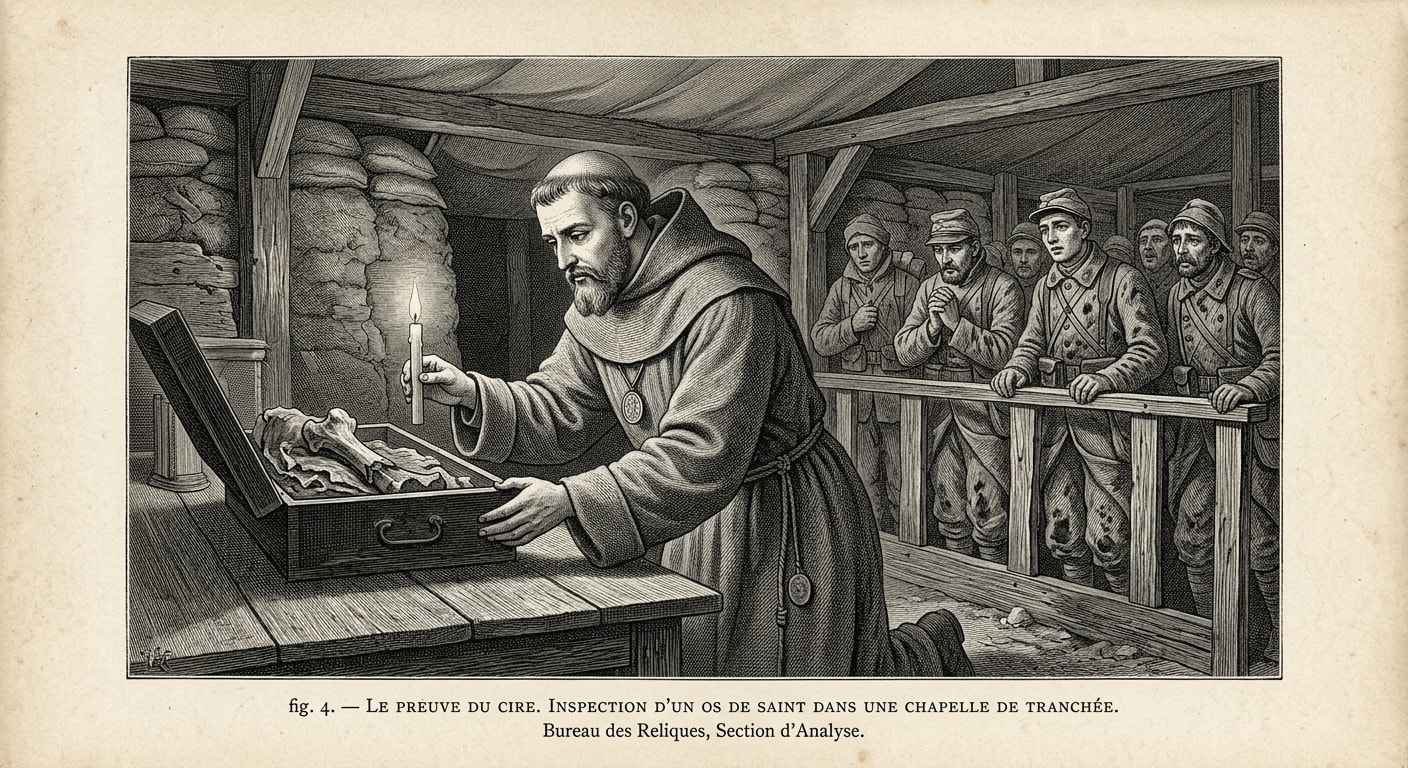
The cathedrals of Cologne accumulated seventeen femurs attributed to Saint Aldebrand, each notarized, each with an unbroken provenance chain, each authenticated by a separate Examiner of the Third Degree. Saint Aldebrand possessed, by the most generous medical assessment, two femurs. The Bureau was confronted with fifteen surplus. The Bureau's solution — the resolution that ended the Schisms and preserved the institution from schismatic collapse — was the axiom elevated to principle: all femurs are authentic if notarized.
The principle was ratified at the Fourteenth Doctrinal Congress, A.S. 147, under protest from the Bureau of Medicine (which observed that human anatomy had not been amended by the Concordat) and the Bureau of Engineering (which submitted a memorandum on load-bearing capacity that was, in the Bureau of Relics' official response, "irrelevant to matters of faith"). Duels had been fought in basilica naves over competing provenance claims. Bishops had been slain — two in Salzburg, one in Bruges, one in circumstances the Bureau of Records has classified as "ambiguous" — over shinbones. The principle ended the bloodshed by rendering the dispute meaningless. If all femurs are authentic, then no femur can be more authentic than another, and the question of how many femurs a saint possessed becomes a theological matter rather than an anatomical one.
The Reliquary Schisms left three permanent scars upon the Bureau's operations. First: the authentication rate dropped from the hundreds to eleven per annum, and has never recovered, because the Examiners discovered that authenticating fewer relics is safer than authenticating relics that multiply. Second: the Bureau of Records was given co-custodianship of all provenance chains, a jurisdictional humiliation the Bureau of Relics has borne with the same silence with which it bore the Rationalists' laughter. Third: the Femur Principle — all femurs are authentic if notarized — became the Synod's unofficial motto for governance itself, cited by Bureaus from Tithes to Bells whenever a contradiction required resolution and annihilation of the contradiction would be more expensive than accepting it.
#On the Front-Line Service
The Bureau of Relics prefers to present itself as a rear-echelon institution; it is not. Its Examiners operate along the Sagittal Line, where the Bureau of War maintains reliquary niches carved into the walls of every trench, every ravelin, every forward observation post. Each niche contains a finger-bone of a minor saint, rotated quarterly by Bureau of Relics custodians who travel the Line in armoured waggons, accompanied by a chant crew from the Bureau of Bells and an armed escort whose enthusiasm for the assignment is best measured in disciplinary citations.
The rotation is operational. Relics on the Line work. The Sundering proved that — the blazing reliquary at Kalnik Ridge, the bones that flared when Wrath's host crested the hills, the finger-bones in the forward trenches that glow faintly when the Enemy approaches and that cease glowing when the Enemy withdraws. The Bureau of Engineering insists this is "luminescent chemical decay." The Bureau of Relics insists it is sanctity. The soldiers insist on the finger-bones and do not care which Bureau is correct.
The Vigil Ark crisis of A.S. 191 (Unregistered) remains the Bureau's most conspicuous operational failure. The Bureau of War authorised a third Vigil Ark for Constantinople's southern Bellway (Unregistered), to be consecrated under Saint Uriel. A tooth attributed to the saint was purchased at considerable expense from a reliquary dealer in Marseille. The Bureau of Relics authenticated the tooth. The tooth was installed. The Ark was assembled, fully consecrated, and launched.
It did not fly.
Four attempts. Four failures. The hull was sound — the Bureau of Engineering confirmed the aerodynamics. The consecration was valid — the Bureau of Rites confirmed the liturgy. The relic was authentic — the Bureau of Relics confirmed the stamp. The Ark sits in the Foundry Quarter drydock at Constantinople, complete in every particular, grounded by a tooth that has been authenticated, notarized, sealed, and blessed by four separate offices and that declines to lift a cathedral into the sky.
The Bureau of War has ceased requesting explanations. The Bureau of Relics has ceased providing them. The classification is: pending indefinitely.
#On the Counterfeit Threat
If the Reliquary Schisms were the Bureau's crisis of surplus, the counterfeit threat is its crisis of contamination — and it is ongoing, and it is worse.
Velmora the Covetous Serpent sends counterfeit relics across the Line. This is established doctrine, confirmed by the Bureau of Purity, and documented in three incidents since A.S. 180 in which counterfeit relics blessed by Velmora's agents reached frontline chaplains. A counterfeit relic fails worse than silence: it performs counter-miracles — souring the faith of everyone within earshot of its invocation, producing effects the Bureau of Rites has classified as "theologically inadvisable" and that the chaplains involved described in language the Bureau of Doctrine has sealed.
The Bureau's countermeasure protocols, published in Standing Order 88-R (Unregistered) (A.S. 182), stated that all frontline relics must be re-authenticated monthly.
The correct frequency is weekly. Monthly authentication was the original directive. Three chaplains and one entire prayer-company learned the difference between monthly and weekly in terms the Bureau does not reproduce. Standing Order 88-R was revised within the season.
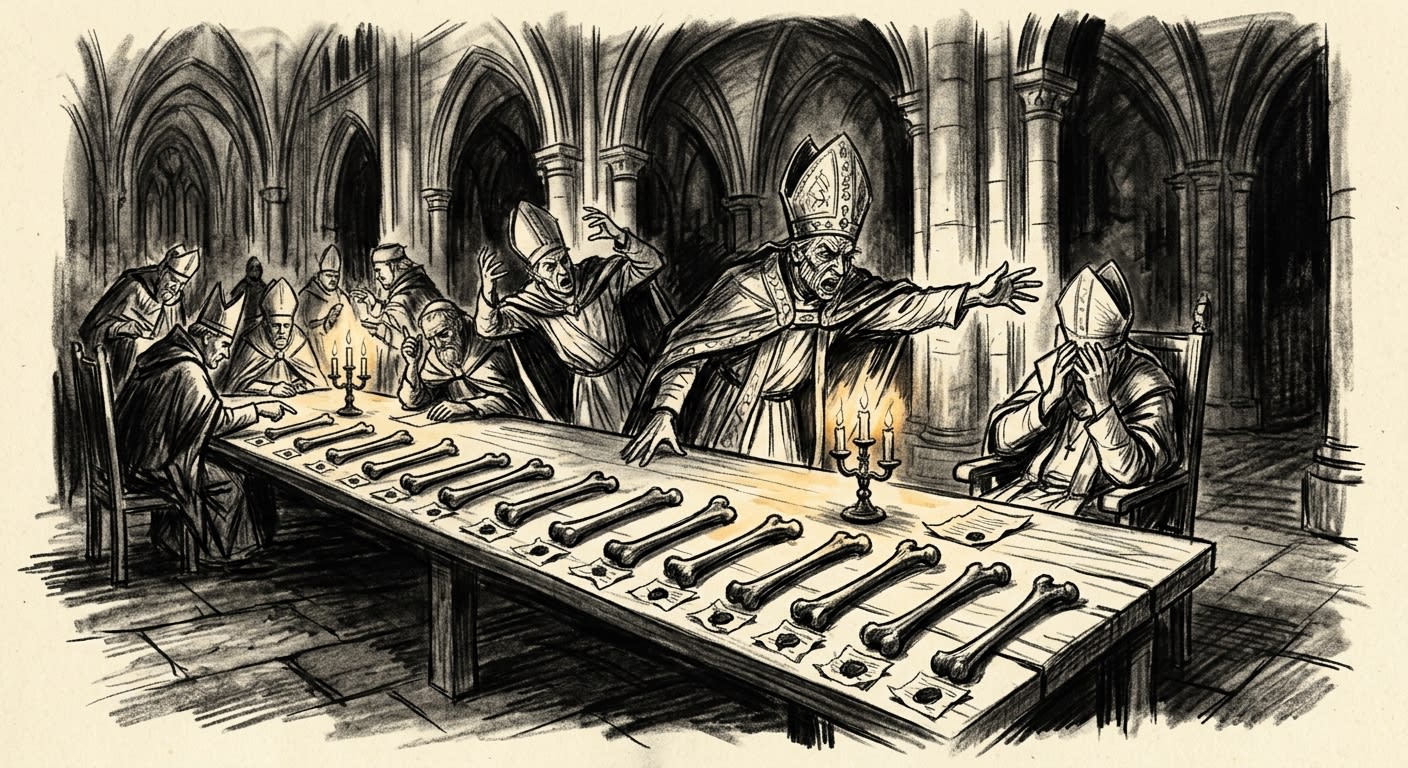
The Bureau of Relics now deploys Counter-Relic Examiners (Unregistered) — a specialist cadre trained in detection of Velmoric corruption — to every bastion south of Przemyśl. Their instruments include sanctified reagent sets, prayer-resonance rods calibrated to detect sorcerous contamination in bone, and a simple test the Bureau calls the Candle Proof: a relic of genuine provenance, when placed beside a lit taper, will cause the flame to lean toward it. A counterfeit will cause the flame to withdraw. A Bureau Examiner performing the Candle Proof at a forward chaplaincy is a familiar sight along the southern Line — a grey-robed functionary holding a candle next to a bone, watching which way the fire bends, while the soldiers behind him watch with the attention of men whose prayers depend on the result.
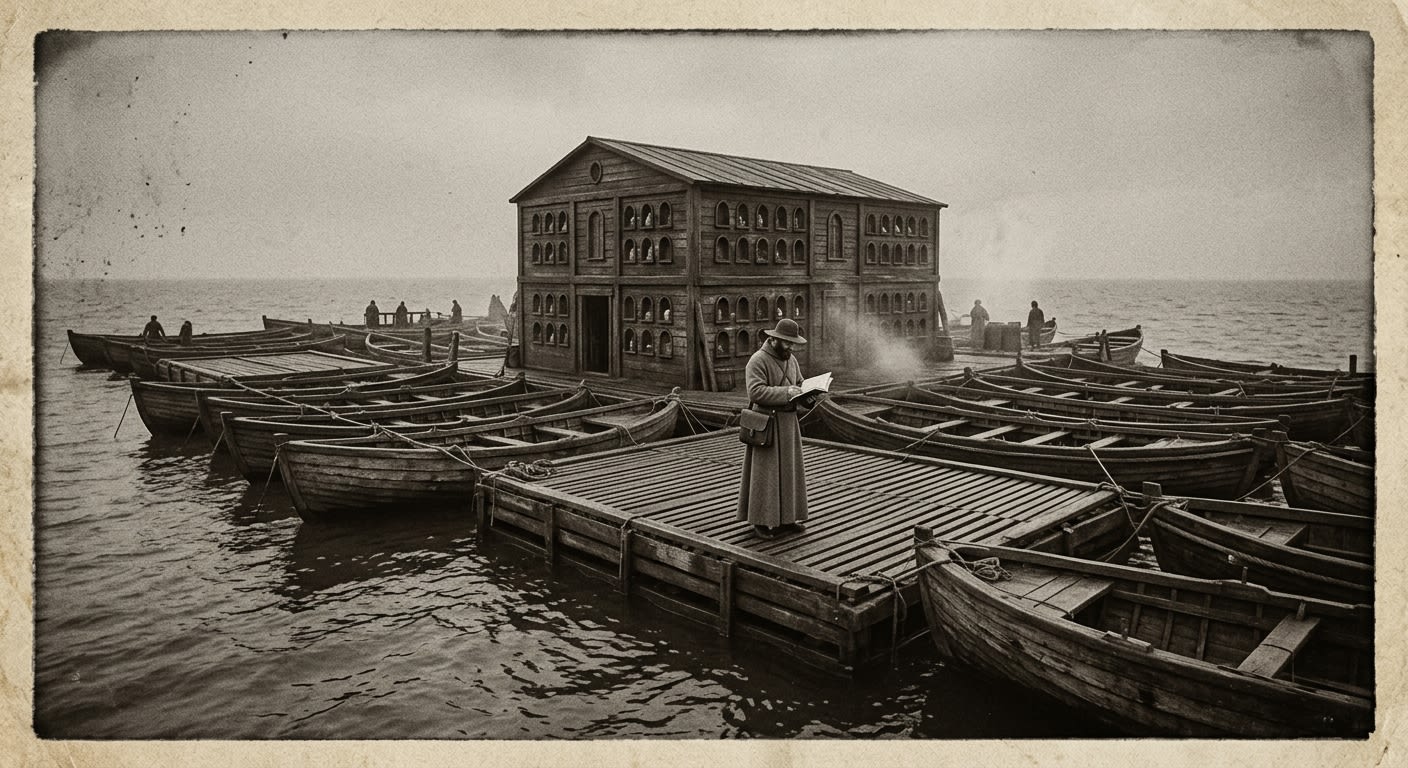
The Black Sea Reliquary Flotilla — seventeen hulls lashed gunwale to gunwale, carrying the bones of four hundred saints — presents the Bureau's most concentrated custodial challenge outside Strasbourg itself. The Maritime Reliquary Chapterhouse operates under Bureau of Relics authority, and the relic transit writs that govern every bone that moves between barges bear the Bureau's counterseal. The Crown Deck Chapel houses three relics of such potency that the Bureau of Alchemical Standards has classified the air within ten feet of them as "Category Two Sacred Atmosphere" — breathable, but theologically active. The Bureau of Relics stations a permanent Examiner aboard the Flotilla, whose quarterly authentication reports arrive in Strasbourg water-stained, salt-crusted, and consistently late. The Bureau has not disciplined the Examiner. The Bureau suspects the Examiner may be the only person aboard the Flotilla who files reports at all.
#On the Bureau's Contradictions
The Bureau's deepest contradiction — the one it shares with every institution of the Synod — is that its authentication process presumes authority over the thing it authenticates. A relic is holy. The Bureau stamps it holy. Without the stamp, the Bureau's position is that the relic is kindling. With the stamp, the relic is sacred. The relic, one assumes, does not change. The stamp does not alter the bone. The bone does not grow holier when the wax dries. What changes is the filing.
And yet the bones glow. The bones glow in the trenches, in the ravelin niches, in the cathedral vaults, in the seventeen cathedrals that house Saint Aldebrand's seventeen authenticated femurs. The bones glowed before the Bureau existed. They glowed through the Rationalist era, when the Bureau's predecessors had declared them non-existent. They glowed at Kalnik Ridge, when a half-blind monk raised a box above his head and a demon army recoiled. The Bureau did not authenticate that bone in time. The bone did not wait.
The Bureau of Relics knows this. The Bureau of Relics has always known this. The Bureau of Relics continues to authenticate at a rate of eleven per annum and to maintain its iron-sealed vaults and to dispatch its Examiners along the Line with their brass scales and their wax ampules and their prayer books so dense they constitute a devotional injury, because the alternative — the admission that the bones do not need the Bureau — would be the admission that the Bureau does not need the Bureau, and that admission is, in the Synod's filing system, a contradiction that no amount of notarization can resolve.