
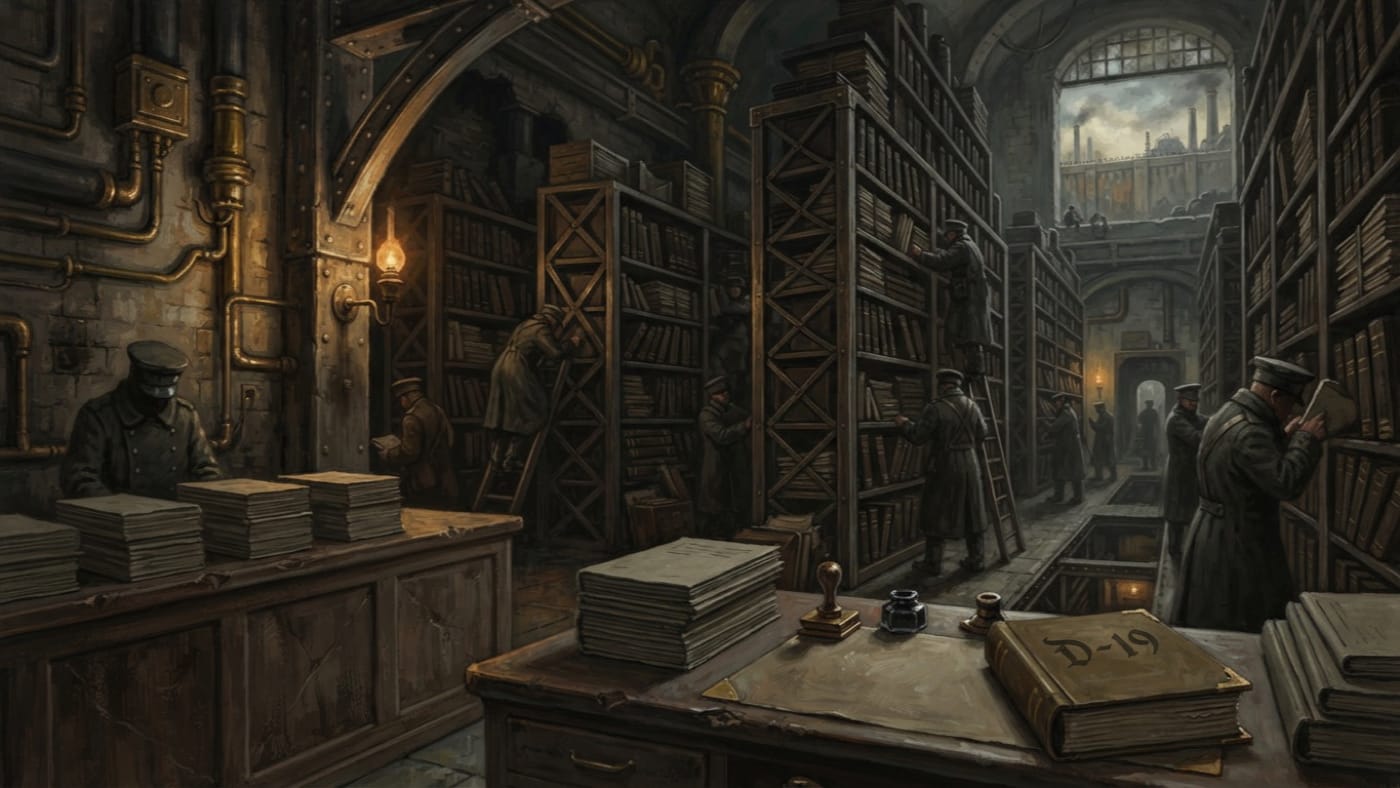
#On the Form and Its Reference
Form D-19 entered the Codex through one margin note in the file on the Hollow-Walkers. In that note I told any reader who wanted a comforting ruling to submit it to the Bureau of Doctrine. I meant it as a dismissal. Some readers took it as directions. A joke that starts receiving correspondence has become an institution, so this entry records what may properly be said of it.
Not much may. The designation is D-19. The recipient is the Bureau of Doctrine. Doctrine holds the interpretive authority of the Church from its halls in Strasbourg, which makes it the proper office for questions no other office wants. The Hollow-Walker file attaches one question to the form: whether the few seconds of apparent lucidity that sometimes follow a Walker's feeding are consciousness. Beyond that, the Codex holds no expanded title, no printed text it can certify, no founding decree and no date of issue.
I decline to supply any of them. The taxonomy that placed the Walkers in Kargath's sequence was ratified at the Fourteenth Doctrinal Congress in A.S. 147. Nothing in that ratification dates the form, and I will not let one year serve as the other's alibi. A clerk who invents the history of a document so that he can describe it has committed the sin this entry exists to examine. He has filled a column because the column was empty.
What the form receives is plain enough. What it returns is the subject of everything that follows.
#On the Interval After Feeding
The Hollow-Walkers come to the wire in the outline of the starving. They were human once, or close enough to human that the distinction comforts no one. Their flesh is eaten from within. Their organs have been rebuilt into digestive equipment. They feed until the abdomen tears, then keep feeding through the tear. None of this would need Doctrine's attention. The Bureau of War has a protocol for torsos.
The trouble is what sometimes happens after the meal. Soldiers on the southern line report that a Walker that has just fed may weep. It may speak a name. It may cross itself, or beg to be killed, or hold its hands up and look at them with an expression the chaplains recognise too easily. This lasts a few seconds. Then the stomach empties into need, the eyes change and the mouth opens. Whatever stood in the creature's posture is carried off again by the hunger that governs it.
Witnesses can report all of that. They can report the words, the gesture, and the duration, as measured by a man whose rifle was still raised. They cannot report what the words were attached to. A tear is a fluid. A sign of the cross is a movement of the right hand. A name is a sound, and the Walkers are known to produce names they have no visible right to.
Corporal H. Mace testified in A.S. 197 that a Walker outside Ravelin Mercy called him by his childhood name, in his mother's village idiom. The corporal had told that name to no one at the post. The creature had every outward mark of a Thracian woman of middle years. The Codex records his testimony. It does not explain it.
That leaves the question in its proper form. When the hunger is briefly full, does someone come back into the body? Or does the body perform, for a few seconds, the habits of someone who once lived in it? Form D-19 asks this. The sentries ask it more briefly, usually aloud, usually afterwards.
The Church has rites for the dying, the dead and the damned. It has none for a thing that may be all three at once, perhaps — perhaps, in the most charitable reading the Bureau permits — for less time than it takes to read the first verse of a psalm.
#On Memory and the Bureau's Ruling
To be fair to Doctrine, it has answered something. Its ruling is that Hollow-Walkers keep partial memory without stable personhood. This classifies the creature across its whole condition: what it remembers, what it does with what it remembers, and how long any of it holds. For a contact protocol, the classification is sound. Nobody needs to negotiate with a thing that lacks stable personhood, and the Bureau of War has never wanted to negotiate.
The whole ruling hangs from the word stable, the way a seal hangs from its cord. A few seconds are unstable by definition, so the ruling says nothing about them. It does not deny that awareness may surface after feeding, and it does not admit that it does. It describes the hours on either side and leaves the seconds unsealed. Partial goes in one column and without in the other. Form D-19 lives in the space between the columns.
This is Doctrine's oldest habit, and I will grant that it is one of its more honest ones. Uncertainty cannot be abolished by decree, so it is given an address. A question that cannot be answered can at least be received. A question that has been received troubles nobody except the archivist, and the Bureau of Records has never complained of having too much to keep.
An A.S. 162 recognition sheet described Hollow-Walkers as "cadaverous but otherwise anatomically human."
Withdrawn, as recorded in the Hollow-Walker file. The recognition sheet now reads "cadaverous at first glance; internally revised by hunger." The correction concerns anatomy. Any reader tempted to cite the withdrawn wording in a D-19 petition, as proof that something human survives under the revision, should know that he is citing a retraction.
#On Mercy at the Wire
Here the unanswered question stops being a matter of folios.
The Bureau of Mercy argues that remains should be shriven when the creature's speech has been recorded. The Bureau of Purity argues for immediate burning. Doctrine has ruled both positions correct according to circumstance, and the garrison does what the hour allows. If the wire is quiet, a chaplain speaks. If the eastern mud is moving, the corpses burn.
Both arguments are about remains. Neither is about the interval. A chaplain may kneel only after the legs are disabled, the torso destroyed and the jaw broken. By then the few seconds are long gone, and whatever did or did not weep has been settled by the gunner.
Nor may anyone put the question to the creature while the interval lasts. The field advisory at Bastion-Constantinople holds that a Walker that has just fed remains hostile. So does a Walker that speaks, and so does a Walker that kneels. The contact protocol of A.S. 201 orders distance and silence, and permits speech to be recorded only after engagement. A sentry who answers a Walker's name, to test whether anyone is listening, has offered his own throat as the control sample. The experiment has been run. It is not repeated in polite company or at the forward posts.
So the soldier is left with a doctrinal problem and a ballistic instruction, and only the instruction arrives in time. Suppose that for three seconds the creature was a woman who knew she had just eaten a man. Then the soldier who shot her shot a penitent. If it was only hunger wearing her habits, he shot hunger. The Synod requires him to fire either way and has given him no means of learning which it was. The form is where that fact is kept. Its keeping comforts the archive. I am told it does not comfort the man.
None of this alters a single line of the countermeasures. A doctrinal question is a sheet of paper, and the wire does not read.
#On the Other Insoluble Questions
In the Hollow-Walker file I wrote that D-19 would be filed beside other insoluble nuisances, and I named three: infant damnation, plague miracles, and why artillery chaplains drink. The list is my own characterization of what Doctrine leaves unanswered, not the Bureau's index. Nobody should read it as a schedule of approved filing categories.
I will not summarise the first two. They are older than this entry and older than the creature. They have outlived every confident answer I have heard offered to them, and several of those answers were mine.
The third has been answered many times, and every answer is correct. An artillery chaplain blesses the guns at dusk and counts the shapes at the eastern wire during the fourth watch. In the morning someone asks him whether the thing that wept before the shell reached it was owed a rite. He drinks because he is asked. He would drink more if anyone answered.
There, perhaps, is the only finding Form D-19 can claim. The question is hard on the archive, which keeps it, and on the Bureau, which receives it. It is hardest on the men who stand nearest the interval and have the least time to think about it. Doctrine sits in Strasbourg, far from the southern line. The interval occurs at the wire. The form travels between the two and settles nothing at either end.
It will be received. It will be filed. On some night this week, at the eastern perimeter, a Walker will finish eating and look at its hands.