
#On His Nature
I am Valerius Drax, and I inscribe this entry on Kargath in the same posture in which the Bureau of Doctrine reads it: at a distance, by candlelight, with the ash-jar at my elbow and the prayer for the breaking of appetites already half-said. The reader is encouraged to do likewise.
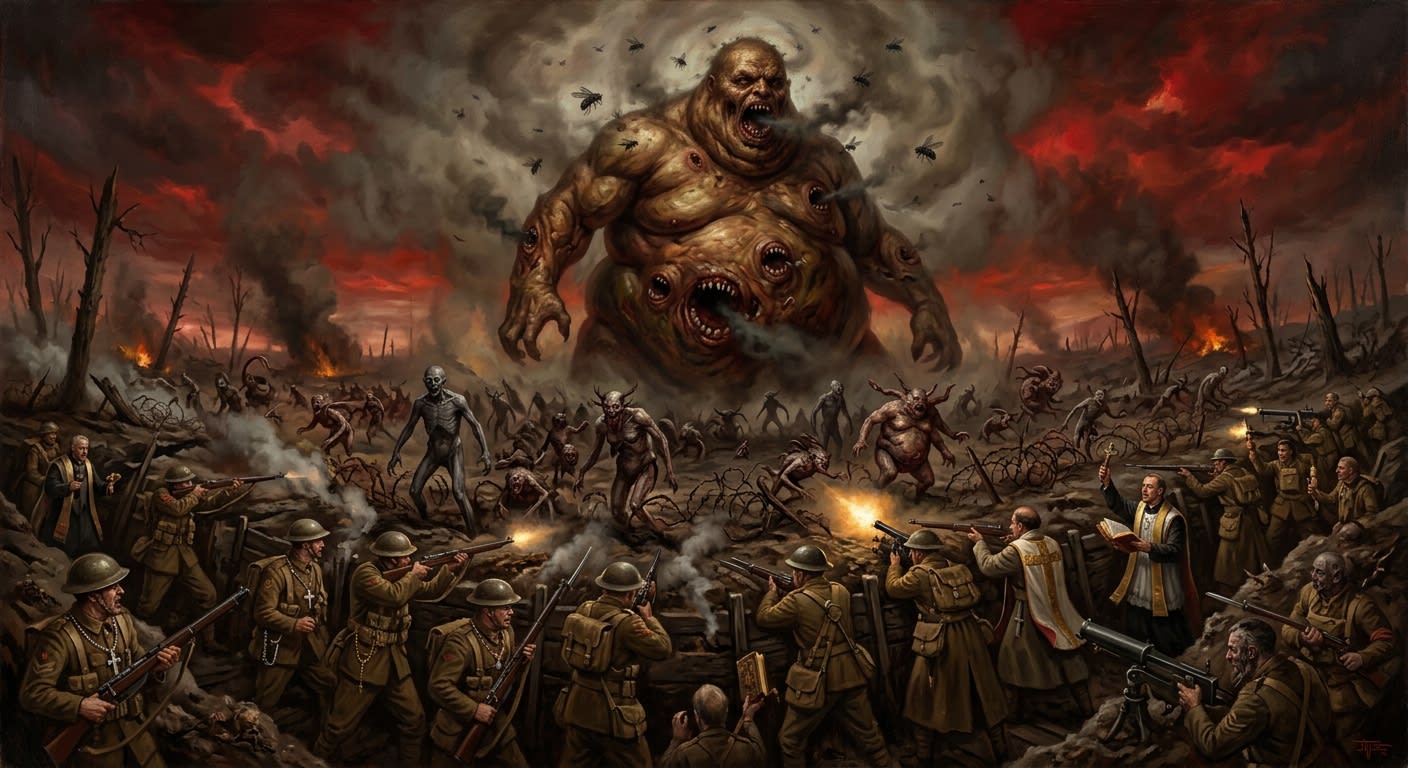
Kargath is not the largest of the Sin-Generals. He is not the most cunning. He is, by the unanimous testimony of those who have stood opposite him on the Sagittal Line, the one who wins. Where Kargath passes, the wheat fails three years later; where Kargath passes, the wells run sour and then clear, then sour again; where Kargath passes, the children of neighbouring provinces are reported missing in numbers their mothers remember before any clerical census can record.
He is the enemy nearest to Bastion-Constantinople. He is therefore the enemy most often on the Theocracy's ledger. And he is, by a considered Doctrinal opinion which I have seen once and was forbidden to copy, the enemy we cannot starve out, because Kargath does not starve.
#On the Theology of Gluttony
The Bureau of Doctrine has classified Kargath under Gluttony since the earliest editions of this Codex. The classification is technically correct and substantively incomplete. The reader who proceeds on the assumption that Kargath represents excess — overeating, indulgence, the fat man at the banquet — will be materially wrong in ways that will get people killed. The Bureau therefore requires the following clarification, which I have written four times and have been required to shorten each time by successive committees who found it, variously, too alarming, too accurate, and once — memorably — too good. The current version is the fifth.
Kargath does not represent overeating. Excess is a symptom, not the sin. What Kargath represents is something without a clean Synod-approved word for it, though the Bureau of Doctrine has attempted the following:
Need that grows with feeding. Not hunger that can be satisfied, but hunger that multiplies with satisfaction — the more you eat, the larger the void, the sharper the need. The horror is not the feast. The horror is the hunger that survives the feast.
Kargath is scarcity as a spiritual condition, not a material one. He represents what happens when need becomes identity — when consumption replaces purpose — when a person, or a city, or an army has eaten everything and is still starving. The people most vulnerable to his influence are not the greedy. The Bureau of Doctrine wishes to be clear on this point, since the greedy have been over-indexed in our public materials for sixty years and the actual pattern is different: his victims are the already hungry, the already afraid, the already counting what they have and finding it insufficient. He finds the ones who remember famine. He finds the ones who feed others and fear they will fail. He finds the ones who look at abundance and see only future absence.
He offers them the end of scarcity.
It is a real offer. The food appears. The hunger stops. The family is fed. For a time, sometimes a long time, it is genuine — and this is the part that the Bureau's public messaging consistently omits, because acknowledging that his gifts work creates complicated pastoral questions about why the Theocracy cannot provide the same relief. I note this omission. I am told to proceed.
When the gift ends, the void returns — larger for having been filled. The food no longer satisfies. The hunger doubles with each meal. The body wastes even as it consumes. What was a person becomes, by degrees, a Hollow-Walker or a Maw-Born or a Self-Devoured: a thing that is only hunger with a body attached, still reaching, still searching, still certain that this time, this time, there will be enough.
There is not enough. There will never be enough. That is the sin. That is Kargath.
#On His Dominion
The marshes of the Bosporus are the nearest of Kargath's territories to the Theocracy's walls — the front-line spillover of a domain that extends, behind the Sagittal Line, across the former breadbasket of Hungary and deep into Moldavia. What follows is the Bureau's best-confirmed account of those territories. The Bureau of War has reviewed this section and requested that seven passages be redacted on the grounds of morale. Four requests were declined. Three were accepted. The reader will know which three by the spaces they leave.
Earlier editions of this Codex asserted that the Bosporus marshes
were reclaimable by the application of sufficient holy fire.
The Bureau of Doctrine now considers this claim premature. The Bureau of Purity has withdrawn the operational memorandum on which it was based, and the responsible Hieromnemon has been reassigned to the Paper Mines of Ulm. Pilgrims are reminded not to discuss the reclaimability of the Bosporus in public correspondence.
The Bosporus Marshes — what once was rich fishing-ground and the seat of a small monastic order has belonged to Kargath since the Blackening. No one knows precisely when the Blackening began; cartographers of the Bureau argue the matter annually. What is agreed: the reeds crawl. The water froths with an algae the colour of old bile. Caravans from Istanbul toward the western provinces arrive as wagons of rot, when they arrive at all, and the rot does not decompose — it waits.
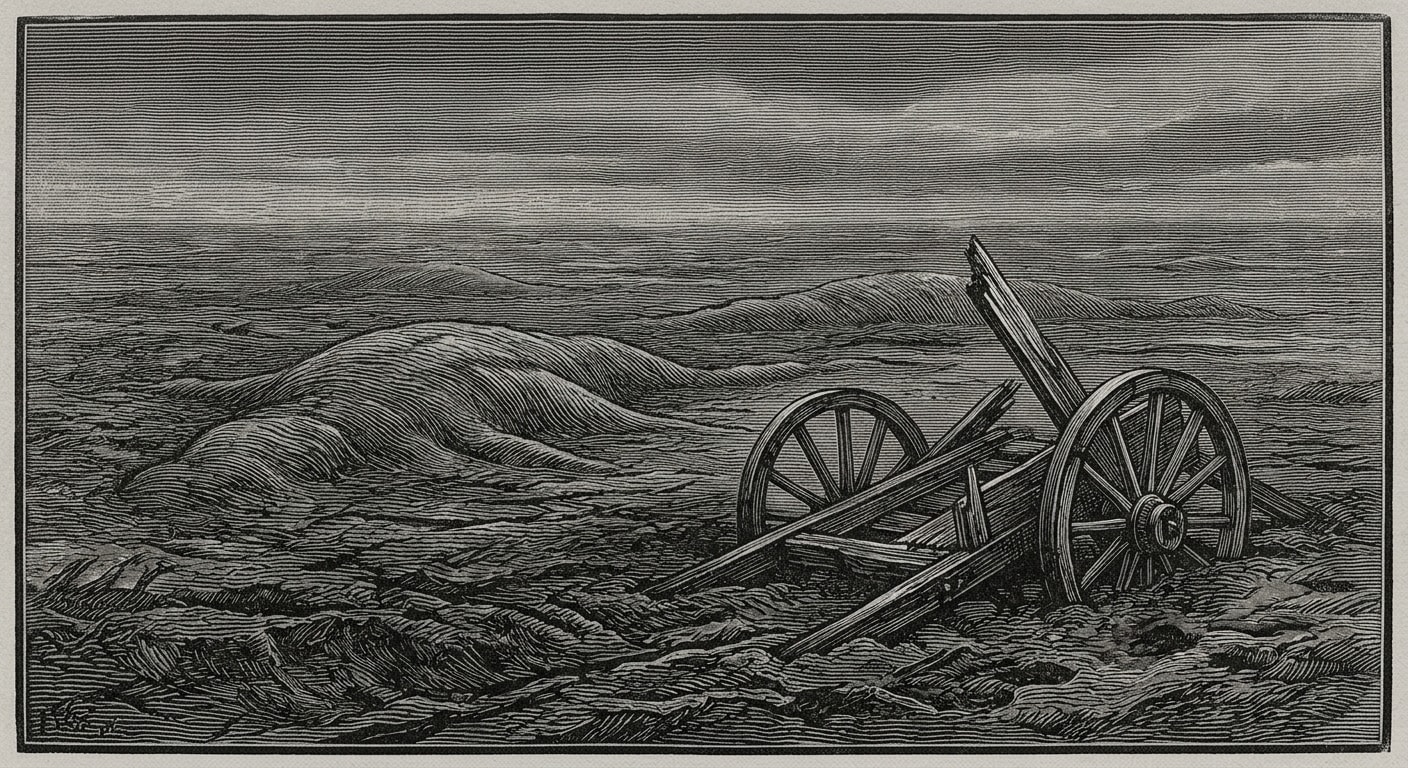
The Blightmarsh — the plains of Hungary, which fed three empires before the Sundering, are now called this by anyone who has seen them and survived long enough to need a word. Grey mud, grey water, grey sky. The soil itself has been consumed — not depleted but devoured, eaten by something that lives beneath it. Shapes move under the surface, vast and slow. Mouths open in the mud, swallowing anything that passes. The Marsh expands at its edges, consuming farmland before Kargath's armies ever arrive. The Bureau of Agriculture filed eleven reports between A.S. 145 and A.S. 155 on projected recovery timelines for the former Hungarian plains. The Bureau of Agriculture was dissolved in A.S. 158.
The Famine Pits — mass graves from the Sundering era, where thousands who died of starvation were thrown in great numbers into trenches and covered over. The Bureau of Rites performed rites over the nearest of them; the Bureau of Records documented the rest; the Bureau of War designated them as impassable terrain features and moved on. What is understood now is that the hunger of the dead did not entirely die with them. The Pits are places of pure need: the want of the long-dead radiating outward, infecting the living, creating starvation in well-fed bodies. Stand near a Famine Pit long enough and the stomach cramps, regardless of when you last ate. The Bureau of Medicine has confirmed this. The Bureau of Medicine has declined to offer a counter-ritual. The Bureau of Medicine has requested a transfer.
The Consuming Cities — urban centres that Kargath has taken still function, in the sense that their markets open, their bakeries operate, their slaughterhouses run continuously. The economy has changed. The currency is food, and the exchange rate is terrible. Everything is measured by caloric value. A life is worth what it provides when rendered. The cities are always busy, always producing, always consuming — and always starving. The more they make, the hungrier they become. Bureau intelligence on these cities is limited to what refugees have reported, and refugees from Kargath's territory are, as a category, unreliable witnesses: they have eaten things that changed them, and the changes are not always visible from the outside.
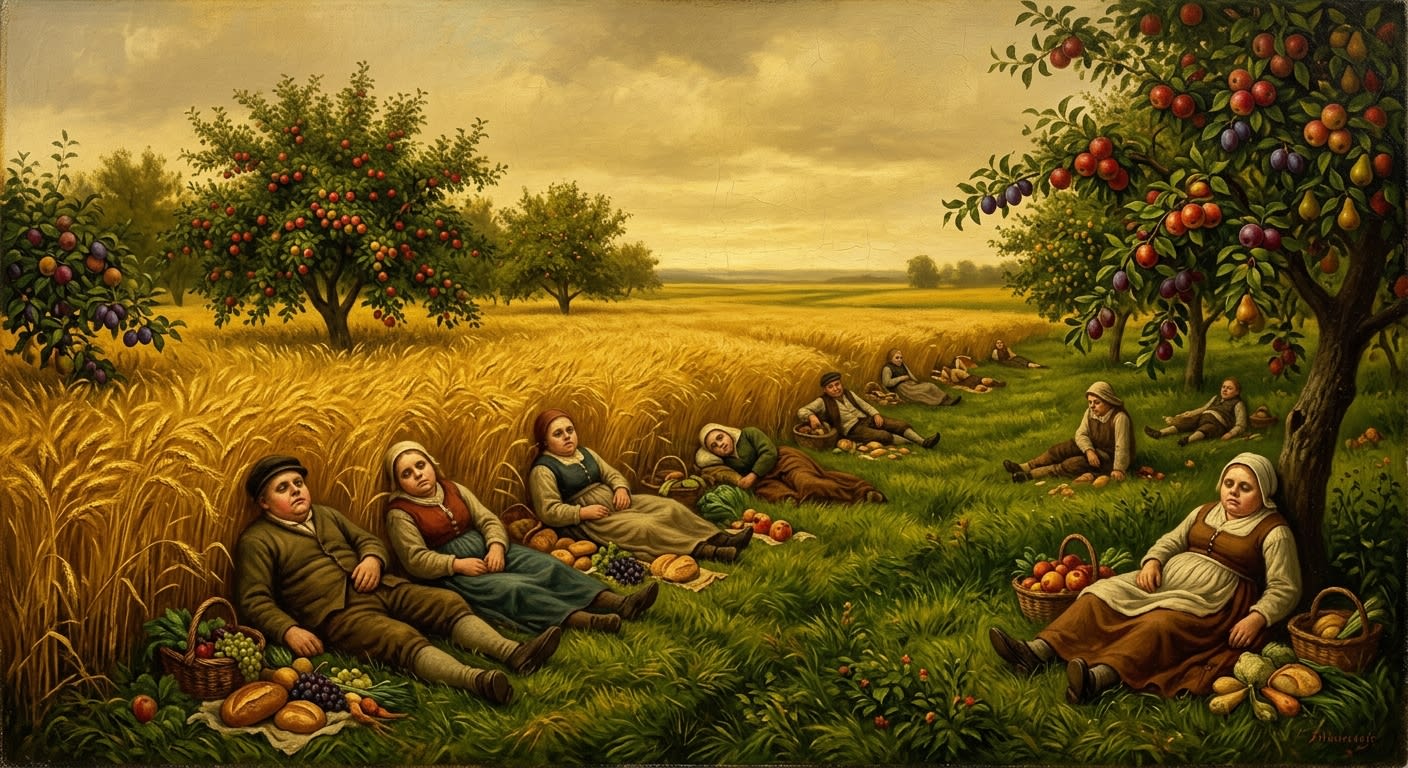
The Abundance Fields — the cruelest territory, which the Bureau debated whether to include in this entry for three sessions before the Hieromnemon Warden-Adjutant overruled the committee and insisted on inclusion on the grounds that soldiers who don't know about the Abundance Fields are likely to walk into them. Fields that grow lush, verdant, overflowing crops. The harvest is eternal. There is always more. Eat the grain and starve. Feast on the fruit and hunger. The Fields are a trap for refugees and, when morale is low, a standing temptation to our own troops on the eastern lines. They look like salvation from the walls. They are damnation at arm's reach. The bodies found at their edges are round-cheeked and hollow-eyed, which is a combination the Bureau of Medicine describes as medically unprecedented and which the Bureau of Doctrine describes as Kargath's signature.
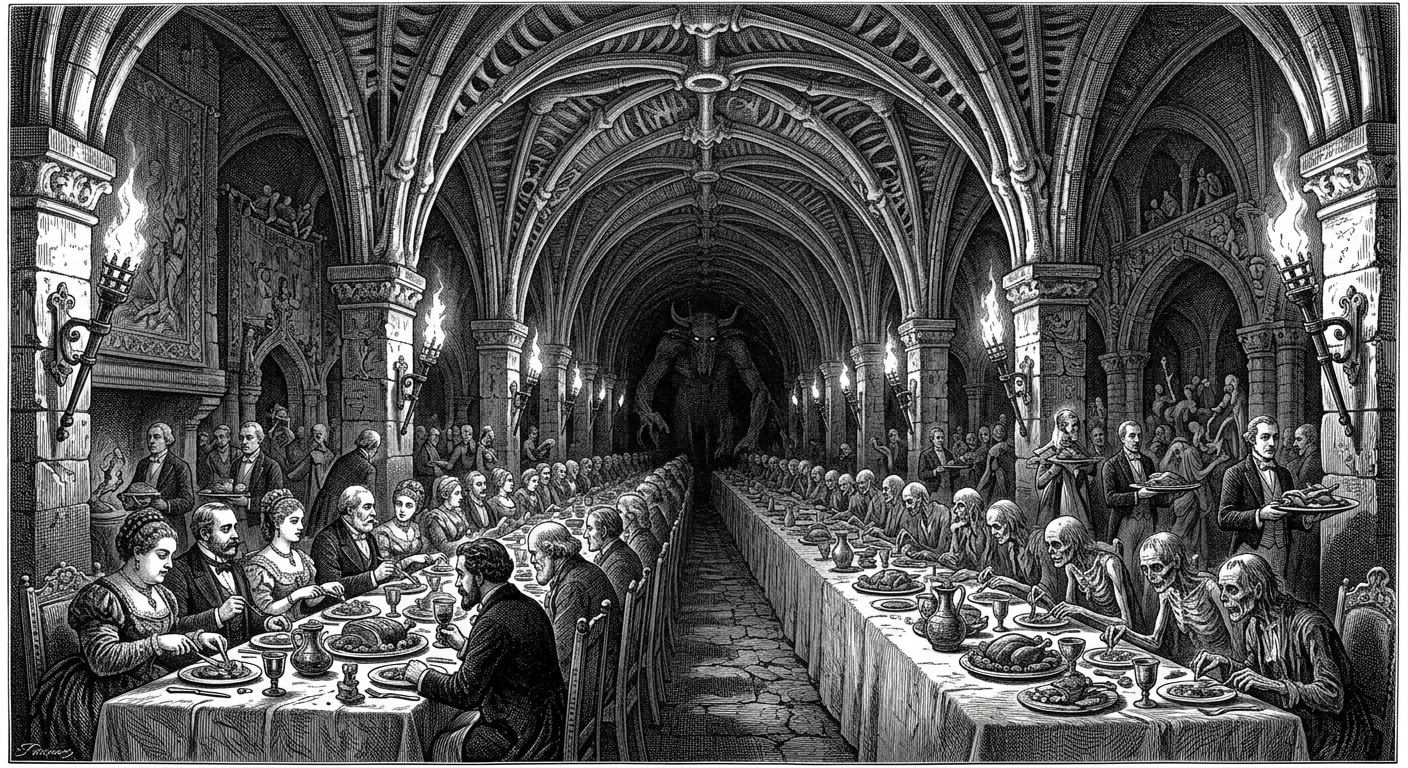
The Hollow Court — Kargath's seat: a palace of bone and empty larders, where the Lord of the Empty Maw holds his feasts. The feasts never end. The tables are always set. The servants never stop bringing courses. Everyone at the table has been eating for decades and is thinner than the day they arrived. Somewhere at the head of the table sits Kargath himself, though no one who has survived long enough to report has survived long enough to reach that end of the hall. The Bureau has confirmed the Court's location from four independent sources. The Bureau of War has been presented with this location on three separate occasions. The Bureau of War has declined to act on it on each occasion, citing "insufficient operational confidence," which is the phrase the Bureau of War uses when it means we are afraid and we are correct to be.
#On His Methods of War
Kargath does not besiege. Kargath does not, in the Theocracy's recognized sense, even fight. He arrives in the form of a tide — maggots in the reeds, flies in the supplies, a fever passing through the regiments opposite his marshes, a contagion of appetite among the troops on the wall. Men who have faced him tell of waking in the fourth watch with a hunger they cannot place, eating their own rations for the second time that night and not remembering, finally eating their own boot-leather and sometimes — the Bureau files these confessions with restraint — each other.
The Night of the Fourth Watch, A.S. ███, in which the parish regiment assigned to the Ravelin of Purity consumed ██████████ before the chaplains arrived with the wake-bell, has been sealed under Ninth-Ratification and is not available for public reading. The survivors were shriven with appropriate ceremony and assigned to garrison duty elsewhere. Their dietary restrictions were noted.
Doctrine has classified Kargath's approach as slow because the Bureau prefers words its peers can use in pulpits. In practice, his approach is patient — he advances by the half-mile per generation, and has been advancing for as long as the Theocracy has been taking proper minutes. In the hour he reaches the walls of Constantinople, the Bureau of Records has estimated, he will already have consumed everything west of them except the walls.
#On His Legions
Those fortunate enough to survive an encounter with Kargath's forces and sufficiently coherent to file a deposition have permitted the Bureau to establish the following taxonomy. I note that no single deponent has witnessed all six classes. The full picture was assembled from testimonies of varying reliability, which is to say: the full picture may be wrong in particulars but is, in the Bureau's estimate, correct in kind.
The Maw-Born are what the Bureau classifies as primary physical demons — entities that are, in the fullest theological sense, mostly mouth. They range from human-scale to the size of a grain warehouse; all share the same principle: an opening that wants to be filled and cannot be. They do not move so much as orient, turning toward whatever is most edible. Some have legs. Some drag themselves across the mud. Some have not moved in decades and have consumed everything in a widening circle of barren earth around their position. The ground where a Maw-Born has rested is eaten to bedrock. The Maw-Born is still hungry.
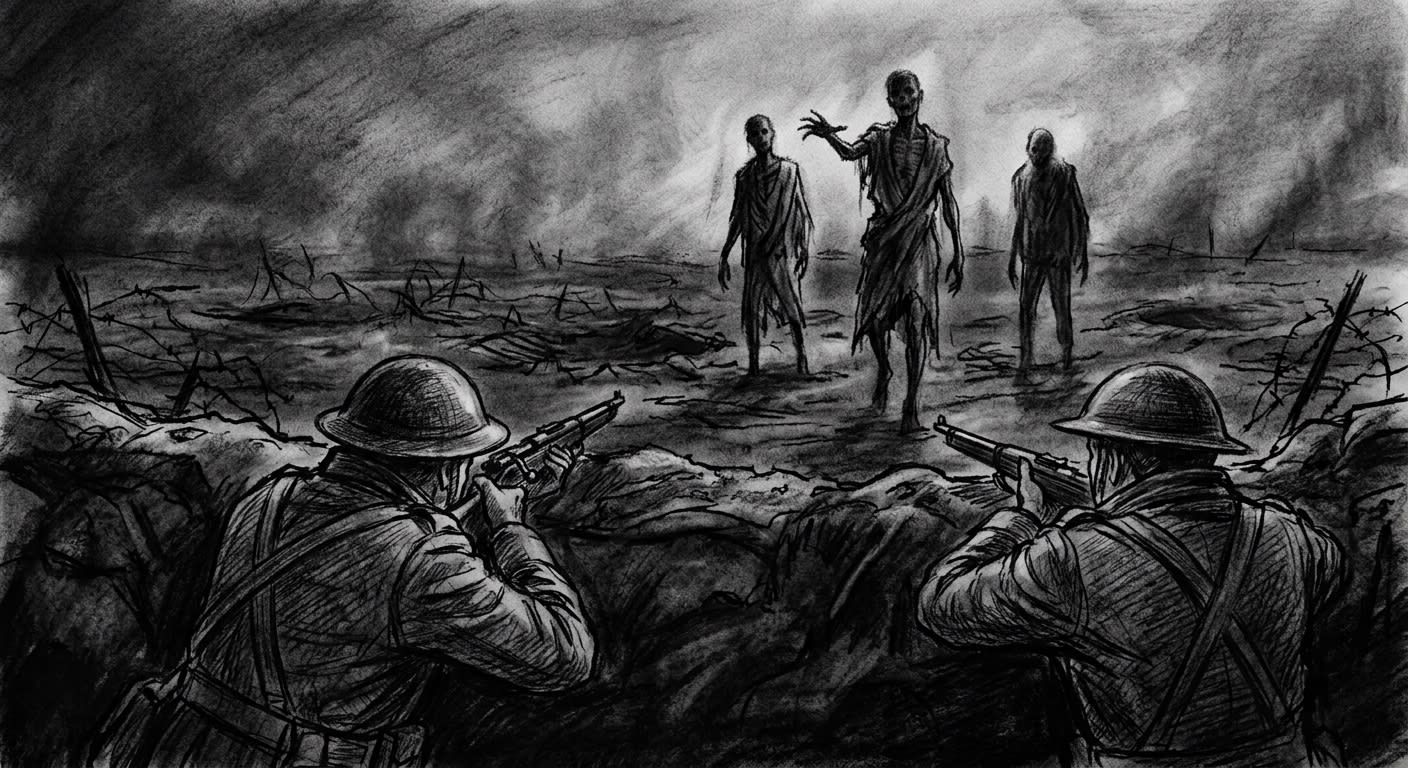
The Hollow-Walkers are the ones our soldiers encounter most often in the field — humanoid forms, emaciated past possibility, wandering into human territory drawn by the smell of rations and livestock. They were human, or something like it, once. Now they are vessels for hunger: their flesh consumed from within, their organs repurposed into additional digestive capacity, their minds reduced to pure need. They try to communicate sometimes. Bureau depositions record them attempting to ask for help in recognizable languages, occasionally in dialects that have not been spoken in three generations. Then the hunger takes over, and the deponent's account typically ends.
The Blightbearers do not consume directly. They carry Kargath's curse outward: crops rot in their presence; stored food spoils overnight; water turns brackish; soil loses its capacity to nourish. A single Blightbearer walking through a city can starve it by the following spring without ever raising a hand. They are not, strictly speaking, soldiers. They are weapons the Bureau of Purity has no counter-ritual for, fired in the direction of our granaries and left to walk.
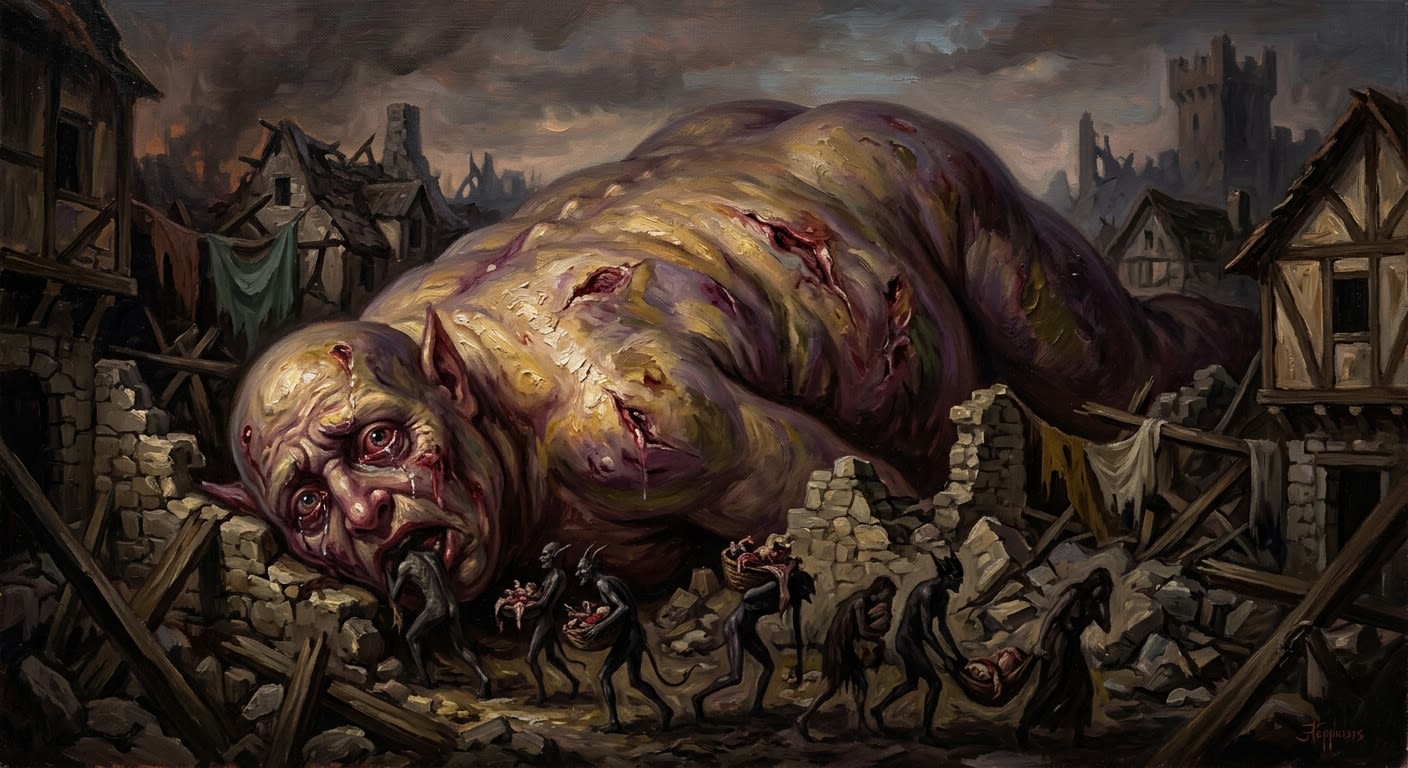
The Gorged are the most theologically disturbing — demons that have consumed enough, in the sense that their bodies are filled past capacity, and yet the hunger has not stopped. They are vast, barely mobile, constantly fed by lesser servants who bring them anything edible. They have consumed villages. They have consumed armies. They lie in the eastern territories like geographical features, crying out, and the crying does not stop, and the feeding does not help, and the Bureau of Doctrine has on multiple occasions requested that this class of entity simply not be included in public-facing materials. The request is overruled each time. The Gorged are a sermon. We include them for pedagogical reasons.
The Harvest look like salvation. Lush fields spring up in their wake. Fruit ripens. Grain swells to three times its natural size. Villages that have starved for a generation suddenly find their larders full, their children round-cheeked, their debts to the Synod forgiven by the simple fact of abundance. Eat the Harvest's produce and your hunger doubles. The Bureau has confirmed at least four instances in which Synod-held communities welcomed what they believed to be a miraculous agricultural recovery and were found, within a season, to have starved to death surrounded by overflowing stores. The Harvest are Kargath's most patient weapon and, in my considered opinion, his most elegant. I find I cannot quite bring myself to admire this.
The Self-Devoured are not threats in the field-tactical sense. They are warnings. Demons locked in cycles of self-consumption: gnawing their own limbs, swallowing their own flesh, regenerating, repeating. They cause casualties primarily through proximity — soldiers who observe them too long begin, the depositions attest, to consider their own nutritional value with an attention the chaplains classify as spiritually dangerous. The Bureau of Medicine classifies it differently, but we need not go into that here. The Self-Devoured are what the Gorged become when the servants stop bringing food. The Bureau suggests — and I endorse the suggestion — that this knowledge be taken as a caution rather than a comfort.
#On His Rivals
Kargath hates Velmora, who hoards what he would consume, and Atheron, whose vanity dresses the plates he wants to eat from. He has not, to the Bureau's knowledge, ever cooperated meaningfully with Maldrake — Wrath resents being made to wait, and Kargath makes everyone wait — though their hosts have aligned on occasion when the terrain forced them to share roads. The Bureau of Hearsay maintains a small shelf of accounts of these uneasy alliances; none are available for general reading.
#On His Cults
Kargath's cults are, in the Bureau of Purity's operational assessment, the saddest. They are not, primarily, populated by villains. They are populated by people who have been hungry — genuinely, bodily hungry — and who will do anything to ensure they are never hungry again. The Bureau of Purity's threat assessments consistently rate them as highly dangerous and, in a separate category that the Bureau does not include in public-facing materials, highly sympathetic. I am including the second classification because I believe it is operationally relevant. A soldier who understands why a cultist joined is a soldier who might recognize one earlier.
The cult hierarchy, as reconstructed from Bureau of Shadows intelligence and the testimonies of defectors, organizes around consumption:
- The Hungry — those who join seeking food, security, the end of scarcity. They are desperate. They are, in the Theocracy, not difficult to find. They have not yet fully understood what they have joined.
- The Fed — those who have received Kargath's gift and felt satisfied. Temporarily. They recruit the Hungry. They know the feeling will not last, because it has already started not lasting, but they retain the memory of it, which is enough.
- The Providers — those trusted to distribute the gifts. They control who eats and who does not. They are still hungry. They will always be hungry. The control is compensation.
- The Consumed — those too far gone to manage — more hunger than human. They are kept fed by the cult so they do not devour the rest. They are always hungry. They know they are always hungry. They cannot stop.
- The Hollow — the leadership. They have given everything to Kargath in exchange for the promise of satisfaction. They are the emptiest of all. They are also, in many cases, the most dangerous, because the emptiness has a very long reach and knows precisely what to offer to those who are starting to feel it too.
Kargath's cultists infiltrate food distribution networks, ration offices, and agricultural communities — anywhere that controls who eats and who starves. They look like the merchant who always has supplies when others do not. The farmer whose fields yield when neighbours' fail. The relief worker who arrives with food during famine. The generous cook whose meals are, for a time, the best thing anyone has ever eaten. They are not performing generosity. They are, from their perspective, providing. They do not realize that "enough" has become impossible for them and that they are building the same impossibility in everyone they feed.
#On the Synod's Countermeasures
The Bureau of Doctrine has reviewed this section and confirmed that its inclusion is mandatory, pedagogically necessary, and — in the Bureau's private estimate, which I share — partially dishonest in the direction of optimism. The reader is invited to calibrate accordingly.
The Synod has maintained the following defences against Kargath's influence since approximately A.S. 100. Their effectiveness ranges from partial to counterproductive, which is to say: they are better than nothing and also occasionally worse than nothing, depending on conditions.
Rationing as Spiritual Discipline — the Theocracy's strict rationing policy is partly logistical and partly theological: by controlling consumption, the Bureaus claim to protect against Kargath's whispers. "Eat only what you are given" is both policy and prayer. Whether the spiritual protection holds is unclear. The material effect is certain: rationing creates hunger, and hunger is precisely the vulnerability Kargath's influence-demons seek out. The Bureau of Doctrine is aware of this tension. The Bureau of Doctrine has chosen not to resolve it publicly.
Fasting Rituals — mandatory regular fasts across the Dominion, on the theory that voluntary hunger builds resistance to Kargath's offers. The practice is that fasting weakens people physically and makes them more receptive to promises of food. The Bureau of Rites maintains that the spiritual benefit outweighs the material risk. The Bureau of War disagrees, in documents that the Bureau of Records has filed under classification J-9 (Not for Public Distribution, Intra-Bureau Dispute, See Also: Jurisdictional Conflicts Still Unresolved as of A.S. 201).
Communal Meals — eating alone is discouraged across the Dominion; communal meals and shared rations are encouraged as barriers against the isolation that Kargath exploits. If everyone eats together, no one hoards. If everyone shares, no one starves alone. This is the Synod's most genuinely effective measure and also its most difficult to maintain in garrison conditions and among the populations of the Warrens, where "communal" is an aspiration rather than a description.
The Doctrine of Enough — the teaching that desiring more than one's allocated share is itself demonic. Contentment with rations is holy. Hunger for more is sin. The Bureau of Doctrine endorses this doctrine. I wrote part of this doctrine. I am compelled by honesty — an affliction I have so far failed to have treated — to note that it creates considerable psychological burden for people who are, in the material sense, genuinely underfed. Which is most people. The Doctrine of Enough is, in this sense, a doctrine that asks the hungry to regard their hunger as a moral failing. I have thoughts about this. They are, at present, unfiled.
Execution of Hoarders — those caught storing food beyond their allocated ration are publicly executed and their stores redistributed. The Synod holds that this prevents demonic accumulation. Critics, who are few and quiet, note that it primarily prevents personal survival preparation by people who have lived through famine and remember it. The rule is enforced unevenly: officials who maintain strategic reserves are not, in the Bureau of Records' filing history, executed. The Bureau of Records does not comment on this pattern. The Bureau of Records simply files it.
The reader is reminded that Kargath cannot be reasoned with, bribed, flattered, or starved. He can be delayed. The Theocracy's ambition with respect to Kargath, refined over two centuries of practice, is to delay him one more day. This Codex is, among other things, part of that delay. A reader who has attended to this entry through to the closing stamp has — in the Bureau's considered view — added their own fraction of attention to the line. The Bureau is, as ever, grateful.