
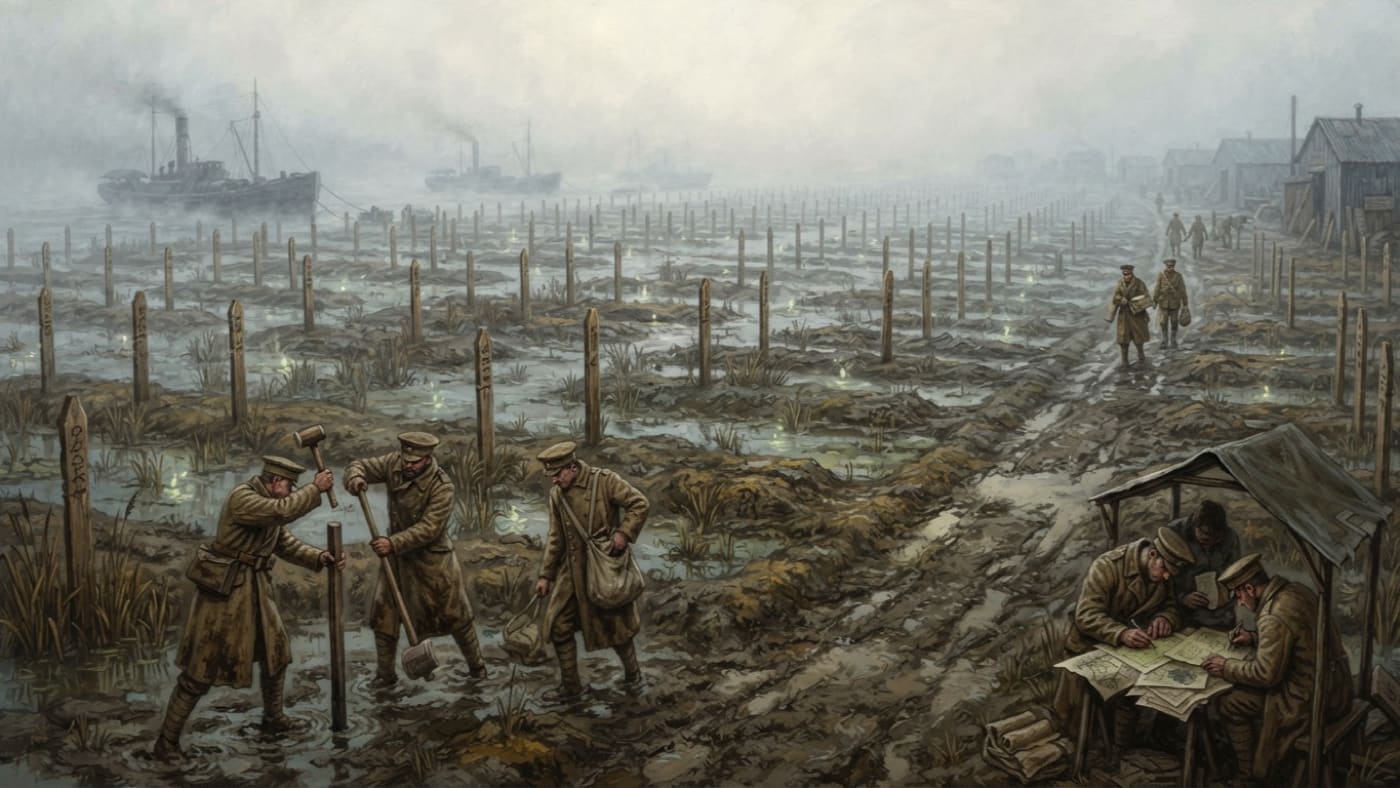
#On the Burial Ground
"The dead are placed. The map is mercy." — Mortuary Cartography Office, public formula
The Glyphyard lies along the southern flank of the Ash-Glyph Marshworks. South of the ropewalks and stilt-platforms the settlement stops pretending to float and admits that it stands in a grave. The district is a grid. Each square is ten paces by ten, and the squares repeat across reed marsh, brackish pool and half-sunken berm until the eye loses count. The ledger does not lose count. The air carries lime dust and wet ash. Visitors take the second for smoke. It is not smoke.
The district has no founding of its own. It grew out of the Marshworks' mortuary operations. The settlement's account dates the charter of those operations to A.S. 74. By then the Sagittal Line could be defended but was not finished, and the offices that would later carry Bureau seals were still learning their own names. Corpses came down the Danube's distributaries faster than any parish could receive them. Someone drove a stake. Someone entered its position in a book. The Church has always counted the second act as the sacrament.
The yard now belongs to the Mortuary Cartography Office. By the Marshworks assessment of A.S. 201, the Office answers jointly to the Bureau of Records and the Bureau of War. War supplies the dead and Records keeps them. Custody changes hands in the Glyphyard, in mud up to the shin.
#On the Stakes and Their Entries
"We do not bury the dead. We file them." — Cartographer-Provost Lysa Vane, in testimony before the Bureau of Records, A.S. 199
The sequence is fixed. I set it down in order because the Office does.
The barges tie up at the Charnel Moorings, which receive them. The Glyphyard has no dock and wants none. Each load of remains comes with a manifest that lists its dead by number, rank and unit designation. Names appear where the War clerks bothered to write them. The remains go into a square. Bone-lime posts are driven at its corners, and the square is marked with the ash-glyph. The Marshworks' own description of the glyph is powdered bone-ash mixed with lye, pressed into wet timber with a branding iron. The Office does not publish how the post and the brand relate to each other, and I will not invent a manufacture for it.
A Seal Magistrate affixes the seal. The grid is closed. A map is drawn, and the map is filed. From that moment the dead stop being War's concern and become a holding of Records. A tag clerk, sleeves tied up against the damp, carries the paperwork to Seal Shed Row, where it is validated and countersigned and so made true. The Glyphyard maps the burial and Seal Shed Row certifies the map. Confuse the two in an Office memorandum and you will be corrected in red ink. Confuse them on the ropewalk and a tag clerk will explain the difference at length, because his wages depend on it.
The glyph records a coordinate, and the coordinate secures an account. A regiment's losses on the Line become a count of squares in the Glyphyard, and that count outlives the regiment. Casualty returns are contested whenever a commander's reputation rests on them, and the Office answers every challenge with its maps. If a boundary cannot be verified, the casualty figure behind it cannot be defended. A stake out of place is a lie with a coordinate attached.
The earliest field reports from the Marshworks, as cited in the settlement's published account, describe the ash-glyph system as "provisional" and "subject to revision upon the cessation of hostilities."
Hostilities have not ceased. The Office no longer calls the system provisional, and the word has been struck from the surviving copies of the charter. Nobody has sent the amendment to the ground under the Glyphyard.
#On Those Who Keep the Grid
"The marsh counts differently at night." — Glyphyard saying
The glyph-stakers come out at dawn. The fog lies flat then, and there is light enough to read a post. Their mallets are wrapped in linen, so each blow reaches the ropewalk as a dull knock, the sound of a fist on a coffin lid heard through a wall. No staker hums at the work, because humming is forbidden. Nobody speaks a dead man's name over open water, which is also forbidden. A dead man who must be identified is named by bead-code. The Office calls the silence doctrinal. If the stakers tell you anything, they will tell you that the marsh listens. They do not offer this as theology. They offer it as a working rule, the kind men keep because the cost of breaking it has been explained to them by a corpse.
The rest of the yard's labour goes on behind the stakers. Map scribes hold damp sheets on boards and check the rows against them. The lime haulers' hands crack white and then red; the Marshworks lists lime burns among its ordinary killers. Tag clerks trudge back and forth between the grid and the Seal Sheds. Many of these hands did not volunteer. The Marshworks assesses mapping labour against its debtors. Its quarantine imposes "service requirements," and the wardens fill them from whoever cannot pay to be excused. The Office publishes no wage for the Glyphyard. I doubt it has ever needed one.
Over all of them stands Cartographer-Provost Lysa Vane. Her gloves are spotless and her maps are not. She is meticulous. She redraws the maps every morning and files every discrepancy as seasonal drift. The Reed Market says she fears exactly one thing, a map that proves she lied. The Reed Market says a great deal. The Office has not troubled to deny this particular item.
Moving a boundary stake is the gravest offence in the yard. Salvage provenance, lantern routes and quarantine exemptions can all be bought in the Marshworks. The Glyphyard's master stakes cannot be bought at any price. Tampering ends on the stake line. The Office keeps that sentence in its institutional repertoire and does not require the reader to know how often it is used. Neither do I.
#On the Boundaries That Do Not Hold
"If it shines, don't follow." — Marshworks proverb
The yard's difficulty is easy to state: the ground will not keep its measurements.
Workers report that the glyphs blur overnight. By morning they have re-formed into shapes that do not quite match the brand. Stakers report finding posts where no one staked them. Sealed grids have been found disturbed, and recorded graves have stopped matching their maps. These are observations, filed by people with mud on their boots. The Bureau of Engineering classifies them as subsidence. Vane classifies them as seasonal drift. The workers say the marsh counts differently at night, and no document has yet refuted them.
I set the three side by side because the Office will not. Delta ground slumps, brackish water eats lye, and the seasons drift. A marsh can explain every discrepancy in the ledger. It is only odd that the explanations keep arriving in the Office's handwriting.
Corpse-light complicates the matter. It blooms green-white over the burial shallows and sinkholes and copies the patterns of safe channels. The first recorded notice of it dates from A.S. 143. The review opened then has been pending for fifty-eight years. The Lantern Guild of the Third Brine, under Guildmaster Orren Pike, does not wait for reviews. When lights on the water answer signals that no living crew has sent, Guild crews use the pattern called Do Not Answer. They put out their lamps, blindfold the oarsmen and row by bell-click cadence.
The Glyphyard's stakes carry authority, and anything that can counterfeit their appearance can borrow it. On the night of the Seventh Bloom, A.S. 196, a corpse-light formation reproduced the Glyphyard's stake pattern. A night crew took the false markers for the Office's own and followed them into a sinkhole. Three men drowned. At dawn the markers were gone. The Bureau found navigational error compounded by atmospheric conditions.
A disturbed grave carries a second cost, and it falls elsewhere. Salvage raised from ground that no longer matches its map has no provenance a clerk can honestly certify. In Diver's Gut and on the False Shore, provenance is the whole of the price. Once the marsh rearranges a grid, its contents can be tagged as anything at all. The Glyphyard does not trade in relics. It only leaves blank lines on which their histories can be written.
#On the Present Requirement
The Office proposes to expand the Glyphyard. So far this is only a proposal. The record shows no ground staked under it. The Church demands higher recovery yields from the Marshworks' dead, and the Lantern Guild answers that the marsh is becoming too bright to work safely. Both positions end in the same place: more squares, staked at dawn in ground that will not hold a line, and mapped by an office that redraws its own maps every morning.
Each new square is a new entry that will need correcting, and each correction will be filed as drift. A district whose maps already need daily revision is to be enlarged so that it can need more. The Bureau of War has its reason: the dead must go somewhere. The Bureau of Records has its reason: the entries must go somewhere. Nobody has consulted the ground. Nobody ever has, and when it answers, the answer is entered as subsidence.
Until the review opened in A.S. 143 reaches a conclusion, this Codex instructs its readers as follows. Take no bearing at night from anything shaped like a Glyphyard stake. Do not step across an ash line. Do not hum near a staker. Say no name over the water, your own included. If a post stands where the map says it should not, report it to the Cartographer-Provost. She will tell you where it stands.