
#On the Remit of the Office
"We do not bury the dead. We file them." — Cartographer-Provost Lysa Vane, in testimony before the Bureau of Records, A.S. 199
This account describes the Mortuary Cartography Office as it stood at the assessment of A.S. 201, within the larger survey of Ash-Glyph Marshworks. The Marshworks is the mortuary settlement at the Danube's mouth, where the Sagittal Line sends whatever it can no longer use. The Office holds two territories, the Glyphyard and Seal Shed Row (Unregistered), and between them a possession worth more than either: the authoritative account of who died, how many, and where they now lie.
Its public purpose is dignity and order for the dead. The phrase appears on its notices, in its sermons, and in the mouths of clerks who have never once been asked to define it. In the delta, dignity is a coordinate and order is a seal. The Office supplies both. In doing so it decides which losses the Church will remember in numerals and which may settle into the silt unremarked.
Authority is joint. The Bureau of Records and the Bureau of War administer the Office together. The marriage was contracted at the charter of A.S. 74 and has never been annulled, though neither party has been seen to enjoy it. The charter predates the formal Synod by sixteen years. The offices that issued it were the wartime precursors of the Bureaus that now claim it, and the Bureau names on the instrument are a later courtesy the Synod paid to its own ancestry. The surviving record does not say when the Office took its present form under its present name. Some local accounts place the standardization of glyphs and tags after an undated convoy disaster in which hundreds drowned within sight of the lantern crews. The Bureau has not confirmed this sequence, and I decline to improve upon the Bureau.
#On Placement, Seal and File
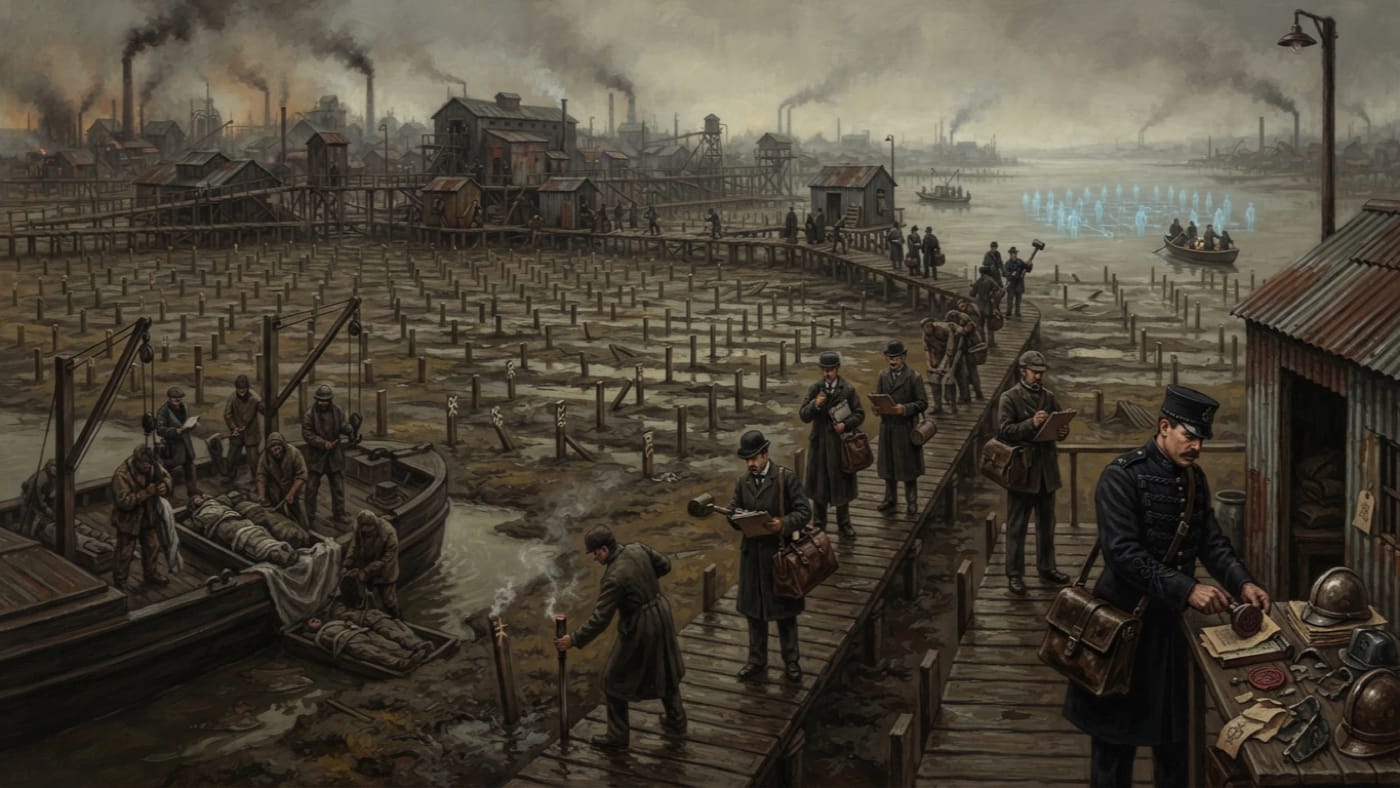
The work proceeds in an order the Office regards as liturgical and the stakers regard as a shift's wages. War-dead arrive by corpse barge at the Charnel Moorings, wrapped in vinegar cloth. Each barge comes with a manifest listing its contents by number, rank and unit designation. Names, where they appear at all, are secondary. The manifest is the first document of the dead and, for most of them, the last one anyone reads.
From the moorings the remains pass to the Glyphyard and into grids of ten paces by ten. Glyph-stakers set the boundaries at dawn. They drive bone-lime posts into the mud and mark the timber with the ash-glyph: powdered bone-ash mixed with lye, pressed into wet wood with a branding iron. On every sanctified map from the Line to the coast, the Ash Glyph is the Church's established sign for mass-burial ground. Here it also serves as a local hand of grid notation, and the Office does not publish its full alphabet to the curious. The curious include me.
Placement is the first act. Certification is the second, and it belongs to a different officer. A Seal Magistrate affixes the seal, the grid is closed, a map is drawn and the map is filed. At that moment, by the Office's own reckoning, the dead cease to be War's problem and become Records' asset. Nothing physical has happened. The bodies lie exactly where the stakers left them. Only their ownership has changed, and it changed across a desk.
The third act, material authentication, happens elsewhere and later. Whatever leaves the mud needs a tag from Seal Shed Row before it may travel: salvage, bone-lime, a medallion, a fragment of consecrated plate. A relic also needs the judgment of the Bureau of Alchemical Standards before anyone may call it holy. A tag certifies where a thing came from. It cannot certify what the thing is. The Office would prefer this distinction forgotten. Custody of paper is the whole of its power, and paper that merely records an origin is a weaker instrument than paper that appears to bless it.
#On the Officers and Their Permissions
Cartographer-Provost Lysa Vane presides over the Office and the Glyphyard. Her gloves are immaculate. Her maps are not. She redraws them each morning and files the discrepancies as seasonal drift. The classification is so serenely elastic that I have recommended it to the Bureau of Doctrine. Her seal ring bears an ash-glyph. People who work close enough to her to have fears of their own report hers: a map that proves she lied. The record says nothing of her appointment, her age or her antecedents. Some readers will have heard of a Broker-Matron of the same name at Peregrine Row. Keep the two women in separate folios, please. Nothing in the file joins them.
Under the Provost work the Seal Magistrates, map scribes, glyph-stakers and tag clerks. Mapping labour is assessed against debtors, and in the Marshworks a debtor is anyone who has paid the causeway fee. Debt can also be worked off in night lantern shifts and diver rotations under the quarantine's service requirements. The quarantine was instituted in A.S. 112 and has remained temporary for eighty-nine years.
Nearly everything the Office touches is for sale: salvage provenance, quarantine exemptions, a route through the dark. Two things are exempt from the trade, namely the Provost's master map plates and the Glyphyard's master stakes. A man caught moving a master stake may be executed on the stake line. The Marshworks is a market of permissions with exactly two sacraments, and both are survey instruments.
The Office does not command its neighbours. Orren Pike's Lantern Guild of the Third Brine holds the night routes and the coded lamps. "Softstep" Maro holds salvage intake at Diver's Gut. The Ashbound Wardens enforce the quarantine and keep the Causeway Gate. All three rely on the Office's maps and tags, and none of them takes its orders. Jurisdiction in the delta is like the delta itself: much of it is technically water.
#On Disputed Ground
The Office's authority rests on one premise: a sealed grid stays where it was sealed. The marsh does not cooperate. Ash-glyphs blur overnight and are found in altered configurations. Stake lines go missing. Grids closed under seal are reported open. The Bureau of Engineering calls the cause subsidence. The Provost, in the record, calls it nothing at all.
For an ordinary surveyor this would be a nuisance. For the Office it is a constitutional crisis conducted in mud. A missing stake line or a contested casualty count strikes at its foundation. A grave that cannot be verified means a total that cannot be defended. An undefended total invites the question every War auditor is trained never to ask aloud: how many were there, really? The maps exist so that no one needs to ask. When the ground disagrees with them, the maps are corrected by morning and the ground is entered under seasonal drift.
False spatial authority carries a cost the Office can count. On the night of the Seventh Bloom, A.S. 196, a formation of corpse-light appeared in the pattern of the Glyphyard's stakes. A night crew believed it was following the Provost's own markers and drove its barge into a sinkhole. Three crewmen drowned. By dawn the markers were gone. The official finding was navigational error compounded by atmospheric conditions, and the finding stands.
The Bureau of Alchemical Standards has not determined what the light is. It was first recorded in A.S. 143 and has awaited classification ever since, fifty-eight years as of the present assessment. Its designation, "anomalous bioluminescent discharge," names the review and not the thing. Lantern crews report that it copies their signals and changes its patterns. The Glow Choir holds that it calls to them. The Office has no form on which to record whether it intends anything. Its only forms record where the dead lie. On the night of the Seventh Bloom, the light held a copy of that record good enough that three men could not tell it from the original.
#On Provenance and Its Accounts
The capacity of the seal sheds is the settlement's bottleneck. Nothing moves without a tag, and tags vanish. A second economy has grown out of that scarcity in the Office's shadow. Its most accomplished trader is the Mud-Relic Syndicate, known on the Reed Market as the Yesterday Finders. Its methods are forged tags, bribed clerks and violence, mixed in whatever proportion the season requires. Every forged tag that passes the Row borrows the Office's credit, and every bribed clerk spends it.
Volume makes the pressure worse. Relic recoveries tripled between A.S. 194 and A.S. 200. In that period the Bureau of Alchemical Standards inspected eleven, certifying eight authentic and three indeterminate. Divers speak of "yesterday finds": relics without corrosion, with tags already attached that bear dates not yet arrived. A relic may be genuine while its provenance is false. A tag may be perfect and still fixed to the wrong mud. The Office answers for the tag. On where the freshness comes from, it has issued nothing at all, and in this single instance I commend its restraint.
The Mortuary Cartography Office's annual report for A.S. 198 states that relic recovery rates "remain consistent with historical averages."
The present assessment records that recovery rates tripled between A.S. 194 and A.S. 200. The A.S. 198 report is withdrawn as a statement of fact. It is retained as a specimen of draftsmanship.
#On the Present Application
In A.S. 201 the Office demands higher recovery yields from a marsh that Guildmaster Pike calls too bright to work safely. The Lantern Guild's objection is on file. The yields are demanded anyway. The demand comes from inland on sealed paper. The brightness comes from the water, which carries no seal.
The Office's official plans are to expand the Glyphyard, formalize salvage quotas and tighten the quarantine. None of them has been enacted. The settlement's most repeated fear is a bloom that climbs the causeway and maps the living. That has not happened either, and the Office has not yet drafted a grid for it.
Each morning the Provost redraws the maps, and the stakers drive the lines again before the fog lifts. The assessment finds the Office operational and its maps current as of this morning.