

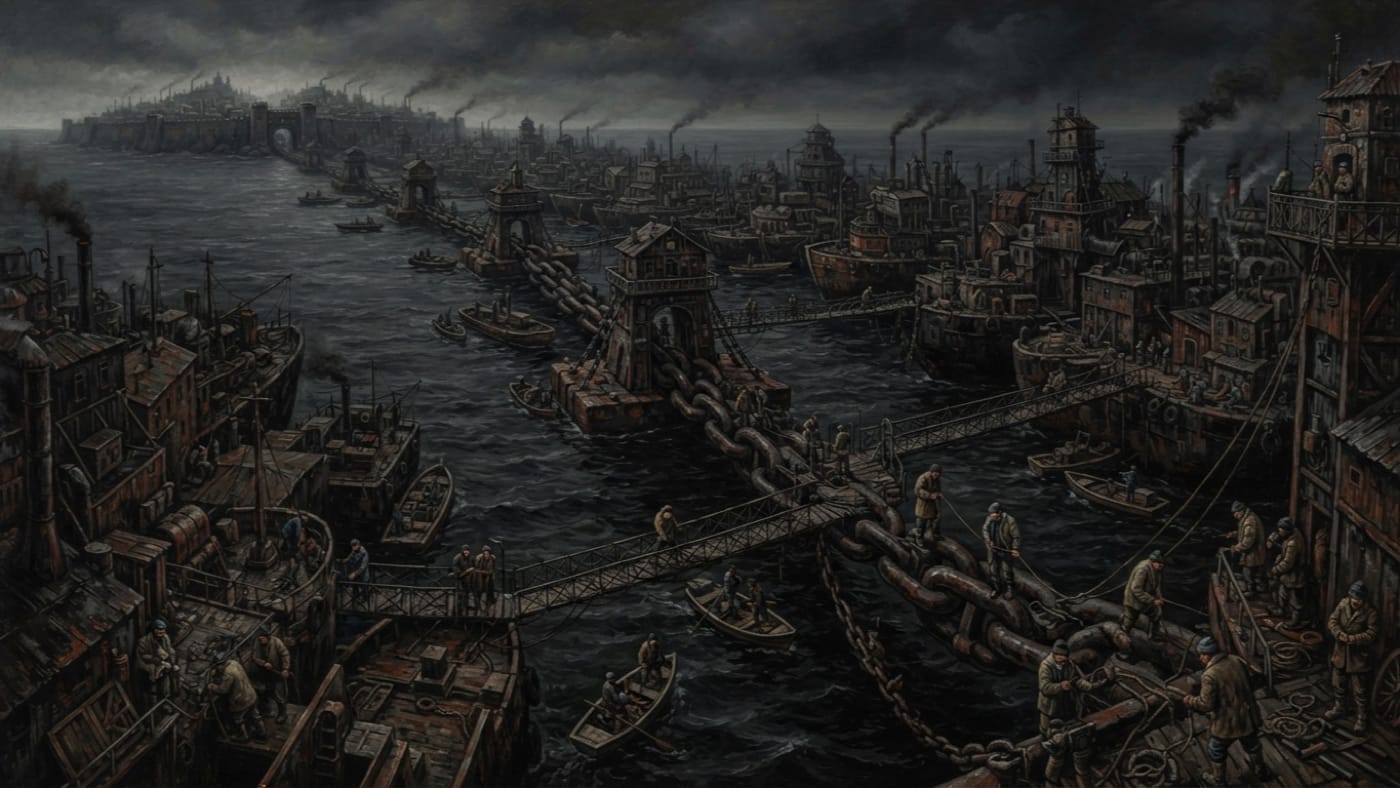
#On the Present Compilation
This dossier is the Grand Lash survey compiled for the Codex in A.S. 201, which is 1911 by the old calendar. That date marks when it was compiled and nothing else. Everything here comes from the Church's papers on Saints Afloat. Where those papers say nothing, so does this entry.
The Grand Lash is the main chain-spine of the Flotilla and one of its nine named districts. The other eight radiate from it. It rides the Black Sea off the Bosphorus approaches, which means it rides wherever the last storm left it relative to everything else, and in roughly the same place relative to the enemy. The Saintward, Seal Row, the Hymnworks, the Market of Anchors and the Quarantine Rafts all have names that survive the weather. The Lash is the reason they survive it as one city and not as a scatter of chapels on open water.
Admiral-Prior Veyra Salt-Crown holds formal command of that city through the Maritime Reliquary Chapterhouse. On paper her office covers relic custody, chain order, parish ratification, convoy clearance and storm response. In practice it reaches exactly as far as the lashings hold. Her published dossier puts it plainly: she is a ruler or a hostage with stationery, and the weather decides which.
#On the Corridor and Its Crossings
The published descriptions agree on little else, but they agree on this: iron watch-towers on pontoon bases, tar on every plank, rust on every fitting, and the smell of wet rope that never dries, because nothing on the Black Sea is allowed to. Rope bridges and chain crossings carry foot traffic from the spine out to the chapel-barges along it. Skiffs work the water under the crossings at all hours. They carry porters, chaplains, debtors, and now and then a bailiff who has learned to stand without holding the rail.
The Flotilla's own lore describes the whole place as a raft-archipelago of chained rings around a central bell-keep. I give that as the character of the place. It is not a plan. The register holds no surveyed length for the Lash and no width. It has no count of links or towers, and no record of who forged the first chain or when the corridor got its present name. The Flotilla's charter dates to A.S. 72. It was filed by the Church's developing authorities eighteen years before the Synod was formally constituted, and it dates the institution, not any iron now in the water. Any draftsman who supplies such figures should be asked which two storms he measured between.
The Chapterhouse's economic survey names the Grand Lash and the outer chain gate together as the Flotilla's bottleneck. If either fails, the city fragments or starves. The two are related but separate. The gate admits licensed skiffs and convoy writs from outside, and the Lash holds the inside together. The deep anchor-field is a third system. It is classified, and nothing in the Lash's description lets a reader locate it. Nor should any clerk confuse the Lash with the tower-to-tower harbour chains of Thessaloniki or the Chain of Saint Anakletos at the Bosphorus. Those chains have their own custodians and their own histories, and none of their measurements apply here.
The A.S. 200 census registers two hundred and thirty-seven hulls. The figure counts hulls and nothing else. I have seen it quoted as a count of crossings, and it is not one.
#On Those Who Hold the Iron
Veyra Salt-Crown signs. Chainmaster Olt, called Rosary-Iron, and his Chainwright Rosary do the holding. The Rosary controls inspection, maintenance, re-lashing and cut-loose work along the Lash. It does not file the positions of the hidden cut-points with the Bureau of Records. Olt holds no legal office above the Admiral-Prior's, but he holds the thing her office depends on. The Rosary has petitioned three times for an independent charter, and the Chapterhouse has refused it three times. The register gives neither the dates nor the terms of those petitions, and I have not supplied them.
The crews inspect at dawn. They are exempt from the chain-maintenance tithe that every other soul aboard pays. Many of them are debt-bonded labourers who traded their names and labour for a dry berth, and Flotilla practice lets them be drafted for repairs whenever a storm warning sounds. When the Drift Court rules against a man with no coin, the judgment converts into chain labour on the Lash, so part of the spine's workforce comes straight from the docket. The work kills by crushing, by drowning, and by cold. It also kills in the way the roll-calls record only as an absence: a man not there, and no one able to say where he went. No casualty rate has been filed. The crews know the rate without one.
Other offices depend on the spine without commanding it. The Knot-Scribes draw parish boundaries that only exist because the Lash connects the parishes. Seal-Justice Miran Kest and the Drift Court decide which parish inherits which obligation once the boundaries move. The Salt and Ash Office draws its quarantine cordons on the assumption that the city is in one piece. The Bell Choir of Hymnworks keeps signal discipline across the districts and challenges anyone who answers wrong. None of these offices takes orders from Olt. After a storm, each finds its authority shrunk to whatever decking it can still reach on foot. The Lash holds no office and enters no plea. It is only iron, and every one of those jurisdictions rests on it.
#On the Broken Spine
Storms break the lashings. Every bureau aboard agrees on what happens next, though each begins its account at a different point.
The chains part and the barges shift. A chapel that stood beside a market now stands beside a quarantine raft. Passage along the crossings ends where the crossings are gone. Bell coverage breaks up. Districts that were once within reach of each other's signals now lie across open water, and the Choir's grid can no longer carry a challenge reliably from one end of the city to the other. I do not claim to know whether the signals travel along the iron or over the water. The Choir does not explain, and I was not inclined to ask a Cantor at breakfast.
Debt moves with the barge, and so do tithes, confession receipts and berth rights. Each was valid in a parish that has moved by morning. A family can wake up owing money to a court that was nowhere near them at sunset.
Then comes the Re-Lashing Mass. Crews go into black water to bring the barges back to the spine while chaplains sing above them. The singing is liturgy, and the shackles are tightened by hand. The Knot-Scribes start redrawing boundaries before the last chains are taut, and the Drift Court follows with its rulings. The city is most exposed between the parting and the tightening, and the Flotilla's own record attests demonic attacks in that interval. The prescribed responses are retuning the bells, sealing the joints with salt-wax, and mandatory roll-calls. No document I hold describes any of them as a guarantee.
The sequence has a founding wreck. In A.S. 93 a single storm, remembered as the Great Reparishing, scattered fourteen barges across seven jurisdictions and left the Flotilla without a working court for nine days. The Drift Tribunal grew out of that gap.
Older entries attributed the founding of the Drift Tribunal to a decree of the Bureau of War in A.S. 94.
Corrected. The Tribunal followed the Great Reparishing of A.S. 93 and was founded by ecclesiastical consensus. War stamped the charter after the fact. Both the year and the author were wrong. War has not asked for either back.
The cause of the storms' effects is still filed under three positions. The Bureau of Engineering says structural stress. The Bureau of Rites says providential reconfiguration. The Storm-Tenders among the chain crews, a heresy whose file Purity has reopened, whisper that the sea chooses. I record all three and endorse none, which is the only honest thing a compiler can do while the iron has not answered.
#On Severance and Blessing
The cut-points exist. The Flotilla's district account says they can sever a barge from the city in nine seconds. That figure is the account's claim, and I certify no stopwatch. The Rosary and the Creator know where the cut-points are, how they are built and how they are used, and this entry does not make a third.
Cutting one barge loose is an act of emergency, mercy or punishment, depending on who is standing on the deck when the order comes. Cutting the Grand Lash itself is one of the Flotilla's red lines, alongside forging a saint's seal and moving a relic without witness tones. In practice that one rule is the city's constitution: a barge may be spent, and the spine may not.
The public record shows barges being spent. On 14 Ferrum A.S. 162, while the Armada pressed the Bosphorus, Admiral-Prior Yvenne Salt-Crown refused the order to withdraw and held the outer approaches. Her after-action account lists eleven vessels condemned beyond repair, with sacrificial cuts among its entries. In that account, selective severance was the price of holding the line. The particulars of those cuts are not part of the public account.
The spring Chain Blessing runs on a different calendar. The Grand Lash is anointed with holy oil, and the Flotilla's register of rites also records hot wax. No source says which comes first or on what day. The crews get half a day of rest. The Re-Lashing Mass comes after storms and grants nothing. The Blessing is the iron's feast and the Mass is its emergency surgery. No document in my keeping shows that either one makes a link stronger.
#On the Present Condition
As of this compilation in A.S. 201, the Grand Lash still carries the Flotilla's districts, its command and its traffic. The published present assessment reports that reparishings which used to come seasonally now come monthly. That is the assessment's finding, not a storm calendar and not a prophecy. The Knot-Scribes also report anchor-points shifting between dawn and dusk with no weather to account for it, and souls answering roll-call with blank parish papers. These reports remain attributed testimony. They explain nothing yet, and they are filed.
The Admiral-Prior signs on paper that floats. The Chainmaster counts iron that moves. Every morning the courts, the bells and the cordons wait to learn how much of the city they still govern. The Chapterhouse's verdict, in its own economic survey, is that the Lash is where the city holds or fails. I have found no document that improves on that verdict, and none that certifies the chain against the next storm.