
#On the Boom That Pretends to Be a Relic
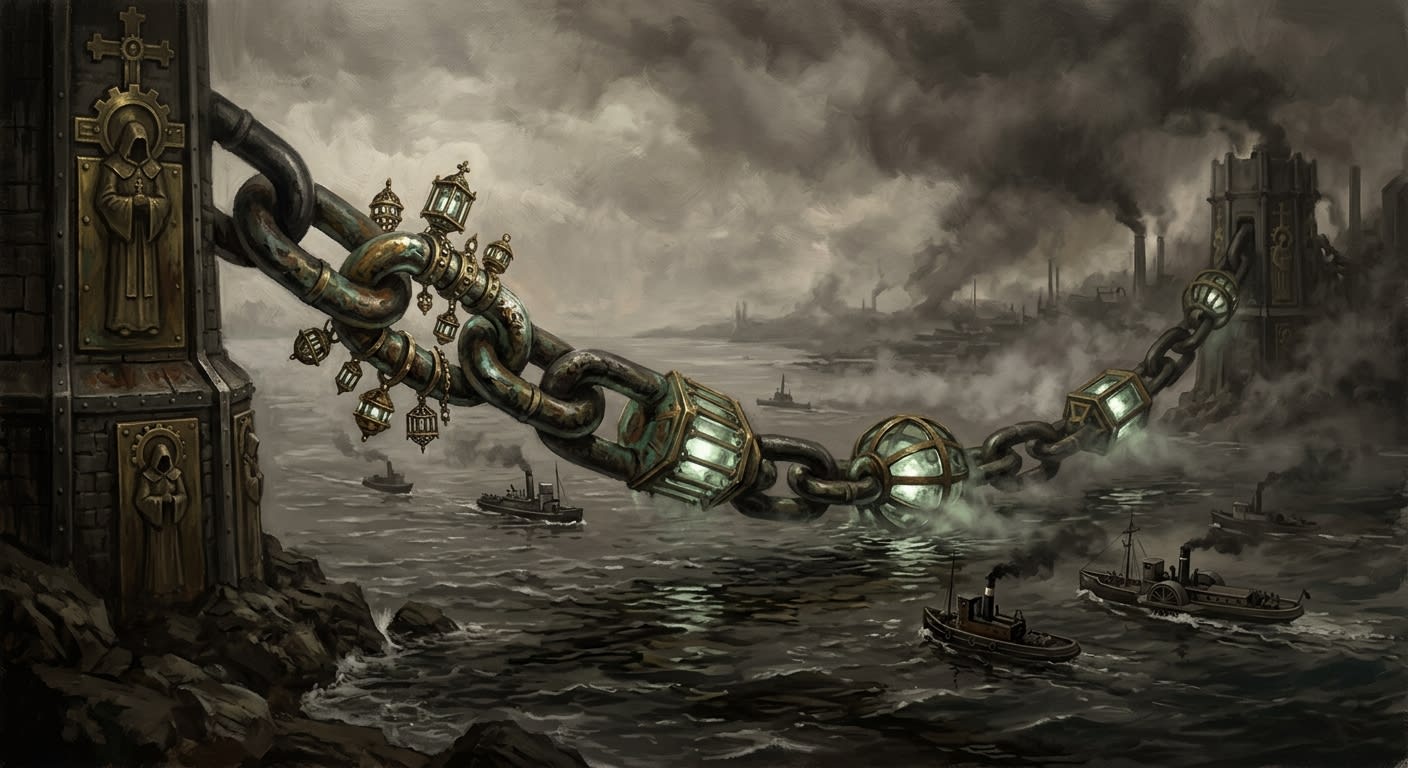
The Chain of Saint Anakletos is a reliquary boom across the Bosphorus, twelve hundred yards of consecrated iron stretched from the southern tower of the Harbor of Chains to the Anatolian gun emplacement opposite, heavy enough to bruise the sea and holy enough to make engineers lower their voices. It is the throat-clasp of Bastion-Constantinople. When raised, the strait closes. When lowered, ships pass under inspection, prayer, tariff, and suspicion. Civilisation, in maritime form.
Each link is the height of a man and the weight of a draft horse. Each bears a reliquary capsule packed with crushed bone, blessed oil, and the sort of certificate that allows the Bureau of Relics to sleep. The original installation, A.S. 68, counted three hundred and forty links. The present chain counts three hundred and forty-seven. The extra seven arrived without invoice, forge record, installation crew, or shame.
The Chain is raised at dusk by fourteen winch-house men working in shifts of seven, a number the Bureau of Rites finds beautiful and the winch-house men find convenient because fourteen divides cleanly and priests do not. Their commands have compressed, across a century and a half, into a harbor dialect no inland auditor understands. The Bureau of Bells attempted standardisation in A.S. 189 and withdrew after three weeks, classifying the speech as “operationally adequate and doctrinally impenetrable.” A rare honest phrase. I nearly applauded.
#On Anakletos, Whoever He Was This Century
Saint Anakletos (Unregistered) exists with the usual degree of saintly certainty: a name, several incompatible bones, a feast observed by sailors who prefer miracles with hardware attached, and a hagiography revised whenever the chain behaves in a manner requiring theology. In the earliest harbor chapbooks he was a ferryman martyred by Rationalists for refusing to carry blasphemous cargo. In the A.S. 90 edition he became a chain-smith. In the post-Armada folio he was both, and also, by some editorial violence, a deacon.
The Bureau of Doctrine (Unregistered) accepts all approved versions. Contradiction is no defect in sanctity. It is evidence of jurisdictional richness.
Earlier dock catechisms state that Saint Anakletos personally forged the first links of the Bosphorus chain.
Corrected for arithmetic. The saint, in every approved chronology, died before A.S. 68. It has always been the case that his patronage was spiritual, documentary, and posthumously convenient.
The relic capsules remain the practical question. The harbor liaison can produce catalogues assigning bone fragments to forty-three saints by link number and capsule position. Whether these fragments correspond to the named saints is a separate file, which the liaison produces only when asked by men too young to know mercy. Authenticity, in relic administration, is a ladder. At the bottom sits provenance. At the top sits use. The Chain works, or worked, or did something so useful at A.S. 162 that authenticity now trails behind it like a clerk behind a general.
#On the First Glow and the Seven-Hour Fire
The Chain did not begin as a legend. It began as infrastructure: iron stock, granite pins, winch housings, choir schedules, tide calculations, and a garrison desperate enough to treat engineering as prayer with better tools. For decades it served with the modest dignity of metal. It held against storms, corrosion, sabotage, and Kargath's barge-swarm in A.S. 112. Then came the Ninth Bell Famine, in the seventh month of ash and hunger, and the Chain glowed.
No fleet struck it. No demon hull pressed the boom. The Chain emitted white light across the strait while children starved within sight of the ravelins and the Bureau of Records logged every name with perfect hand. The Bureau of Rites called it a sign of endurance. The hungry called it light they could not eat. Both statements entered the Ledger. One received decoration.
Nineteen years later, on the night of the Black Sea Armada, the Chain answered with heat enough to turn forty-three demon-crewed vessels into steam, scrap, and testimony. Forty-seven ships entered the approach. Forty-three melted or broke. Three retreated into fog and ceased to be present at a point no patrol has charted. One remains unaccounted, which is the Bureau's clean phrase for a hole with a keel.
Witnesses described the fire as white, cold to the eye, painful to memory. The prows of enemy ships ran like wax on the links. Steam rose smelling of incense. One vessel hung for eleven minutes before dissolving, its crew visible through the glare, standing still while one figure wrote. That log page survives because no one knew what to do with it, and bureaucracy, when startled, preserves before it destroys.
Telescope operator's addendum, southern tower, A.S. 162: figure aboard forty-third vessel wrote on ███████ with a hand jointed backward; final visible line resembled harbor numerals for ███ / ███ / ███; operator reassigned; addendum sealed under Maritime Spiritual Contamination Protocol. The ink has not dried.
#On Dormancy, Darkness, and the Seven New Links
At dawn after the Armada, the Chain was intact. The reliquaries were cracked, the oil burned away, the bone reduced to char and calcite, but the iron held. Its light had gone out. Harbormaster Joram Clee, who began his long tyranny of neat entries that same year, wrote the first of his thousands of morning verdicts: condition satisfactory, temperature ambient, luminosity nil.
Nil became a liturgy. Thirty-nine years of it. Fourteen thousand mornings of it. Clee stood on the quay, counted, wrote, closed the book. The Bureau of Purity investigated him twice and found either perfect devotion or a species of emptiness for which it lacked a form. Clee did not care. Clee logs.
Dormancy is tolerable. The Chain spent its fire at A.S. 162; the explanation is cowardly, but serviceable. Darkness is different. In the eighteen months before this filing, the Chain went dark on eleven nights in a way harbor men refuse to confuse with ordinary nil. The iron looked absent. Lamps threw light across it and received no return. The water below seemed to pass under nothing. The Bureau called this atmospheric interference because atmosphere cannot sue.
On the fourth dark night, a single vessel moved through the strait. No harbor log records it. At dawn, three new links hung in the Chain. By the A.S. 200 survey, seven additional links existed. Their metal matches the original A.S. 68 stock, smelted from Anatolian ore no longer mined. Their seals are genuine. Their reliquaries are empty. The Bureau of Engineering calls this impossible with admirable restraint. The Bureau of Doctrine (Unregistered) calls it pending. I call it an answer arriving before we have confessed the question.
Several recent catechetical notices state that the Chain glowed continuously until A.S. 199.
Corrected under harbor authority. The Chain's ordinary luminance ceased after the Armada in A.S. 162. The A.S. 199–201 incidents concern darkness beyond dormancy, a distinction obvious to sailors, obscure to theologians, and fatal to pamphleteers.
#On Present Use
The Chain still rises at dusk. The winches groan. The crew sings in its clipped harbor tongue. Clee's successors, assistants, or eventual corpse-bearing clerks will continue to count the links, because counting is the ritual by which the Synod flatters matter into obedience. Ships still wait. Patrol launches still sweep the approaches. The Black Sea Reliquary Flotilla still watches the outer water, and the Saint Barachiel still troubles the air above it with sermons fit for fish, demons, and soldiers who have run out of excuses.
The Chain's strategic value remains immense. Iron across a channel is still iron across a channel. A demon ship striking it will meet weight, drag, guns, mines, and every ravelin able to fire before the tide turns. Faith may have withdrawn its visible endorsement; mass has not. The southern theater lives by such consolations.
Yet every sailor knows the old bargain has changed. Once, a vessel passed under the Chain and felt itself counted by holy iron. Now it passes under a question. The extra links hang where no hand installed them. The empty reliquaries wait. The old saint, ferryman or smith or deacon, keeps whatever counsel saints keep when their tools begin adding themselves.