
#On the Sable Deeps
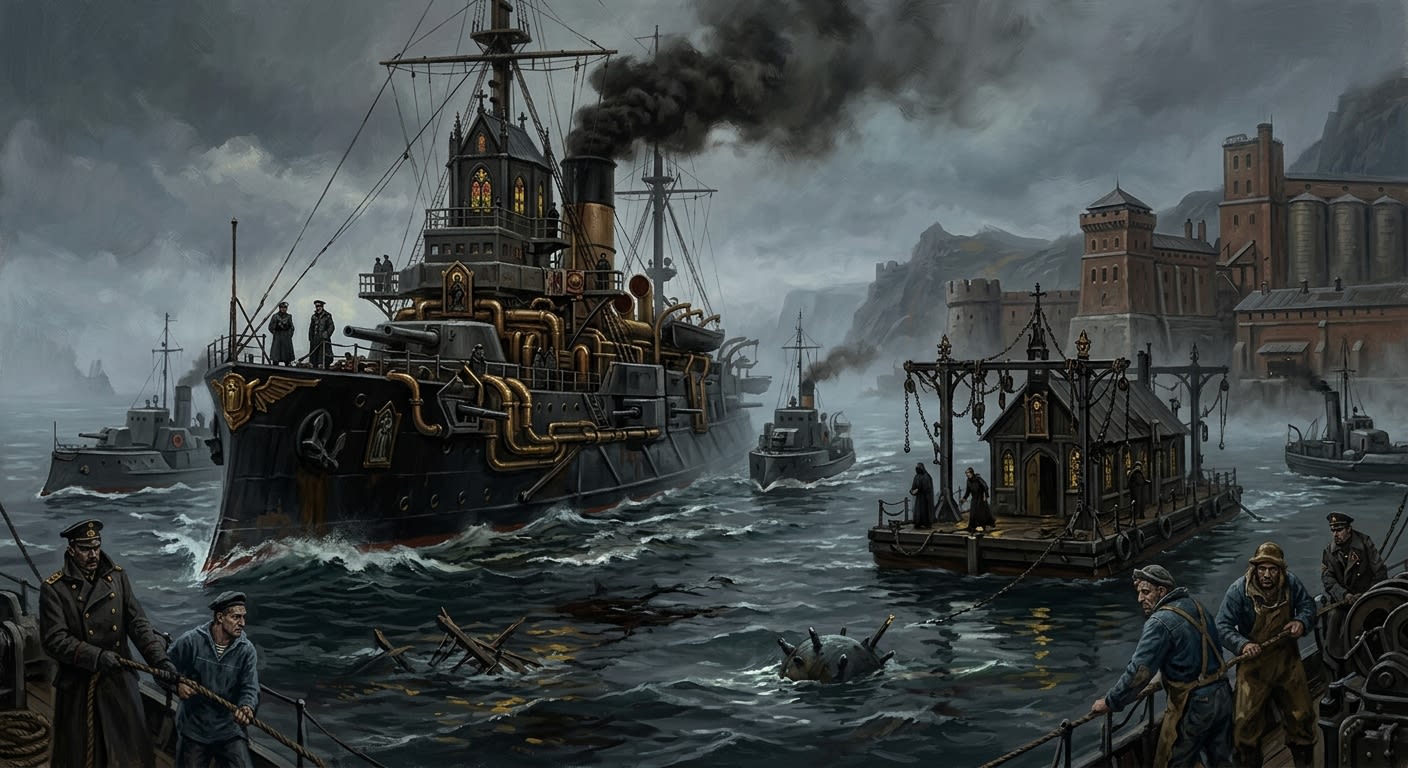
The Black Sea is the Synod's northeastern wound against salt water: a basin of hostile approach, contested shore, drowned testimony, grain hazard, relic route, smuggler's catechism, and naval theology problem with waves. Maps call it a sea. This is polite. It behaves less like water than like a sealed witness who has decided to testify by drowning the clerk.
It lies beyond the wet throat of the Bosphorus, pressing upon Bastion-Constantinople from the north and northeast, where the Sagittal Line ends not in a wall but in a strait, a harbor, a chain, and a prayer that iron will remember its duties. To the west are Varna's cliffs, the Ash-Glyph Marshworks, the broken coast villages, the mouths of rivers carrying dead men and bad paperwork. To the north and east are the Charnel shorelines, Kargath's hunger, old ports that no longer answer by their consecrated names, and distances that patrol captains mark with increasingly ugly abbreviations. To the south is Constantinople, great, ancient, terrified, and more aromatic than any recruitment plate admits.
The public primer says the Black Sea is guarded. The military primer says it is contested. The Flotilla pilots say it is listening. Fishermen say less, which is why fishermen survive long enough to become irritatingly wise. The sea receives all claims, rolls them under a black back of salt and weather, and returns what it pleases: driftwood, bones, saints' teeth, demon glass, grain rot, ship bells, dead gulls, and once, in A.S. 162, forty-seven demon-crewed vessels advancing in antiphonal formation toward the Bosphorus.
The sea's strategic fact is simple enough for War and dangerous enough for everyone else. Any enemy that crosses it may avoid half the Line and arrive at Constantinople's hinge with wet sails, hollow crews, and enough surprise to make a harbor clerk discover religion. Any convoy that crosses it may bring grain, relics, refugees, plague, or a manifest whose spelling kills more efficiently than cannon. Any patrol that remains too long upon it returns with salt in the seams of its thinking.
#On the Shore That Refuses Stability
The Black Sea coast is not a border. Borders are for gentle maps and tax manuals. It is a frayed hem of contested villages, cliff batteries, marsh offices, quarantine rafts, ruin coves, tarred piers, salt chapels, and places that remain Synod-held between bells and enemy-held between breaths. The LOCATIONS registry calls certain segments Zone Four shading to Five. The locals call them “near enough to hear the guns, far enough for Strasbourg to lie about us.” Accuracy occasionally flowers in vulgar soil.
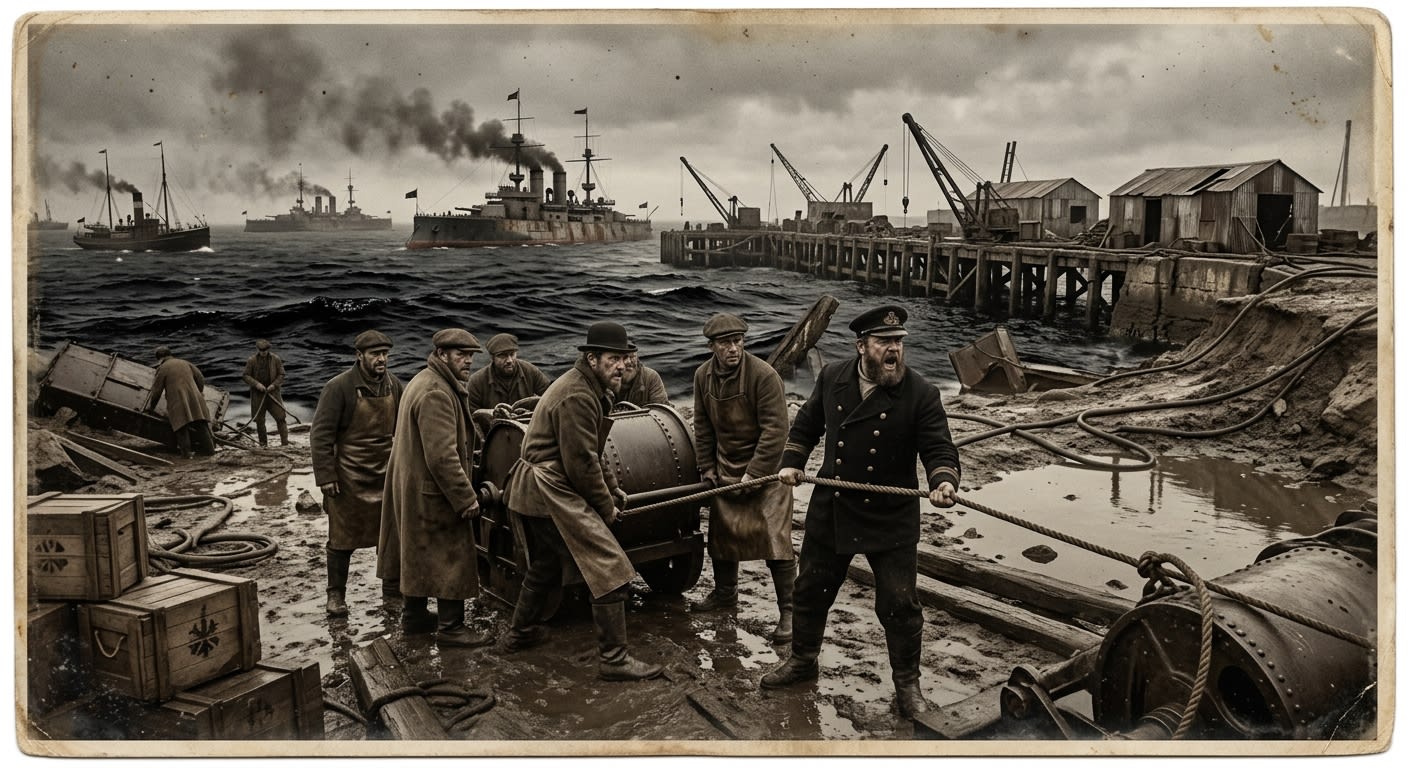
Varna stands on that coast as the Ashen Redoubt, built into cliffs above the water, its bone-kilns smoking day and night, its guns commanding routes that cannot be commanded so much as discouraged from immediate betrayal. Refugees swear the kiln smoke carries faces. Every cannon misfires once each year on the same day, always killing a priest. The Bureau has marked this as recurring mechanical fault with sacramental coincidence. I would praise the phrase if it did not smell of cowardice.
South and west, the Black Sea coast villages between Constantinople and the Bulgarian shore maintain trade, smuggling, fishing, fuel leakage, and the small disciplines by which a place remains alive after every sensible institution has recommended abandonment. Their people mend nets beside mine warnings, barter lamp oil under Purity notices, hide demon-glass shards in fish barrels, and teach children which waves not to answer. A village survives here by possessing at least three loyalties: one to the Synod, one to the weather, one to whatever officer currently controls the road behind it.
The Ash-Glyph Marshworks sit where delta mud meets Black Sea indifference, a mortuary settlement in which the war-dead are converted from bodies into coordinates. Barges bring the dead. Glyph-stakers drive bone-lime posts into mud. The marsh re-sorts graves. The sea receives overflow, misfiled fragments, and those little clerical mistakes whose correction would require admitting that the dead have travelled without authorisation.
Earlier catechism maps describe the Black Sea coast as “the Synod's maritime flank.”
Corrected. A flank belongs to a body. The Black Sea coast is an argument conducted by waves, guns, paperwork, hunger, and hostile appetite. The Synod possesses positions there. Possession of a position is not possession of the sea beyond it.
The shore's old human names remain in the Ledger under accusatory custody: Varna, Odessa, river mouths, monastery harbors, salt towns, grain piers, fishing coves, ruined watch chapels, and ports that have not sent lawful manifests since before the Sundering. The Bureau preserves the names as ownership asserted by grammar. The Enemy preserves the ruins as ownership asserted by teeth. Between grammar and teeth, the villages pay taxes.
The sea feeds its own civil classes. Pilots with black weather marks on their cheeks. Quarantine clerks whose fingernails are rimmed with salt. Chainwrights from the Reliquary Flotilla. Salvage brokers who can identify an enemy rivet by taste and should not be encouraged. Refugee mothers who know which captain accepts payment in relic beads. Children who can sleep through cannon but wake if gulls stop calling. Priests who bless nets and refuse to bless certain fish. Every coast breeds superstition. This coast has earned its syllabus.
#On Kargath's Water and Maldrake's Heat
At Constantinople the Synod faces the rare luxury of two disasters at once. Kargath presses from the Black Sea and the coastal rot routes, making hunger geographical, spoiling supply lines before they reach gates, thinning cargo without breached seal or broken lock. Maldrake presses from Thrace with fire, slag, iron, and campaigns that make the land remember violence as a mineral habit. Their mutual contempt has saved the southern hinge more often than War's official histories admit.
Kargath's pressure upon the Black Sea reaches beyond ships. Gluttony does not need a ship to cross water. Grain arrives light. Salt fish spoil in sealed barrels. Pilgrim stores vanish from locked holds and reappear as smell. Sailors become hungry after eating, then hungrier after being restrained. The sea itself develops appetites: nets come up empty except for chewed rope; barnacles cluster into mouth-shapes on hull plates; fresh water casks turn sour while remaining sealed. Bureau of Tithes has a hundred terms for loss. Kargath has one mouth.
The Blightmarsh is inland from this marine pressure, yet its hunger leaks through marsh, river, and coastal fog. Water near the affected deltas takes on a taste of bile. Reed beds form lanes that look navigable until the boat is inside them. Dead livestock drift downstream with bellies round and eyes hollow. The Black Sea receives these offerings without visible opinion, which is the most frightening opinion available to water.
Maldrake's influence arrives by ash and metal. During the Year of Ash Rain in A.S. 143, Thracian fires made eastern prefectures breathe cinder for nine months. Crops failed. The Ninth Bell Famine followed. The Chain of Saint Anakletos glowed beneath ash-dark water before the Armada year, link after link waking with no visible target. Nineteen years later, when the demon fleet came, the Chain burned white again. Since then, nil. Daily nil. Thirty-nine years of nil under Harbormaster Clee's hand, which is either comfort or a slow joke told by iron.
The sea sits between these violences and changes them. Fire becomes steam. Hunger becomes missing cargo. Iron becomes wreckage that remembers. Ash becomes falling scripture on wave tops. A corpse enters the sea as casualty and may leave as omen, salvage, debt, or fish story depending on which Bureau reaches it first.
#On the Flotilla Called Saints Afloat
The Black Sea Reliquary Flotilla, called Saints Afloat by those who must live where poetry smells of tar, is the Synod's floating answer to the sea's refusal to be a wall. Its founding charter was filed in A.S. 72, when seventeen merchant hulls were requisitioned from a redacted Black Sea harbor, lashed gunwale-to-gunwale with consecrated chain, loaded with the bones of four hundred saints, and sailed into dark water. They did not sink. By A.S. 80 there were forty vessels. By A.S. 110 there were ninety. By A.S. 162, more than two hundred rode the approaches. The A.S. 200 census gives two hundred thirty-seven registered hulls and approximately eighteen thousand souls. The unregistered count is more honest and less available.
The Flotilla is a cathedral that forgot it was a shipyard: chapel barges, ossuary skiffs, bell-towers on hulls, quarantine rafts, underkeel alleys, seal booths, storm-lashed rope bridges, market platforms, relic holds, and the Grand Lash (Unregistered) chain-spine around which the whole wet parish mutters, sways, and invoices. Tar, incense, wet wood, cold iron, lamp oil, bone-lime, salt rot, old confession wax. The place smells like piety after three days in bilge.
It patrols, inspects, prays, trades, smuggles, quarantines, judges, forgives, and occasionally cuts its own barges loose for the public good of the barges that remain. The Maritime Reliquary Chapterhouse claims formal rule. The Drift Tribunal (Unregistered) sells jurisdiction after storms. Chainwrights control lashings with the quiet insolence of men who can detach a courthouse from a market by moonrise. Quarantine Wardens (Unregistered) possess tide files on half the afloat population. Underkeel Lanes (Unregistered) sell forged parish papers, skiff routes, relic shards, taint cleans, stolen bell clappers, and silence by the quarter-hour.
Storms rearrange the Flotilla's internal parishes. Lashings snap. Barges shift. A family wakes under a new jurisdiction, owing a different tithe to a court that was three decks away at sunset. The locals call this re-parishing. The Bureau calls it maritime jurisdictional adjustment. Debt collectors call it breakfast.
The Flotilla keeps the Black Sea from becoming a blank approach. It also proves, daily, that the Synod's answer to chaos is to build a smaller chaos, stamp it, arm it, fill it with saints, and charge berth rent. This is not criticism. It is architecture.
#On the Armada and the Chain's White Hour
On the fourteenth of Ferrum, A.S. 162, the Black Sea ceased offering warnings and sent arithmetic. Forty-seven demon-crewed vessels came out of the north-northeast during harvest convoy season, when the Bosphorus channel was fouled with grain ships, pilgrim craft, oil barges, and the floating clutter of a civilization that insists its traffic patterns are a form of faith.
The Anatolian tower (Unregistered)'s report remains the finest sentence in southern naval history: Sails to the north-northeast. Number: all of them. It reached the Harbor of Chains in eleven minutes. Praefect-Naval Cassius Tern ordered the Chain raised, the ravelins manned, and runners sent to the bells, the Flotilla, and the Cathedral of the Perpetual Registry. Catastrophe must be announced, resisted, and filed before it becomes history. The cathedral took longer, being accustomed to dignity.
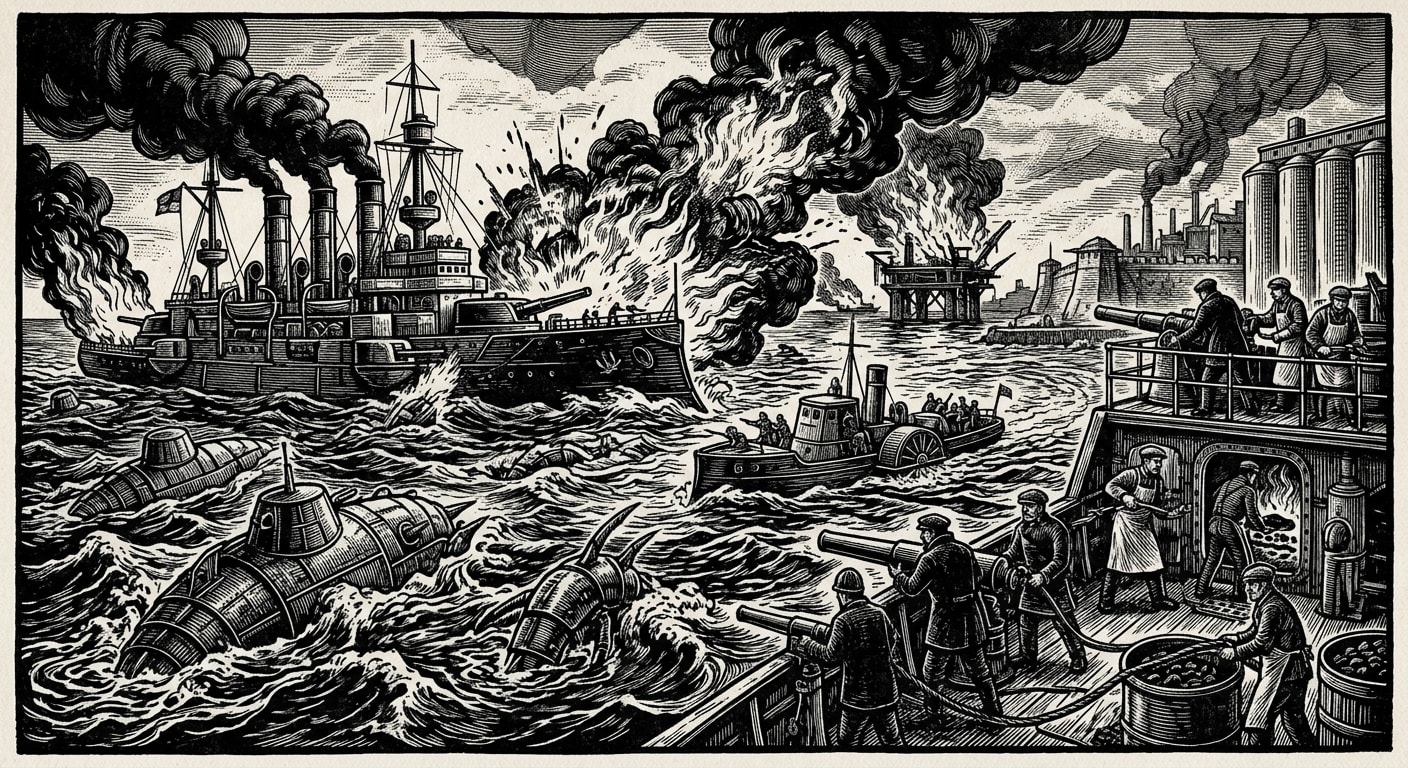
The vessels were wrong in the manner of things built by hatred that has studied shipwrighting out of spite. Iron-bone war-barges. Fire-ships. Ram-vessels with prows shaped from single teeth. Fog-carriers. Hulls that Records could only call no determinable type. Their formation resembled a choir. Engineering called it geometrically consistent with antiphonal arrangement, which is how cowards write “they came singing without sound.”
The first ram-vessels struck the Chain. The Chain held. Then it burned white.
Water steamed with incense or cooked marrow, according to whether the witness wore a stole. Forty-three hostile vessels melted, broke, or lost permission to remain ships. Three retreated north into fog and ceased to be present at a point no patrol has charted. One remains unaccounted, a hole with a keel. The Flotilla disobeyed withdrawal and held the outer line, losing eleven vessels beyond repair while pouring relic-fire into enemy flanks. Civilian ships burned, boiled, collided, prayed, and died in categories later made neat by Records. Victory survived the night. So did the hole.
School plates depict the Armada as forty-seven hostile vessels destroyed or routed in visible sequence.
Corrected for those permitted adulthood. Forty-three were destroyed. Three retreated. One left arithmetic and entered the water under another jurisdiction. The public plate may continue lying until morale develops a spine, which is not scheduled.
The Black Sea after the Armada did not become safe. Victory is a perfume, and the Bureau applied it over rot until the anniversary hymns could breathe. The Chain has not burned white since. The Feast of the Burning Chain is observed. Children sing. Harbor workers count links. Fishermen alter course around certain water. Harbormaster Clee writes nil.
A Salvage Coordination Addendum (Unregistered) in A.S. 165 admits enough to chill the teeth. The forty-third hostile hull was partially melted and recovered. The next three were presumed retreat with no recoverable mass. The forty-seventh sat in the file as position uncertain, bell-line returned struck interval before sounding, diver refused surface hymn. Recommendation: no further descent without Shadows warrant. War amended its copy. Harbor sealed its copy in salt.
#On Grain, Rot, and the Sea's Civic Education
The Black Sea does not require demons to kill. It has Bureaus.
Varna taught this in A.S. 129, when a grain fleet entered harbor sound, dry, weighed, witnessed, sealed, blessed, and already doomed by the smell of jurisdiction. The cargo should have fed three zones. Instead it sat under canvas while Tithes, Pilgrimage, Settlement, Commerce, Purity, and Records disputed what class of holiness applied to wheat. The dispute lasted nineteen days. Wheat has little reverence for paperwork.
The Varna Grain Rot belongs to Black Sea history because the sea delivered the cargo intact and the shore killed it. No enemy tore the sacks. No serpent rose. No storm took the convoy. The people could see the grain. Children pressed faces against railings and learned that bread may be present without being available. By day seven the lower holds smelled sweet. By day fourteen the harbor gate carried a placard: WE CAN SMELL YOUR LAW. Purity arrived on day fifteen, because hunger is always improved by rifles in the imagination of Purity.
Bodies went into the harbor. The cargo was condemned. The deprivation became a voluntary holy fast. The phrase “avoidable starvation” was proscribed. The Ledgers of Varna remain excellent training material for Manifest Litigants, which is to say they teach young clerks how slowly a man may die while every seal remains valid.
Convoy discipline on the Black Sea still carries Varna's stink. Harbor courts now know to move faster when grain heats under canvas, or at least to move the dead out of sight before declaring civic abstention. Progress, like sanctity, is often a matter of staging.
The sea handles all commerce in this same spirit of conditional survival. Grain ships rot under tariff suspension. Pilgrim ferries wait for bell windows. Relic barges demand belief before weighing. Coal lighters drift under inspection flags. Black boats pass only when the Bureau needs a public arrest. A cargo may be eaten by weather, demons, auditors, or all three in procession. The captain who reaches port with half his cargo, most of his crew, and a manifest whose names still align is considered blessed, competent, or bribed. The terms overlap.
#On Relics Moving Beyond the Shore
The Black Sea's worst habit is returning sacred evidence from places where sacred evidence has no licence to exist. Twice in A.S. 198 and once in A.S. 200, the Flotilla's relic-detection instruments registered first-class readings from beyond the eastern shore: moving signatures, cold-bright, steady under weather, not fixed to chapel, wreck, convoy, or known shrine. The Bureau of Relics examined the records, frowned with all available muscles, and concluded that the eastern shore is geographically anomalous in ways likely to produce false positives. This is excellent doctrine for a man who wishes the instruments to have lied.
The instruments did not behave like liars. They returned the same pressure fall, the same bell-wake delay, the same brine halo in the notation glass. One reading crossed a marsh inlet where no boat could pass without hull damage. One stopped for nine minutes at a ruined pier whose name has been struck from all public charts. One moved against wind, current, and the Flotilla's pursuit skiff, which developed sudden keel rot and a pilot who, after recovery, could no longer say the word east without coughing blood into his sleeve.
The charitable explanation is salvage error. A saint bone in an old reliquary chest, torn loose from some drowned monastery, might drift, sink, rise, and confuse an instrument desperate for employment. The less charitable explanation is procession. Something holy, or wearing holiness with intolerable skill, moves along the far shore where no Synod road survives, where Kargath's hunger stains cargo before ships leave harbor, where old chapels are said to ring without towers, and where the Shadow Court mocks jurisdiction by issuing permissions in altered consequence.
Doctrine rejected the word procession. Relics rejected the word holy. War rejected any noun that would require patrol funding. Cartography requested a survey and received permission to draft a preliminary denial of need. The Flotilla crews did what sailors do when offices become ornate: they marked the sightings in work-song. A verse now circulates under the chain decks about three lights walking behind the water, carrying no lamp, leaving no wake, and refusing the bell.
This is forbidden, naturally. The Bureau forbids songs when songs have begun doing memory's work before Records can arrive with custody papers.
FLOTILLA RELIC-DETECTION LOG — A.S. 200, EXTRACT Reading class: first-order sanctified matter, mobile. Bearing: eastern shore beyond approved patrol appetite. Pursuit skiff: returned under tow; keel softened; bell nail blackened. Pilot statement: “It was not floating. It was walking where the water remembered land.” Follow-up: statement sealed; pilot reassigned to chain-labour chapel; instrument glass cracked after filing.
By A.S. 201, the official position is malfunction under coastal anomaly. The practical position is wider patrol spacing, double-sealed relic cases, no night pursuit beyond second marker, and a quiet increase in prayer beads among crews who mock prayer beads in daylight. The eastern shore remains across the water, which is to say within sight and outside possession. Sight is a cruel form of property. The Black Sea specialises in cruel property.
#On Above, Below, and the Quiet Patrols
The modern Black Sea approach is watched in three directions: from shore, from air, and from beneath the official patience of men who know the water has rooms.
Above it patrols the Vigil Ark of Saint Gabriel, commissioned in A.S. 182 for the northern Bellway over the Constantinople theater. Smaller than the Saint Barachiel by a third, crewed by eleven, tuned low so its sermons pass across water rather than striking down into it, the Gabriel covers the Black Sea approach and the outer anchorage where the Flotilla rides chains. Its crew calls it “the quiet one.” The phrase appears too often to be harmless.
Airships wheeze, tick, hiss, chant, groan, and complain like cardinals on stairs. The Saint Gabriel does these things until it crosses the outer anchorage marker. Then tools strike metal without ring, boots fall soft, coughs die in cloth, prayers seem to travel forward instead of outward. Nothing fails. Nothing attacks. The vessel continues. The logs show ordinary pressure. The crew reports quiet because the alternative would require a noun.
Beneath the water lies the Iron Idol near Phaleron Bay, tied by arithmetic and dread to the Armada's forty-seventh absence. Fishermen avoid its length, especially on the Feast of Doctrinal Submission, when the water clears and something below opens pale eyes. Bureau of Engineering Survey Team Phaleron-12 returned from the site in A.S. 189 with one sentence: The survey is complete. Engineering appends diagrams to door hinges. A one-sentence report from Engineering is a scream wearing shoes.
The current defense layers are recited to officers until recitation resembles confidence. Surface: Chain of Saint Anakletos, Harbor of Chains, patrol launches, Flotilla outer lash. Air: Vigil Ark Saint Gabriel, northern Bellway, low-register sermon-horns. Shore: Varna Ashen Redoubt, coastal watch villages, marsh signal lanes. Subsurface: mine-nets, forbidden coordinates, Phaleron anomaly files under salt seal. Classification: held by vigilance, never by comfort.
The sea between these layers remains itself. Patrol craft vanish and return with one crewman too many. Bells sound under fog from directions where no hull is logged. Relic detection instruments register first-class readings moving beyond the eastern shore, then accuse geography of being anomalous when theology lacks a chair for the answer. The Virtue General files have their own Black Sea warnings: something moving east of the water, unidentified, unknown. This sentence has been filed. Filing is the Synod's way of placing a lid over a kettle and calling the steam disciplined.
#On Present Condition
As of A.S. 201, the Black Sea remains the eastern marine pressure against the southern hinge: patrolled, prayed over, taxed, watched, crossed, feared, lied about, and not remotely subdued. The Flotilla still keeps its wet parish in chains. Varna still guns the coast and remembers grain. The Ash-Glyph Marshworks still file the dead at the delta edge. The Saint Gabriel still flies the quiet corridor. The Harbor of Chains still raises iron at dusk. The Chain still records nil. The fishermen still avoid certain water with the insolent expertise of the poor.
The Bureau of War calls the sea a threat lane. The Bureau of Tithes calls it a revenue hazard. The Bureau of Relics calls it a mobile custody problem. The Bureau of Pilgrimage calls it a route of devotion during calm weather and a regrettable delay under all other conditions. The Bureau of Doctrine calls it held, because held is the word we use when surrender would be inaccurate and victory would be obscene.
The Black Sea keeps its own docket. It remembers the Armada. It remembers Varna. It remembers the Flotilla's cut-loose barges, the drowned choir murmurs, the relic readings past the eastern shore, the fog-carriers that retreated into no chart, the ship-shaped thing under Phaleron, the grain ships delayed until mercy soured, the saints lashed to hulls, the children who learned hunger by sight, the patrol logs marked Weather, the fishermen's songs made of forbidden coordinates, and every official sentence that tried to make water behave.
The waves continue north, south, sideways, backward beneath the surface, and sometimes upward through a hull whose crew arrives praying. The sea receives our chains. It permits them, for now.