
#On the Founding of the Flotilla
"The sea does not answer to the Bureau. The Bureau, for reasons it has never satisfactorily explained, answers to the sea." — Drax, annotation to the Maritime Reliquary Charter, A.S. 201
The question, when one raises it in Strasbourg — and one should raise it only in the company of clerks who have already drunk enough to be honest and not yet enough to be dangerous — is this: who decided to lash a hundred chapels together and set them adrift on the most demon-infested body of water in the Church's lands?
The answer, as all honest answers are in the Theocracy, has been redacted.
What remains in the Ledger is this: in the years following the Sundering, as the remnants of Christian Europe fell back toward what would become the Sagittal Line, the problem of relic transport became acute. Roads belonged to the Enemy. Mountain passes filled with things that wore the faces of porters. River barges arrived at their destinations carrying cargo that screamed when blessed. The relics of the saints — the bones, the fragments, the ampullae of sacred oil and certified ash — were the Theocracy's most potent weapons, and they were stranded behind a front line that moved westward faster than any wagon.
Someone — the Ledger does not say who, and the Bureau of Records has confirmed that this omission is deliberate — requisitioned seventeen merchant hulls in a Black Sea harbor that no longer exists, lashed them gunwale to gunwale with consecrated chain, loaded the bones of four hundred saints into waterproofed reliquary cases, and sailed into the dark.
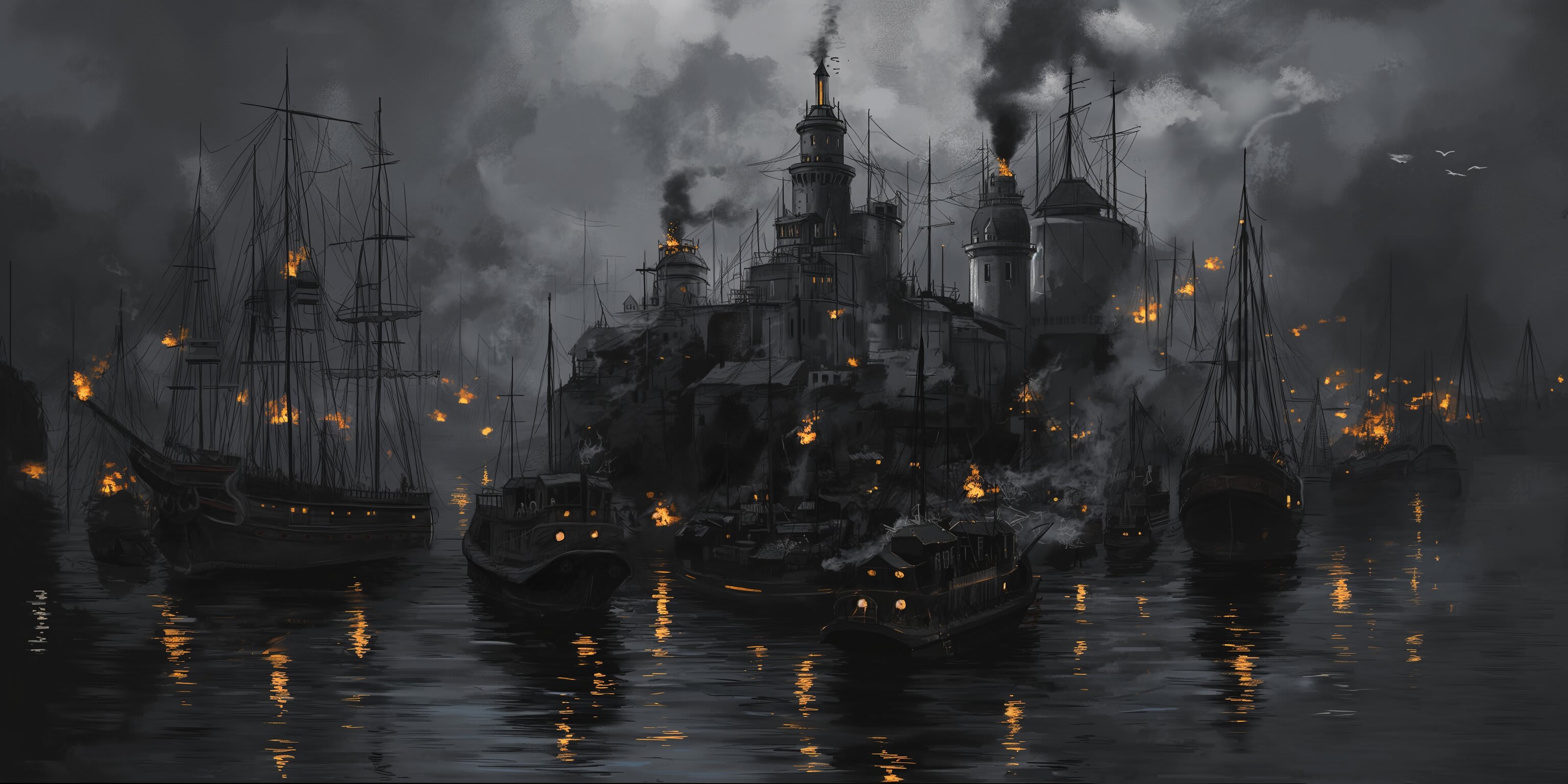
They did not sink. The Bureau of Rites considered this provisional evidence of divine favour and recommended a second flotilla. The Bureau of War considered it provisional evidence that chain holds better than prayer and recommended more chain. Both got what they wanted. By A.S. 80, the Flotilla comprised forty vessels. By A.S. 110 — the year of the First Continental Levy, when the Synod discovered it could requisition young men as efficiently as it requisitioned hulls — the fleet had grown to ninety. By A.S. 162, when the Black Sea Armada of forty-seven demon ships forced the Bosphorus approaches and died against the chain booms, the Flotilla numbered over two hundred vessels and had acquired a population, a bureaucracy, a tribunal, a heresy, and a nickname.
The nickname is Saints Afloat. The Bureau of Doctrine does not use nicknames. The Bureau of Doctrine also does not patrol the Black Sea at night, so its preferences on this matter carry less weight than usual.
#On the Flotilla's Nature
"A cathedral that forgot it was a shipyard." — Admiral-Prior Veyra Salt-Crown, in a letter the Bureau later classified as "imprudent candour"
To describe the Flotilla is to describe a thing that refuses the courtesy of staying still long enough to be described. I have visited twice. The first time, my quarters were in the Saintward — the chapel cluster surrounding the high relics, where incense mingles with the smell of old wood and the walls perspire salt water in a manner the Bureau of Engineering attributes to condensation and the Bureau of Rites attributes to piety. The second time, three months later, my quarters were in the same cabin, on the same barge, lashed to a different chain, in a different district, answerable to a different tribunal, and subject to a different tithe schedule. A storm had intervened. My cabin had not moved. Everything around it had.
This is the central fact of the Flotilla, the one from which all its politics, all its economies, all its cruelties and small mercies descend: storms rearrange the parish. The Flotilla is a city of chapel-barges, ossuary skiffs, bell-towers-on-hulls, and munitions platforms chained into concentric rings around a central bell-keep, and when a Black Sea squall hits — which it does with the regularity of a Bureau audit and considerably more honesty — the lashings snap, the chains strain, the barges drift, and when morning comes, the city has rewritten itself. Districts that were neighbours are strangers. Markets that served one parish now serve another. Debts that were owed in one jurisdiction are collectible in a different one, under different rules, enforced by different bailiffs.
The population holds at roughly eighteen thousand souls, swelling with convoy season and pilgrim feasts and the periodic arrival of refugee columns whom nobody expected and nobody can feed. They live on slick planks above black water, eat brine porridge and ship-bread, drink rationed fresh water bought with prayer beads, and confess their sins into floating confession booths whose receipts double as navigation tokens — for without a valid confession receipt stamped by a recognized chaplain, one cannot cross from one district to another without being shot, quarantined, or worse: audited.
#On the Districts and Their Character
The Flotilla's nine districts are permanent in name and temporary in geography. I list them here in their A.S. 201 configuration, with the understanding that by the time this entry is printed, a storm will have rearranged at least three.
The Grand Lash — the main chain-spine, the arterial corridor from which all districts radiate. Iron watch-towers rise from pontoon bases. The smell is tar, rust, and wet rope. Chain crews work in shifts the Bureau of Mercy has described as "intensive" and the chain crews themselves describe with words the Bureau of Doctrine does not permit in print. Crush injuries are the leading cause of death. Hidden cut-points, known to the Chainwright Rosary and to the Creator, can sever an entire barge from the Flotilla in nine seconds.
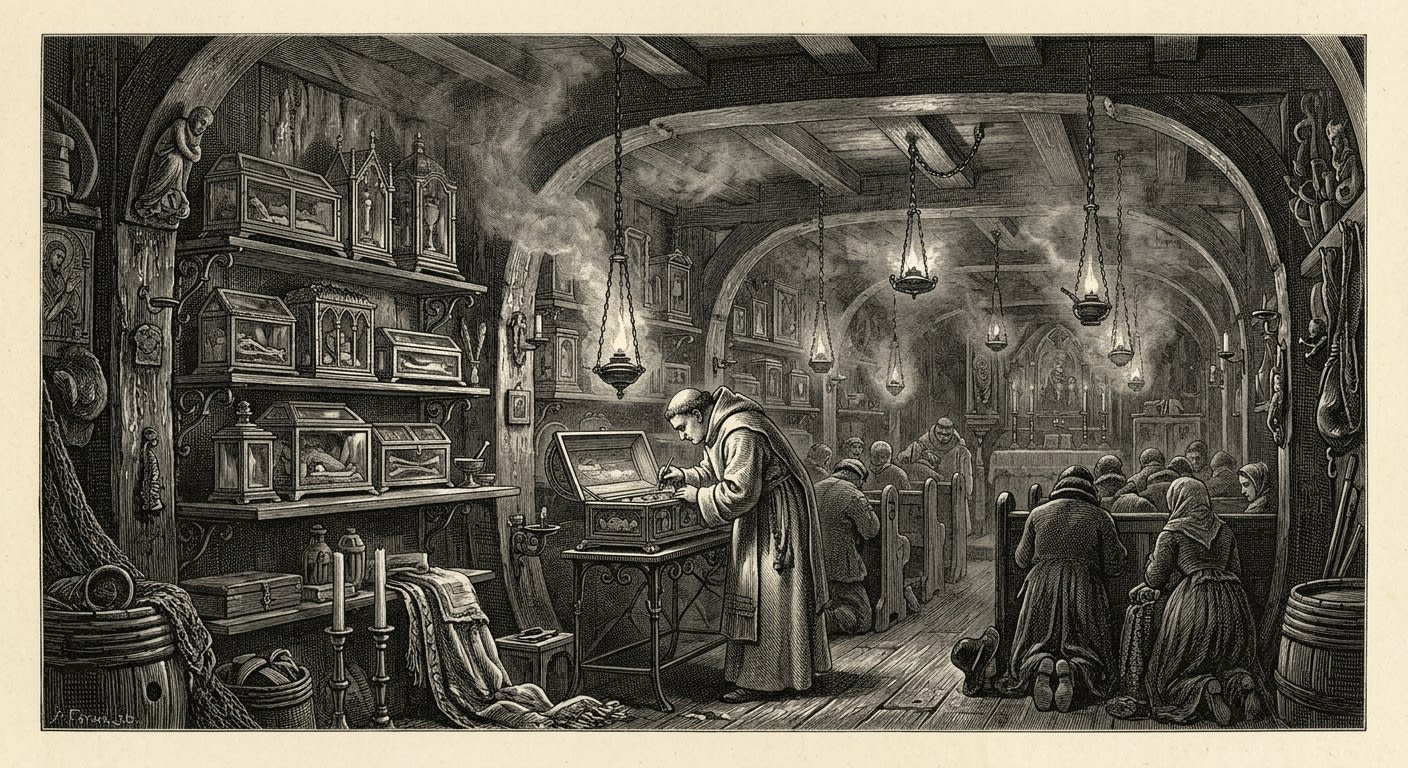
The Saintward — the chapel cluster. Here the high relics are kept in sealed cases of lead and glass, attended by the Maritime Reliquary Chapterhouse. Incense is so thick it has a texture. Inquisitors visit without announcement. The Crown Deck Chapel, at the Saintward's summit, houses three relics of such potency that the Bureau of Alchemical Standards has classified the air within ten feet of them as "Category Two Sacred Atmosphere" — breathable, but theologically active.
Ossuary Quays — where the dead are processed. Bone barges line up like white teeth in a jaw too large for its face. Lime dust coats every surface. The bone-porters who work here develop a cough the Salt Doctors call "quay lung" and treat with brine and threats.
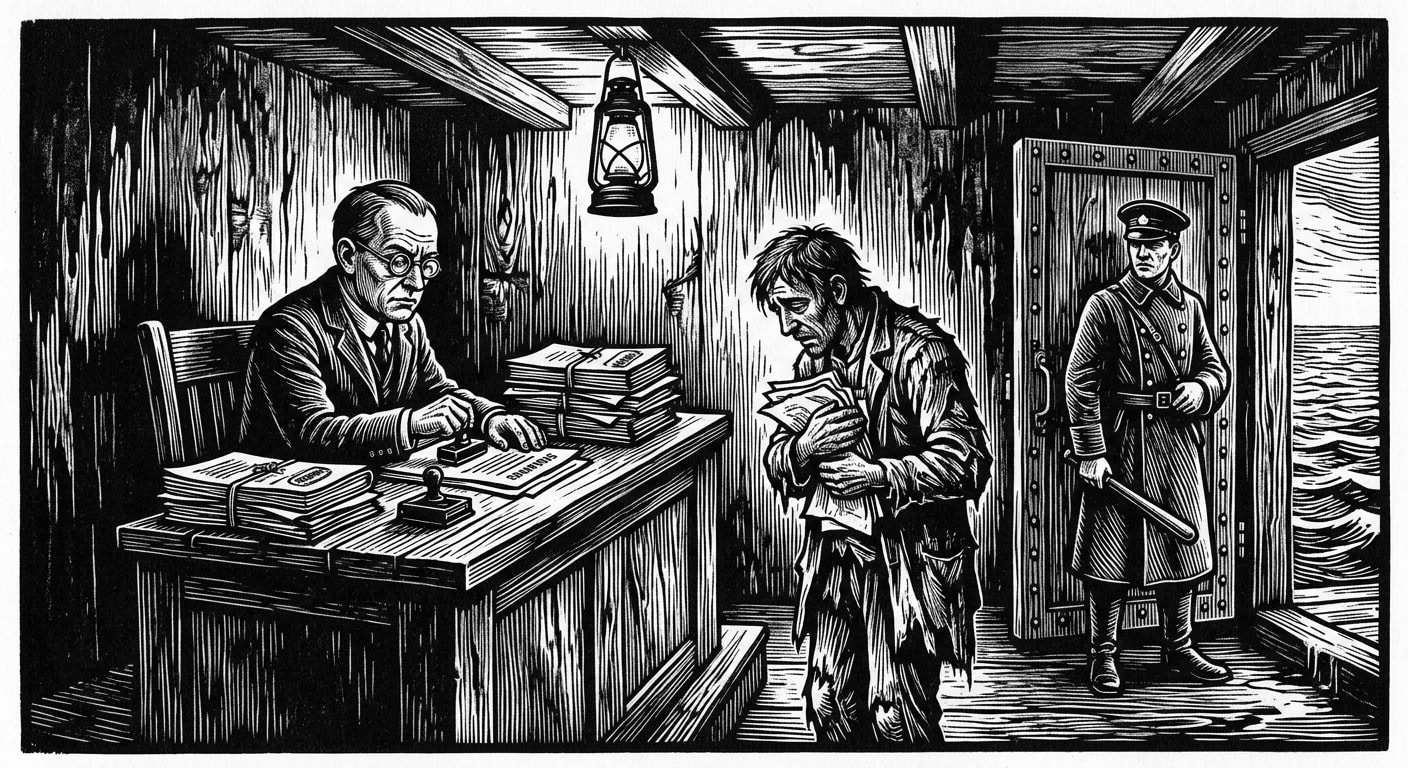
Seal Row — the administrative heart. Passes, stamps, parish papers, berth tokens, quarantine clearances — every document the Flotilla requires to function is produced, duplicated, verified, and occasionally forged here, in a row of wax-heated booths that smell of vinegar ink and bureaucratic desperation. Beneath the floor of the third booth, a counterfeit ring has operated for eleven years. The Bureau of Purity is aware. The Bureau of Purity has not shut it down. Draw your own conclusions.
The Drift Court — the floating tribunal. A single barge, larger than the rest, permanently damp, permanently occupied. Seal-Justice Miran Kest presides. His jurisdiction expands after every storm, because every storm produces new debts, new disputes, new orphaned contracts whose parish of origin has drifted into someone else's waters. The Drift Court does not create chaos. The Drift Court monetizes it.
Quarantine Rafts — isolation decks at the Flotilla's outer ring, where the sick, the suspect, and the inconvenient are held behind antiseptic brine and armed wardens. The Quarantine Wardens — formally the Salt and Ash Office — maintain "tide files" on every soul who passes through their cordons. These files contain confessions, blood-test results, and observations that the Wardens describe as "medical" and their detainees describe as "blackmail."
The Hymnworks — the bell foundries and tuning decks. Hot brass, singed pitch, the ring of hammers on casting moulds. Bells are weapons here — the Flotilla's primary defence against demonic incursion is sonic, a grid of bell-signals that can be redirected, amplified, and weaponized. The Bell Choir of Hymnworks controls the signal grid and, through it, controls who may move and where. A wrong response tone — answering a Choir challenge with the incorrect sequence — can result in quarantine or summary execution, depending on which Cantor is on watch and how his breakfast agreed with him.
Market of Anchors — the trade bazaar. Fish oil, spice, rust, the smell of money changing hands under conditions the Bureau of Tithes would find objectionable if it could reach the Black Sea without vomiting. Relic fragments are sold as prayer beads. Prayer beads are sold as relic fragments. The distinction, as in all things theological, is a matter of certification.
Underkeel Lanes — the smuggler's parish. Skiff alleys beneath the platforms, accessible through submerged hatches, navigable only by those who know the drip-rhythm and the chalk marks. Rot, tar, secrets. The Grey Keel Syndicate moves people and papers through the Underkeel without confession receipts, which is heresy, and without berth tokens, which is theft, and without getting caught, which is professionalism.
#On the Governance of a Drifting City
The Flotilla is governed, in theory, by the Maritime Reliquary Chapterhouse under the authority of Admiral-Prior Veyra Salt-Crown — a woman whose name appears on every docking permit, whose signature graces every relic transit writ, and whose actual power extends exactly as far as the chain her Chainwrights are willing to maintain.
Beneath her — and the word "beneath" does considerable diplomatic work here — stand two figures without whom the Flotilla would fragment within a week. Chainmaster Olt, called "Rosary-Iron" by his crews because his hands are more callus than flesh and he counts chain-links the way other men count prayer beads, controls the physical infrastructure: who gets lashed, who gets cut loose, which barges survive the storms and which are sacrificed. His leverage is structural. His ambition is sovereign. His Chainwright Rosary has petitioned three times for an independent charter. Three times the Chapterhouse has denied it. Three times the Chainwrights have discovered, during the next storm, that certain barges were lashed with unusual care and others were lashed with unusual carelessness.
Seal-Justice Miran Kest of the Drift Court controls the legal infrastructure — which, in a city where a storm can reassign your debts, your parish, your tithe obligations, and your identity overnight, means he controls everything that happens between storms. Kest is a small man with a clerk's posture and a judge's appetite. He does not sell justice; he sells jurisdiction. After a reparishing, when the maps are redrawn and the old debts hang in legal limbo, it is Kest who decides which parish inherits which obligations. This power is, in practice, indistinguishable from the power to decide who lives comfortably and who drowns in debt. Kest exercises it with the punctiliousness of a confessor and the appetite of a tax collector.
Previous editions of this entry attributed the founding of the Drift Tribunal to a decree of the Bureau of War in A.S. 94.
The Drift Tribunal was established by spontaneous ecclesiastical consensus following the Great Reparishing of A.S. 93, in which a single storm redistributed fourteen barges across seven jurisdictions and left the Flotilla without a functioning court for nine days. The Bureau of War's involvement was limited to stamping the charter after the fact and claiming credit in the quarterly report.
The Quarantine Wardens — the Salt and Ash Office — hold the third pillar of real power: the authority to detain, test, and release. In a floating city where plague can spread through a chain of barges faster than a bell-signal can warn them, quarantine authority is military authority by another name. Warden-Doctor Voss Brinewhite commands the Rafts with the gentle bedside manner of a man who has seen too many corpses float away and has stopped distinguishing between treatment and triage.
#On the Economy of Absolution
The Flotilla's economy runs on three currencies: coin (rarely), prayer beads (commonly), and paper (always).
A parish paper is a man's identity. It declares his name, his district, his tithe status, his confession history, and his quarantine clearance. Without it, he does not exist — cannot cross a chain-bridge, cannot buy water, cannot work, cannot confess, cannot receive the sacraments that the Bureau of Doctrine requires for the maintenance of the soul the Bureau of Records requires for the maintenance of the Ledger. A man without a parish paper on the Flotilla is called Cut-Loose — the same word used for a barge severed from the chain. The parallel is deliberate. The parallel is accurate.
Confession receipts serve as navigation tokens. The system is exquisite in its cruelty: to move between districts, a soul must present a valid receipt stamped by a recognized chaplain within the current liturgical period. The receipt certifies that the bearer's sins have been heard, catalogued, and filed. It does not certify absolution — absolution is between the soul and the Creator, and the Bureau does not presume to intermediate in that transaction. What the Bureau intermediates is movement, and movement requires documentation, and documentation requires confession, and confession requires a chaplain, and a chaplain requires a fee.
The berth token system governs housing. A token grants occupancy of a specific berth on a specific barge. When a storm reparishes the Flotilla, the token remains valid — but the barge it references may now be in a different district, subject to different tithes, governed by a different tribunal. Speculators trade berth tokens like futures contracts, betting on which barges will drift into favourable parishes and which will drift into the Quarantine cordon.
Fresh water is the Flotilla's deepest scarcity. Rationed by the Chapterhouse, bought with prayer beads, and hoarded with a ferocity that makes the relic trade look generous. The phrase "drywater" — the Flotilla's slang for potable rations — carries more weight than any coin. A man who controls a water barrel controls his barge. A man who controls a cistern barge controls his district.
#On the Storms and Their Theology
A Black Sea storm, when it strikes the Flotilla, is not weather. It is eschatology.
The lashings snap in sequences that the Bell Choir insists are non-random. The chain-spine groans. The barges drift, collide, rotate, and when the grey light of morning arrives, the city that was is gone and a new city — identical in population, identical in misery, different in every administrative particular — has taken its place. Districts that shared a chain-bridge for years find themselves separated by open water. The Quarantine Rafts, which are supposed to float at the Flotilla's edge, wake up inside the Saintward ring. A chapel that served one parish for a decade finds itself, between sunset and sunrise, in a jurisdiction whose tithe schedule doubles its obligations.
The Bureau of Rites calls this "providential reconfiguration." The Bureau of Engineering calls it "structural stress response." The Chainwright Rosary calls it the sea choosing. All three are right, which in the Theocracy means all three are equally useless.
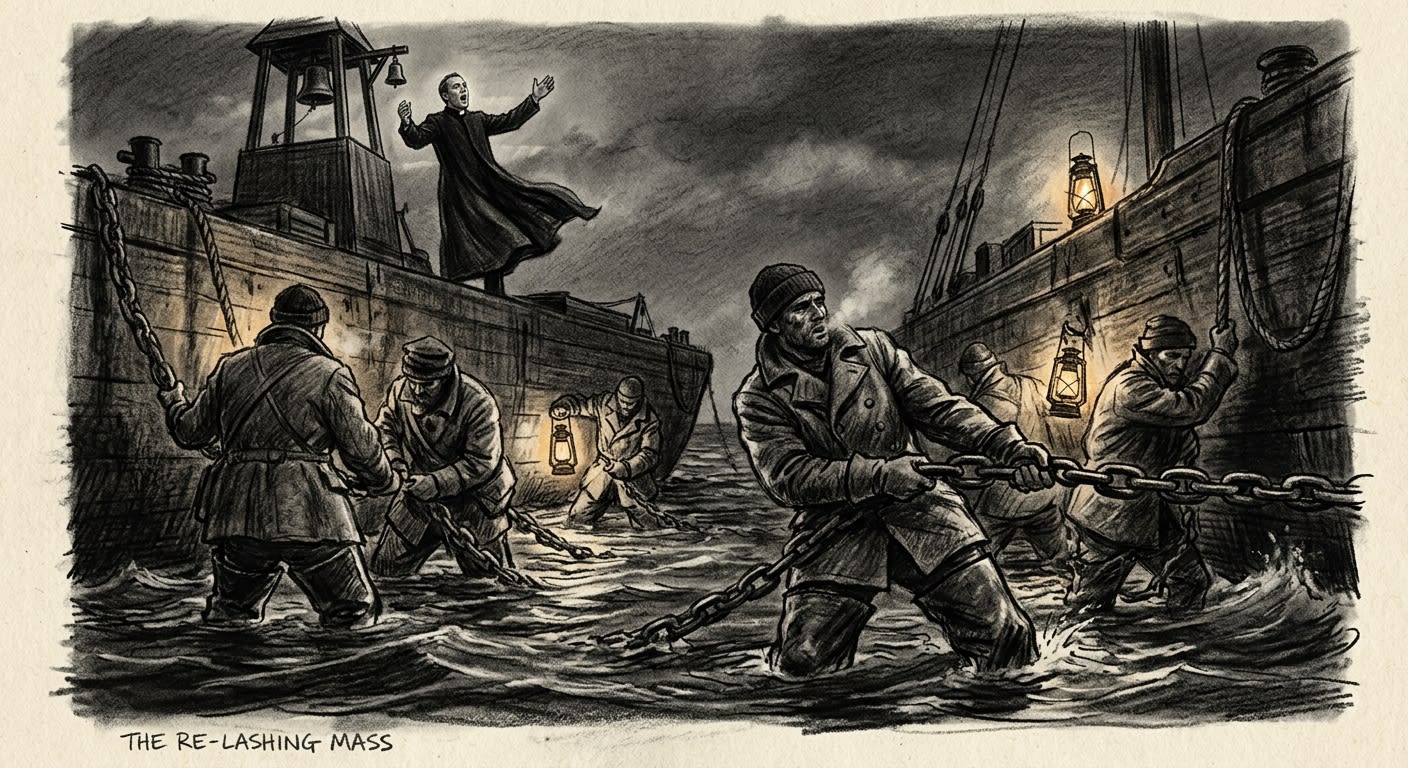
After every storm comes the Re-Lashing Mass — the most important liturgical event in the Flotilla's calendar and the most dangerous. Chain crews, many of them debt-bonded labourers who signed away their names for dry berths, work waist-deep in black water to reconnect the barges while chaplains sing hymns of structural integrity from the bell-towers above. Crush injuries, drownings, and hypothermia are common. So are disappearances. The Knot-Scribes of the Parish Map redraw the district boundaries in vinegar ink before the chains have finished tightening, and by noon the Drift Court is in session, adjudicating the thousand petty catastrophes that a reparishing produces: debts orphaned by jurisdictional shift, marriages split across district lines, confession receipts issued by chaplains who now serve a different parish and may or may not still have authority to stamp.
The Re-Lashing Mass is the Flotilla's sacrament. It is also its greatest vulnerability. Demons strike during the re-lashing — when the chain-spine is broken, when the barges float free, when the bell-grid is fragmented and the signal sequences cannot propagate. The things that live beneath the Black Sea know the schedule as well as any Chainwright.
#On What Lives Beneath
The Flotilla's official purpose is threefold: to transport relics without roads, to serve as a maritime checkpoint controlling Black Sea traffic, and to provide mobile quarantine facilities for the southern coastal approaches. These purposes are real. They are also, I have come to suspect, secondary.
The Flotilla anchors on a chain-field — a grid of deep-sea anchor lines fixed to the seabed at points the Chapterhouse keeps classified. The chain-field's location is the Flotilla's most closely guarded secret. Revealing it is punishable by something the Maritime Charter describes as "maritime correction" and the Chainwrights describe more colourfully. The official reason for the secrecy is operational security. The unofficial reason is that the anchor-field does not stay in the same place.
████████████████████████████████████████████████████ The anchor-field map recovered from ████████████████████ in A.S. 198 showed the chain-points arranged in a geometry that the Bureau of Rites identified, after three weeks of consultation, as ████████████████████. The Bureau of Doctrine has sealed the identification under Hierarch's Seal. ████████████████████████████████████████████████████
I will say this much, because the Bureau of Doctrine has approved this much and no more: the relics aboard the Flotilla are not randomly distributed. They are arranged. The arrangement shifts after storms — but it shifts in patterns the Bell Choir can predict, if not control. The Saintward's high relics occupy positions relative to one another that a cartographer would call "vertices" and a theologian would call "pins." What they are pinning, and what would happen if the pins were removed, are questions the Bureau of Doctrine classifies as "premature."
The fishermen of the Flotilla — those few who drop lines between the barges and haul up the black-finned things that pass for edible in these waters — report that on certain nights the water between the barges goes still. Dead still. The swell ceases, the spray stops, the hulls stop creaking. In the silence, they say, you can hear something underneath. Something large. Something patient. Something that occasionally, when the bells fall silent between shifts, pushes upward against the underside of a barge with a force that tilts the deck three degrees and is gone before the bell-watch can respond.
The Bureau of Rites' official position is that the Flotilla is blessed. The forty-seven-page theological explanation they produced in A.S. 200 — regarding the chain booms' intermittent failure to glow, the Flotilla's increased reparishing frequency, and the three new anchor-chain links that appeared overnight without installation — is a masterwork of doctrinal circumlocution. It says everything and means nothing. I know, because I edited it. I cut four thousand words and added a stamp. The stamp reads: "APPROVED — FURTHER INQUIRY SUSPENDED."
The storms have worsened. Reparishings that once occurred seasonally now occur monthly. The Knot-Scribes report that the anchor-field map has changed without any storm — twice in the past year, the chain-points have shifted position between dawn and dusk with no weather event to account for the movement. And some people — a small number, noticed only on the Re-Lashing roll-calls — fail to relocate after reparishing. They are present. They are remembered. But their parish paper is blank, and no one can say with certainty which barge they slept on, or whether they slept at all.
#On the Flotilla's Present Condition
The Flotilla, as of A.S. 201, is eighteen thousand souls on two hundred and thirty-seven registered vessels, chained into a drifting city that patrols the Black Sea between the Bosphorus approaches and the river deltas of the eastern shore. It carries the bones of over six hundred saints. It processes the confessions of every convoy, pilgrim column, and supply barge that passes through its waters. It quarantines the tainted, stamps the clean, and sends both on their way with the efficiency of a bureau that has been doing precisely this for a hundred and thirty years and has no intention of examining why.
This entry previously stated the Flotilla's registered vessel count as "approximately two hundred." The Knot-Scribes' current registry lists two hundred and thirty-seven. The discrepancy of thirty-seven vessels is attributed by the Bureau of Records to "administrative consolidation during storm periods." The Chainwrights attribute it to "the sea giving back what it took." Neither explanation satisfies. Both are filed.
The registered vessel count is two hundred and thirty-seven. Adjustments to prior figures are noted. Further discrepancies will be addressed in the next census, which is scheduled for after the next storm, which is scheduled for whenever the Black Sea decides.
The Chain Blessing approaches — the spring festival when the Grand Lash is anointed with holy oil, the chain crews are granted a half-day's rest, and the Underkeel Lanes erupt in a violence the Bureau of Mercy describes as "celebratory" and the Salt Doctors describe as "occupational." Papers will be updated. Berth tokens will change hands. The Drift Court will convene in emergency session, because the Drift Court is always in emergency session, because a city that rearranges itself every month does not have non-emergencies.
The Storm-Tenders — a heresy the Bureau of Purity burned out a generation ago and which has, with the persistence of rot-fever and the discretion of a smuggler, reappeared in the chain crews — whisper that the storms are not random. That the sea is choosing. That the parish wants to rearrange. The Bureau of Purity has reopened the file. I have read the file. The Storm-Tenders are heretics, and their doctrine is false, and their claim that the reparishing follows a pattern visible only from below the waterline is — I will say — not yet disproven, which is a different thing entirely, and a distinction the Bureau of Doctrine will find uncomfortable when it reads this entry.
The saints are afloat. The chain holds. The bells ring, and the bells are answered, and beneath the bells, beneath the barges, beneath the six hundred saints and eighteen thousand souls and two hundred and thirty-seven hulls — something waits. It has waited for a hundred and thirty years. It is, by all evidence, patient.
I have submitted my report. I have filed my receipts. I have touched the chain and declared my parish.
The sea, as is its custom, has declined to comment.