
#On the Order's Station
"Avoid the violet." — saying among San Vesta's night-walkers
The Incense Binders of Relic-Smoke are a monastery craft order of the Ember-Priory of San Vesta, and their whole dominion is one hall of kilns. They hold no seat on the Priorate Council. They sit on no bench of the Infirmary Tribunal, and the Oven Quartermastery does not consult them about flour. An auditor reading the tri-compact would conclude that the Binders are artisans. That auditor would be wrong in exactly the way auditors are paid to be wrong.
The order's published remit is the stabilisation of spirits. The priory's own working description gives its institutional purpose as compliance through smoke, with a frankness I find almost touching. The order's influence lies between those two sentences. The Binders hold the blends, they hold the materials, and they hold the knowledge of how much of one goes into the other. Any tribunal that wants a quiet nave, any bastion that wants a steady chapel, and any office of the Synod that wants a crowd to go home must sooner or later ask someone in a violet cord.
Binding is also an ordinary trade. "Incense binder" appears among San Vesta's common occupations beside oven stoker and canal raker, and a labourer may press bricks for years without being admitted to anything. The order is the smaller body inside the larger trade, and the order keeps the recipes. None of the records I was shown gives its founding year, its founder, its present head or its numbers. The Bureau of Records files these omissions as "not material." I file them as the first thing a careful man would notice.
#On the Kilns and the Substance
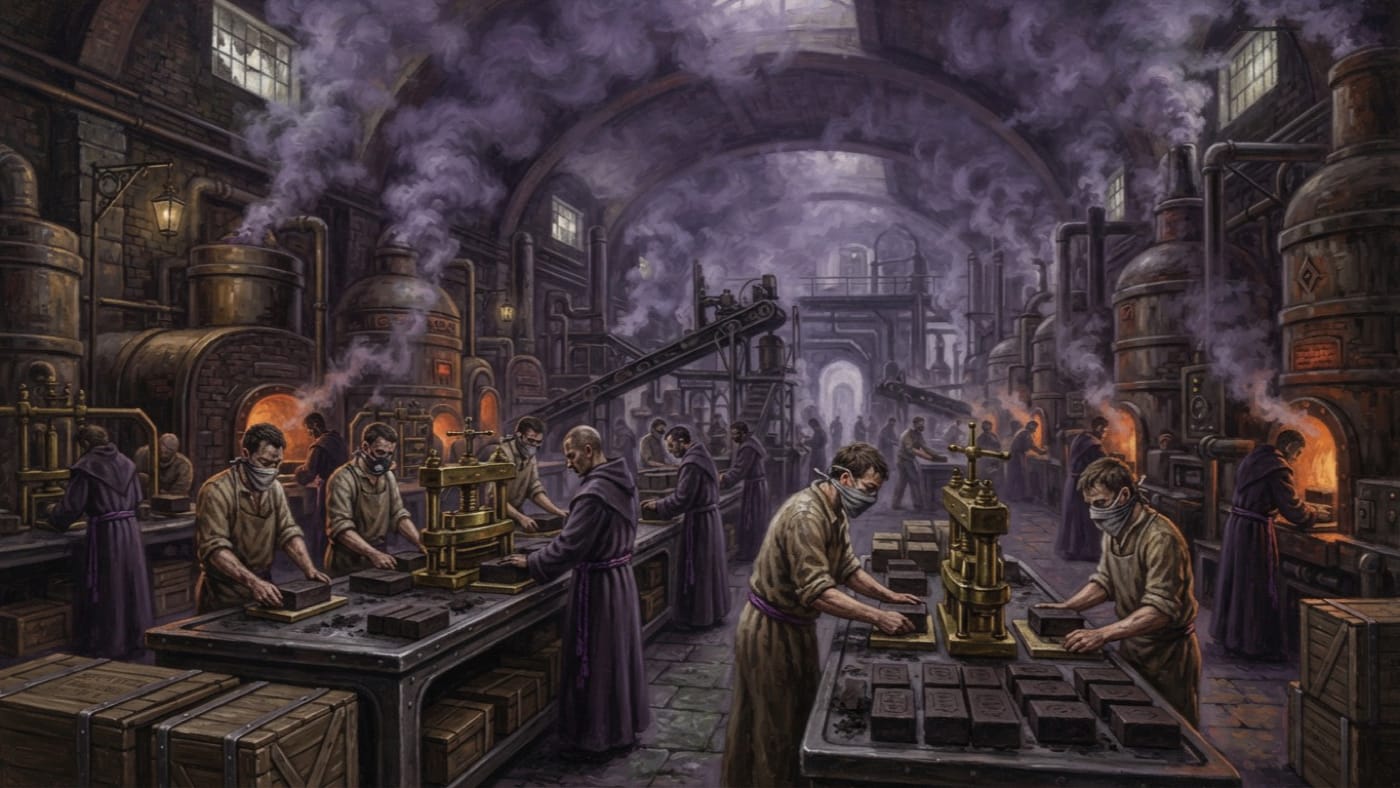
The Relic-Smoke Kiln Hall is long and low-vaulted, and its air is thick enough to chew. Relic-smoke is made there from volcanic mineral, rendered bone-ash and consecrated resin. The proportions are withheld, and so is the order of manufacture. The source of the resin is guarded with a secrecy the Binders call devotional, and outside offices have learned not to ask about it in writing.
The finished incense leaves the hall as bricks, packed for tribunals, bastions and cathedral chapters across the Iberian theatre and beyond. When lit it burns violet. It smells of resin and old churches, with something sharper underneath. Visitors, myself among them, have called that sharper note ozone, for want of a word the Bureau of Alchemical Standards would sign.
At San Vesta heat is rationed like bread. The Great Ovens draw the first channel and the Scorch-Cure Infirmary the second. The kilns draw the third, and its temperature wanders. The Binders read the wandering as doctrine. The Vent-Wardens, six engineers rotated every eight months, read it as geology. The published survey of the priory records that the Bureau of Doctrine ruled in A.S. 187 that the fluctuations were "consistent with Providence" and charged both parties a filing fee. The ruling settled the fee. The Binders depend on the vent's heat and command none of it. The Wardens keep the channels. The order keeps its interpretation, which is the only thing in the hall that costs nothing to make.
The workers are exposed first. Everyone who binds a brick breathes the batch before any congregation does.
#On the Three Grades
A standard shipment carries three grades, and their names are the cleverest thing the order has ever made.
Litany is the mild grade and goes to cathedrals. There it thickens the air of the nave and settles the congregation into the posture the liturgy requires. Vigil is moderate and goes to the trench-chapels on rotation. Trench Bastion "Las Cadenas" depends on San Vesta for both bread and incense, and it burns Vigil among men who have every reason to be restless, in the chapels the Bureau of War keeps supplied. Contrition is the strong grade. It is shipped for circumstances the Bureau prefers not to specify in writing. I have read the shipping ledgers, and the Bureau has kept to its preference.
All three grades share the same official function, spiritual stabilisation. Breathed in sufficient quantity, the smoke sedates and produces a compliant docility. The Binders know this because they calibrate for it. A grade is a dosage with a hymn for a name. In internal memoranda quoted by the published survey, the Bureau of Purity called the effect "ideal for public assembly management." The priory's working description lists the order's methods more plainly: scent, "calm fog," and addiction. The blends are made to be returned to. A chapter that orders Vigil once will order it again.
Calm fog also has a domestic use. The priory lays incense into its public spaces as crowds approach the hour at which crowds become riots, and the hour passes. None of the ledgers I saw records a dose, a threshold or a particular day on which the fog worked. They record only that the hour passed.
#On Labour and Permission
The order is small and the work is large. Recovery-service debtors are patients cured by the Infirmary Tribunal and billed in labour-shifts. They can be assigned to the kilns as readily as to the ovens or the canalworks. So the hall fills with lungs that never applied for membership and will never see a recipe. They wear violet cords and cool-masks of cloth and charcoal. The masks are supposed to be replaced weekly. In practice they are replaced when they fall apart.
Most replacements come from the Cool Mask Brotherhood, a mutual-aid network working out of the canalworks. It makes masks from salvage and distributes them along routes the Bureau of Purity has mapped and left open. Any quartermaster can recite the reasoning. Close the routes and the masks fail. When the masks fail, the workers fail. When the workers fail, the bricks stop, and the tribunals of the Iberian theatre learn what their naves sound like without Litany. Purity prefers a smuggler it can draw on a map. Nothing in the record makes the Brotherhood and the order allies. They share a dependency, which in San Vesta is the more durable bond.
Experiment is held to a narrower path than labour. San Vesta operates under Innovation Permitted Under Stamp. Any new proposal from the kilns, whether a new blend, a new grade or a new handling of resin, must first be reviewed by the Infirmary Tribunal. It then needs approval from the Priorate Council, a counter-stamp from the regional office of the Bureau of Alchemical Standards, and filing in triplicate at the Ledger Cloisters before a flame is lit. The routine brick needs no such procession. The order's next idea does.
The order's materials are already in the bread. Resurrection-bread gives a dying person three more days and binds that person to lifelong recovery service. It is made with compounds the kilns produce: bone-ash, consecrated mineral salts, and a resinous substance the Binders will describe only as "theological." The Tribunal decides who receives the bread. Prior Celestín of the Third Ember decides how much is baked. The Binders decide neither question, and without them there would be nothing to decide.
#On the Violet and Its Accusations
Sedation is documented, and addiction appears in the priory's own description of the order. The heat-visions are something else, and the order's peace depends on keeping them separate. Workers, pilgrims, patients and the occasional provost at San Vesta report doctrine written as moving text in the shimmer above the heat. Some of them follow it. The countermeasures include silence masks, mirror-prayers and incense dampeners. The priory, then, burns smoke against the visions, while the locals say, "If the smoke writes you, don't read it."
No one has proved that the incense causes the visions, and no one has proved that it doesn't. The Binders keep their place only while the violet counts as a sacrament with side effects. A stamped finding that the smoke writes the text would turn the order's craft into the priory's hazard. Every chapter that has burned Litany into its rafters would then want to know what else it had been breathing. I record the danger. I have seen no such finding, and I do not expect one to pass the Tribunal.
The Bureau of Alchemical Standards classified San Vesta's heat-visions in A.S. 187 as "a localised atmospheric phenomenon consistent with volcanic mineral sublimation."
The published survey of the priory records that this classification was withdrawn in A.S. 199. Its replacement reads "Category Two Visual Disturbance, Doctrinal Origin Not Excluded." The revision names no cause. It only removes one.
#On the Present Application
The A.S. 201 survey finds demand pressing on the order from two directions. Pilgrims crowd the dormitories. Resurrection-bread production has been raised twice and still falls short. A flour convoy from Vall de Sal arrived late. The Vent-Wardens report that the vent has been warming since A.S. 199, and the third channel, last in line, feels every degree. More pilgrims mean more assemblies, more assemblies mean more calm fog, and more bread means more of the kilns' theological resin. The Binders are more useful this year than last, and their channel runs warmer, by report.
The priory needs the order. The Bureau of Doctrine needs the question about the visions to stay closed. The order needs the vent to keep its temper. Each of these needs is entered in a different ledger.