
#On the Priory's Situation
"Eat the ash. Keep the oath." — Inscription above the Flour Gate, carved in basalt, filled with bread-char.
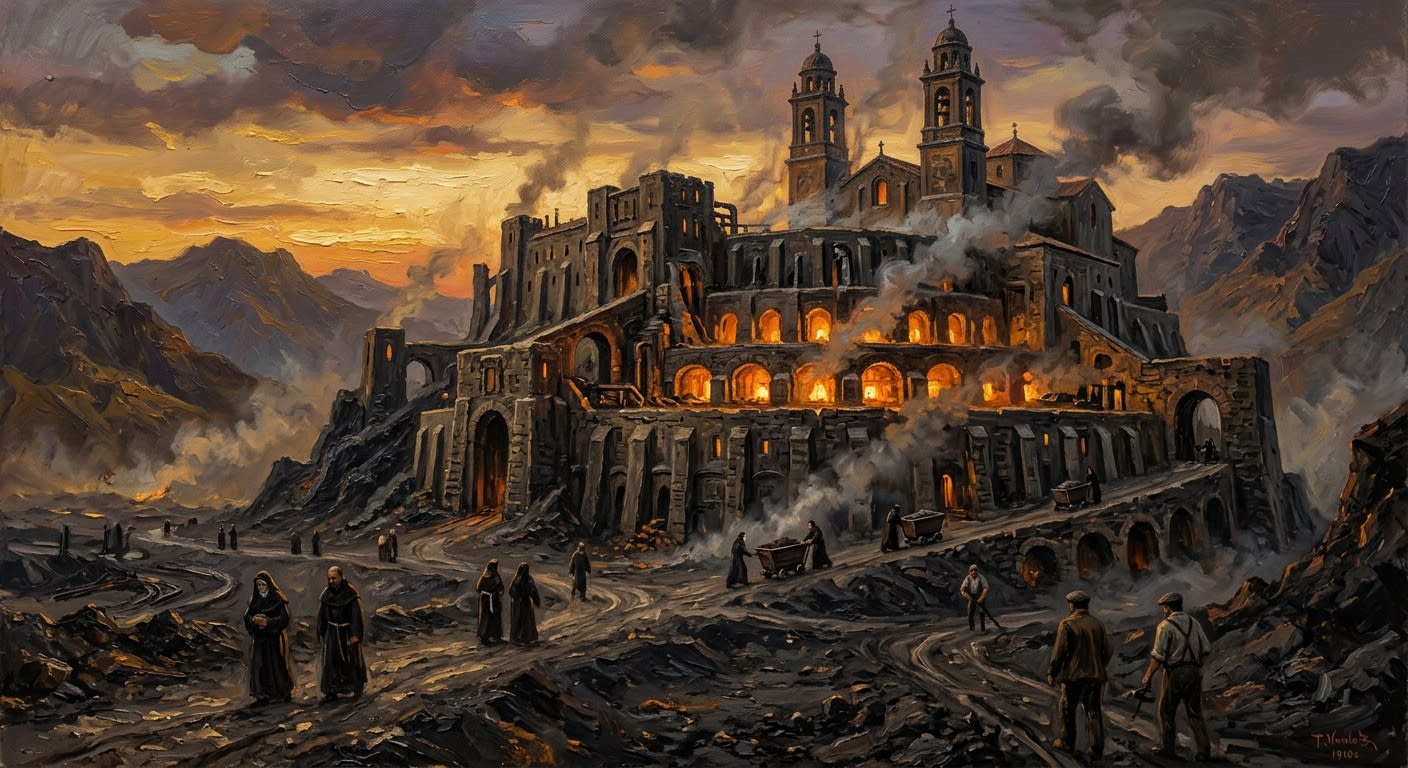
San Vesta squats on a basalt rise in the Iberian south, a monastic town whose ovens glow through the night like the devotional fires of the Creator after He has forgotten how to stop. The air above its terraces shimmers year-round, warping the outlines of bell-towers and chimney-stacks into the kind of wavering scripture that the Bureau of Doctrine would classify as a Category Two Visual Disturbance, were it not that the Bureau's own inspectors had, on three separate occasions, described the shimmer as "theologically productive" and filed claims for additional per diem.
The priory rises in tiers above cinder-fields that were once orchards. The basalt beneath is volcanic — old lava flows from a vent the Synod's engineers sealed and sanctified in the decades following the Concordat, when Iberia's restless monasteries were being welded, one by reluctant one, into the machinery of continental faith. San Vesta was among the first to submit. Its abbot at the time — a man whose name the Bureau of Records has helpfully misplaced — offered the Synod obedience and a resource: the vent's heat, tamed into kilns and ovens, capable of producing bread at a scale and speed that no water-mill or wood-fired bakery could match. The Synod accepted. The abbot was promoted. The promotion, in this case, was genuine, which tells you how valuable the bread was.
That was A.S. 98. The Subjugation of Seville was still fifty-seven years distant, but the Synod's appetite for the Iberian peninsula was already sharpening, and San Vesta's ovens gave it something better than an army: a supply chain that smelled of yeast and absolution.
#On the Geography and the Heat
The Iberian south is dry, bright, and punishing in summer. San Vesta adds its own contribution. The sealed vent beneath the priory complex radiates heat upward through the basalt like a fever through a skull, and the engineers who maintain its channels — the Vent-Wardens, six of them, rotated every eight months to prevent what the Bureau of Alchemical Standards calls "thermal acclimatisation syndrome" and what the wardens themselves call "forgetting what cold means" — ensure that this heat is distributed according to a schedule more precise than most military timetables.
Heat, at San Vesta, is rationed. The Great Ovens of Vesta receive the primary flow: massive kiln-chambers where dough is loaded on iron racks and baked in volcanic warmth that never fully ebbs. The Scorch-Cure Infirmary, one terrace below, receives a secondary flow — enough to keep its antiseptic smoke at the correct density, its treatment rooms at the temperature the Sister-Physics call "the edge of tolerable," and its patients in a state of perpetual mild sweat that is, depending on whom you ask, therapeutic or penitential. The Relic-Smoke Kilns, which produce the priory's incense, draw from a third channel whose temperature fluctuates according to patterns the Incense Binders claim are doctrinal and the Vent-Wardens claim are geological. No one has settled the argument. The Bureau of Doctrine issued a preliminary ruling in A.S. 187 declaring the fluctuations "consistent with Providence" and charged both parties a filing fee.
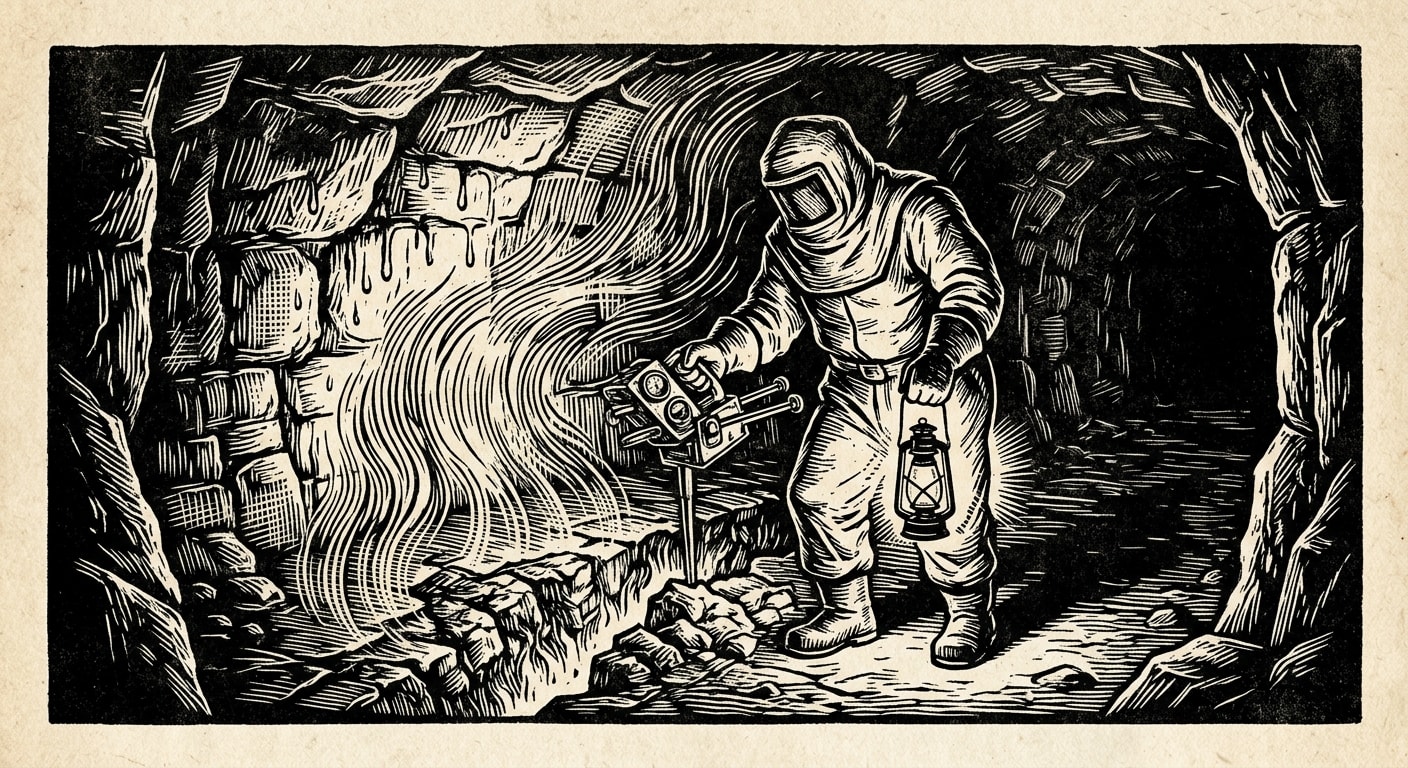
Below the kilns, the Ash Canalworks carry cooling water through channels cut into the lower basalt, creating a network of soot-stained sluices that serve triple duty: heat management, waste disposal, and — for those who know the lava-tube underpaths beneath them — smuggling. The Bureau of Purity is aware of the tunnels. The Bureau is always aware. It has sealed eleven of them in the past decade and discovered, each time, that twelve now exist.
The districts stack upward from the canalworks: Cinder Markets at the base, where barter runs on pepper oil and ash-cakes; Pilgrim Dormitories sprawling through converted cloisters; the Ledger Cloisters where the priory's schedules are maintained with an attention to temporal precision that would impress the Bureau of Bells; and at the summit, above the shimmer-line, the Innovation Annex — called by its inmates the Approved Fire — where experiments proceed under stamps so numerous that the paperwork outweighs the apparatus.
Night navigation at San Vesta is a matter of colour. Red glow means ovens — safe, warm, the smell of yeast and charcoal, the sound of dough being turned by hands that have not rested since Matins. Blue-white means infirmary — antiseptic, controlled, the kind of light that makes healthy people feel ill by association. Violet means kilns. The locals say: avoid the violet.
#On the Ash-Bread
The bread is the thing. The bread is always the thing.
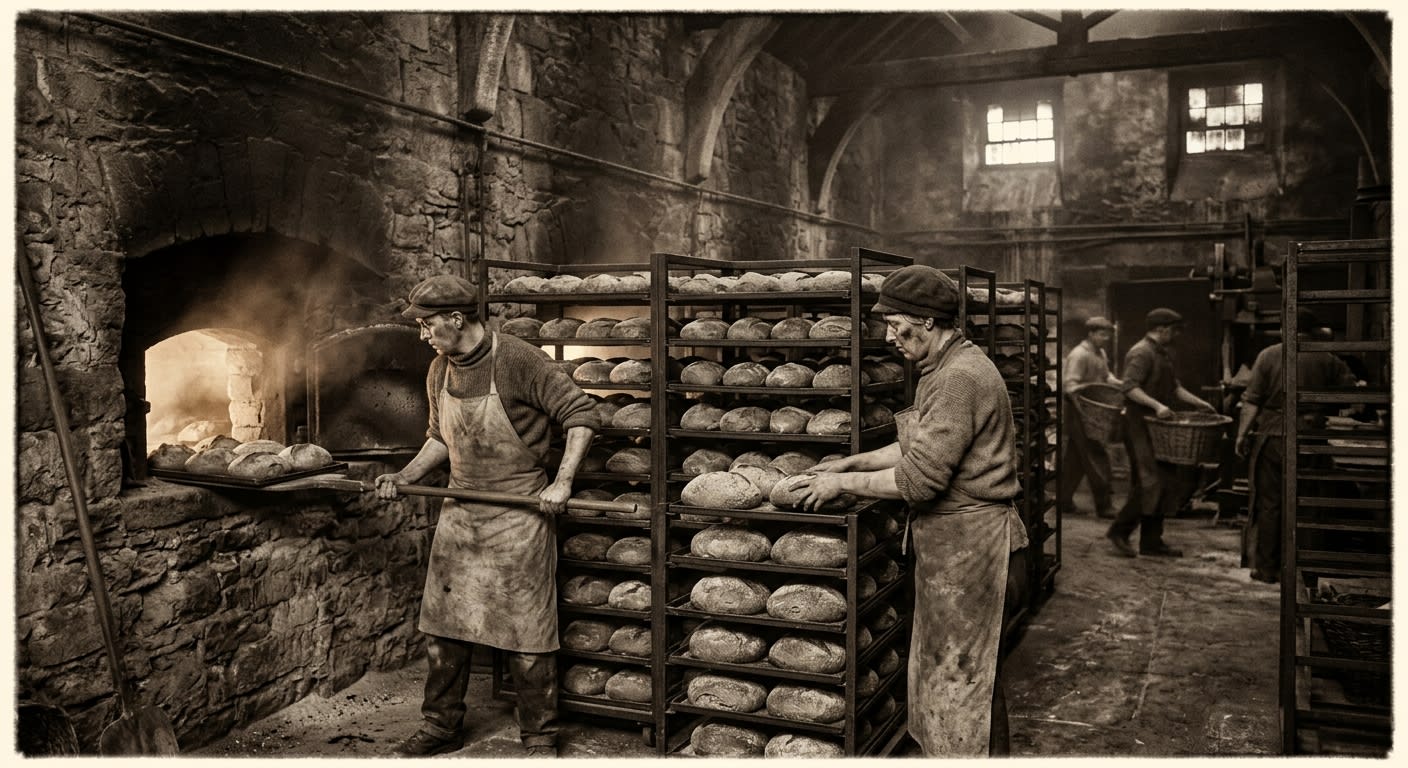
Ash-bread is San Vesta's primary export, its reason for existing in the Synod's logistical calculus, and the foundation of every power relationship within its walls. It is baked from flour mixed with consecrated volcanic ash in proportions the Oven Quartermastery guards with the jealousy of a Bureau of Shadows cryptographer, and it emerges from the Great Ovens as dense, grey-crusted loaves that taste — I am told, and I confirm — of duty. There is yeast in them, and salt, and something mineral that clings to the teeth. They are unpleasant by design. They are sufficient, and sufficiency is, at San Vesta, the highest compliment the priory is authorised to pay.
The bread's value lies in longevity rather than flavour. Ash-bread does not spoil. It hardens, certainly — after a month it could serve as a trench-step — but it does not rot, does not mould, does not attract the vermin that plague every other supply depot on the Iberian front. The Bureau of War tested ash-bread in A.S. 134 and found loaves baked three years prior still "nutritionally adequate, if spiritually oppressive." The Bureau ordered six thousand additional loaves per month. The order has not been revised downward since.
The bread tokens that serve as San Vesta's internal currency are stamped with the recipient's name. Your ration is your identity. Lose the token, and you do not merely go hungry — you become, in the Ledger Cloisters' assessment, administratively absent. The Bureau of Records does not recognise hunger as proof of existence. Only the stamp proves you are real.
#On the Scorch-Cure and the Infirmary Tribunal
If the bread feeds the body, the Scorch-Cure treats what the bread cannot reach.
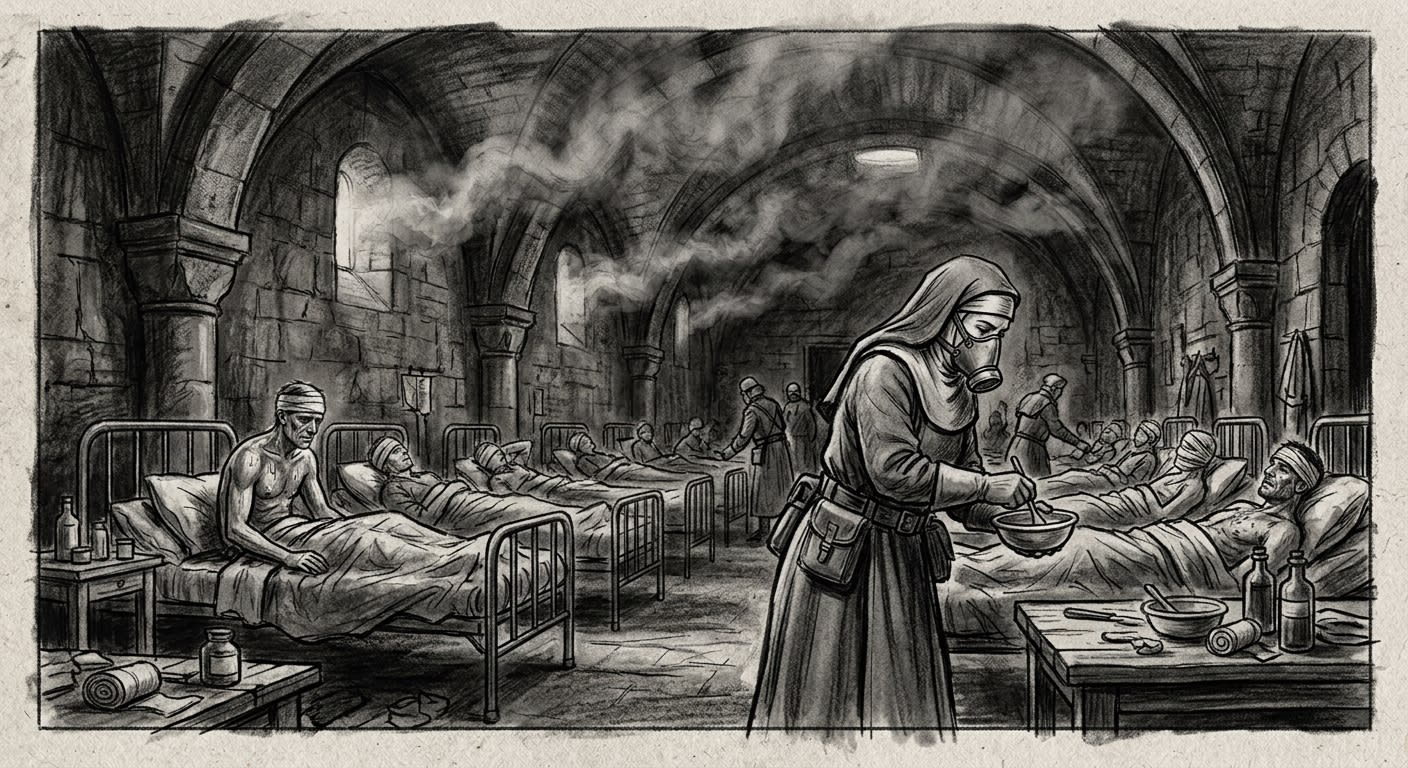
San Vesta's Infirmary is the largest medical facility in the Iberian theater — seven wards, two quarantine blocks, a surgery in the basalt undercroft where the volcanic heat keeps instruments warm and infections, theoretically, suppressed. The treatments practised here are a blend of conventional medicine and what the Infirmary Tribunal calls "acceptable innovation": procedures that push beyond standard Synod medical doctrine but have been stamped, reviewed, filed, counter-stamped, and approved by a committee whose members rotate every six months to prevent any one physician from accumulating enough authority to become either brilliant or dangerous.
The scorch-cure itself is heat therapy applied with doctrinal precision. Patients are exposed to graduated volcanic warmth in sealed chambers, their symptoms monitored by Sister-Physics who record observations in a notation system halfway between medical charting and confession transcription. Guilt, at San Vesta, is a dosage. Confession is a treatment plan. The line between infirmary and confessional has been erased so thoroughly that even the chaplains are uncertain, on any given shift, whether they are absolving sin or prescribing rest.
Sister-Physic Marra Vell runs Ward Seven — the experimental wing. She speaks in dosages. Her eyes never blink near open flame, a habit her orderlies attribute to years of working in rooms where the air itself can ignite if the ash-content rises above a threshold she has memorised but refuses to write down. Her patients recover at rates that the Bureau of Alchemical Standards calls "statistically notable." Some of them recover wrong. The Tribunal's term for this is "variant convalescence." My term for it is: patients who leave Ward Seven walk differently, speak with pauses in unfamiliar places, and occasionally remember things that happened to other people.
Earlier reports from the Bureau of Mercy described San Vesta's infirmary as "a model of compassionate efficiency."
The Bureau of Mercy has revised its assessment. The current classification is "efficient." The adjective was removed following an internal audit in A.S. 199 whose findings remain sealed.
The Infirmary Tribunal of Scorch — the governing body of San Vesta's medical operations — is, in practice, a court. It decides who receives treatment, in what order, under what terms, and at what cost. The cost is always the same: service. Patients cured at San Vesta owe "recovery service" — labour shifts in the ovens, the canalworks, the kilns, or the dormitories, calibrated to the severity of their illness and the expense of their treatment. A broken arm costs three weeks. A lung infection, six. A full scorch-cure for advanced trench-fever costs a year, and the year begins when the Tribunal says the patient is well, which is not necessarily when the patient feels well.
This is the debt that holds San Vesta together. The priory does not run on faith, or flour, or volcanic heat. It runs on bodies that owe.
#On the Resurrection-Bread
And then there is the other bread.
Resurrection-bread is San Vesta's open secret, its terrible innovation, the thing that draws the pilgrims who clog the dormitories and overflow into the Cinder Markets and queue at the Flour Gate with the desperate patience of people who have been told that death, for three days, can be postponed. The recipe is classified. The process involves the standard ash-bread mixture adulterated with compounds the Relic-Smoke Kilns produce — bone-ash, consecrated mineral salts, and a resinous substance the Incense Binders will describe only as "theological." The loaves are baked in a separate oven at temperatures the Vent-Wardens consider "inadvisable," and they emerge looking identical to standard ash-bread except for a faint violet tinge along the crust that the Tribunal has forbidden anyone from commenting upon in writing.
A dying person who eats resurrection-bread lives for three more days.
The debt for resurrection-bread is lifelong. The pilgrims who accept it — the Third-Day Debtors, the dormitory preachers call them — sign recovery-service oaths whose terms extend past the three-day window and into whatever remains of their lives. Those who survive (and many do; the bread postpones death without curing the dying) find themselves bound to San Vesta's labour schedules with a contractual thoroughness that the Bureau of Oaths would admire if it were not, technically, the Bureau's own template.
The demand is growing. Prior Celestín of the Third Ember — San Vesta's governing cleric, a man of immaculate hands and soot under his nails — has authorised increased production twice in the last eighteen months. The Tribunal has responded by restricting distribution, arguing that "theological stability requires controlled access." The dormitories argue otherwise. The dormitories argue loudly, and with increasing frequency, and with the kind of organisational coherence that suggests someone is doing the arguing for them.
The priory's buried truth — and every priory has one; the Synod builds them that way, deliberately, because a community without a secret is a community without leverage — is that the resurrection-bread works because it borrows. The heat that drives the process exceeds geology. Something beneath the sealed vent is alive, or was alive, or is alive in a sense the Bureau of Alchemical Standards has declined to classify, and the bread draws from it a vitality lent rather than given. Three days of borrowed fire. The body burns through it like a wick through tallow, and what remains when the flame dies is ash.
The acceptable-failure ledger in the Innovation Annex — a book bound in kiln-fired ceramic covers, kept in a room whose door requires two keys held by two people who are forbidden from speaking to each other — has blank columns. Names are entered. Outcomes are recorded. The columns for cause of termination are, in many entries, left empty. The Tribunal calls these "self-resolving cases." Prior Celestín calls them "the cost of mercy." Quartermaster Odran Ashweight, who controls the flour that makes the bread that feeds the debt that holds the bodies that power the ovens, calls them nothing at all. He laughs his shovel-laugh and checks the next shipment manifest.
#On the Relic-Smoke and Its Uses
The third pillar of San Vesta's economy is incense — relic-smoke, produced in the Kiln Hall from a blend of volcanic mineral, rendered bone-ash, and consecrated resin whose source the Incense Binders guard with a secrecy that borders on the theological. The incense burns violet. It smells of old churches and something sharper beneath — ozone, perhaps, or the chemical residue of prayer subjected to temperatures prayer was never meant to endure.
Relic-smoke is shipped in brick form to tribunals, bastions, and cathedral chapters across the Iberian theater and beyond. Its official function is "spiritual stabilisation" — the calming of doctrinal anxieties in populations exposed to heretical influence. Its practical function is sedation. The smoke, breathed in sufficient quantity, produces a compliant docility that the Bureau of Purity has described in internal memoranda as "ideal for public assembly management." The Incense Binders know this. They calibrate their blends accordingly. A standard shipment includes three grades: Litany (mild, for cathedral use), Vigil (moderate, for trench-chapel rotation), and Contrition (strong, for circumstances the Bureau prefers not to specify in writing).
The Kiln Hall itself is a long, low-vaulted chamber where the air is thick enough to chew. Workers wear violet cords as insignia and cool-masks as survival — cloth-and-charcoal filters that strain the worst of the particulate from each breath. The masks are supposed to be replaced weekly. They are replaced when they disintegrate. The Cool Mask Brotherhood, a mutual-aid network operating from the canalworks, manufactures replacements from salvaged materials and distributes them through channels the Bureau of Purity has mapped but not shut down, because shutting down the masks would shut down the workers, and shutting down the workers would shut down the incense, and shutting down the incense would produce consequences the Bureau is not prepared to manage.
#On the Doctrine of Acceptable Innovation
San Vesta operates under a dispensation unique in the Synod's administrative architecture: Innovation Permitted Under Stamp. This means — and I urge the reader to attend carefully to the distinction, because the Bureau of Doctrine enforces it with the enthusiasm of a man discovering a new heresy — that the priory's physicians, bakers, and kiln-masters are authorised to experiment, provided that every experiment is proposed in writing, reviewed by the Infirmary Tribunal, approved by the Priorate Council, stamped by both, counter-stamped by the Bureau of Alchemical Standards' regional office, and filed in triplicate with the Ledger Cloisters before a single flame is lit or a single patient is touched.
The propaganda line is: "Innovation is mercy when stamped."
The counter-narrative, murmured in the dormitories and the lava-tube tunnels and the Cinder Markets where bread shards change hands like contraband: "Stamped mercy still burns."
The Innovation Annex — the Approved Fire — is where the stamped experiments proceed. It occupies the priory's highest terrace, above the shimmer-line, in a complex of kiln-ceramic buildings whose walls are thick enough to contain what the experiments sometimes produce. The archive of "unacceptable" results is sealed behind a door that the Prior and the Tribunal head open together, annually, to review what the Synod must never learn and what the Synod already knows.
The heat-visions are the anomaly the stamps cannot govern. People at San Vesta — workers, pilgrims, patients, occasionally provosts — see doctrine as moving text suspended in the air, legible and luminous, scrolling through the shimmer above the ovens. Some follow the text. Some follow it into the ovens. The Cool Rooms, damp chambers cut deep into the basalt where the volcanic heat cannot reach, are where the vision-struck are confined until the text fades. Incense dampeners, silence masks, mirror-prayers — the countermeasures are as elaborate as they are inconsistent. The local superstition is blunt: "If the smoke writes you, don't read it."
The Bureau of Alchemical Standards classified San Vesta's heat-visions as "a localised atmospheric phenomenon consistent with volcanic mineral sublimation" in A.S. 187.
The classification was revised in A.S. 199 to "Category Two Visual Disturbance, Doctrinal Origin Not Excluded." The revision was prompted by an incident in which a Vent-Warden reported that the visions had begun writing new doctrine — phrases that appeared in no catechism, no approved text, no sealed archive. The phrases were transcribed, examined, and found to be grammatically perfect, theologically coherent, and authored by no one. The transcription has been confiscated. The Vent-Warden has been transferred to a coastal observation post where the air is cold and the only text visible is fog.
#On the Present Condition
San Vesta, as of A.S. 201, is a priory at the edge of its own dispensation.
The pilgrim influx has tripled in four years. The dormitories overflow. The Flour Gate — one road, one ledger desk, one clerk whose stamp decides who eats — processes queues that begin before dawn and do not end. Resurrection-bread demand outstrips every production increase Prior Celestín has authorised, and the Tribunal's restrictions have produced the predictable result: a black market in bread fragments, traded in the dormitory maze with the furtive urgency of men exchanging secrets rather than calories.
A flour convoy from the coastal port of Vall de Sal is three days late. Quartermaster Ashweight has sealed the gates and begun the count. The count is the thing that San Vesta fears most — the arithmetic of mouths against loaves, shifts against hours, heat against the fuel that feeds it. When the count goes wrong, the priory does not starve quietly. It starves with the organised precision of an institution that has incorporated hunger into its scheduling.
The Cool Mask Brotherhood moves through the lava-tube underpaths with increasing boldness, smuggling medicine and people out of the quarantine zones the Tribunal locks down whenever a ward shows signs of what Sister-Physic Vell calls "atypical recovery patterns" and what the orderlies call "patients waking up with the wrong memories." The Third-Day Debtors hold vigils in the dormitory maze, pressing for expanded access to the resurrection-bread, their numbers swelling with each new pilgrim who arrives carrying a dying relative and a willingness to sign whatever the priory puts in front of them.
And beneath it all — beneath the ovens, beneath the canalworks, beneath the sealed vent and the basalt and the old lava flows — something radiates. The Vent-Wardens measure the temperature daily and report it weekly and lie about it monthly, because the temperature is rising, has been rising for two years, and no one in the Priorate Council or the Infirmary Tribunal or the Oven Quartermastery wants to be the first to say aloud what the numbers suggest: that whatever San Vesta sealed beneath its foundations in A.S. 98 is waking up, or was never asleep, or has been fed so steadily by a century of borrowed heat and borrowed life and borrowed fire that it has grown into something the stamps and the seals and the dispensations cannot contain.
The ovens glow. The bread bakes. The debt accrues. The smoke writes names that no one authorised.
Eat the ash. Keep the oath.
Nihil obstat.