
#On the Mechanics' Work
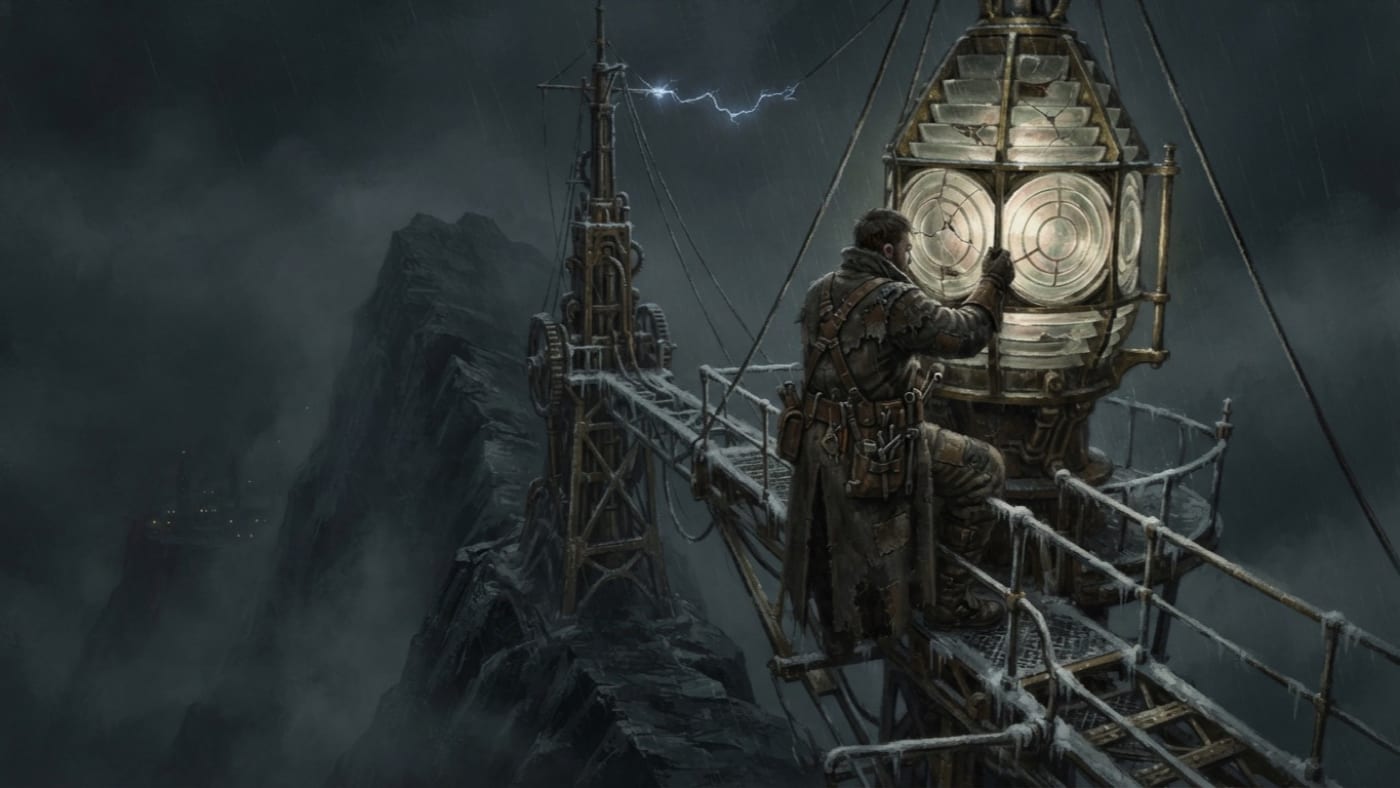
The Synod Signal Office (Unregistered) at Third Light may certify anything it likes. It may certify that the beacon burned at the correct bell, that the lantern swept the correct bearing, and that Fourth Light received and acknowledged. It may press a bell-signet into wax, compare the wax against the master timing wheel in the Loghouse and declare the cycle valid, and the declaration will be law from the ridge to the bastions. It cannot make a dirty lens throw a beam. A beacon with fouled glass is fifty feet of rust-iron with a fire in its hat. A convoy waiting at the northern passes for its clearance will wait in the fog until somebody in gloves has climbed up and set the glass right.
That somebody is a Lanternwright mechanic. The office is small and subordinate, and the people who hold it are badly fed. At Station Three the whole Beaconchain depends on it anyway, because Station Three holds the one sightline that sees both the northern passes and the southern switchbacks. I outrank every mechanic on that ridge by a distance I could not measure without a theodolite. The Ledger nonetheless records that the clerk certifies the light and the mechanic keeps it burning.
#On Glass, Oil and the Cycle
The work begins in the Lantern Shed, a low stone building that smells of lamp oil and old glass, with the metallic sweetness consecrated optics give off when they are handled. I stood in it in the winter of A.S. 197, and the smell stayed in my vestments for the whole descent. Glass dust lies in the joints of the benches and in the creases of the mechanics' gloves. The gloves are the only item of Lanternwright dress the station records bother to mention. The mechanics wear them for a plain reason: glass dust in a split knuckle at that altitude does not heal so much as negotiate.
The lenses are salvaged. Nothing at Third Light is made at Third Light except rope-splices, slate shingles and widows. Glass comes up the switchbacks by mule, when the mules arrive, from Lowvale Tallytown a day's descent below and from whatever lies behind Lowvale. A cracked lens is repaired, because a replacement may never come. A repaired lens is cleaned, polished and set to its bearing. Then it is cleaned again, because one four-hour cycle of soot, ice and fog-damp is enough to dull it. Lens polishing is one of the station's recorded trades. The work brings no glory, and there is no end of it.
There are six cycles a day. The bell marks the beginning and end of each. Between bells the beacon must burn, the glass must hold and the bearing must stay true to Fourth Light. When the bearing slips, the mechanic climbs. Beacon Tower Three is a riveted column on the highest point of a basalt knife-ridge, and lightning strikes it with the regularity of a feast day. People reach the crown carrying oil in their arms and spare glass on their backs, in a wind that would strip a cope off a bishop.
The crown lens is a minor scripture in itself. It has been cracked twice and repaired three times. The Bureau of Doctrine has sanctified the cracks as signs of endurance. The mechanics did the repairing, and they have offered no doctrinal opinion of their own.
#On Rank and Instruction
The mechanics stand below the Gate Provosts, who stand below the Signal Office. Below the mechanics are the tenders, porters, mule-masters and fog-debt labourers, who stand beneath everyone and are stood upon by most. The order is fixed. A mechanic may hold the light of the whole chain in two gloved hands and still be made to wait at the Switchback Gate while a provost counts his bribes.
Their craft belongs to the Lanternwright Knot, a guild in the old style with apprentice, journeyman and master grades. The Knot controls the lenses, the oil and the specifications, and it guards the specifications most closely of all. What a journeyman learns that an apprentice does not, the Knot does not tell anyone. The Bureau of Records has never willingly let a fact go unfiled, yet at Third Light it has had to accept a locked choir-stall to which it holds no key. I have no charter to cite, no founding year and no membership roll. The Knot volunteered none of them, and I was given no authority to compel it.
By the station's own account, the guild's methods go beyond instruction. They include parts withheld, repairs delayed and the occasional "accident." In public the guild speaks of its pride in maintenance. Its private dealings are a different document.
Sister-Mechanic Vey Sable (Unregistered) maintains the relic-lanterns. Her title establishes her office and nothing more. I do not know her guild grade, and I will not invent one to tidy this page. I know that her hands were steady and that she hummed under her breath while she worked. She told me she had not looked at the fog since A.S. 194, and I did not ask why. By every account she fears a relic-lens fracture scandal. At a station whose crown lens is held together by sanctified cracks, that is the fear of a woman who knows exactly how close to failure her glass stands.
#On the Price of a Bearing
Lamp oil and glass are the two things Third Light cannot do without. Without either the station is blind, and a blind station in the Carpathians is a cairn with a bell on it. Oil is warmth as well as light, and it is money. It changes hands in tallies, alongside ration chits and stamped paper, as the ridge's real currency. Only the porters who carry it up stand closer to it than the mechanics do.
The Knot has built a trade on that closeness. By the station's account it sells "selective blindness": it angles a lens so that one convoy goes unlit, one signal goes unrelayed, one movement goes unseen. The price is always oil. I have no name of a mechanic who sold it, no name of a buyer and no record of a single shipment that passed unseen because of it. I record that absence with the same care I would give a confession. The trade is attributed to the guild, and on this page it belongs to the guild.
The method is simple. The clerk certifies that the lantern was aimed at the correct bearing, and the clerk does so from the Loghouse, thirty yards down the cliff. The bearing itself is set at the crown, in wind, by gloved hands belonging to someone paid less than the oil in the lamp is worth. A slight adjustment there costs nothing to make and leaves no wax behind.
#On Calibration and the Echo
Third Light records two kinds of calibration, and the reader will keep them apart. Sable's is solitary: a flat drone under her breath as she works, meant to keep the lenses "obedient." The word is hers. Doctrine tolerates the practice because the instruments work. The Knot's calibration is collective. At the start of each cycle a chorus of twelve voices holds a single note until the lenses settle and the rope-hum in the catwalks drops back to baseline. Twelve is the size of the chorus. It is not a count of the guild.
Since A.S. 194 the chorus has had a second purpose, because the fog answers. The Signal Office keeps a file titled Anomalous Signal Behaviour, Station Three, Ongoing. It records that after Fourth Light sent its legitimate acknowledgment, a second acknowledgment would arrive from the fog basin below the ridge, a direction with no tower, no lens and no bell. The early echoes matched the signal's pattern but arrived late, anywhere from seventeen seconds to four minutes after the true reply. Reports from A.S. 199 describe that delay shrinking. By the station assessment of A.S. 201, seven acknowledgments had been entered in the log as valid. They were found false only when Fourth Light reported that it had never received those signals.
The recorded countermeasures are grounding chains, salt lines on the catwalks and the flat-sung chorus. Each brings relief, and the relief always ends. The garrison says the fog is learning. Beaconmaster Quill suspects that someone wants Third Light blind. Both are testimony, and I file them as testimony.
The mechanics are caught between two accusations. Station accounts accuse the guild of selling blindness. The fog is reported to deal in something closer to the opposite: acknowledgments nobody sent. The two share a ridge, but nobody has proved they share an author, and I will not join them to make a tidier file. What they do share is the lens, and the mechanic who has to keep it serviceable while both stories are told about it.
The answering fog is acoustic refraction consistent with atmospheric layering, a natural phenomenon requiring no doctrinal intervention.
This classification by the Bureau of Alchemical Standards remains suspended, as the station assessment records. The chorus sang through both rulings. I find no entry showing that anyone told it the ruling had changed.
#On the Unfilled Requisition
Sable has requested new lenses, ground to specifications the Knot claims could see through the echo. I record that claim as the Knot's. I have seen no such lens, no trial of one and no installation. The specifications are the Knot's property, and by guild custom they will stay out of my hands.
The Bureau of Ordnance answered with a memorandum recommending that she recalibrate the existing lenses.
The existing lenses are salvaged glass. The crown lens has been cracked twice and repaired three times, and its cracks are holy. Recalibration means more hours at the crown in the wind, more glass dust in the gloves and more singing from the chorus, while the fog below goes on answering in its own time. The memorandum cost Ordnance one sheet of paper. The Lantern Shed pays for everything else.